
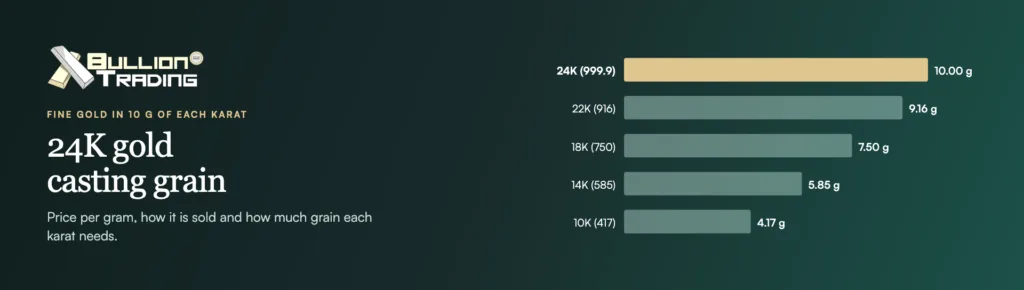
24K gold casting grain is pure gold, 999.9 fine, in small granules, and Bullion Trading LLC sells it by the troy ounce (31.1035 g) at the live gold price plus a premium per ounce. Today an ounce of 24K grain costs $4,027.35 by check or wire: $129.50 per gram of gold, 1.2% over the Ask (below the random-brand 1 oz bar's 3.2%). In Bullion Trading LLC's price records since 27 October 2024, the premium has had a median of 1.9%, and on half of all trading days it sat between 1.4% and 2.4%.
Jewelers and casters buy fine grain, also called gold pellets or granules, to mix their own karat gold. Jewelers used 1,638 tonnes of gold in 2025, a third of all demand, and jewelry demand fell to 278 tonnes in the second quarter of 2026, the lowest since the pandemic, even as spending on it rose 14%, the World Gold Council reported on 30 July 2026. This page covers the price per gram and its history, how much grain each karat takes, and how an order is paid for, shipped or collected on 47th Street.
| Key finding | Result |
|---|---|
| How it is sold | By the troy ounce (31.1035 g), priced from the live gold price plus a premium per ounce |
| Premium today | 1.2% over the Ask, $129.50 per gram of gold by check or wire |
| Median premium since 27 October 2024 | 1.9% over the Ask (middle half of days 1.4% to 2.4%) |
| Premium, monthly medians | 0.9% (October 2026) to 2.8% (November 2024) |
| Per gram of gold today, grain vs a 1 g bar | $129.50 vs $167.31 |
| Paying | Wire or check from $1,000; card or PayPal at 5% more, up to $7,500 |
| Bought back by Bullion Trading LLC | No: the buy desk takes coins, bars and rounds only |
How much does 24K gold grain cost per gram?
About as much as gold in the largest bars, and far less than gold in gram bars. $129.50 per gram is today’s check/wire price for an ounce of grain divided by its 31.1 grams of fine gold. Jewelers who price in pennyweights (dwt) can multiply by 1.555, since 20 dwt make a troy ounce (NIST Handbook 44).
| Form | Per gram of gold today |
|---|---|
| 24K grain, per oz | $129.50, 1.2% over the Ask (2-year median 1.9%) |
| 1 g bar | $167.31, 30.8% over the Ask (2-year median 31.6%) |
| 10 g bar | $139.41, 9.0% over the Ask |
| 1 oz bar | $132.03, 3.2% over the Ask |
| 1 kilo bar | $131.41, 2.7% over the Ask |
The comparison flatters grain only at an ounce or more. A caster who needs 6 grams still buys a full ounce of grain and keeps the rest for the next melt; someone who wants 5 grams to hold is better served by a 5 g bar.
How has the price of gold grain changed?
The premium is set in dollars per ounce and often stayed put for months at a time, so its share of the price fell as gold rose. Monthly median premiums ran from 0.9% over the Ask in October 2026 to 2.8% in November 2024. At the two-year median premium and today's Ask, a gram of gold as grain would cost about $130.40.
Prices are set from spot plus the premium every time the store reprices, so the chart’s dots move with the market.
For a buyer, a premium set in dollars cuts both ways: when gold is higher the same premium is a smaller share of the price, but it is never fewer dollars, so the timing of an order matters far more for the metal than for the premium.
How much 24K grain do you need for 14K or 18K gold?
Multiply the finished weight by the gold share of the karat. Karat counts parts of gold in 24, so 18K is 75% gold and 14K is 58.3%; the hallmarking standards set 14K at 585 (British Hallmarking Council). Ten grams of 14K (585) takes 5.85 g of fine gold and 4.15 g of master alloy.
Why start from pure grain rather than buy pre-alloyed grain? Casters have their own formulas for color, hardness and how the metal flows, and pre-mixed grain fixes that choice for them. The master alloy sets the color: copper gives a reddish tint, silver a greenish one, and nickel or palladium bleach gold white (Cretu and van der Lingen, Gold Bulletin, 1999).
Weigh carefully. Under the National Gold and Silver Stamping Act, a gold article may test no more than three parts per thousand below its karat mark, or seven including solder, so a piece stamped 14K needs at least 58.0% gold before solder.
A worked case: a 6 g ring in 14K needs 3.51 g of fine gold, so one ounce of grain covers eight such rings with 3.0 g to spare, and at today's $129.50 a gram the gold in each ring costs $455. Buying that gold as a 5 g bar instead would cost $731 and leave 1.49 g over.| Working data, fine gold | Value |
|---|---|
| Melting (freezing) point | 1,064.18 °C (1,947.52 °F) |
| Density | 19.3 g/cm³, about 10.2 troy oz per cubic inch |
| One troy ounce | 31.1035 g = 20 dwt = 480 grains |
How is 24K casting grain sold and shipped?
- Unit: one troy ounce of grain per unit; order as many ounces as you need.
- Paying: Card and PayPal prices are 5% higher and stop at $7,500 an order, which today covers one ounce of grain; larger orders go by wire or check (from $1,000). Wires must arrive within 3 business days and checks within 5.
- Delivery: U.S. addresses only. Orders of $1,000 or more ship FedEx with an adult signature for $10, or free to a FedEx location for pickup.
- Pickup: free at 20 West 47th Street, Lower Level #24, New York, Monday to Thursday 8:30 to 4 and Friday 8:30 to 1.
- Returns: within 7 days of delivery, with a 10% restocking fee.
How do you check the purity of gold grain?
The reference test is fire assay, standardized as ISO 11426:2021: a weighed sample is cupelled and parted until only gold is left, then weighed again. Refiners settle on it; X-ray fluorescence analyzers are faster but read the surface. 999.9 means at least 99.99% gold, “four nines”; bars on the LBMA’s Good Delivery list need only 995.0.
Under the FTC Jewelry Guides, the word “gold” with no karat may describe only fine, 24 karat gold. Buy grain from a seller that states the fineness on the listing and the invoice, and keep the invoice: it is your record of what the grain should assay at.
What other casting grain is there?
Fine silver grain (999) is sold by the troy ounce, today at 17.5% over the silver Ask, a larger share than for gold grain, since an ounce of silver is worth far less. A 5 oz pack is 17.0% over the Ask. Platinum grain comes as 950 alloys: platinum-ruthenium is widely used in the U.S., especially for machined rings, while platinum-cobalt casts fine detail best, Platinum Guild International’s Jurgen Maerz writes. Bullion Trading LLC carries Johnson Matthey’s 95.2% platinum, 4.8% ruthenium grain and Umicore’s 95/5, both per ounce.
Casting grain in stock


The large price is the check/wire price; the card/PayPal price is listed under it. Prices follow the live spot price.
Should you buy gold grain as an investment?
Only if you know where you will sell it. Grain carries no refiner’s stamp or serial number, and Bullion Trading LLC sells casting grain but buys back coins, bars and rounds only; a refiner would melt and assay grain before paying for it. A jeweler can use leftover grain in the next melt; an investor’s only exit is that assay and its charges, which the price records here do not capture. The cost of that exit, and who grain suits, is in what casting grain is and its drawbacks for investors.
How we did the research
We took the check/wire price recorded for the 24K grain (per troy ounce) and for the random-brand bars, about four times a day, used each day’s median, and divided it by the value of the fine gold at that day’s spot close: the LBMA Gold Price PM, after 28 September 2026 the 5 pm New York close, converted to the Ask the same way as today’s numbers, so today and history compare like with like. The grain series covers 506 trading days from 28 October 2024 to 3 November 2026. Charts use 10-trading-day medians. Limits: one dealer’s prices, and a daily median against one fixing adds noise. Daily records: CSV download.
The bottom line on 24K casting grain
Bought by the ounce for the melting pot, 24K grain is among the cheapest ways to buy gold: a median 1.9% over the Ask over two years, 1.2% today. Order the ounces your alloy needs, pay by wire or check above the card limit, and keep resale out of the plan.
Frequently asked questions
What is the price of 24K gold casting grain?
Today $4,027.35 per troy ounce by check or wire, $129.50 per gram of gold (1.2% over the Ask); the premium has had a median of 1.9% since 27 October 2024.Are gold grains, pellets and granules the same thing?
Yes. They are trade names for refined gold in small pieces made for melting; “shot” is another. What matters is the stated fineness, such as 999.9 for 24K.
How many grams are in an ounce of gold grain?
31.1035, because gold is weighed in troy ounces; the ordinary ounce used for food is 28.35 g.
Sources
- World Gold Council, Gold Demand Trends Q2 2026 and Full Year 2025: jewelry demand.
- NIST, Handbook 44 (2026), Appendix C: troy ounce, pennyweight, grain.
- BIPM, Guide to the Realization of the ITS-90, and Los Alamos National Laboratory, Gold: melting point and density.
- British Hallmarking Council, Hallmarking Guidance Notes: fineness standards.
- Cretu and van der Lingen, Coloured gold alloys, Gold Bulletin 32 (1999): alloy colors.
- 15 U.S.C. §295 and 16 CFR §23.3: karat tolerance and the word “gold”.
- ISO, ISO 11426:2021, and LBMA, Good Delivery List Rules 2026: assay and fineness.
- Jurgen Maerz, Platinum Guild International, Platinum alloys: features and benefits.
- Bullion Trading LLC price records, current prices and checkout settings: every price, premium and payment limit here.