
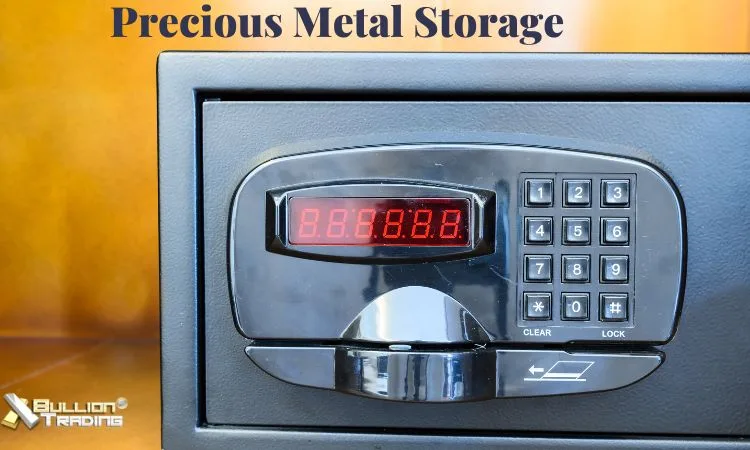
Gold and silver are usually stored in one of three places: at home, in a bank safe deposit box, or in a private depository. None is free of risk. The choice comes down to who can reach the metal, who pays if it is lost, and what that costs each year. A standard New York homeowners policy pays at most $200 for stolen money, bullion, gold and silver unless they are insured separately (NY Department of Financial Services). The contents of a bank box are not covered by deposit insurance (FDIC). And depositories charge by value: the state-run Texas Bullion Depository charges 0.49% a year for segregated accounts under $500,000, under a fee schedule in force since 1 April 2026.
Space depends on the metal more than on the money. In Bullion Trading LLC calculations at the current price, At today's Ask, $50,000 buys about 990 oz of silver, 30.8 kg, against 12.6 oz of gold, 0.39 kg. The Ask is the price level dealers quote for buying.
| Key finding | Result |
|---|---|
| Home safe | A standard New York homeowners policy pays at most $200 for stolen bullion, gold and silver unless they are insured separately |
| Bank safe deposit box | Not covered by FDIC insurance; in New York, a box with a year of unpaid rent can be opened after 30 days’ notice |
| Private depository | Texas Bullion Depository: 0.49% a year, segregated, under $500,000; $25 a quarter minimum |
| Metals IRA storage | $100 to $125 a year commingled, $150 to $225 segregated, at four custodians |
| IRA metal kept at home | Treated as a taxable distribution (U.S. Tax Court, 2021) |
| $50,000 of silver | $50,000 of silver is 990 oz, 30.8 kg (67.9 lb) and 2.9 liters of metal. |
Where is the safest place to store gold and silver?
There is no single safest place; each option trades access against protection, and the right mix often changes as a holding grows.
| Option | Access | Yearly cost | If it is stolen or lost |
|---|---|---|---|
| Home safe | Any time | The safe, plus a rider or floater | Covered only as far as you insured it |
| Bank safe deposit box | Bank hours | Rent by box size | Not FDIC-insured; read the lease |
| Depository, segregated | Shipment or appointment | A percentage of value, with a minimum | The depository’s insurance, per its contract |
| Depository, commingled | Shipment of like metal | Lower than segregated | As above; you own a share of a pool |
| Unallocated account | Delivery on request | Often no visible fee | You are an unsecured creditor |
How much space do gold and silver take up?
Gold needs very little; silver needs room and a strong shelf. At the $50.48 silver Ask, $10,000 of silver is 198 troy ounces and 6.16 kg (13.6 lb), but only 587 cm³ of metal, a cube about 8 cm on a side. Real coins and bars stack with gaps and sit in tubes and boxes, so they fill several times that volume.
In everyday pieces: At 3 November 2026 prices, $10,000 buys about 2.5 oz of gold in 1 oz coins, a short stack that fits in a hand, or about 170 oz of silver in 1 oz coins, which weigh 11.8 lb. That is why storage choices often split by metal: gold fits in a small safe or box, while a large silver holding is heavy to move and fills a bank box quickly.
Is it legal and safe to keep gold at home?
It is legal. Americans have been free to own gold since 31 December 1974, when Executive Order 11825 revoked the gold regulations dating from 1933 (National Archives). Safety at home depends on three things.
- Insurance. Besides the $200 limit, New York’s regulator suggests insuring valuables “separately by endorsement with a higher limit of coverage” or with a personal articles floater. Ask the insurer whether bullion qualifies and what proof it wants.
- Theft and fire. They are tested separately. UL 687, the UL standard for burglary-resistant safes, rates them against attack with tools (classes such as TL-15 and TL-30); a fire rating says nothing about a break-in.
- Condition. Gold does not corrode. Silver tarnishes when sulfur compounds in the air form black silver sulfide (Canadian Conservation Institute); the silver content is unchanged, but buyers of bright bullion coins may pay less for toned ones. Original tubes, capsules and sealed bags help.
Myth: gold in a bank box is insured by the bank’s deposit insurance. Fact: the FDIC lists “safe deposit boxes or their contents” among the things it does not cover. Insuring them is up to the box holder.
Can you store gold in a safe deposit box?
Yes, but the box is a rental, not an account. Access follows bank hours, and the rules for an unpaid box are strict. In New York, once rent has gone unpaid for a year, the bank may send a certified notice and, 30 days later, open the box before a notary; after two years, items of value can be sold at public auction, and the proceeds become abandoned property three years after the opening (Banking Law §335). Keeping the rent current, an inventory with photos stored elsewhere, and a co-lessee who can open the box all reduce those risks.
What does depository storage cost?
Usually a percentage of the metal’s value each year, with a minimum. The Texas Bullion Depository charges 0.49% for segregated accounts under $500,000, 0.44% from $500,000 and 0.39% from $1 million, billed quarterly with a $25 minimum and no setup fee; shipping metal home costs $17.95 plus 0.18% of its value, insured. Segregated storage keeps your own bars and coins apart; commingled storage keeps the same kind of metal together and costs less. An unallocated account is different again: you hold a claim on the provider rather than metal, as explained in allocated vs unallocated storage.
Flat fees weigh most on small holdings. A 10 oz gold IRA, worth $39,780 at today's Ask, pays 0.54% to 1.16% of its value a year at these four firms, before trading fees. Before signing, ask for the fee schedule, what the insurance covers and up to how much, who audits the vault and how often, and how you get your metal out.
Can you keep IRA gold at home?
No. Metal held in an IRA has to stay with a trustee or approved custodian. In McNulty v. Commissioner (157 T.C. No. 10, 2021), the Tax Court treated coins an IRA owner kept at home through the IRA’s own company as distributions, taxable in the year they were taken. The gold and silver IRA guide covers the rules and costs.
What happens if a vault or dealer fails?
It depends on whether the metal is legally yours. Segregated or properly allocated metal remains your property; an unallocated balance is a debt. The SPDR Gold Trust’s own definition puts it plainly: the holder of an unallocated account “is an unsecured creditor” of the bullion dealer (GLD FAQ, January 2026). The record of gold dealer bankruptcies shows how that distinction played out for customers.
Could the government seize stored gold?
The one U.S. precedent is from 1933. Executive Order 6102, signed on 5 April 1933, ordered gold coin, gold bullion and gold certificates delivered to a Federal Reserve bank or member bank by 1 May 1933. It exempted gold needed in industry, a profession or art, up to $100 of gold coin and certificates per person, and gold coins with “a recognized special value to collectors of rare and unusual coins” (American Presidency Project). The regulations that followed were revoked with effect from 31 December 1974, and no similar order has been issued since.
What about storing gold offshore?
Vaults in Switzerland or Singapore spread holdings across legal systems, but add shipping, insurance and, for U.S. taxpayers, possible reporting duties. The comparison of offshore gold storage covers costs and rules.
The case against each choice
Home storage concentrates the risk in one place and is insured only as far as you add coverage. A bank box is cheap but slow to reach, uninsured by default and, in New York, subject to strict rules once rent lapses. A depository costs money every year, so over a decade a 0.49% fee alone takes about 5% of the metal’s value, and you depend on its records and insurer. Paying no fee at all, through an unallocated account, swaps those costs for the provider’s credit risk.
- I know which policy covers the metal, and up to how much.
- I keep an inventory with photos away from the metal.
- Silver is in sealed tubes, capsules or bags.
- Someone I trust knows how to find it.
- Bank box: the rent is paid and a co-lessee can open it.
- Depository: I have its fee schedule, insurance terms and audit report.
The bottom line
Storage is a trade between access, protection and yearly cost. A home safe is quick to reach but typically insured for $200 unless you add coverage; a bank box is cheap but uninsured and bound by bank hours; a depository insures and audits for a fee, 0.49% a year at the state-run Texas depository. Gold fits almost anywhere; silver’s weight often decides where it goes.
Frequently asked questions
Is it legal to store gold at home?
Yes. Private gold ownership has been legal in the United States since 31 December 1974. Gold held in an IRA is the exception: it must stay with a custodian.
How much does it cost to store gold?
At home, the cost of a safe and any insurance rider. A bank box is a yearly rent set by size. Depositories charge a share of value, such as 0.49% a year at the Texas Bullion Depository, with a minimum.
Is stored gold taxed?
Not while you hold it. When you sell, gains on bullion are taxed as collectibles, at up to 28% for long-term gains (IRS Topic 409), so keep the invoices.
Sources
- NY Department of Financial Services, Homeowners basic coverage.
- FDIC, Understanding deposit insurance.
- New York State Senate, Banking Law §335.
- Texas Bullion Depository, Pricing (from 1 April 2026).
- U.S. Tax Court, McNulty v. Commissioner (2021).
- National Archives, Executive Order 11825; American Presidency Project, Executive Order 6102.
- SPDR Gold Trust, FAQ (January 2026); IRS, Topic 409.
- Canadian Conservation Institute, Silver: care and tarnish removal; UL Solutions, anti-theft testing standards (UL 687).
- Custodian fee schedules (GoldStar Trust, STRATA Trust, The Entrust Group, Equity Trust) as summarized in the IRA guide; Bullion Trading LLC Ask for the weights.