
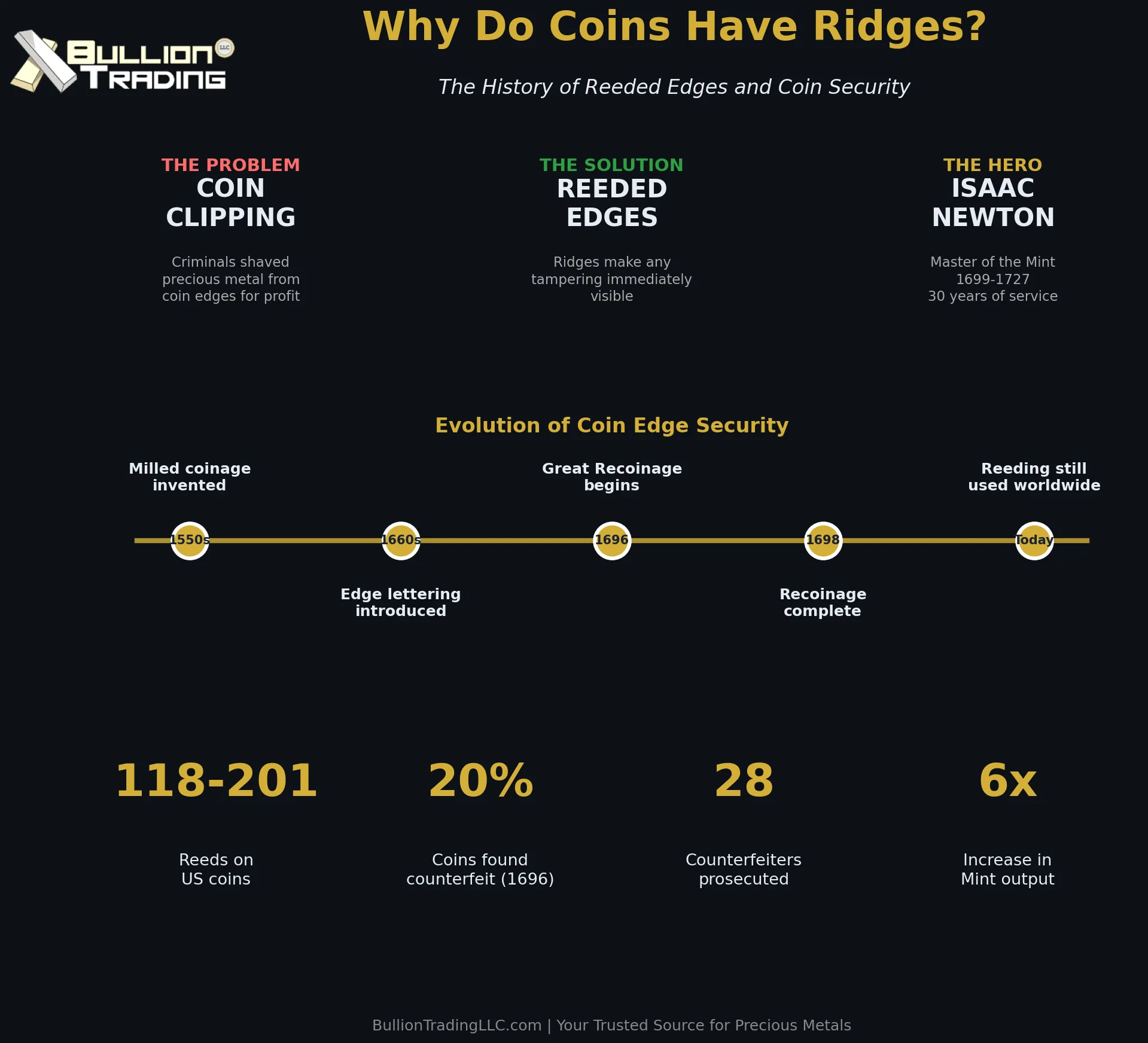

If you have ever looked closely at a quarter or dime, you have probably noticed the tiny grooves running along the edge. These small ridges, known as “reeding” or “milled edges,” appear on coins around the world, from American Silver Eagles to British sovereigns. But have you ever wondered why do coins have ridges in the first place? The answer takes us on a fascinating journey through centuries of monetary history, touching on everything from ancient counterfeiting schemes to the scientific genius of Isaac Newton.
Understanding why these ridges exist reveals something important about the history of precious metals and the lengths societies have gone to protect the integrity of their money. For anyone interested in gold and silver coins, whether as investments or collectibles, this knowledge provides valuable context for appreciating the craftsmanship behind modern bullion.
The Problem That Created the Solution: Coin Clipping
To understand why coins have ridges, we first need to understand the crime they were designed to prevent. Before the modern era, coins were made from precious metals like gold and silver. Unlike today’s base metal coins, these pieces contained real value in the metal itself. This created an irresistible temptation for criminals.
Coin clipping was the practice of shaving or cutting small amounts of precious metal from the edges of coins. The clipped coin could then be spent at its full face value, while the thief kept the metal shavings. Over time, these tiny clippings could be melted down and sold as bullion or used to create entirely new counterfeit coins.
The practice was devastatingly effective. Early coins, produced by hammering metal between two dies, were irregular in shape and size. This made it nearly impossible to detect whether a coin had been clipped. A skilled clipper could remove a significant percentage of a coin’s metal without the average person noticing.
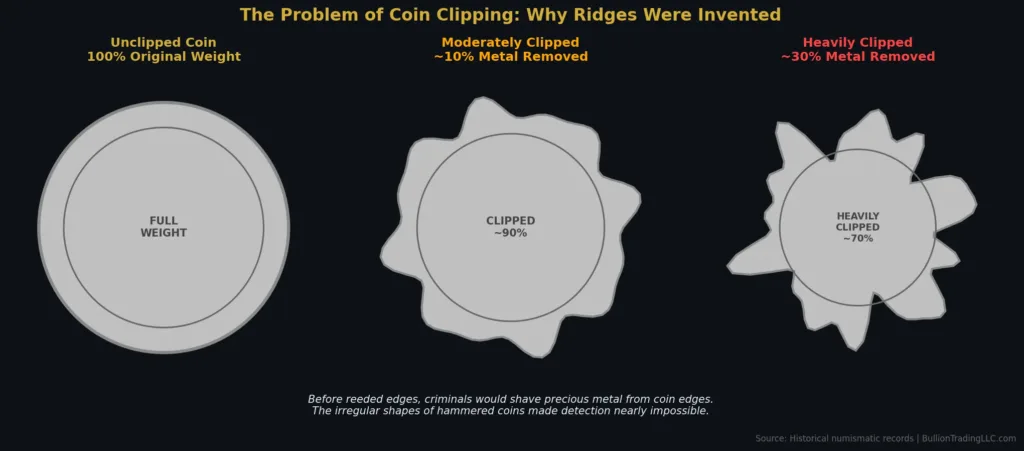
The consequences extended far beyond individual victims. When clipped coins circulated alongside full-weight coins, people naturally preferred to spend the lighter, debased coins and hoard the good ones. This phenomenon, known as Gresham’s Law, states that “bad money drives out good.” As clipping became widespread, entire economies suffered from currency that was worth less than its stated value.
Authorities took coin clipping extremely seriously. In medieval and early modern England, coin clipping was considered a form of high treason, punishable by death. Criminals convicted of the offense could face being hanged, drawn, and quartered. Despite these harsh penalties, the practice remained common because the profits were substantial and detection was difficult.
The Rise of Milled Coinage: A Technological Revolution
The solution to coin clipping required a technological revolution in how coins were made. The key innovation was milled coinage, which used mechanical presses instead of hand-hammering to produce coins. This technology originated in the mid-1500s and gradually spread across Europe.
According to historical records, the mechanical minting process can be traced back to innovations developed around 1550 when French ambassador Charles de Marillac learned of an engineer in Augsburg who had perfected a process for rolling bullion to uniform thickness, cutting circular blanks, and striking them with mechanical precision. This technology was so advanced for its time that the inventor’s identity was kept secret through code names.
Machine-made coins offered several advantages. First, they were perfectly round, making any attempt at clipping immediately obvious. Second, and more importantly, the minting process could add detailed designs to the coin’s edge. This edge decoration, whether in the form of ridges (reeding) or inscribed text, served as a tamper-evident seal. Any attempt to clip the coin would destroy this pattern, instantly revealing the fraud.
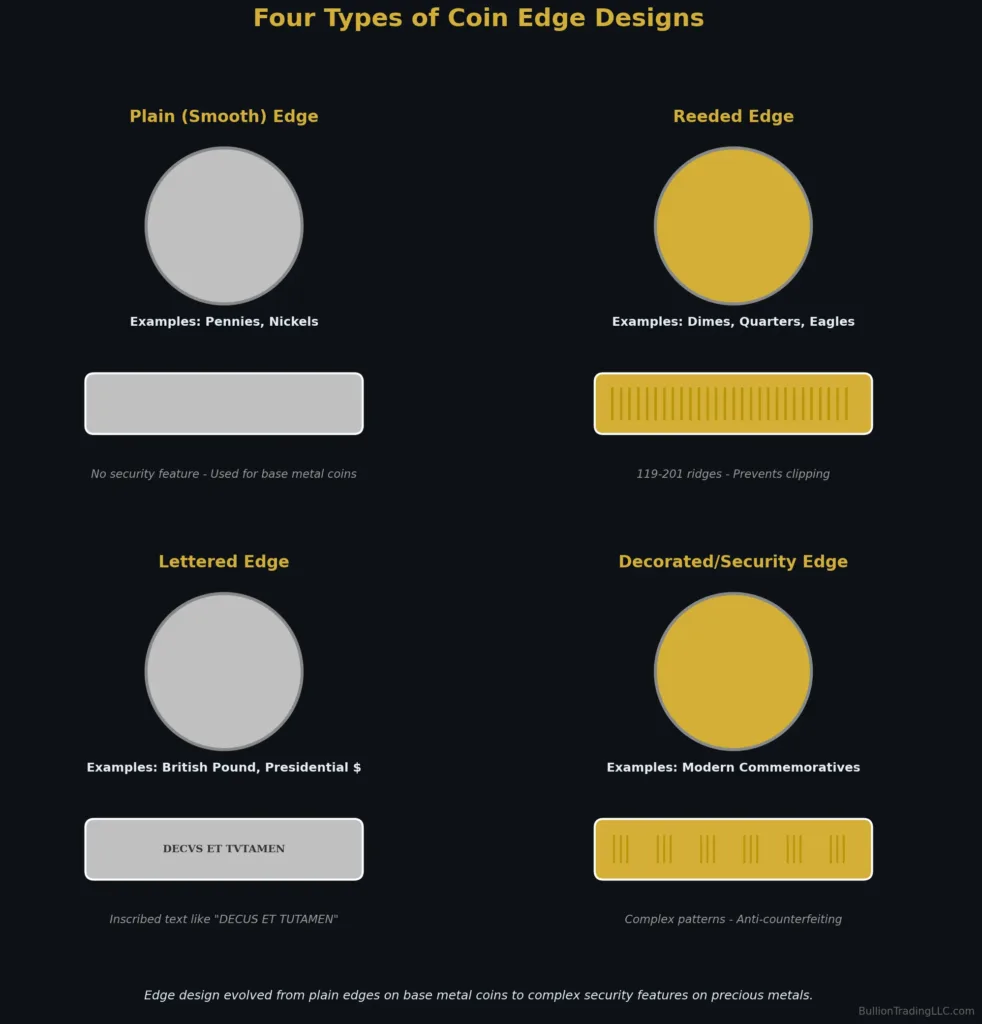
The phrase “DECVS ET TVTAMEN,” meaning “an ornament and a safeguard,” was inscribed on the edges of English coins beginning in the 1660s. This Latin motto, adapted from Virgil’s Aeneid, perfectly captured the dual purpose of edge decoration: it made coins more beautiful while simultaneously protecting them from tampering.
Isaac Newton and the Great Recoinage of 1696
Perhaps no figure in history is more associated with coin edge security than Isaac Newton. Yes, the same Newton who formulated the laws of motion and gravity spent the last three decades of his life overseeing England’s money supply.
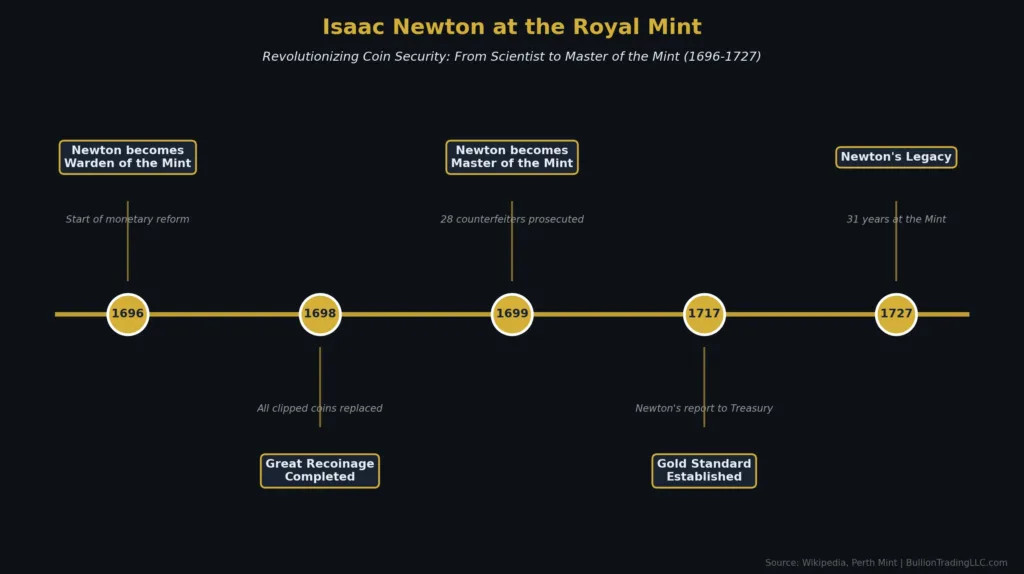
Newton became Warden of the Royal Mint in 1696 during a period of monetary crisis. According to the Perth Mint, clipping had become so severe that England’s silver coinage was in chaos. With many hammer-struck coins still in circulation, the problem had reached catastrophic proportions. People on continental Europe were willing to pay high prices for silver bullion, making the temptation to clip English coins overwhelming.
At Newton’s disposal was “a new invention of rounding the money and making the edges of them with letters or grainings.” When the government decided to recall all clipped and badly worn coins, Newton oversaw the replacement program with remarkable efficiency. The Great Recoinage was completed by mid-1698, replacing the old, vulnerable coins with new machine-struck pieces featuring milled edges.
Newton estimated that approximately 20 percent of the coins brought in during the recoinage were counterfeit. His work extended beyond simply managing the mint’s operations. He personally investigated counterfeiters, disguising himself to gather evidence in taverns and bars. He successfully prosecuted 28 counterfeiters during his tenure, including the notorious serial counterfeiter William Chaloner, who was executed for his crimes.
Newton was promoted to Master of the Mint in 1699, a position he held until his death in 1727. His meticulous approach to the position was characteristic of his scientific mind. He improved minting technology, reduced the standard deviation of coin weights, and greatly increased the Mint’s productivity, raising weekly coin output from 15,000 pounds to 100,000 pounds.
The Anatomy of a Reeded Edge
The ridges on modern coins are created through a remarkably precise process. Today, reeded edges are applied using a collar die, a ring that surrounds the blank coin (called a planchet) when it is struck. As the coin is pressed between the obverse and reverse dies, the collar simultaneously imparts the edge design.
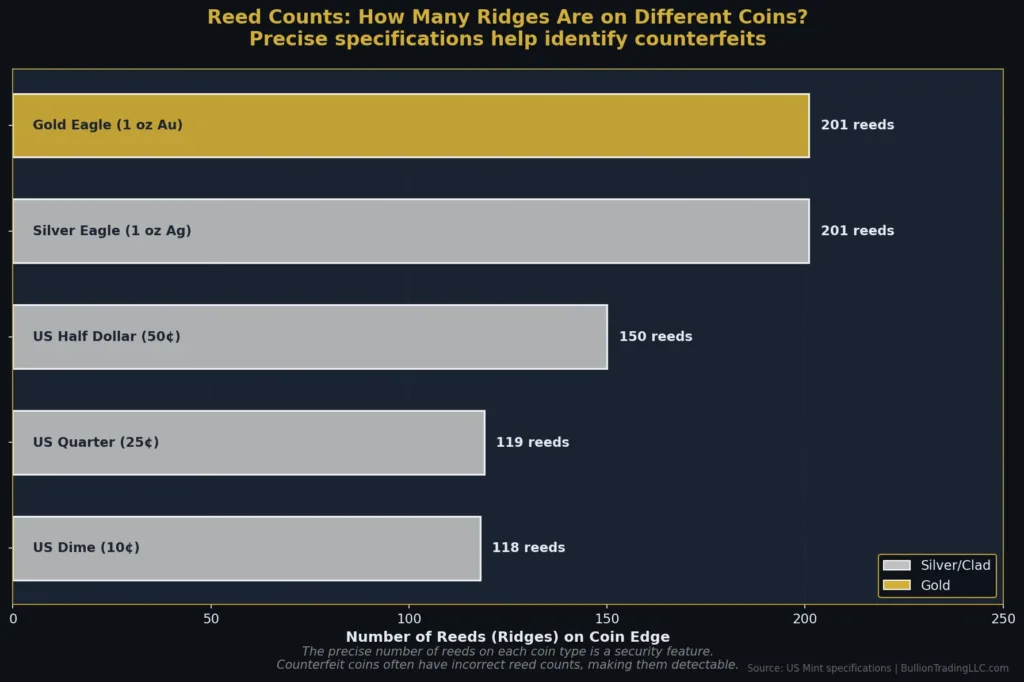
The number of reeds varies by coin. American quarters have 119 reeds, while dimes have 118. The American Silver Eagle has 201 reeds on its edge. These specifications are precise enough that numismatists can sometimes identify counterfeit coins simply by counting the number of edge reeds.
Different countries and mints use various edge treatments beyond simple reeding. Some coins feature lettered edges, with text inscribed around the circumference. Others combine reeding with smooth sections, creating a distinctive pattern. The British one-pound coin, for example, uses alternating milled and lettered sections that make it particularly difficult to counterfeit.
Why Some Coins Have Smooth Edges
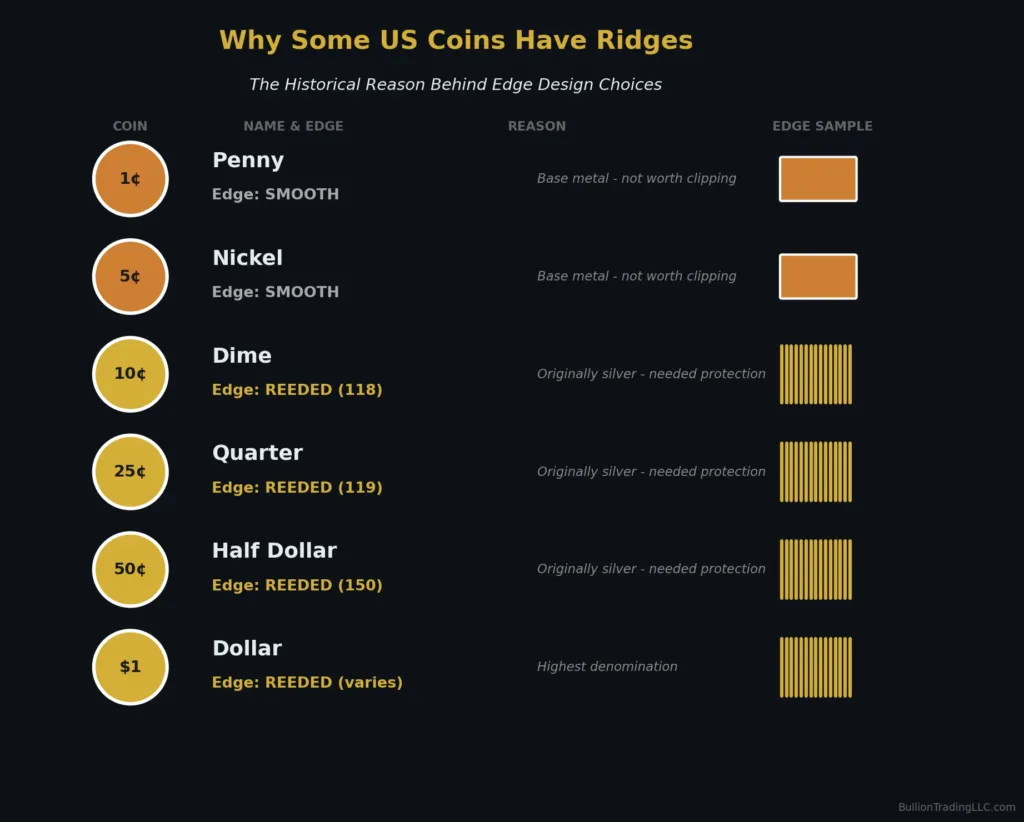
You may have noticed that not all coins have ridges. In the United States, pennies and nickels have smooth edges, while dimes, quarters, half dollars, and dollars have reeded edges. This distinction is not arbitrary.
Historically, only coins containing precious metals received reeded edges because only those coins were valuable enough to clip. Pennies and nickels, made from base metals like copper and copper-nickel alloys, were never worth clipping. The metal content was simply not valuable enough to justify the effort and risk.
When the United States removed silver from circulation coins in 1965 (dimes and quarters) and 1970 (half dollars), the reeded edges remained. By this point, reeding served important purposes beyond anti-clipping measures. The edges help vending machines and other automated systems distinguish between denominations. They also assist visually impaired individuals in identifying coins by touch.
This accessibility function has become increasingly important in modern coin design. The distinctive edge patterns help blind and visually impaired people distinguish between different coin denominations by feel alone. Australia’s two-dollar coin, for instance, has a mostly smooth rim alternating with small sections of reeding, while the one-dollar coin has the opposite pattern.
Reeding on Precious Metal Bullion Coins
For collectors and investors in precious metals, reeded edges remain highly relevant. Modern gold and silver bullion coins, including American Eagles, Canadian Maple Leafs, and South African Krugerrands, all feature reeded edges as part of their anti-counterfeiting measures.
Unlike base metal circulation coins, precious metal bullion coins contain substantial intrinsic value. A one-ounce gold coin worth over $2,000 presents a worthwhile target for counterfeiters. The reeded edge serves as one of several security features that help authenticate these valuable coins.
Experienced precious metals dealers examine edge quality as part of their authentication process. Genuine coins exhibit sharp, uniform reeding with consistent depth and spacing. Counterfeit coins often show uneven reeding, incorrect reed counts, or edges that appear mushy or poorly defined. The precision of the reeded edge reflects the overall quality of the minting process.
Modern Anti-Counterfeiting Technology
While reeded edges were revolutionary in their time, modern mints employ numerous additional security features. These include micro-engraving invisible to the naked eye, precisely positioned privy marks, security holograms, and advanced metallurgical techniques that produce specific colors and weights.
Edge lettering has evolved significantly since Newton’s era. The Royal Canadian Mint, for example, uses edge lettering with a laser-engraved maple leaf privy mark on some of its Maple Leaf coins. The U.S. Mint has introduced various edge inscriptions on dollar coins, including the Presidential dollar series, which featured the year and mint mark on the edge.
Despite these technological advances, the humble reeded edge remains a fundamental security feature. Its longevity is a testament to the elegance of the original solution. By making tampering immediately visible, reeding solved a problem that had plagued monetary systems for millennia.
The Legacy of Coin Ridges
The next time you hold a quarter or examine a gold coin, take a moment to run your finger along the edge. Those tiny ridges connect you to centuries of monetary history. They represent humanity’s ongoing effort to protect the integrity of money from those who would undermine it.
The story of why coins have ridges illustrates how practical problems drive innovation. Faced with the persistent threat of coin clipping, mints developed new technologies and standardized practices that remain in use today. The reeded edge transformed from a revolutionary anti-fraud measure into a standard feature of coinage worldwide.
For precious metals investors, understanding this history adds another dimension to coin ownership. When you purchase a gold or silver coin with a reeded edge, you are acquiring not just metal but a piece of monetary heritage. The ridges on that coin connect to Isaac Newton pacing the corridors of the Royal Mint, to French engineers perfecting mechanical presses in the 1550s, and to countless individuals throughout history who recognized the importance of sound money.
Whether you are a seasoned collector or new to precious metals investment, Bullion Trading LLC offers a wide selection of gold and silver coins with the impeccable quality and security features that reflect centuries of minting evolution. From American Eagles to historic sovereign coins, each piece in our inventory represents the culmination of this remarkable history of protecting precious metal coinage from tampering.
