

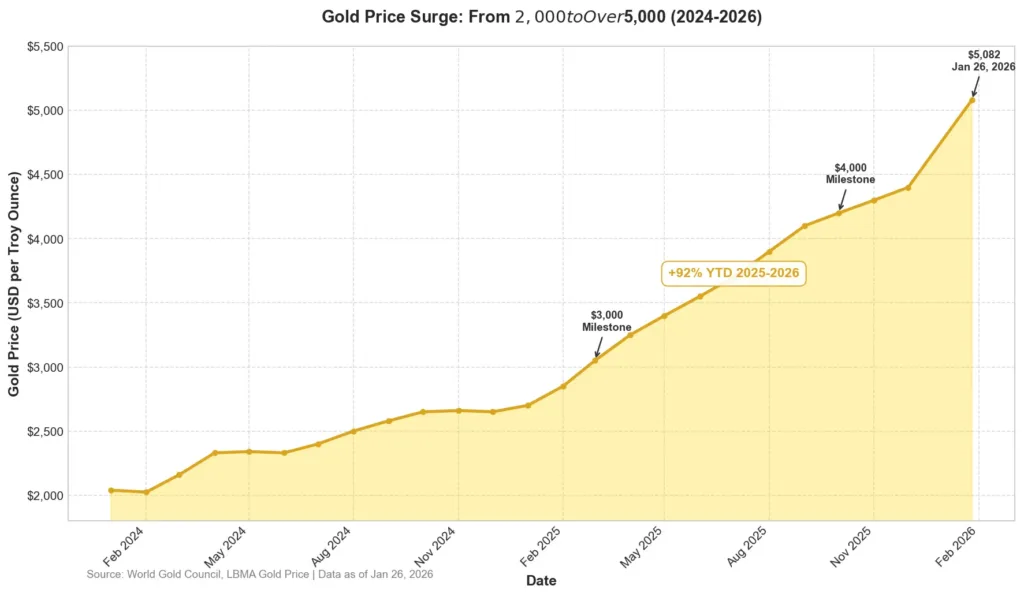
The gold price has hit a record high in 2026, officially entering uncharted territory. On January 26, 2026, spot gold prices surged past $5,100 per ounce, marking a gold record high in January 2026 that has captivated investors worldwide. According to World Gold Council data, gold is now trading around $5,088 per ounce, having gained nearly 18% so far this year alone. For context, the yellow metal gained an extraordinary 64% throughout 2025, breaching both the $3,000 and $4,000 thresholds for the first time in history.
This isn’t just another price milestone. The speed and magnitude of gold’s ascent tell a deeper story about the current state of global markets, shifting investor sentiment, and a fundamental reassessment of what constitutes a safe store of value in uncertain times.
What’s Driving Gold Prices Higher in 2026?
Understanding what’s driving gold prices higher requires examining the convergence of several powerful forces that have collectively created what some analysts describe as the perfect storm for precious metals. Unlike previous rallies driven primarily by a single factor, the current surge draws strength from multiple, reinforcing sources of demand.
Gold Safe Haven Demand Surges Amid Geopolitical Tensions
Gold safe haven demand has emerged as perhaps the most immediate catalyst for gold’s January 2026 spike, driven by escalating geopolitical uncertainty. According to Reuters reporting on January 26, President Donald Trump’s threat of a 100% tariff on Canada if it proceeds with a trade deal with China has rattled markets and sent investors scrambling for geopolitical gold investment opportunities.
“For precious metals this year, the major drivers are going to be ‘Trump and Trump,'” noted Adrian Ash, head of research at online marketplace BullionVault, referencing the administration’s unpredictable policy direction. The combination of trade disputes, tariff threats, and diplomatic tensions has created an environment where traditional risk assets feel increasingly uncertain.
Adding to investor anxiety, a Trump administration criminal investigation of Federal Reserve chairman Jerome Powell has cast a shadow over this week’s Fed meeting. The potential implications for central bank independence have further elevated safe-haven demand. The World Gold Council’s 2026 Outlook specifically highlighted that “heightened geopolitical and economic uncertainty” continues to support gold’s appeal as portfolio insurance.
The Dollar’s Decline Amplifies Gold’s Appeal
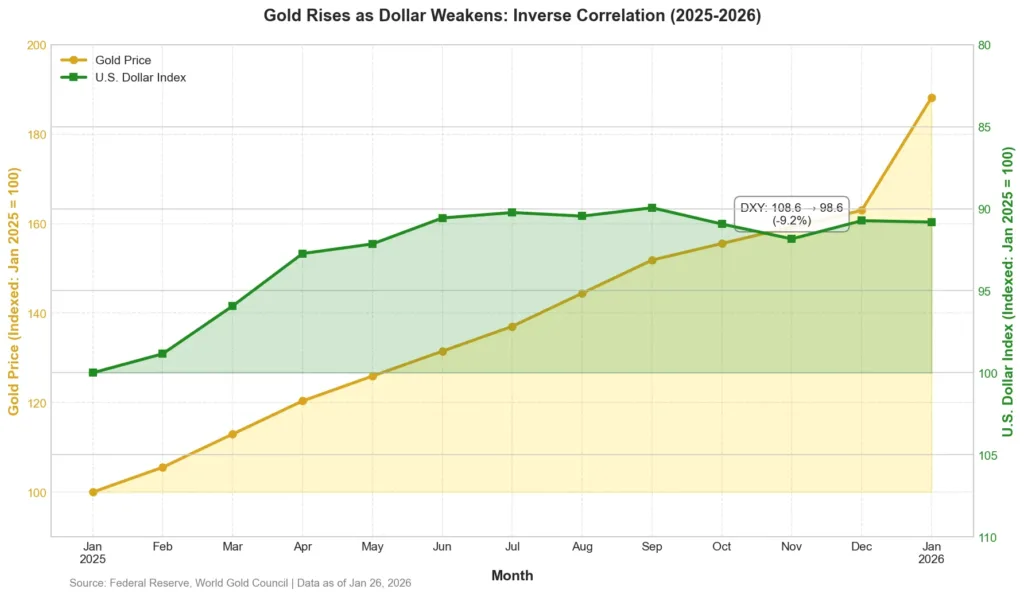
A weakening U.S. dollar has provided additional tailwind for gold prices. The greenback has been lingering near multi-month lows, making dollar-priced assets like gold more affordable for holders of other currencies. This currency dynamic has historically been one of gold’s most reliable price drivers, and the current environment is no exception.
The possibility that coordinated currency intervention by U.S. and Japanese authorities could be imminent has added another layer of uncertainty to foreign exchange markets, further boosting gold’s appeal as a currency-neutral store of value.
Institutional Demand Reaches Record Levels
Beyond short-term geopolitical catalysts, structural demand from major institutions has been building steadily. This institutional buying provides a more durable foundation for gold prices than speculative trading alone.
Gold ETF Inflows 2025: Shattering All Records
Gold ETF inflows 2025 numbers are staggering. According to the World Gold Council’s January 2026 ETF report, global gold ETFs witnessed their strongest year of inflows on record in 2025. Annual inflows surged to $89 billion, the largest ever recorded. Global gold ETF assets under management doubled to an all-time high of $559 billion, with physical holdings reaching a historic peak of 4,025 tonnes, up from 3,224 tonnes in 2024.
The momentum hasn’t slowed entering 2026. December 2025 marked the seventh consecutive month of positive global gold ETF flows, with North American funds leading the charge. This sustained institutional buying suggests the rally has fundamental support rather than being purely speculative.
“Strong ETF demand is absorbing limited inventories after several years of deficits,” Morgan Stanley analysts noted in their recent research, highlighting the structural supply-demand imbalance supporting prices.
Central Bank Gold Buying Continues at Record Pace
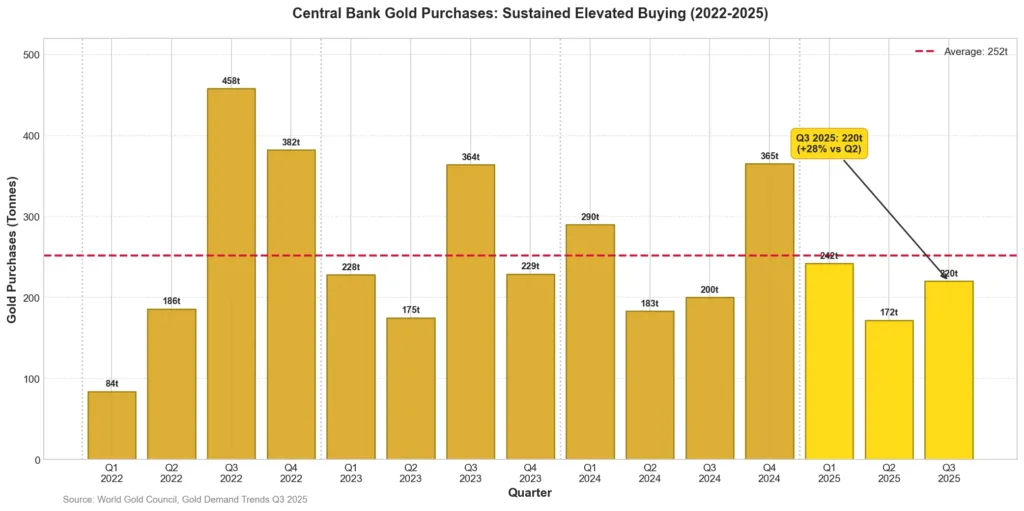
Central bank gold buying has emerged as one of the most significant demand drivers in recent years. According to World Gold Council demand data, central bank buying remained elevated at 220 tonnes in Q3 2025, representing a 28% increase from the prior quarter.
The World Gold Council’s reserves data shows China’s central bank extended its buying streak to 14 consecutive months through 2025, accumulating over 2,303 tonnes of gold reserves. Other notable buyers include Kazakhstan, Brazil, Turkey, and Guatemala, all adding to their reserves in recent quarters.
This institutional buying reflects a broader trend of reserve diversification away from the U.S. dollar. In an era of financial sanctions and currency volatility, central banks are increasingly viewing gold as essential portfolio insurance.
Retail Investors Join the Rush
It’s not just institutions driving prices higher. “A wave of new first-time investing is driving this move in precious metals,” explained Adrian Ash. “It’s led by private investors across Asia and Europe, rushing to build their personal holdings of gold and silver.”
The World Gold Council’s India market update highlighted that December 2025 witnessed unprecedented inflows into Indian gold ETFs, taking overall gold demand in 2025 to a historic high. The domestic demand remains resilient, supported by strong investment buying and healthy revenue growth among listed jewelry companies.
In China, despite weakness in the jewelry sector, investment demand has been robust. The People’s Bank of China’s continued buying has signaled to domestic investors that gold remains a priority store of value, encouraging private accumulation alongside official purchases.
Gold Price Forecast 2026: What the Experts Are Predicting
With gold already above $5,000, what does the gold price forecast 2026 look like? The forecasts suggest further upside potential, though opinions on the magnitude vary.
Societe Generale anticipates gold reaching $6,000 per ounce by year-end, noting this may actually be a conservative estimate with scope for further gains. Morgan Stanley has highlighted a bull-case target of $5,700, suggesting the rally has more room to run even from current elevated levels.
The World Gold Council’s 2026 outlook offers a more nuanced view, noting that gold achieved over 50 all-time highs in 2025 and returned over 60%. Looking ahead, they suggest that if economic growth slows and interest rates fall further, gold could see moderate gains. In a more severe downturn marked by rising global risks, gold could perform strongly. However, they also caution that successful policy outcomes could accelerate economic growth, reduce geopolitical risk, and lead to higher rates and a stronger dollar, potentially pushing gold lower.
The Silver Lining (Literally)
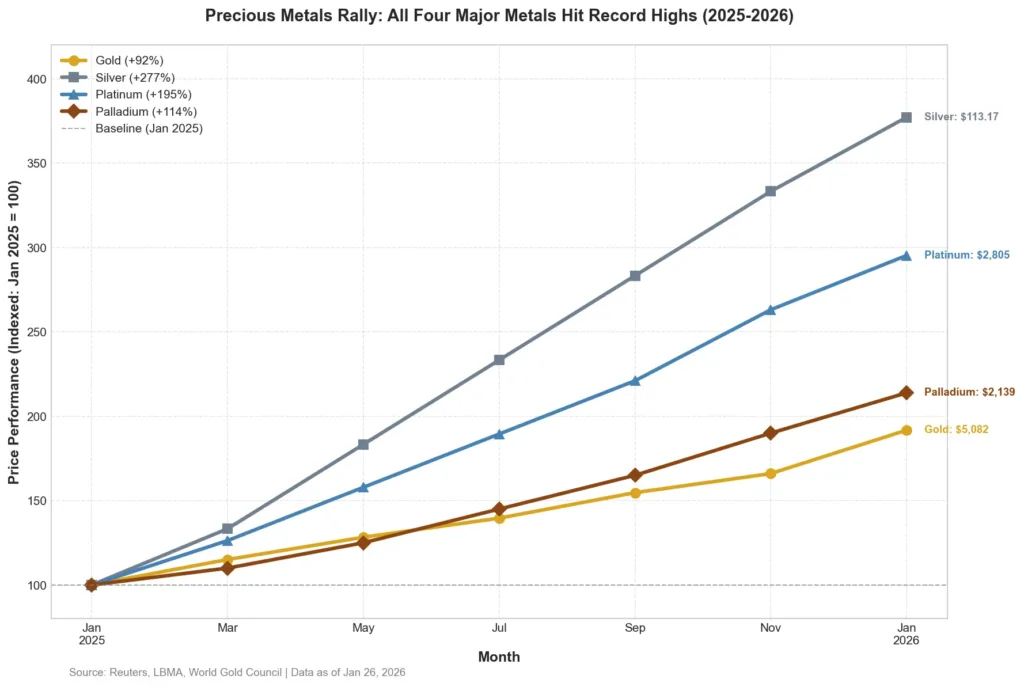
Gold isn’t the only precious metal making headlines. According to Reuters, silver has scaled a new high of $110.87 per ounce, having broken the $100 mark on Friday as retail investor and momentum-driven buying added to tight physical markets. The gold-silver ratio has compressed significantly as silver catches up to gold’s gains, a pattern often seen in the late stages of precious metals bull markets.
Platinum and palladium have also joined the rally, with platinum reaching record highs above $2,900 per ounce. The broad-based strength across precious metals suggests this isn’t simply a gold story but rather reflects deeper concerns about fiat currencies and traditional financial assets.
Understanding the Risks
While the bullish case for gold appears compelling, investors should understand the risks. Gold pays no yield or dividend, meaning investors sacrifice income-generating potential by holding the metal. If inflation subsides, interest rates rise, or geopolitical tensions ease, gold could give back some of its gains.
The World Gold Council’s analysis notes that a successful outcome from current policies could “accelerate economic growth and reduce geopolitical risk, leading to higher rates and a stronger US dollar, pushing gold lower.” In other words, the very factors driving gold higher could reverse if circumstances change.
Premium costs also matter for physical buyers. With prices moving rapidly and supply chains under pressure, premiums on retail products like coins and small bars can be elevated. Investors paying substantial premiums should recognize they’re paying for immediate availability and convenience.
What This Means for Investors
Gold’s surge to record highs reflects genuine concerns about the global economic and political environment. The combination of geopolitical uncertainty, currency volatility, institutional buying, and retail investor demand has created a powerful tailwind for prices.
For investors considering gold exposure, the current environment offers both opportunity and risk. The structural drivers supporting prices, particularly central bank buying and ETF inflows, suggest this isn’t purely speculative froth. However, the speed of the rally means prices have moved far and fast, increasing the potential for near-term volatility.
Dollar-cost averaging, spreading purchases over time rather than making a single large buy, can help investors manage timing risk in such environments. Diversification across product types, from large bars trading closer to spot prices to smaller retail products offering liquidity and divisibility, provides flexibility for different needs.
Perhaps most importantly, investors should focus on fundamental drivers rather than short-term price movements. The long-term case for precious metals allocation as portfolio diversification and inflation hedging remains independent of whether prices are at $5,000 or $6,000 per ounce.
Conclusion
Gold’s breakthrough above $5,000 per ounce marks a historic moment for the precious metals market. The rally reflects a convergence of factors: escalating geopolitical tensions, dollar weakness, record institutional demand through ETFs and central bank purchases, and surging retail investor interest.
Whether gold continues climbing toward the $6,000 targets some analysts predict or consolidates at current levels, the message from markets is clear: in an era of unprecedented uncertainty, gold’s role as a store of value and portfolio diversifier remains as relevant as ever.
For investors looking to navigate these historic market conditions, Bullion Trading LLC offers comprehensive precious metals solutions backed by market expertise. Our extensive inventory of gold, silver, platinum, and palladium products provides options across the spectrum, from large institutional bars to popular retail coins, helping investors implement their preferred strategy regardless of market conditions.
