

With silver prices reaching historic highs above $75 per ounce in early 2026, many investors are discovering an often-overlooked corner of the precious metals market: 90% junk silver coins. These pre-1965 U.S. coins offer a unique combination of silver content, historical significance, and practical divisibility that makes them particularly attractive in today’s market environment.
Unlike modern bullion products, junk silver coins were actually designed for everyday commerce. They circulated in American pockets for decades before the Coinage Act of 1965 removed silver from U.S. coinage. Today, these coins represent one of the most accessible ways to own physical silver, and understanding their characteristics can help you make informed purchasing decisions.
What Exactly Is 90% Junk Silver?
The term “junk silver” might sound disparaging, but it simply refers to U.S. coins that have no collectible or numismatic premium above their metal content. These coins are valued primarily for the silver they contain rather than their rarity or condition. The word “constitutional” is sometimes used interchangeably because these coins were minted under the original constitutional monetary standards.
Before 1965, all U.S. dimes, quarters, and half dollars were struck with a composition of 90% silver and 10% copper. According to the Coinflation melt value calculator, every $1.00 in face value of these circulated coins contains approximately 0.715 troy ounces of pure silver. This standardized silver content makes calculating value straightforward, which partly explains the enduring appeal of junk silver among precious metals investors.
The Coinage Act of 1965 ended this era, authorizing the Treasury to produce dimes and quarters from a copper-nickel clad composition instead. President Lyndon B. Johnson signed the legislation on July 23, 1965, citing dwindling Treasury silver stocks and growing industrial demand for the metal. Half dollars continued to be minted with 40% silver content from 1965 through 1970, but these are considered a separate category from true 90% junk silver.
Which Coins Qualify as 90% Junk Silver?
Understanding which coins belong in this category helps avoid confusion when shopping. The following U.S. coins contain 90% silver:
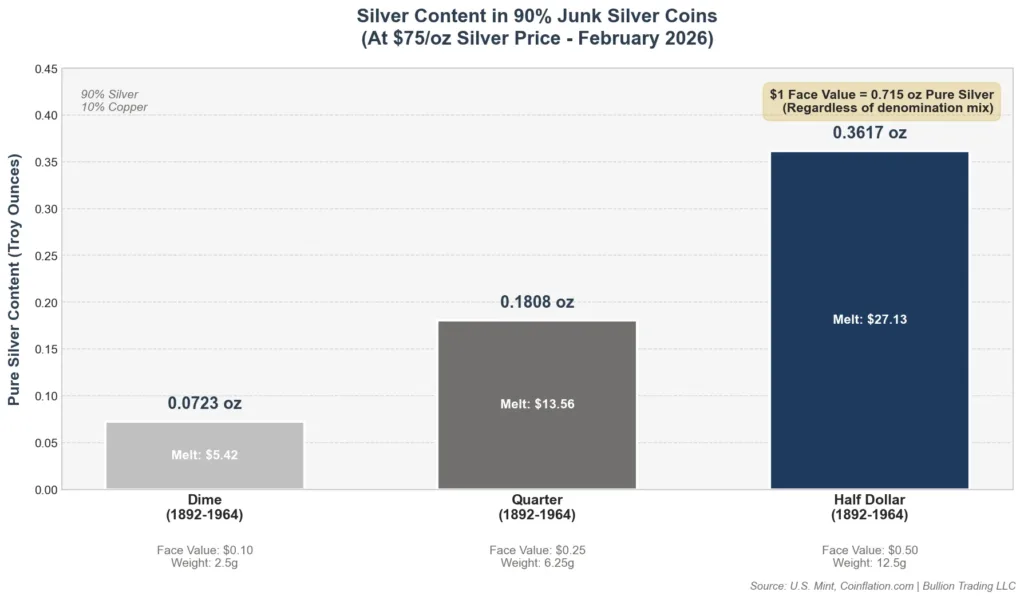
Dimes (1892-1964): This includes Barber dimes (1892-1916), Mercury dimes (1916-1945), and Roosevelt dimes (1946-1964). Each dime weighs 2.5 grams and contains approximately 0.0723 troy ounces of pure silver. At current prices near $75 per ounce, the melt value of a single 90% silver dime exceeds $5.40.
Quarters (1892-1964): Barber quarters (1892-1916) and Washington quarters (1932-1964) fall into this category. Each quarter weighs 6.25 grams with roughly 0.1808 troy ounces of silver content. Their larger size makes them popular for those who prefer handling fewer individual pieces.
Half Dollars (1892-1964): Barber halves (1892-1915), Walking Liberty halves (1916-1947), Franklin halves (1948-1963), and early Kennedy halves (1964 only) are included. Each contains about 0.3617 troy ounces of silver, giving them substantial heft and value per coin.
It’s worth noting that some special coins also contain 90% silver. War nickels minted from 1942-1945 contain 35% silver (not 90%), so they belong to a different category. Similarly, Kennedy half dollars from 1965-1970 contain only 40% silver and are typically sold separately from true 90% silver.
Current Market Values and How to Calculate Them
The value of junk silver fluctuates directly with spot silver prices. As of mid-February 2026, with silver trading around $75 per ounce, the melt values are significant. A single 90% silver dime contains roughly $5.42 worth of silver, a quarter holds about $13.56 worth, and a half dollar contains approximately $27.13 in silver value.
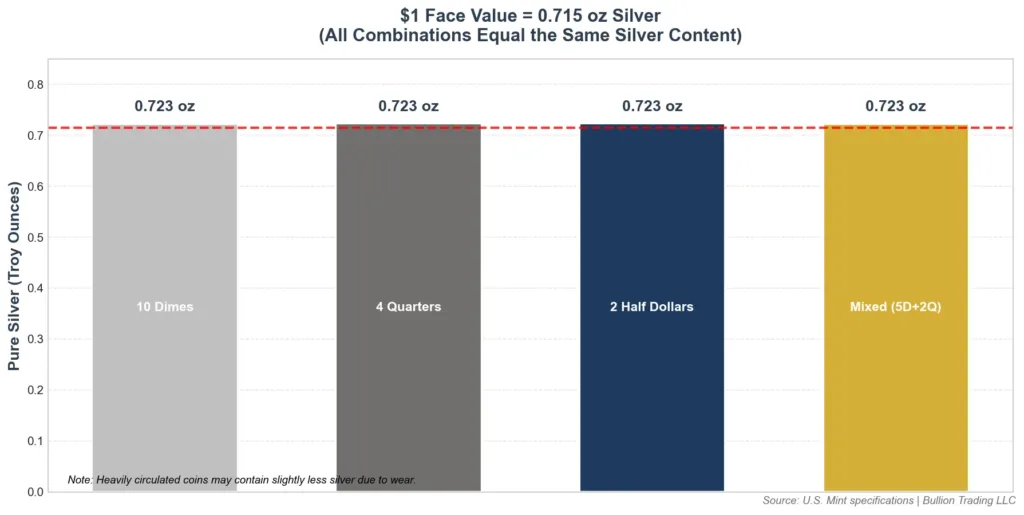
The standard trading unit for junk silver is the “$1 face value” amount, which refers to the total face value of the coins regardless of denomination. Whether you have ten dimes, four quarters, or two half dollars, $1 face value always contains the same 0.715 ounces of silver. Dealers commonly sell junk silver in bags containing $100, $500, or $1,000 face value, though smaller quantities are certainly available.
To calculate the approximate melt value of any quantity of 90% junk silver, simply multiply the face value by the current spot price and then multiply by 0.715. For example, a $100 face value bag at $75 spot silver would have a melt value of roughly $5,362 (100 × 75 × 0.715).
Premiums: What to Expect in 2026
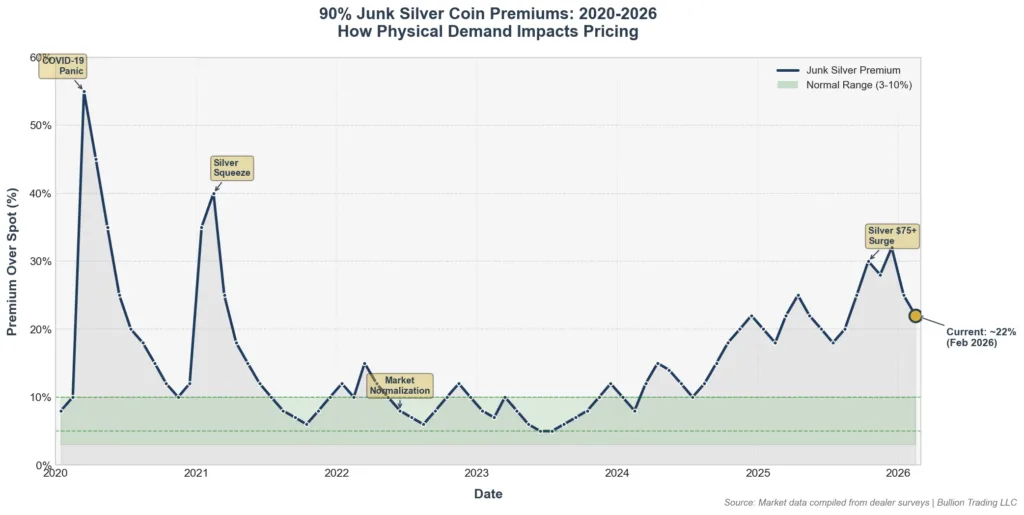
Junk silver rarely trades exactly at melt value. Dealers add a premium to cover their costs and profit margin, and this premium can vary considerably based on market conditions. During periods of calm markets, premiums on 90% junk silver typically range from 3% to 10% above melt value. However, when physical demand surges, as occurred during the silver market rallies of late 2025, premiums can expand dramatically.
According to the Silver Institute’s World Silver Survey 2025, the silver market has experienced structural deficits for several consecutive years, with total demand exceeding supply. This fundamental backdrop, combined with record industrial demand driven by solar photovoltaics, electronics, and electric vehicles, has kept physical premiums elevated compared to historical norms.
When comparing prices across dealers, always look at the percentage above melt value rather than the absolute dollar price. A slightly higher price from a reputable dealer often proves worthwhile compared to questionable sources offering suspiciously low premiums. Counterfeit coins do exist, and established precious metals dealers like Bullion Trading LLC provide authenticity guarantees that protect your investment.
Advantages of Buying 90% Junk Silver
Several characteristics make junk silver particularly appealing to certain investors. The divisibility factor stands out immediately. If you ever need to sell or trade a small amount of silver, junk silver allows you to do so without dividing a larger bar or coin. A Roosevelt dime represents a much smaller increment of value than a one-ounce silver bar.
Recognition and authenticity present another advantage. These coins were minted by the U.S. government over decades, and their designs are instantly recognizable to most Americans. This widespread familiarity can make selling easier, especially to private buyers who might be cautious about unfamiliar bullion products.
The historical connection appeals to many collectors and investors. Holding a Walking Liberty half dollar from 1942 or a Mercury dime from 1920 provides a tangible link to American monetary history. While pure investment-grade junk silver is valued only for metal content, the historical aspect adds an intangible dimension that resonates with many buyers.
Premiums on junk silver tend to be lower than those on newly minted bullion coins like American Silver Eagles or Canadian Maple Leafs. When every dollar counts, the ability to acquire more silver for the same money makes junk silver attractive to cost-conscious investors.
Potential Drawbacks to Consider
No investment is without limitations, and junk silver presents some practical challenges. Storage density is one consideration. Because these coins contain only 90% silver (versus 99.9% for modern bullion), you need more physical space to store the same amount of silver. A bag of $1,000 face value junk silver weighs approximately 55 pounds, which creates logistical challenges for those accumulating significant positions.
Circulated coins show wear, and this affects their actual silver content. While $1 face value theoretically contains 0.715 ounces of silver, heavily worn coins might contain slightly less. This factor is typically priced into the market, but it’s worth understanding that worn coins aren’t identical to uncirculated specimens.
Selling junk silver can be more complex than selling standard bullion products. Some refiners and dealers prefer handling bars or modern coins rather than sorting through bags of circulated coins. When it comes time to liquidate, having a relationship with a dealer who actively buys junk silver simplifies the process.
Where and How to Buy 90% Junk Silver
Several channels exist for purchasing junk silver, each with distinct characteristics. Established online dealers offer convenience and competitive pricing, though shipping costs and minimum order requirements apply. Local coin shops provide the opportunity to inspect coins before purchase and avoid shipping delays, though their premiums may be higher.
Estate sales and coin shows occasionally yield junk silver at favorable prices, particularly when sellers don’t fully understand current values. However, these opportunities require time and knowledge to exploit effectively. Online auction platforms can offer bargains but also present authenticity risks that experienced buyers have learned to navigate carefully.
When making purchases, specify whether you want a particular denomination or are open to a mix. Some investors prefer the larger half dollars for their heft and lower per-coin sorting effort. Others favor dimes for maximum divisibility. Mixed bags containing various denominations offer variety while maintaining the standard silver content per dollar of face value.
Storing and Protecting Your Investment
Proper storage preserves your coins and simplifies future transactions. While junk silver isn’t valued for appearance, keeping coins clean and organized makes counting and verification easier. Cloth bags breathe and prevent moisture buildup, while plastic tubes or containers work well for smaller quantities.
Home safes provide reasonable security for moderate amounts, but larger accumulations may warrant bank safe deposit boxes or third-party precious metals storage facilities. Insurance coverage should reflect actual replacement value, which fluctuates with silver prices. Document your holdings with photographs and inventory lists stored separately from the physical coins.
Regarding taxes, the IRS considers precious metals including junk silver as collectibles, subject to a maximum 28% capital gains rate for assets held over one year. This differs from the standard long-term capital gains rates applied to stocks and bonds. Keeping purchase records with dates and prices paid simplifies tax reporting when you eventually sell.
Is 90% Junk Silver Right for You?
Junk silver fits certain investor profiles better than others. If you value divisibility, historical significance, and potentially lower premiums over spot price, these coins deserve serious consideration. The practical nature of government-minted coinage appeals to those who view precious metals as a form of financial insurance rather than purely a price speculation.
For investors seeking the purest form of silver exposure or prioritizing compact storage, modern bullion bars and coins might prove more appropriate. Portfolio allocation ultimately depends on individual circumstances, risk tolerance, and objectives.
The silver market in 2026 presents both opportunities and challenges. Industrial demand continues to grow, particularly from green energy applications, while mine supply has struggled to keep pace. According to the Silver Institute, global silver mine production rose just 0.9% in 2024 to 819.7 million ounces, while demand dynamics remain robust. This fundamental backdrop suggests continued interest in physical silver of all forms, including the humble but practical 90% junk silver coin.
Whether you’re building your first precious metals position or diversifying an existing portfolio, understanding the characteristics of 90% junk silver helps you make informed decisions. These coins served as money for generations of Americans, and they continue to serve as a store of value for investors who appreciate their unique combination of attributes.
Ready to explore 90% junk silver options? Bullion Trading LLC offers a selection of constitutional silver coins alongside our full inventory of gold, silver, platinum, and palladium products. Our experienced team can help you find the right precious metals solution for your investment goals.
