


The Fourth Industrial Revolution is unfolding faster than most economists predicted. Unlike previous technological disruptions that primarily affected manufacturing, today’s AI systems are replacing accountants, customer service representatives, software developers, legal researchers, and middle management, the backbone of the middle-class economy.
According to McKinsey Global Institute research, generative AI could automate 60 to 70 percent of employees’ work activities across industries. The World Economic Forum projects that by 2027, 83 million jobs will be eliminated while 69 million will be created, a net decrease of 14 million positions. Critically, eliminated jobs tend to pay higher wages than newly created positions.
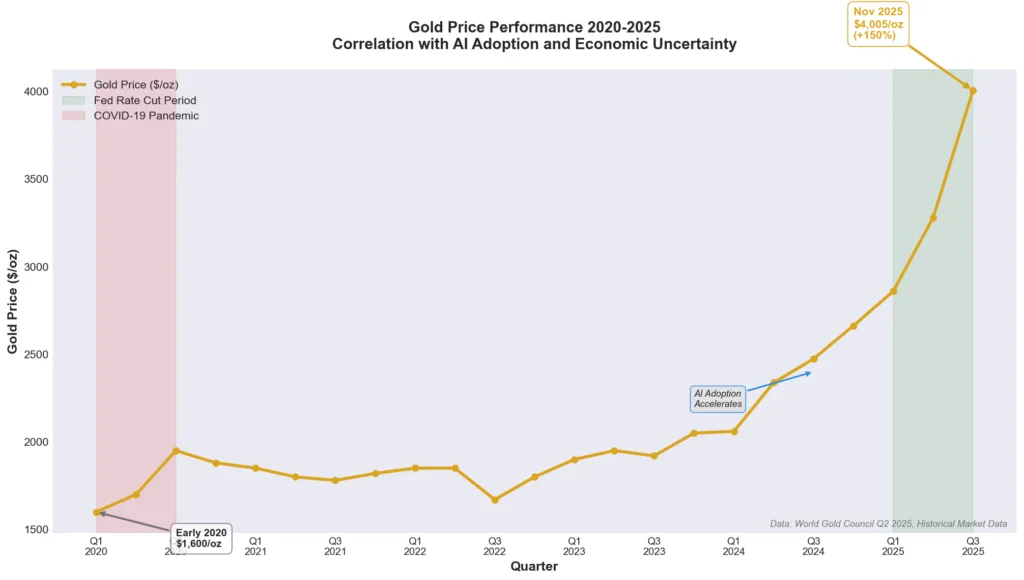
This isn’t just a labor story. It’s a macroeconomic shift with profound implications for inflation, monetary policy, and asset allocation. When productivity rises while incomes fall, when corporate profits grow while consumer purchasing power erodes, you get exactly the environment where gold historically outperforms traditional financial assets. With gold advancing more than 150% from early 2020 levels to above $4,000 per ounce in late 2025, the market is already pricing in these structural concerns.
The AI Displacement Wave Accelerates
The pace of AI-related workforce adjustments accelerated dramatically throughout 2024 and into 2025. Unlike previous downturns where companies reduced headcount due to declining revenue, current workforce reductions occur amid strong profitability with explicit acknowledgment that AI systems can perform equivalent work at substantially lower cost.
Technology companies have led the reductions, with the sector eliminating more than 260,000 positions globally in 2023 according to Layoffs.fyi tracking data. But displacement extends far beyond Silicon Valley into financial services, customer support, media, legal services, and healthcare administration.
This creates structural income compression distinct from traditional recession dynamics. Total employment might remain stable, productivity metrics improve, but median household income faces sustained downward pressure. The gap between production capacity and consumer purchasing power widens, a dynamic that historically generates significant macroeconomic instability.
Stagflation: Gold’s Historical Sweet Spot
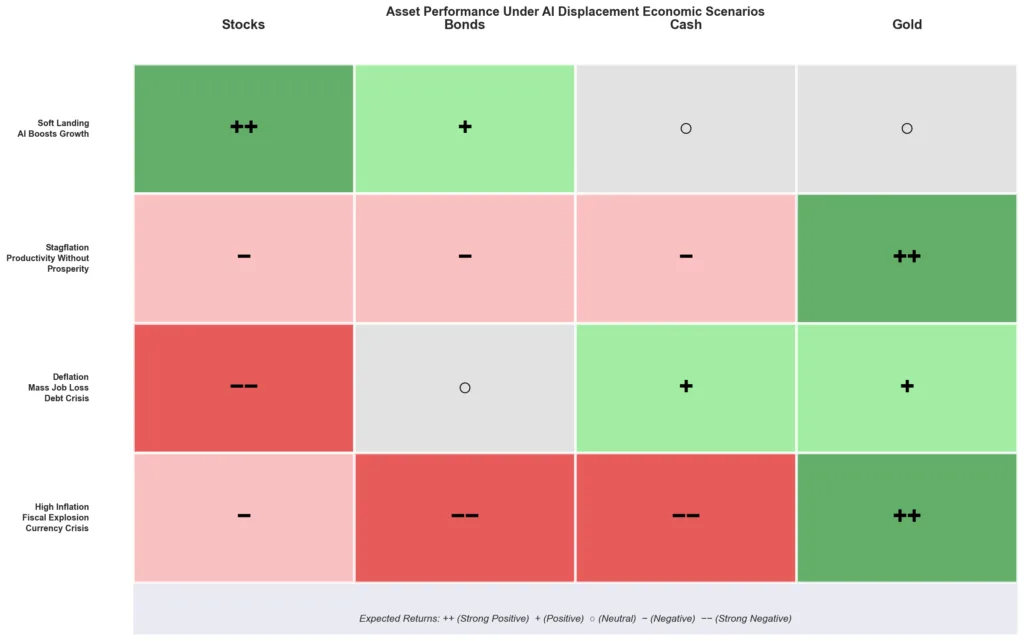
Stagflation, stagnant economic growth combined with persistent inflation, represents one of the most challenging conditions for policymakers and investors. Traditional monetary policy faces a cruel dilemma: raising rates to combat inflation risks deepening economic weakness, while cutting rates to support growth risks accelerating inflation.
The original stagflation period of the 1970s saw the U.S. economy experience repeated recessions combined with inflation that peaked above 14%. This environment proved catastrophic for traditional portfolios. Stock returns were flat to negative in real terms across the entire 16-year period from 1966 to 1982, while bond investors suffered devastating losses as rising interest rates destroyed principal values.
Meanwhile, gold surged from $35 per ounce in August 1971 to over $850 by January 1980, a gain exceeding 2,400%.
Current AI Dynamics Mirror Stagflationary Pressures
The AI-driven displacement creates conditions structurally similar to 1970s stagflation through different mechanisms:
Productivity Without Prosperity: AI boosts output per worker but doesn’t translate to wage growth for displaced workers. Corporate profits rise while household incomes stagnate.
Political Pressure for Monetary Expansion: As displacement becomes politically salient, pressure mounts for government intervention through expanded social programs, infrastructure spending, or income support, all involving substantial deficit spending.
Currency Debasement Dynamics: Governments facing technological unemployment while managing massive debt burdens face powerful incentives to tolerate higher inflation. The U.S. national debt exceeding $38 trillion (approximately 125% of GDP) creates structural pressure for inflationary policy.
This combination, productivity growth without broad prosperity, political pressure for fiscal expansion, and debt levels encouraging currency debasement, creates textbook conditions for stagflation. And in stagflation, gold’s properties as a monetary metal with fixed supply and no counterparty risk become exceptionally valuable.

Why Gold Serves as the Optimal Hedge
No Counterparty Risk in an Uncertain System
Perhaps gold’s most critical attribute during technological disruption is its nature as a physical asset with no counterparty risk. Unlike stocks, bonds, or bank deposits, physical gold ownership doesn’t depend on any institution’s solvency, government’s stability, or corporation’s viability.
When technological unemployment creates systemic stresses, banking instability from mortgage defaults, bond market dysfunction from debt servicing concerns, or currency crisis from fiscal expansion, gold maintains value independent of these institutional failures. The 2023 regional banking crisis demonstrated this principle when Silicon Valley Bank and others failed within weeks while gold surged as investors sought assets outside the banking system.
Fixed Supply Versus Unlimited Fiat Creation
Gold’s supply increases approximately 1.5% annually through mining, a rate that has remained stable for decades and cannot be accelerated regardless of price. This contrasts with fiat currency that can be created in unlimited quantities.
When governments face political pressure to address technological unemployment, funding must come from taxation (politically difficult), borrowing (increasingly expensive), or monetary expansion (printing money). The path of least resistance is typically monetary expansion through quantitative easing, yield curve control, or other mechanisms.
Gold’s fixed supply makes it the natural beneficiary. As currency units multiply while gold ounces remain constant, each ounce becomes worth more currency units, not speculation, but basic mathematics of relative scarcity.
Portfolio Diversification During Correlated Markets
Recent market behavior shows increasing correlation across traditional asset classes during stress periods. When crises hit, stocks and bonds now frequently decline simultaneously, eliminating the diversification benefit the classic 60/40 portfolio was designed to provide.
Gold maintains low to negative correlation with traditional assets, particularly during stress periods. World Gold Council research demonstrates that gold’s correlation with stocks and bonds decreases precisely when investors need diversification most. If AI displacement shocks affect both equity valuations and bond prices, gold provides one of the few assets likely to appreciate while traditional holdings suffer.
Central Banks Signal Long-Term Conviction
Perhaps the most significant validation comes from central bank behavior. According to World Gold Council data, central banks purchased 1,037 tonnes of gold in 2024, marking the third consecutive year of purchases exceeding 1,000 tonnes, unprecedented in the modern era.
This buying accelerated in early 2025, with Q1 official sector purchases reaching approximately 250 tonnes, the highest first-quarter total on record. While Q2 2025 saw a moderation to 166 tonnes, the full-year trajectory remains extraordinary.
Central banks are diversifying away from dollar-heavy reserves for reasons directly related to AI displacement dynamics: currency debasement concerns, geopolitical diversification needs, and systemic risk hedging. When the world’s most sophisticated reserve managers aggressively accumulate gold amid AI-driven economic transformation, individual investors should pay attention.
Strategic Implementation
Financial advisors historically recommended 5-10% precious metals allocation. However, the unique risks posed by AI-driven transformation may justify 10-15% gold allocation for conservative investors, with potentially higher percentages for those particularly concerned about technological displacement effects.
Physical Gold: Sovereign coins and bars provide direct ownership with no counterparty risk, the purest insurance against systemic financial risks.
Gold ETFs: Products like GLD offer liquidity and convenience without storage concerns, suitable for tactical allocations.
Precious Metals IRAs: IRS-approved IRAs allow holding physical gold in tax-advantaged retirement accounts.
A balanced approach might include 60-70% physical gold for true insurance, 20-30% ETF exposure for liquidity, and 10-20% mining stocks for leveraged upside potential for aggressive investors.
Important Considerations
Gold isn’t perfect. The metal experiences regular drawdowns of 10-20%, with occasional corrections exceeding 30%. The 2011-2015 period saw gold decline from near $1,900 to below $1,100, over 40%. Investors need financial capacity and psychological tolerance to maintain positions through volatility.
Gold generates no cash flow and typically underperforms during stable economic periods. This opportunity cost must be accepted in exchange for protection during crisis periods. Additionally, physical gold faces a maximum 28% federal tax rate on long-term gains rather than preferential 15-20% rates for stocks, though precious metals IRAs eliminate this consideration for retirement accounts.
Conclusion: Preparing Portfolios for Economic Transformation
The technological displacement driven by AI adoption represents a fundamental economic shift with profound implications for employment, monetary policy, and asset performance. While exact timelines remain uncertain, the direction is clear: millions of middle-class jobs face displacement over the coming decade, creating political and economic pressures likely resulting in substantial monetary expansion and fiscal intervention.
This environment, productivity growth that doesn’t benefit average workers, political pressure for government action, debt levels encouraging inflation, and geopolitical uncertainty, creates textbook conditions for gold appreciation. Historical precedent from the 1930s and especially the 1970s demonstrates gold substantially outperforms traditional assets during periods of technological unemployment combined with monetary expansion.
Gold doesn’t represent speculation on short-term movements or a bet on economic collapse. Rather, it serves as strategic insurance against purchasing power erosion and systemic risks created when societies manage technological displacement through currency expansion rather than structural adjustment.
As central banks worldwide demonstrate through record accumulation, those with the longest time horizons understand gold’s role in the coming decade. The AI revolution will create tremendous wealth and opportunity, but also tremendous disruption and risk. Gold ensures your wealth benefits from the former while being protected from the latter.Whether you’re establishing initial precious metals positions or expanding existing holdings, Bullion Trading LLC offers comprehensive precious metals solutions backed by expertise and commitment to investor education. In an economy where machines increasingly do the work while humans face uncertain employment prospects, owning the asset that has preserved wealth through every previous technological transition becomes not just prudent, it becomes essential.
