


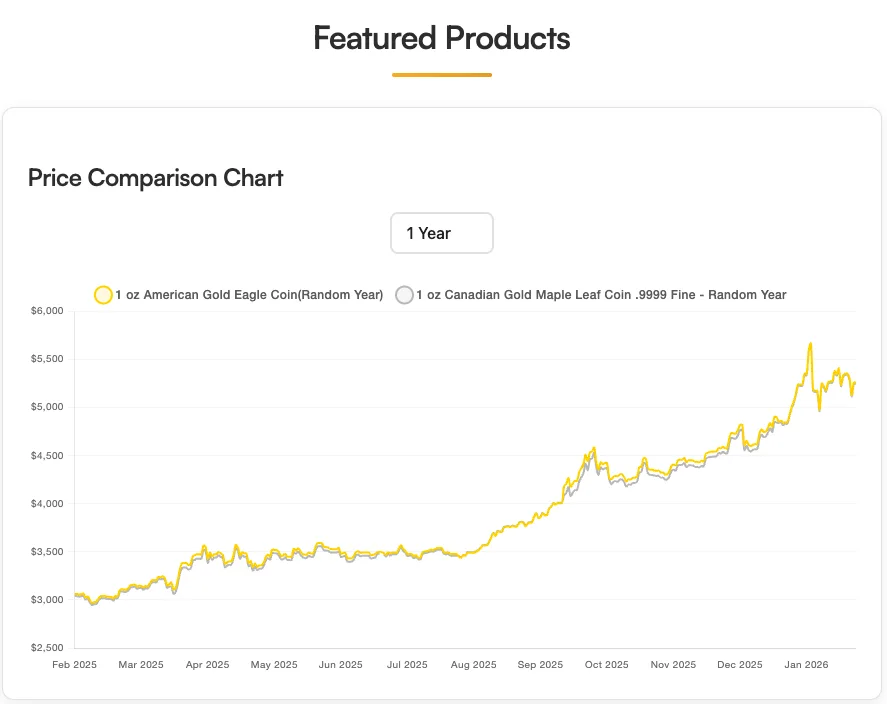
With gold trading near $5,000 per ounce in February 2026, selecting the right bullion coin has never been more consequential for investors. The American Gold Eagle and Canadian Gold Maple Leaf stand as two of the world’s most recognized and trusted gold coins, each backed by their respective governments and produced by prestigious national mints. But which one makes more sense for your portfolio?
The comparison between American Gold Eagle vs Canadian Gold Maple Leaf goes beyond simple preference. These coins differ significantly in gold purity, composition, design philosophy, and practical considerations like scratch resistance and resale liquidity. Understanding these distinctions can help you make informed decisions whether you’re building a long-term wealth preservation strategy, diversifying retirement assets through a gold IRA, or simply seeking the most efficient way to own physical gold.
American Gold Eagle vs Canadian Gold Maple Leaf
A Brief History of Two Iconic Coins
The Canadian Gold Maple Leaf arrived first, introduced by the Royal Canadian Mint in 1979. At the time, the only significant competition came from the South African Krugerrand, which faced widespread boycotts due to apartheid-era politics, and the Austrian 100 Corona. The Maple Leaf entered the market with a revolutionary claim: it was the first bullion coin to offer .999 fine gold purity, and it quickly raised that standard to .9999 (four nines) by 1982.
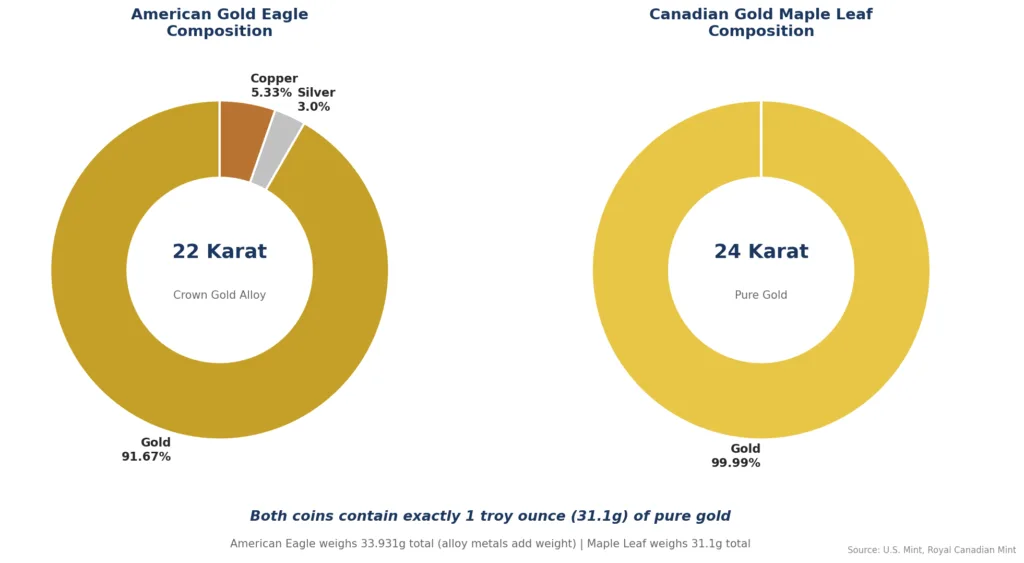
The American Gold Eagle followed in 1986, authorized by the Gold Bullion Coin Act of 1985. Rather than matching the Maple Leaf’s pure gold approach, the U.S. Mint chose a different path. The American Gold Eagle uses a 22-karat gold alloy composition known historically as “crown gold,” containing 91.67% gold with the remainder being silver and copper. This decision reflected a deliberate design philosophy prioritizing durability over maximum purity.
Both coins have evolved over their respective histories. The Gold Maple Leaf introduced micro-engraved security features in 2013 and radial line patterns in 2015 to combat counterfeiting. The American Gold Eagle received its first major design update in 2021, replacing the classic family of eagles reverse with a striking close-up eagle portrait designed by Jennie Norris.
Gold Purity: The Core Difference
The most fundamental distinction between these two coins lies in their gold content and overall composition. The Canadian Gold Maple Leaf contains .9999 fine gold (99.99% pure), making it one of the purest regular-issue bullion coins available worldwide. Special editions have even achieved .99999 purity (five nines).
The American Gold Eagle, by contrast, is 91.67% gold (22 karats), with approximately 3% silver and 5.33% copper making up the remainder. However, a crucial point many investors miss: the American Gold Eagle still contains exactly one troy ounce of pure gold in its standard size. The alloy metals are added to that gold content, which is why a 1 oz American Gold Eagle actually weighs 1.0909 troy ounces (33.931 grams) total, while a 1 oz Canadian Gold Maple Leaf weighs exactly 31.1 grams.
This compositional difference creates real-world implications. The Maple Leaf’s pure gold makes it softer and more susceptible to scratching, nicks, and surface wear. Handling a Maple Leaf carelessly can leave visible marks that, while not affecting the gold content, may impact aesthetics and potentially resale premiums for collectors seeking pristine specimens. The American Gold Eagle’s copper and silver alloy creates a more durable, scratch-resistant coin that better withstands handling over time.
Design and Visual Appeal
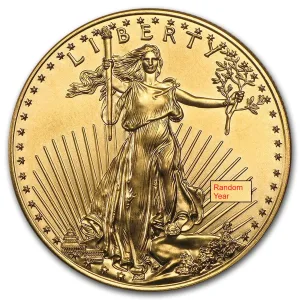
The American Gold Eagle’s obverse features one of the most celebrated designs in American numismatic history. The full-length figure of Lady Liberty, torch raised and olive branch in hand, is adapted from Augustus Saint-Gaudens’ iconic design for the pre-1933 $20 gold piece, a coin that President Theodore Roosevelt personally commissioned to rival the beauty of ancient Greek and Roman coinage. This connection to American numismatic heritage resonates strongly with U.S. collectors and investors.
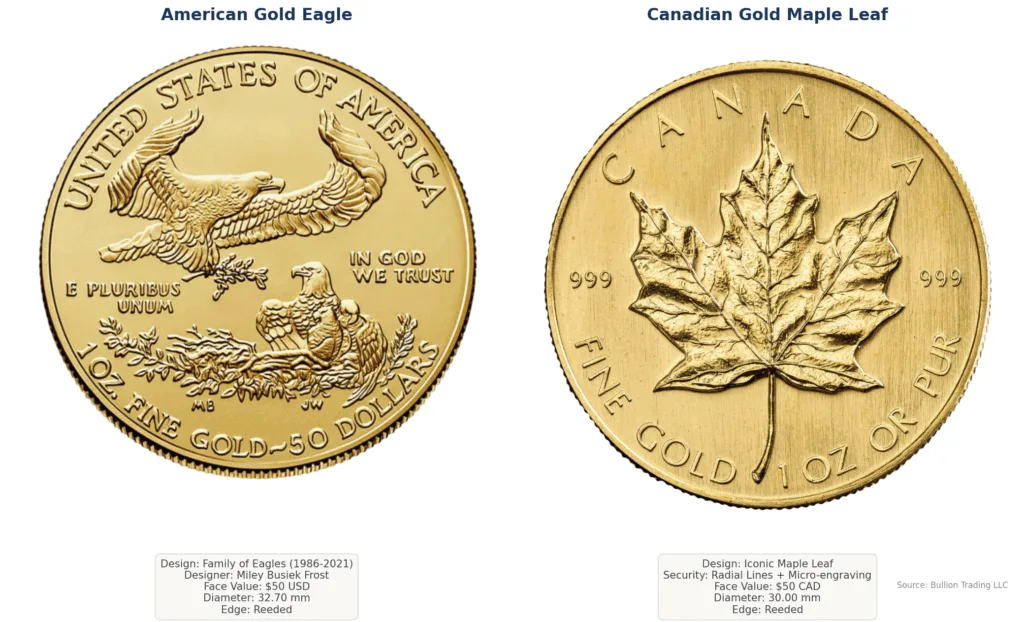
The reverse design changed significantly in 2021. Prior coins (1986-2021) featured Miley Busiek Frost’s design of a male eagle carrying an olive branch above a nest with a female eagle and eaglets, which the artist described as “a symbolic tribute to the American family.” The current reverse, introduced in 2021, displays a dramatic close-up portrait of an eagle’s head, designed by Jennie Norris, who sought to capture “the intensity of his stare” and “pride and wisdom passed down through generations.”
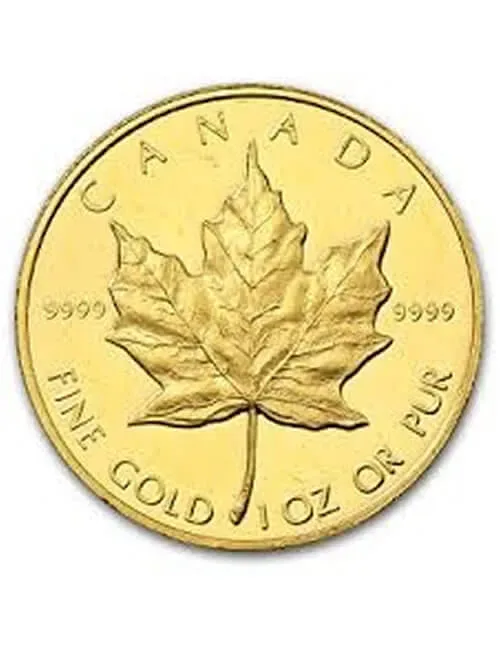
The Canadian Gold Maple Leaf takes a cleaner, more minimalist approach. The reverse displays the iconic maple leaf, Canada’s national symbol, rendered with elegant simplicity. The obverse featured Queen Elizabeth II’s portrait from 1979 through 2023, with the image updated several times to reflect her aging. Beginning in 2024, the coins now feature King Charles III’s portrait facing left. This clean design aesthetic appeals to investors who prefer understated elegance over elaborate imagery.
Specifications Comparison
For the standard 1 oz versions that most investors purchase, the specifications break down as follows:
The American Gold Eagle measures 32.70 mm in diameter with a thickness of 2.87 mm. It weighs 1.0909 troy ounces (33.931 grams) total but contains exactly 1 troy ounce of pure gold. The coin carries a face value of $50, though its market value obviously far exceeds this nominal denomination. According to U.S. Mint specifications, the gold must come from domestic American sources.
The Canadian Gold Maple Leaf measures 30 mm in diameter with a slightly smaller overall profile. It weighs exactly 31.1 grams (1 troy ounce) since there are no alloy metals adding extra weight. The face value is 50 Canadian dollars. The Royal Canadian Mint has incorporated several advanced security features, including micro-engraved laser marks visible only under magnification and precise radial lines on both coin faces that are difficult to replicate.
Both coins are available in fractional sizes for investors who prefer smaller denominations or want to dollar-cost average their purchases. The American Gold Eagle comes in 1/10 oz ($5 face value), 1/4 oz ($10), 1/2 oz ($25), and 1 oz ($50) sizes. The Canadian Gold Maple Leaf offers even more variety: 1 gram, 1/20 oz, 1/10 oz, 1/4 oz, 1/2 oz, and 1 oz denominations.
IRA Eligibility and Tax Considerations
Both the American Gold Eagle and Canadian Gold Maple Leaf qualify for inclusion in a precious metals IRA, but the regulatory framework differs slightly. According to IRS guidance on retirement plan investments, certain gold coins are exempted from the general prohibition on collectibles in retirement accounts.
The American Gold Eagle benefits from specific statutory language. Under IRC Section 408(m)(3)(A), gold coins described in 31 USC Section 5112 are explicitly permitted, and American Gold Eagles fall under this provision. This means American Gold Eagles are IRA-eligible regardless of their 22-karat composition, even though the general rule requires .995 fineness for gold bullion.
The Canadian Gold Maple Leaf qualifies under a different provision. IRC Section 408(m)(3)(B) permits gold bullion meeting a fineness of .995 or higher when held by a bank or approved non-bank trustee. Since the Maple Leaf exceeds this threshold at .9999 purity, it easily satisfies IRA requirements when properly custodied.
For taxable transactions outside retirement accounts, both coins are subject to collectibles capital gains rates of up to 28%, rather than the lower long-term capital gains rates that apply to stocks and many other investments. This tax treatment applies regardless of purity or nationality, so there is no advantage to either coin from a federal tax perspective.
Premiums, Liquidity, and Resale Value
Premium structures for both coins have fluctuated significantly during the gold price surge of recent years. As physical gold demand intensified through 2024 and 2025, premiums above spot price increased for both products. Currently, in February 2026, premiums for 1 oz American Gold Eagles typically run between 4% and 7% over spot, while Canadian Gold Maple Leafs command similar premiums in the 3% to 6% range.
The slight premium advantage sometimes observed with Maple Leafs reflects their higher purity and lower manufacturing complexity. However, premiums can vary significantly between dealers, and shopping around often matters more than the underlying coin choice.
Liquidity for both coins is excellent. The American Gold Eagle is the most widely recognized and traded gold bullion coin in the United States, and virtually every coin dealer, pawn shop, and precious metals exchange will readily purchase them. The Canadian Gold Maple Leaf enjoys similar global recognition, with strong demand throughout North America, Europe, and Asia. Investors should have no trouble selling either coin at fair market value.
Counterfeit Protection and Authentication
Counterfeiting concerns have grown alongside rising gold prices, and both mints have responded with enhanced security measures. The Royal Canadian Mint has been particularly aggressive in this area. Starting in 2013, Gold Maple Leafs feature a laser micro-engraved maple leaf mark with the year of issue visible only under magnification. In 2015, the mint added radial lines machined into both coin faces, creating a light-diffracting pattern that is extremely difficult to replicate with current counterfeiting technology.
The American Gold Eagle relies more on its distinctive design elements and the U.S. Mint’s quality control reputation. The coin’s specific weight, dimensions, and reeding pattern provide authentication touchpoints, though it lacks the overt security features found on modern Maple Leafs. The 2021 redesign did incorporate some subtle anti-counterfeiting elements in the detailed eagle portrait.
For either coin, purchasing from reputable dealers like Bullion Trading LLC remains the best protection against counterfeits. Established dealers authenticate inventory before sale and stand behind their products with buyback guarantees.
Which Coin Is Right for You?
Choosing between the American Gold Eagle and Canadian Gold Maple Leaf ultimately depends on your priorities as an investor. The American Gold Eagle makes sense if you value durability and handling resistance, prefer coins with deep American numismatic heritage, want the psychological assurance of explicit U.S. statutory IRA eligibility, or plan to hold coins outside of professional storage where scratch resistance matters.
The Canadian Gold Maple Leaf may better suit investors who prioritize maximum gold purity in their holdings, appreciate advanced anti-counterfeiting security features, prefer a cleaner aesthetic design, or want slightly lower premiums when available.
Many serious precious metals investors hold both coins, recognizing that each offers distinct advantages. Geographic diversification between U.S. and Canadian-minted products can provide additional peace of mind for those concerned about political or economic uncertainties affecting a single country.
At current gold prices approaching $5,000 per ounce, the small percentage differences in premiums and the compositional distinctions translate to meaningful dollar amounts. A 1% premium difference on a single ounce represents roughly $50 today, and that differential compounds across larger portfolio allocations. Taking time to understand these factors and shop competitively for whichever coin you choose can significantly impact overall acquisition costs.
Conclusion
The American Gold Eagle vs Canadian Gold Maple Leaf comparison reveals two excellent approaches to gold bullion ownership rather than a clear winner. The American Gold Eagle’s 22-karat composition offers superior durability and connects to beloved American coin design traditions. The Canadian Gold Maple Leaf’s .9999 purity provides the highest gold content possible in a standard bullion coin, backed by innovative security features from one of the world’s most respected mints.
Both coins deliver what matters most: direct ownership of physical gold in a government-backed, highly liquid form that preserves purchasing power across generations. Whether you choose the iconic Lady Liberty of the American Gold Eagle or the elegant simplicity of the Canadian Gold Maple Leaf, you’re acquiring a time-tested store of value recognized and accepted worldwide.
For investors ready to add gold bullion coins to their portfolios, Bullion Trading LLC offers competitive pricing on both American Gold Eagles and Canadian Gold Maple Leafs, with expert guidance to help you select the right products for your investment goals.
