


Gold has been a symbol of wealth and power for thousands of years, and wherever there is gold, there are people willing to risk everything to steal it. From Victorian-era train heists to sophisticated vault breaches in modern Europe, the biggest precious metals robberies in history read like Hollywood scripts. Many of them have, in fact, been adapted into blockbuster films and bestselling books.
What makes these crimes so fascinating is not just the staggering amounts of gold, silver, and diamonds involved, but the human stories behind them. You have aging career criminals pulling off one final job, Mafia associates turning on each other over the spoils, and a French paratrooper who tunneled through the sewers of Nice only to leap from a courthouse window when the law finally caught up with him. Some of these heists took years of painstaking planning. Others came together almost by accident, when thieves expecting a modest payday stumbled onto vaults packed with bullion worth far more than anyone imagined.
Here are ten of the most notorious precious metals robberies ever committed, each one a story worth telling in full.
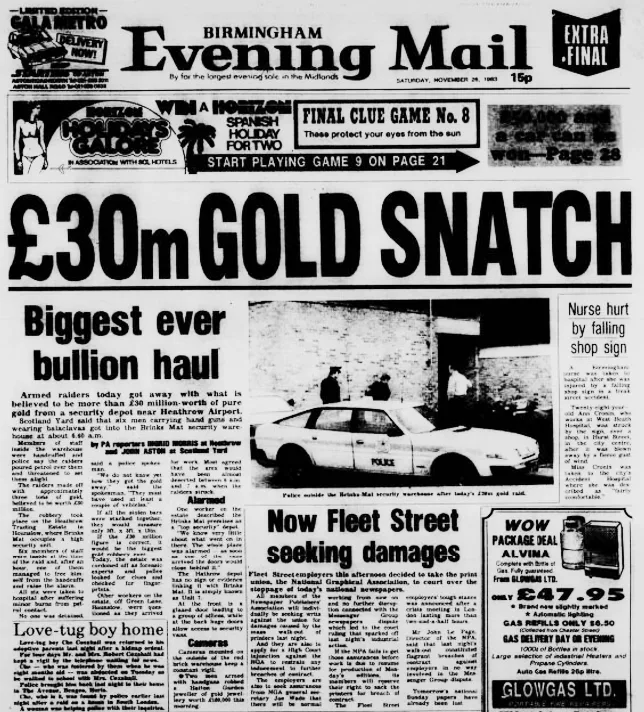
1. The Brink’s-Mat Robbery (1983)
On the morning of November 26, 1983, a gang of six armed men broke into the Brink’s-Mat warehouse at the Heathrow International Trading Estate near London’s Heathrow Airport. They expected to find roughly £3 million in cash. What they found instead changed the course of British criminal history.
Inside the warehouse sat three tonnes of gold bullion, packed into 6,800 bars, alongside platinum ingots and cut diamonds. The total haul came to £26 million, equivalent to roughly £290 million in 2025 money. The men behind the robbery had no plan for gold of that magnitude. They had come for banknotes.
The operation was made possible by Anthony Black, a security guard at the facility and the brother-in-law of one of the gang members. Black provided detailed floor plans, alarm codes, and the schedule of staff movements. When the gang arrived in the early hours, they overpowered the small night crew, dousing two guards with petrol and threatening to set them on fire unless they opened the vault. It worked.
The aftermath of the Brink’s-Mat robbery proved even more dramatic than the crime itself. The gang had no infrastructure for laundering three tonnes of gold, so they turned to professional criminals and shady dealers who could smelt and redistribute the bullion through shell companies and front businesses. One key figure, Kenneth Noye, was later convicted for his role in laundering the gold through a Bristol-based smelting operation. Over the following decades, at least six people connected to the stolen gold were murdered in what the British press came to call the “Curse of Brink’s-Mat”. Investigators believe that much of the laundered gold eventually entered the legitimate gold bullion market, where it may still be circulating today in the form of jewelry and investment bars.
2. The Antwerp Diamond Heist (2003)
The Antwerp Diamond Centre sits in the heart of Belgium’s diamond district, a neighborhood that handles an estimated 84 percent of the world’s rough diamonds. The building’s underground vault was protected by what security experts considered a nearly impregnable system: infrared heat detectors, a magnetic field sensor, a seismic sensor, Doppler radar, a lock with 100 million possible combinations, and a thick steel door. None of it mattered.
On the weekend of February 15-16, 2003, a group of Italian thieves who called themselves the “School of Turin” broke into the vault and emptied 109 of its 189 safe deposit boxes. They walked out with more than $100 million in diamonds, gold, silver, and other jewelry. It was immediately dubbed the “heist of the century”.
The mastermind was Leonardo Notarbartolo, a career thief from Turin. More than a year before the robbery, he rented a safe deposit box inside the vault, giving him legitimate, repeated access to the building. Each visit was an intelligence-gathering mission. He studied the alarm placements, the guard rotations, the vault door mechanism, and the architecture of the stairwells and corridors. He recruited specialists for each obstacle: one man handled the alarm systems, another managed the lock, a third took care of logistics.
Their preparation was extraordinary. They built a replica of the vault’s lock to practice on. They used aluminum foil and tape to neutralize infrared sensors and hairspray and polyester to block the magnetic field detector. The Doppler radar was rendered useless by carefully controlling their movement speed. On the night of the robbery, they worked through the vault methodically, stripping 109 boxes of their contents.
What undid them was sloppiness after the fact. Notarbartolo dumped trash bags full of evidence in a forest outside Antwerp, including half-eaten salami, envelopes with names from the safe deposit boxes, and a VHS tape from the building’s security system. A local man found the garbage, saw the diamond-related paperwork, and called police. Forensic analysis of a jewelry polishing cloth in the trash yielded DNA that led investigators straight to Notarbartolo. He and several accomplices were convicted, though the vast majority of the stolen precious metals and gems were never recovered.
3. The Dresden Green Vault Burglary (2019)
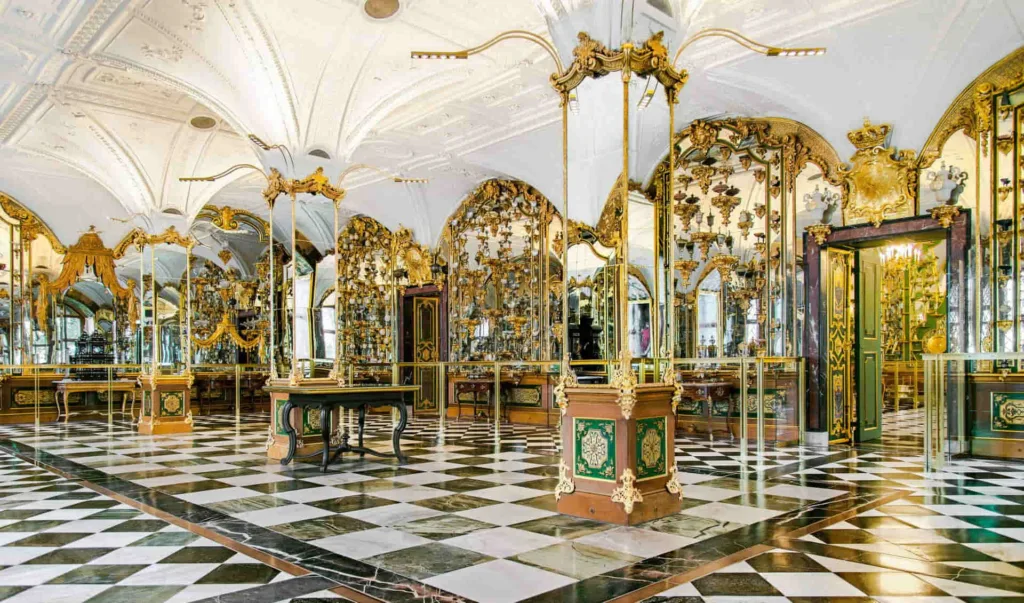
The Historisches Grünes Gewölbe, or Historic Green Vault, at the Royal Palace in Dresden is one of Europe’s oldest and most significant museum treasure collections. Founded in 1723 by Augustus the Strong, Elector of Saxony, the vault houses items of incalculable historical value: crowns, swords, brooches, and full jewelry sets encrusted with thousands of diamonds and other gemstones, all set in gold and silver.
In the early hours of November 25, 2019, members of the Berlin-based Remmo crime clan attacked the collection. The clan, a large Lebanese-German family notorious in Berlin for organized crime, had prepared meticulously. They started by setting fire to an electrical junction box near the Augustusbrücke, a bridge adjacent to the palace. That single fire knocked out power to the area, disabling streetlights, traffic cameras, and the museum’s external security systems.
The thieves then smashed through a barred window using an axe. Inside, they went directly for the jewel room, shattered a display case, and grabbed 21 pieces of 18th-century jewelry containing more than 4,300 diamonds. They were in and out in minutes. The officially declared value of the stolen items was €113 million, though cultural experts argued the true loss was closer to €1 billion when you account for the historical and artistic significance of pieces that can never be replicated.
German police launched one of the largest investigations in the country’s postwar history. Arrests followed in November 2020. In a plea deal that shocked many observers, 31 of the stolen items were recovered in December 2022 after being hidden near a Berlin apartment building. Five Remmo clan members were convicted in May 2023. When the recovered treasures were examined, conservators found that some diamonds had been pried from their gold and silver settings, presumably in preparation for selling them individually. Several pieces remain missing to this day.
4. The Knightsbridge Safe Deposit Robbery (1987)
Valerio Viccei was an Italian playboy, the son of a lawyer, who arrived in London in 1986. He was already wanted in Italy for some 50 armed robberies, but in England he was a blank slate. He lived lavishly, drove expensive cars, frequented nightclubs, and burned through cash at an alarming rate. To fund his lifestyle, he needed another robbery, and this time he wanted to go big.
On July 12, 1987, Viccei and an accomplice walked into the Knightsbridge Safe Deposit Centre, located in Cheval Place in one of London’s wealthiest neighborhoods, and politely asked to rent a safe deposit box. A staff member escorted them into the vault. Once inside, the two men pulled handguns and subdued the manager and security guards. They taped a sign to the front door explaining that the centre was “temporarily closed for maintenance”, then let in more accomplices through a side entrance.
What followed was a methodical ransacking. The gang cracked open box after box, filling bags with cash, gold bars, loose gemstones, jewelry, and precious metals. The total haul was estimated at £60 million, roughly $98 million at the 1987 exchange rate. It was, at the time, one of the largest robberies in British history.
Viccei’s downfall came from a single drop of blood. During the break-in, he cut his hand and left a fingerprint at the scene. Police ran the print and got a match. After a period of surveillance, they arrested several accomplices in coordinated raids on August 12, 1987. Viccei himself fled to Latin America, but made the fatal mistake of returning to England to retrieve his prized Ferrari Testarossa and have it shipped overseas. Police arrested him on the spot. He received a 22-year sentence. After being deported to Italy in 1992 to serve the rest of his term in an open prison in Pescara, Viccei was killed in a shootout with police during a day release outing in April 2000. He was 45 years old.
5. The Société Générale Sewer Heist, Nice (1976)
Albert Spaggiari was a man of many contradictions. A French ex-paratrooper who had served in Indochina, a former member of the right-wing Organisation armée secrète, a convicted political terrorist, a chicken farmer, and an amateur photographer. He was also, as it turned out, the mastermind of one of the most creative bank robberies ever pulled off.
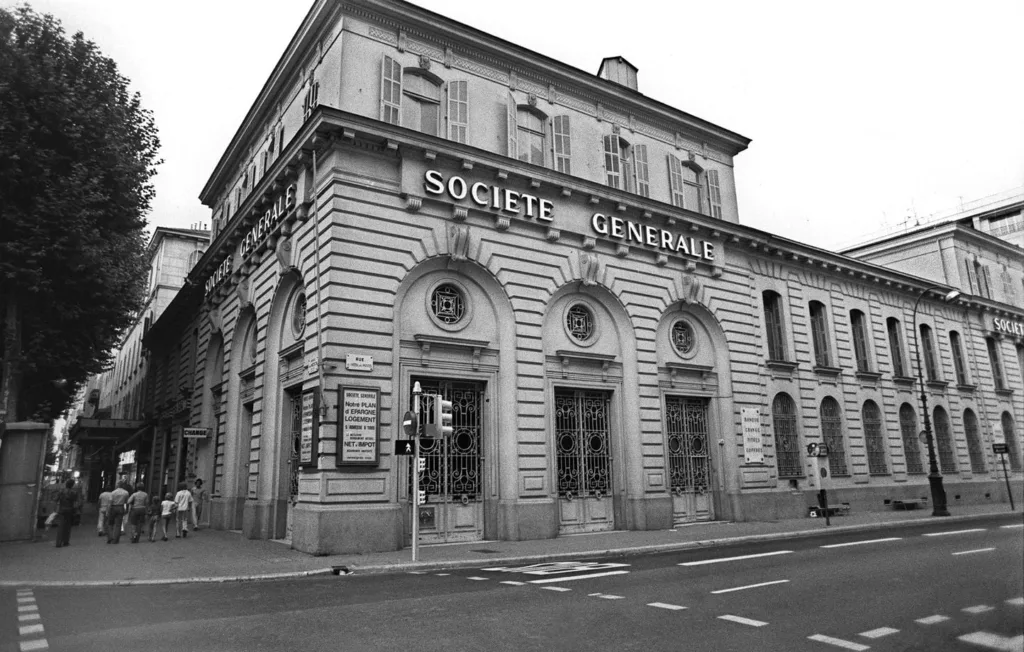
Spaggiari learned that the municipal sewers of Nice ran directly beneath the vault of a local Société Générale bank branch. He recruited a crew of at least 20 men, many with connections to the OAS, and over two months they dug an eight-metre tunnel from the sewer system upward into the vault floor. The logistics of the operation were remarkable. The men navigated underground waterways using rubber rafts. They strung hundreds of metres of electrical cable for lighting. They set up picnic tables and air mattresses in the tunnel for meals and rest. They cooked below ground and treated the excavation almost like a construction project, working in organized shifts.
On July 16, 1976, the Bastille Day long weekend, the gang finally broke through the vault floor. With most of Nice’s residents away on holiday and the bank closed for four straight days, the crew had all the time in the world. They spent the entire weekend methodically opening safe deposit boxes and sorting through cash, gold, securities, and personal valuables. The total take was estimated at 46 million francs.
Before leaving, they spray-painted a now-famous message on the vault wall: “sans armes, ni haine, ni violence”, meaning “without weapons, neither hatred, nor violence”. It was a declaration of pride as much as a taunt.
French police were initially stumped. But in late October, a tip from a former girlfriend of one of the gang members led to an arrest, and under interrogation the man gave up everyone, including Spaggiari. When Spaggiari returned from a trip abroad as photographer for the mayor of Nice, he was arrested at the airport. During a pretrial hearing on March 10, 1977, with the judge momentarily distracted by a forged document Spaggiari had introduced, Spaggiari jumped out of a first-floor courthouse window, landed on a parked car, and escaped on a motorcycle driven by an accomplice. He was sentenced to life in prison in absentia, but he was never recaptured. Reports placed him in Argentina for most of his remaining years. He died of lung cancer in France in 1989, at 56.
6. The Hatton Garden Safe Deposit Burglary (2015)
What made the Hatton Garden burglary so extraordinary was less about what was stolen and more about who did the stealing. The perpetrators were not young, tech-savvy professional criminals. They were a group of elderly men, most in their 60s and 70s, pulling what the tabloids gleefully called “one last job”.
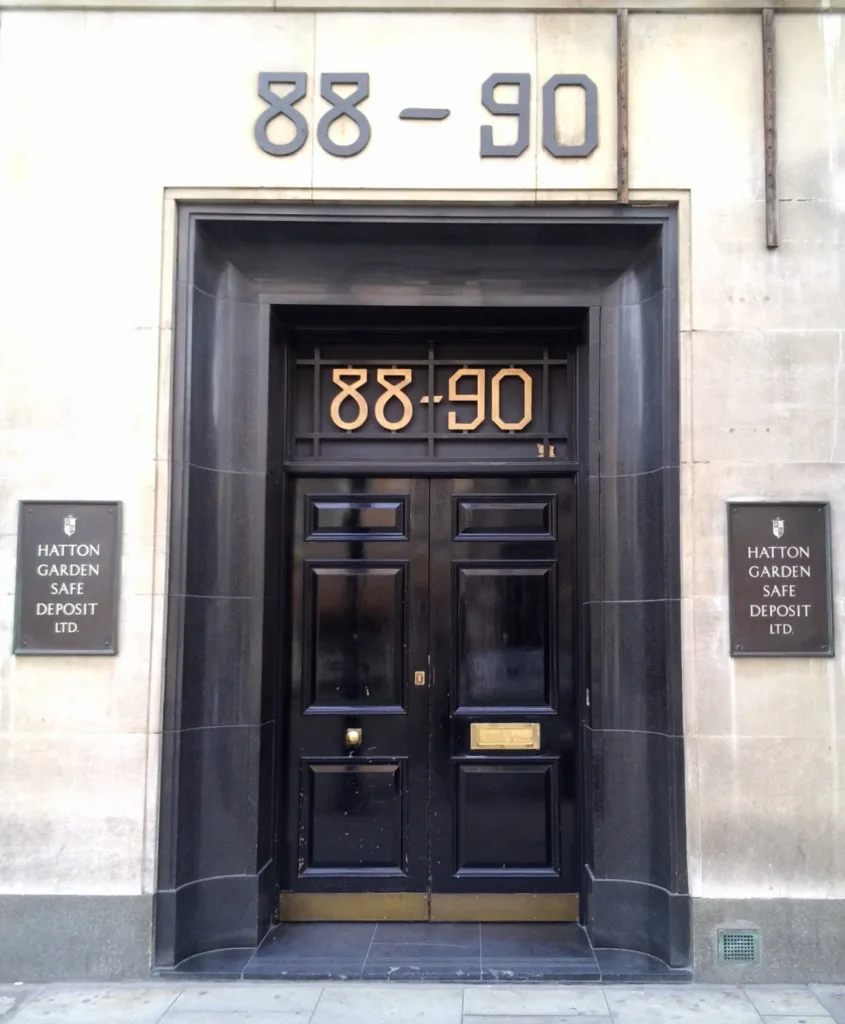
Over the Easter weekend of April 2015, the gang broke into the Hatton Garden Safe Deposit Company, located at 88-90 Hatton Garden in London’s historic jewelry quarter. The building’s elevator shaft provided access to the basement level. From there, they used a Hilti DD350 diamond-tipped industrial drill, a machine weighing over 50 kilograms, to bore through the 50-centimetre-thick reinforced concrete vault wall. The operation required multiple trips: they drilled on Thursday night, encountered a problem when a cabinet inside the vault blocked the hole, left, regrouped, returned on Saturday, moved the cabinet, squeezed through, and finally ransacked 73 of the vault’s safe deposit boxes.
The haul was estimated at up to £14 million in gold, silver, precious stones, jewelry, and cash. British courts later described it as the “largest burglary in English legal history”.
The ringleader was Brian Reader, 76 years old at the time and a man whose criminal career stretched across decades. Reader had connections to the 1983 Brink’s-Mat robbery, was present when Kenneth Noye fatally stabbed a police detective in 1985 (Reader was acquitted of any involvement), and journalist Paul Lashmar has linked him to the 1971 Baker Street robbery as well. Also in the gang were John “Kenny” Collins, 75, who acted as lookout, Daniel Jones, 60, Terry Perkins, 67, and several others.
Their downfall was almost comically old-school. CCTV cameras captured them repeatedly walking in and out of the building. Collins was tracked through his car. One member discussed the crime on a phone that was being tapped. Reader, Jones, Perkins, and Collins all received sentences ranging from six to seven years. The case was adapted into the 2017 film King of Thieves starring Michael Caine, and the 2018 film Hatton Garden: The Heist.
7. The Lufthansa Heist (1978)
The Lufthansa heist is arguably the most famous robbery in American history, largely thanks to Martin Scorsese’s 1990 masterpiece Goodfellas. But the real story was even more violent and chaotic than the film portrayed.
At around 3:00 a.m. on December 11, 1978, a black Ford Econoline van carrying six armed men pulled up to Building 261, the Lufthansa cargo terminal at John F. Kennedy International Airport in New York. The crew, connected to the Lucchese crime family, cut through a padlock, stormed the building in ski masks, and took eight Lufthansa employees hostage at gunpoint. They forced cargo manager Rudi Eirich to open the double-door vault, knowing from an inside source that opening the second door incorrectly would trigger an alarm to Port Authority Police. The robbers knew exactly what they were doing.
They loaded 72 fifteen-pound cartons of untraceable currency and a case of jewelry into the van. By 4:21 a.m. they were gone. The total take was $5 million in cash and $875,000 in jewelry, equivalent to about $28 million today. It was the largest cash robbery ever committed on American soil at the time.
The robbery was allegedly planned by James “Jimmy the Gent” Burke, a feared Lucchese associate. The tip had come from Louis Werner, an airport worker who owed $20,000 in gambling debts to a bookmaker connected to Burke’s circle. Werner and a co-worker named Peter Gruenwald provided the inside intelligence about Lufthansa’s cash shipments.
What followed was a bloodbath. Parnell “Stacks” Edwards, the man tasked with destroying the getaway van, instead parked it in front of a fire hydrant at his girlfriend’s apartment. Police found the van within days, along with Edwards’ fingerprints. Burke, furious and paranoid, ordered Edwards killed, seven days after the heist. That was only the beginning. Over the next several months, at least six people connected to the robbery were murdered on Burke’s orders. Martin Krugman, the bookmaker who had originally tipped Burke off, was killed after making anxious, public demands for his $500,000 cut. Louis Cafora, a money launderer, was murdered alongside his wife after he bought her a flashy pink Cadillac Fleetwood with his share, brazenly driving it near the airport where the FBI was still investigating. Joe Manri and Robert McMahon were found shot execution-style in a parked car.
The stolen money and jewelry were never recovered. Werner was the only person convicted for the robbery. Burke was never officially charged in connection with the Lufthansa heist, though he was convicted of other crimes thanks to testimony from Henry Hill, the mob informant whose story became the basis for Goodfellas.
8. The Baker Street Robbery (1971)
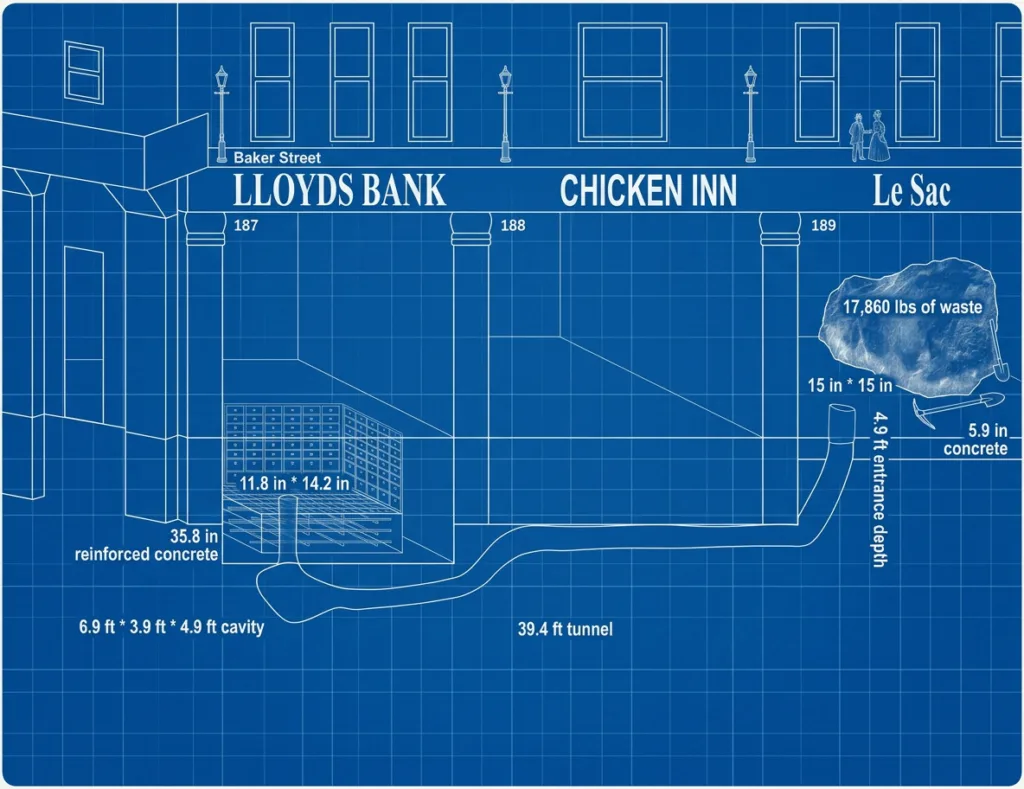
The Baker Street robbery of September 1971 was, fittingly enough, inspired by a Sherlock Holmes story. Anthony Gavin, a 38-year-old photographer and career criminal from North London, read “The Red-Headed League”, an 1891 story in which criminals tunnel into a bank vault from the cellar of a nearby shop, and decided the fiction could become reality.
In May 1971, the gang secured the lease on Le Sac, a leather goods shop at 189 Baker Street, just two doors down from a branch of Lloyds Bank at number 185. One of Gavin’s men, Reg Tucker, opened an account at the bank and rented a safe deposit box, using his visits to meticulously map the vault. He measured the room using the span of his arms and an umbrella, calculating distances from the regularly sized nine-inch floor tiles. He drew detailed plans of the room, noting the position of every cabinet and piece of furniture.
The digging began on a Friday evening during the August bank holiday of 1971 and continued on weekends through September 10. Gavin personally led the excavation, losing two stone in the process. The tunnel ran 40 feet from Le Sac’s basement, under the neighboring Chicken Inn restaurant, to a point directly beneath the bank’s vault. There, the gang created a cavity large enough to work in. The operation generated eight tonnes of waste, hauled back into Le Sac and piled toward the rear. The tunnel was later described in court as “a magnificent piece of engineering”.
On the weekend of September 10-12, they broke through the vault floor using explosives timed to coincide with passing traffic noise. They emptied 268 of the roughly 1,000 safe deposit boxes. Estimates of what they stole range from £1.25 million to £3 million (roughly £22 million to £54 million today) in gold, jewelry, cash, and personal valuables.
What nearly foiled them was pure bad luck. Robert Rowlands, an amateur radio enthusiast living in a flat on Wimpole Street, half a mile away, accidentally picked up the gang’s walkie-talkie communications around 11:00 p.m. on Saturday night. He heard voices discussing a break-in and called police. Scotland Yard sent detectives to listen to the recordings, but they still could not identify which bank was being targeted. They searched 750 banks in an eight-mile radius, even visiting the correct Lloyds branch at 3:30 p.m. on Sunday, but the vault was time-locked and could not be opened. The gang may have been hiding inside, keeping silent.
Police identified the gang within weeks, partly because Benjamin Wolfe, a 64-year-old accomplice, had signed the Le Sac lease in his own name. Gavin, Tucker, and a third man were each sentenced to twelve years. Wolfe received eight years. The case became known as “the walkie-talkie job” and inspired the 2008 film The Bank Job. Roughly 800 pages of files related to the break-in remain sealed at the National Archives until January 2071, fueling persistent rumors about what may have been inside those boxes.
9. The Big Maple Leaf Gold Coin Theft (2017)
The Big Maple Leaf is one of the most extraordinary coins ever minted. Produced by the Royal Canadian Mint in 2007, it weighs 100 kilograms (220 pounds), measures 50 centimetres in diameter, and is composed of 99.999 percent pure gold. Only five were ever made. One of them was loaned to the Bode Museum in Berlin by private collector Boris Fuchsmann and displayed in the museum’s world-renowned coin cabinet, alongside a collection of more than 500,000 coins spanning the ancient Greek and Roman periods.
In the early morning hours of March 27, 2017, thieves broke into the museum through a window accessible from elevated S-Bahn railway tracks that run adjacent to the building. They entered the coin exhibit, somehow bypassed internal security, and removed the massive coin from its display case. Using a wheelbarrow, they wheeled the 220-pound disc along the railway tracks and lowered it to street level, where a getaway vehicle waited.
The coin was valued at approximately $4 million at the time of the theft. At current gold prices, a single Big Maple Leaf would be worth around $12 million.
Berlin police soon traced the crime to the Remmo clan, the same crime family that would later carry out the Dresden Green Vault burglary. Two brothers, Ahmed and Wissam Remmo, and their cousin were identified as the primary suspects. A fourth person, Denis W., was a school friend of the Remmos who worked at the Bode Museum and was found guilty of providing inside information about the museum’s security protocols. Ahmed and Wissam were sentenced to four and a half years; Denis received three years and four months. The judge also ordered seizure of €3.4 million from the defendants.
The coin itself was never recovered. Investigators found highly pure gold dust, consistent with the Big Maple Leaf’s exceptional 99.999% purity, on seized clothing and inside a car belonging to the suspects. The conclusion was grim: the thieves had almost certainly melted down one of the rarest gold coins ever created, destroying a numismatic treasure to sell the raw gold by weight.
10. The Great Gold Robbery (1855)
Long before electronic alarms, motion sensors, or biometric locks, precious metals moved through the world protected by little more than heavy iron safes and the assumption that no one would dare tamper with them. The Great Gold Robbery of 1855 shattered that assumption and became one of the first major precious metals thefts of the industrial age.
On May 15, 1855, three iron-bound boxes containing 224 pounds (102 kilograms) of gold bars and coins were loaded onto a South Eastern Railway train traveling from London Bridge station to Folkestone, where the gold was to be shipped across the English Channel to Paris. Each box was secured with two Chubb locks, considered state-of-the-art at the time. The railway held one key; the bank that owned the gold held the other. No single party could open a box alone. It seemed foolproof.
Edward Agar, the mastermind, had been planning the robbery for more than a year. He recruited William Pierce, a ticket clerk at the South Eastern Railway, who had access to the rooms where the bullion safes were stored between journeys. Over a period of months, Pierce made wax impressions of both sets of keys, and Agar had duplicates cut. They also enlisted James Burgess, a guard on the bullion train, and William Tester, a railway employee based at the London Bridge office.
On the night of the robbery, Agar and Pierce boarded the train in the luggage car alongside the gold. During the journey, they unlocked the safes, removed the gold bars, replaced them with carefully weighed bags of lead shot so the boxes would still feel the same when handled, and locked the safes again. The switch was so clean that nobody noticed anything wrong until the shipment reached Paris and the French receivers opened the boxes to find lead instead of gold.
The stolen gold, worth about £12,000 at the time (roughly £1.4 million today), was melted down and partially sold before the scheme unraveled. Agar was eventually arrested on an unrelated forgery charge, and when his accomplice Pierce refused to support Agar’s mistress and child as they had agreed, Agar turned informant and confessed everything. Pierce, Burgess, and Tester were convicted. Agar was sentenced to transportation for life to Australia. The case was the sensation of its era, tried in front of packed courtrooms, and it remains one of the earliest documented large-scale precious metals heists in modern history.

What These Robberies Tell Us About Precious Metals Security
Looking at the biggest precious metals robberies in history, certain patterns emerge again and again. The most consistent one is insider access. Anthony Black opened the doors at Brink’s-Mat. Parvez Latif let Viccei into the Knightsbridge vault. Louis Werner provided the intelligence for the Lufthansa heist. Denis W. handed the Remmo clan the security blueprint for the Bode Museum. Physical security systems, no matter how layered or advanced, can be undermined if someone with legitimate access decides to cooperate with the wrong people.
Another recurring theme is the near impossibility of recovering stolen precious metals. Gold can be melted, recast into bars or jewelry, and reintroduced into the market with no forensic trace of its origin. The Brink’s-Mat gold was laundered through smelting operations and legitimate-looking businesses. The Big Maple Leaf, one of the most unique coins ever produced, was almost certainly melted into anonymous bullion within days of being stolen. Silver, diamonds, and other precious stones face similar fates. Once removed from their settings or their packaging, they become essentially untraceable. This fungibility is one of the core reasons gold and silver are valued as stores of wealth, but it also makes them irresistible targets for organized crime.
