


If the past two decades have taught investors anything, it’s that the unimaginable can become reality seemingly overnight. From the 2008 financial crisis that nearly collapsed the global banking system to the COVID-19 pandemic that shut down economies worldwide, these rare and devastating events share a common characteristic: almost nobody saw them coming. In the world of finance and risk management, these catastrophic surprises have a name that has become increasingly familiar to investors everywhere: black swan events.
Understanding what black swan events are, and more importantly, how to position your portfolio to weather them, has become essential knowledge for anyone serious about protecting their wealth. Throughout history, gold has demonstrated a remarkable ability to preserve and even increase value during these moments of maximum uncertainty. With gold trading at $4,635 per ounce as of January 2026 and central banks accumulating the metal at record pace, understanding the relationship between black swans and gold has never been more relevant.
What Exactly Is a Black Swan Event?
The term “black swan” was popularized by former Wall Street trader and risk analyst Nassim Nicholas Taleb in his 2007 book “The Black Swan.” The name comes from an old Western assumption that all swans were white, a belief held as absolute truth until Dutch explorers discovered black swans in Australia in the 17th century. What was thought impossible turned out to simply be rare and unexpected.
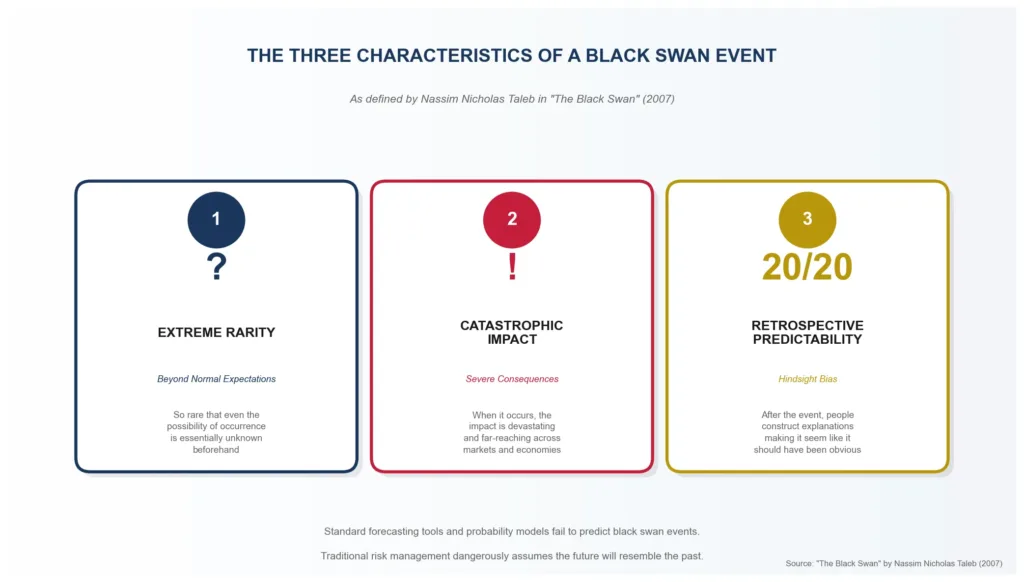
Taleb defines a black swan event through three key characteristics. First, it must be so rare that even the possibility of its occurrence is essentially unknown beforehand. Second, when it does happen, its impact is catastrophic and far-reaching. Third, and perhaps most psychologically interesting, after the event occurs, people construct explanations that make it seem as if it should have been predictable all along. This hindsight rationalization is what makes black swans so dangerous for investors who believe they can model and predict all risks.
The critical insight from Taleb’s work is that standard probability models and forecasting tools fail spectacularly when it comes to these events. Traditional risk management assumes that the future will roughly resemble the past, that extreme events are so rare they can be safely ignored, and that historical data provides reliable guidance for future outcomes. Black swan events expose these assumptions as dangerously flawed.
Historical Black Swan Events That Shook Global Markets
Looking back at recent history reveals several events that meet Taleb’s criteria and fundamentally changed financial markets. Each offers valuable lessons about the nature of systemic risk and the limitations of conventional portfolio construction.
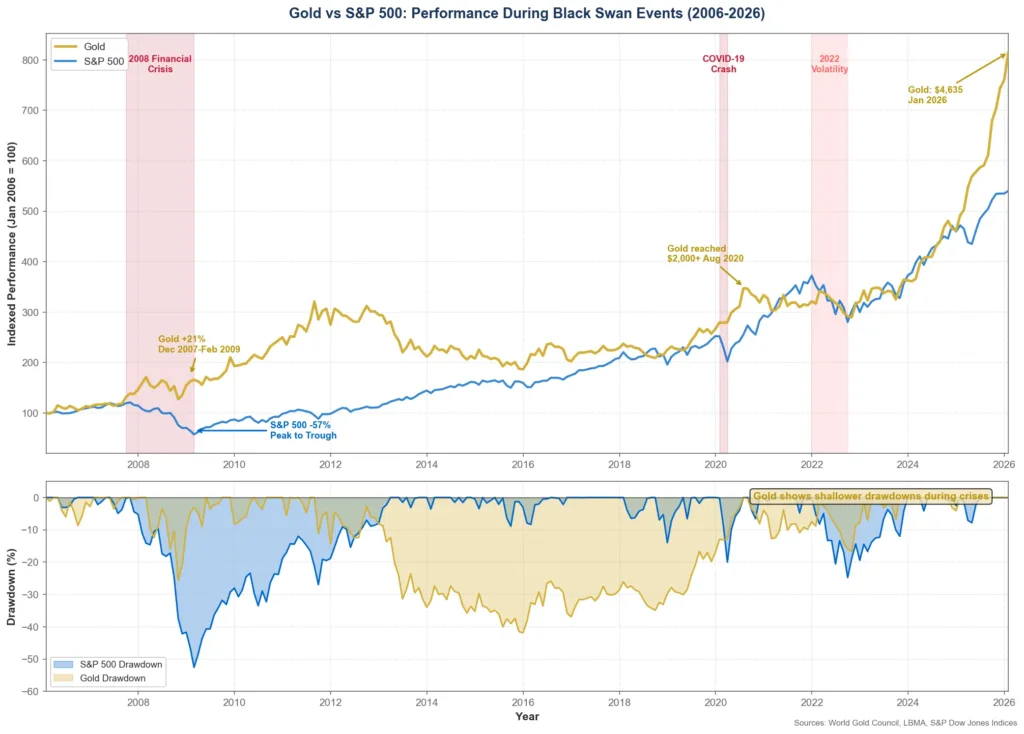
The 2008 global financial crisis stands as perhaps the most significant black swan of the modern era. The collapse of the U.S. housing market triggered a cascade of failures across global financial institutions, revealing hidden interconnections that regulators and risk managers had completely overlooked. Lehman Brothers, a 158-year-old institution, filed for bankruptcy on September 15, 2008, sending shockwaves through every major economy. The S&P 500 lost more than 50% of its value from peak to trough, and countless investors saw their retirement savings devastated.
The COVID-19 pandemic in 2020 represents another textbook black swan. While epidemiologists had long warned about pandemic risk, the specific timing, severity, and global response were impossible to predict. Markets experienced their fastest crash in history during March 2020, with the Dow Jones Industrial Average falling nearly 3,000 points in a single day on March 16. Entire industries were shut down overnight, supply chains collapsed, and economic assumptions that had held for decades were suddenly irrelevant.
Other notable black swan events include the September 11, 2001 terrorist attacks, which closed U.S. markets for four trading days and fundamentally altered geopolitical dynamics. The 1998 collapse of Long-Term Capital Management, a hedge fund run by Nobel Prize-winning economists, demonstrated that even the most sophisticated models could catastrophically fail. Zimbabwe’s hyperinflation in 2008, which reached an almost incomprehensible 79.6 billion percent at its peak, showed how quickly monetary systems can completely break down.
How Gold Has Historically Performed During Black Swan Events
When examining gold’s behavior during past crises, a clear pattern emerges that explains why the metal has earned its reputation as a safe haven asset. According to the World Gold Council’s research on gold as a strategic asset, gold’s negative correlation to equities and other risk assets actually increases when those assets sell off most severely. In other words, gold tends to perform best precisely when investors need protection most.
During the 2008 financial crisis, while the S&P 500 was losing more than half its value, gold rose approximately 21% from December 2007 to February 2009. This wasn’t a coincidence. As credit markets froze, banks teetered on the brink of failure, and investors fled risk assets, gold served as one of the few liquid stores of value that didn’t require counterparty trust. You don’t need a functioning banking system to own physical gold, and that independence becomes extraordinarily valuable during systemic crises.
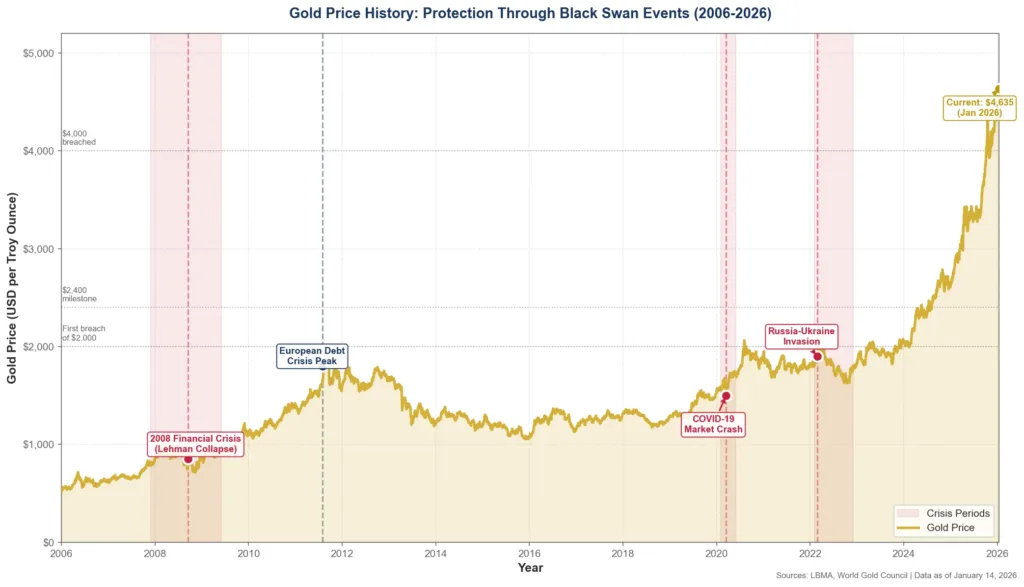
The pattern repeated during the COVID-19 market panic. While global equities crashed in March 2020, gold initially declined briefly alongside other assets during the liquidity scramble, but quickly recovered and surged to new highs. By August 2020, gold had reached record prices above $2,000 per ounce, while many other asset classes remained well below their pre-pandemic levels. The World Gold Council’s data confirms that gold’s performance remained positive during the sharp equity market pullbacks of both 2020 and 2022.
Russia’s invasion of Ukraine in February 2022 provides another recent example. As geopolitical uncertainty spiked and European energy markets were thrown into chaos, gold prices surged toward $2,050 per ounce within weeks of the invasion. Investors sought safety in an asset that transcends borders and political systems, one that would retain value regardless of how the conflict evolved.
Why Gold Works as a Black Swan Hedge
Understanding why gold protects portfolios during crises requires examining several fundamental characteristics that distinguish it from other asset classes. These aren’t merely theoretical advantages; they have proven themselves repeatedly during actual market dislocations.
First, gold carries no counterparty risk. When you own physical gold, its value doesn’t depend on any institution’s promise to pay. During the 2008 crisis, this mattered enormously as banks failed and credit markets froze. Bonds, even supposedly safe ones, depend on the issuer’s ability to pay. Stocks depend on corporate solvency. Even cash in a bank account depends on that bank remaining operational. Physical gold simply exists as a store of value, independent of anyone else’s financial health.
Second, gold maintains value across time and circumstance because of its unique physical properties. It doesn’t corrode, can be easily verified for authenticity, and is scarce enough to retain value while available enough to serve as a medium of exchange. These characteristics have made gold valuable across virtually every human civilization for thousands of years. When uncertainty about paper currencies or financial systems increases, investors naturally gravitate toward an asset with this track record.
Third, gold tends to benefit from the very policies that governments implement during crises. Central banks typically respond to financial panics by slashing interest rates and creating new money through quantitative easing. Both actions tend to support gold prices: lower rates reduce the opportunity cost of holding a non-yielding asset, while money creation raises concerns about currency debasement. The unprecedented monetary response to COVID-19, which saw central banks inject trillions of dollars into financial systems, helped propel gold to new highs.
The Central Bank Perspective on Gold as Protection
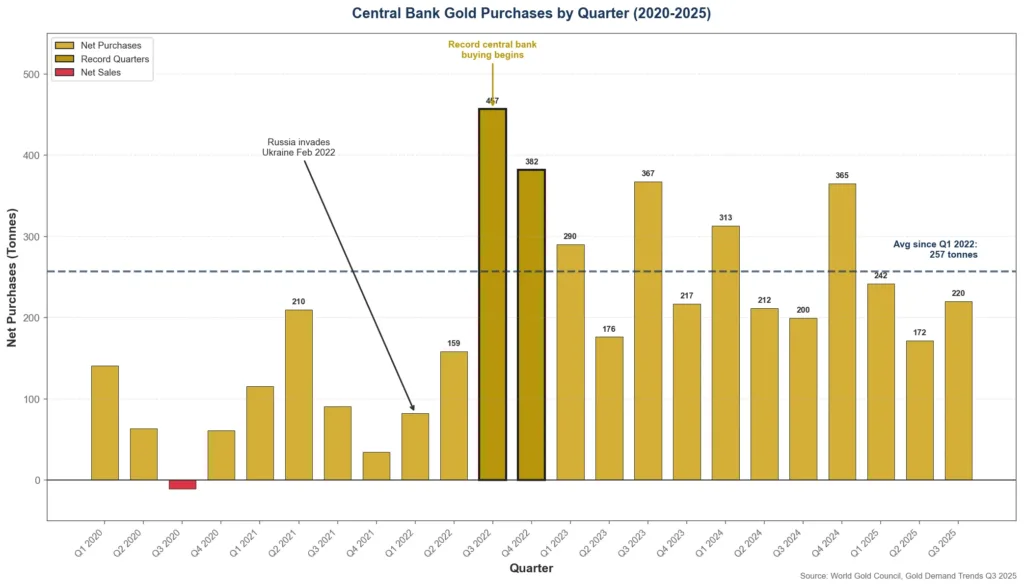
Individual investors aren’t the only ones recognizing gold’s value as crisis protection. Central banks, the institutions responsible for managing national monetary reserves, have dramatically increased their gold holdings in recent years. This shift represents a fundamental change in how the world’s monetary authorities view portfolio risk.
According to World Gold Council data on central bank gold reserves, central banks have been net buyers of gold for fourteen consecutive years, with purchases accelerating dramatically since 2022. In Q3 2025, Kazakhstan added 18.21 tonnes, Brazil added 15.49 tonnes, Turkey added 6.52 tonnes, and China added 4.98 tonnes to their reserves. The United States holds 8,133 tonnes of gold, representing 80.36% of its total foreign reserves, while China has accumulated 2,303 tonnes.
Why are these institutions, staffed by highly trained economists and risk managers, accumulating gold at such pace? The answer relates directly to black swan protection. Central banks worry about the same systemic risks that threaten individual portfolios: currency crises, geopolitical conflicts, financial system failures. Gold provides an asset that will retain value regardless of what happens to any particular currency or financial system. It represents the ultimate diversification away from paper-based financial assets.
Building Black Swan Protection Into Your Portfolio
Incorporating gold into an investment portfolio as black swan protection requires thoughtful consideration of allocation size, form of ownership, and integration with other holdings. The goal isn’t to predict when the next crisis will occur, because by definition black swans are unpredictable. Instead, the goal is to hold a meaningful allocation that will provide value whenever crisis does strike.
Financial advisors and research institutions have studied optimal gold allocations extensively. The World Gold Council’s analysis suggests that a 5-15% allocation to gold improves portfolio efficiency across various economic scenarios. This allocation is large enough to meaningfully impact portfolio performance during crises, but not so large that it creates excessive drag during normal periods when risk assets typically outperform.
The form of gold ownership matters as well. Physical gold in the form of coins and bars offers the purest form of crisis protection because it doesn’t depend on any financial intermediary. Bullion Trading LLC provides access to a wide range of physical gold products, from American Gold Eagles to gold bars of various sizes, allowing investors to build positions suited to their specific needs. For larger allocations, gold-backed exchange-traded funds offer convenience and lower storage costs, though they do introduce counterparty risk that physical ownership avoids.
Integration with other portfolio holdings is also important. Gold tends to have low or negative correlation with stocks and bonds over time, meaning it often moves independently of other assets. This diversification benefit is most valuable during crises when correlations between traditional assets tend to increase. Having gold in a portfolio can reduce overall volatility and improve risk-adjusted returns, even during periods when gold itself isn’t producing exceptional gains.
Current Market Conditions and Gold’s Role Today
As of January 2026, gold trades at approximately $4,635 per ounce, reflecting years of appreciation driven by multiple factors that increase black swan risk. Geopolitical tensions remain elevated across multiple regions. Government debt levels in major economies have reached unprecedented heights. The global monetary system continues to grapple with the consequences of pandemic-era stimulus. Any of these factors could potentially trigger the next black swan event.
The current price represents both a challenge and an opportunity. On one hand, investors who waited have missed substantial gains. On the other hand, the factors driving gold’s appreciation, particularly central bank buying and inflation concerns, show no signs of abating. For investors without meaningful gold exposure, the question isn’t whether gold is at the “right” price to buy, but whether their portfolios have adequate protection against catastrophic events that could occur at any time.
Looking at gold through the lens of insurance provides useful perspective. No one buys fire insurance hoping their house burns down, and no one times their insurance purchase based on whether premiums seem cheap or expensive. You buy insurance to protect against devastating loss, and you maintain that insurance regardless of whether a fire seems likely in any particular year. Gold serves a similar function in portfolios: it provides protection against financial devastation that, while rare, can destroy wealth accumulated over lifetimes.
Common Objections to Gold as Crisis Protection
Skeptics of gold as a portfolio holding raise several objections worth addressing. The most common is that gold produces no income, unlike stocks that pay dividends or bonds that pay interest. This objection is valid during normal market conditions, when yield-producing assets typically outperform. However, during crises, income becomes secondary to capital preservation. A stock’s dividend means little if the stock itself loses 50% of its value, and bond payments become worthless if the issuer defaults.
Another objection concerns gold’s supposed volatility. While gold prices do fluctuate, this volatility tends to be positive during exactly the periods when portfolio protection matters most. Gold’s volatility during normal times represents the cost of maintaining crisis insurance. And compared to the volatility many stocks experience during crashes, gold’s movements appear relatively modest.
Some argue that government bonds, particularly U.S. Treasuries, provide better crisis protection because they rally when stocks fall and pay income during normal times. This argument has merit in many scenarios, but black swan events can include crises of confidence in government debt itself. Gold provides protection against scenarios that would impair even Treasury bonds, including sovereign debt crises, currency collapses, or loss of confidence in monetary authorities.
Practical Steps for Adding Gold to Your Portfolio
For investors convinced of gold’s value as black swan protection, implementation involves several practical decisions. Starting with physical gold makes sense for investors who want the purest form of protection. American Gold Eagles, Canadian Gold Maple Leafs, and gold bars from recognized refiners all provide reliable access to physical gold. These products can be purchased through trusted dealers like Bullion Trading LLC and stored either personally or in allocated storage facilities.
Building a position gradually through dollar-cost averaging can help manage timing risk. Rather than trying to identify the perfect entry point, which is essentially impossible for any asset, investing a fixed amount regularly smooths out price volatility over time. This approach is particularly appropriate for gold, given its role as long-term portfolio insurance rather than a trading vehicle.
Security and storage require attention. Physical gold is valuable precisely because it’s tangible and independent of financial systems, but this also means it can be lost or stolen. Home safes, bank safe deposit boxes, and allocated vault storage each offer different tradeoffs between accessibility, cost, and security. Investors should choose storage solutions appropriate for the size of their holdings and their specific circumstances.
Conclusion: Preparing for the Unpredictable
Black swan events are, by their very nature, impossible to predict. No one knew in 2007 that the housing market would collapse and nearly destroy the global financial system. No one knew in late 2019 that a novel coronavirus would shut down the world economy within months. The next black swan, whatever form it takes, will similarly arrive without warning and with consequences that seem obvious only in retrospect.
This unpredictability is precisely why preparation matters. Gold has demonstrated across centuries and civilizations its ability to store value during times of crisis. Modern data confirms what historical experience suggests: gold tends to perform best when portfolios need protection most. Central banks, among the most sophisticated institutional investors in the world, are accumulating gold at record pace precisely because they understand this dynamic.
For individual investors, the question isn’t whether another black swan will occur, because history guarantees that it will. The question is whether portfolios are positioned to survive and potentially benefit when it does. A thoughtful allocation to gold, maintained consistently as portfolio insurance, provides a answer to this question that has proven its value across financial crises stretching back through human history.
Whether you’re beginning to build gold exposure or looking to expand existing holdings, Bullion Trading LLC offers comprehensive access to physical gold products suited to various investment needs and sizes. From fractional gold coins for those starting their precious metals journey to larger bars for substantial positions, professional guidance and competitive pricing help investors implement their protection strategies effectively.
For more information about building portfolio protection through precious metals, explore our resources on first-time precious metals buying and optimal gold and silver allocation to develop a strategy suited to your specific circumstances and goals.
