

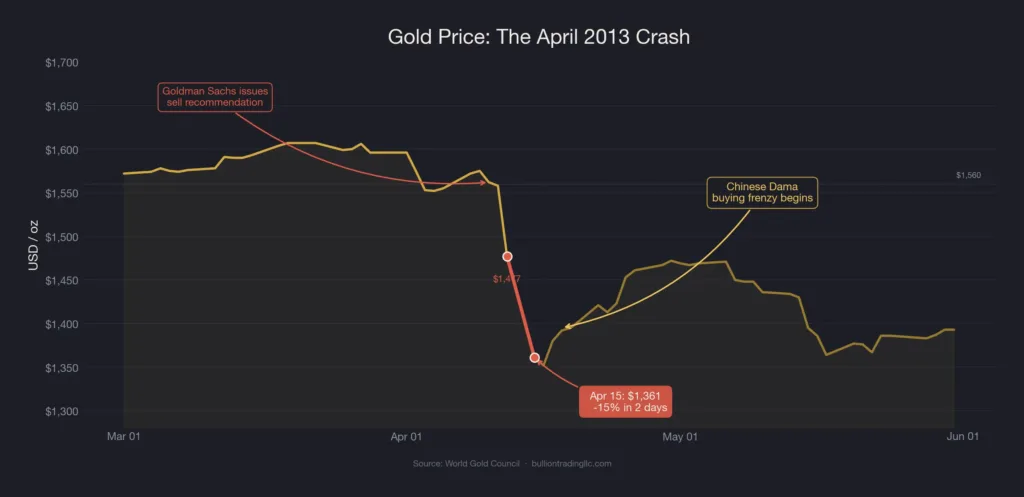
In April 2013, Wall Street declared that gold was finished. Goldman Sachs had just issued a sell recommendation, predicting gold would fall to $1,390 per ounce. Hedge funds piled into short positions. Within 48 hours, gold crashed from roughly $1,560 to $1,321 per ounce, its worst two-day drop in three decades. Financial media ran victory laps. The gold bull market, they said, was dead.
Then the Chinese aunties showed up.
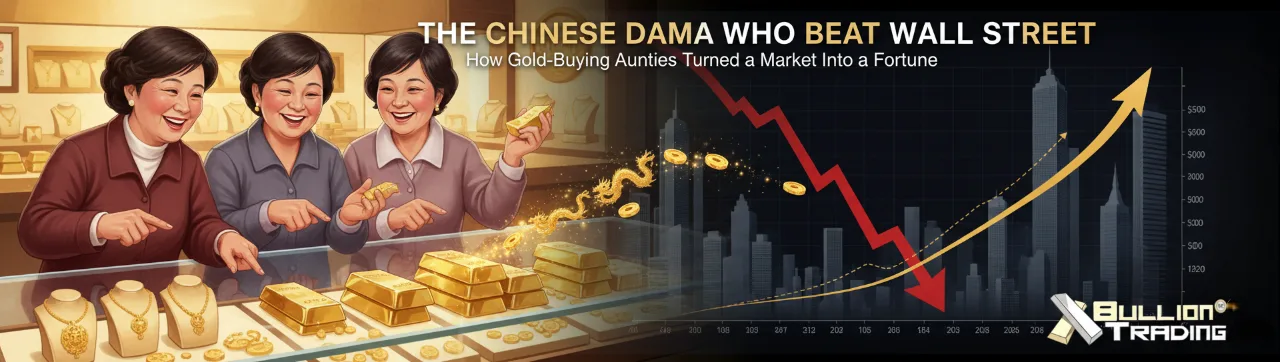
Across China, tens of thousands of middle-aged and older women flooded jewelry stores and gold shops. They lined up for hours, cleared display cases, and bought gold bars by the kilogram. The Chinese press dubbed them the “dama” (大妈, meaning “big mama” or “auntie”), and the story became a cultural phenomenon framed as a David-and-Goliath showdown: regular Chinese women versus the titans of Wall Street. Thirteen years later, with gold trading around $5,397 per ounce as of early March 2026 according to World Gold Council live pricing, those aunties didn’t just win. They crushed it.
The April 2013 Crash: When Wall Street Bet Against Gold
To understand what the Chinese dama did, you need to understand what happened to gold in early 2013. After a 12-year bull run that took prices from $271 per ounce in 2001 to a peak of $1,921 in September 2011, the metal had been drifting sideways for about 18 months. By early April 2013, gold sat around $1,560 per ounce.
On April 10, Goldman Sachs cut its gold price forecast and recommended clients close their long positions. Two days later, on April 12, gold dropped $84 in a single session. On April 15, the selloff accelerated with another plunge of over $130. In just two trading days, gold lost roughly 15% of its value. It was the sharpest decline since the early 1980s.
For institutional investors, the message seemed clear: get out. Hedge funds increased their short bets. Western gold ETFs saw massive outflows. COMEX positioning turned overwhelmingly bearish. The financial establishment had spoken, and their verdict was that gold’s decade-long run was over.
Enter the Dama: China’s Gold-Buying Aunties
Half a world away, a very different reaction was unfolding. For Chinese retail buyers, particularly the generation of women who had lived through economic upheaval, a 15% discount on gold was not a reason to panic. It was a reason to shop.
Within days of the crash, scenes of near-pandemonium erupted at gold retailers across mainland China, Hong Kong, and beyond. Shoppers crowded into stores from Beijing to Shenzhen, buying everything from 24-karat jewelry to small gold bars and coins. Many of these buyers were women in their 40s, 50s, and 60s, ordinary people without Bloomberg terminals or hedge fund connections, just a deep cultural instinct that gold holds its value.
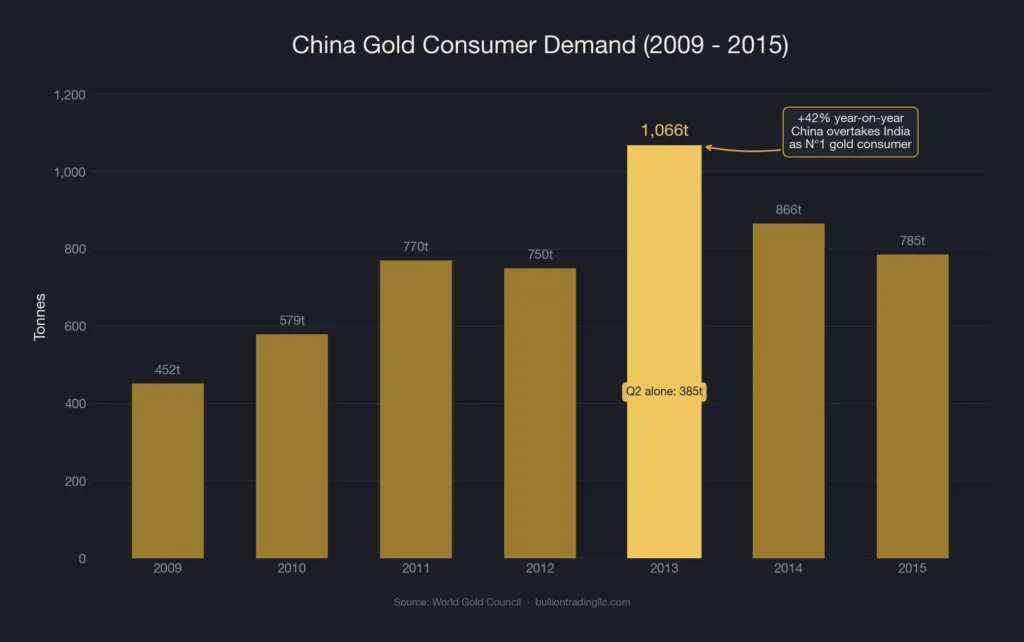
Chinese media reported that in the ten days following the crash, Chinese consumers bought an estimated 300 tonnes of physical gold. While the exact figure has been debated by analysts, the World Gold Council’s Gold Demand Trends Q2 2013 report confirmed that Chinese consumer demand surged 87% year-on-year in the second quarter, reaching approximately 385 tonnes in just three months. That is a staggering amount of physical metal changing hands at the retail level.
The full-year 2013 data was equally striking. The China Gold Association reported total Chinese gold consumption of 1,176 tonnes for the year, up 41% from 2012. China officially overtook India as the world’s largest gold consumer for the first time. The World Gold Council’s own methodology put Chinese consumer demand at around 1,066 tonnes, still a record at the time by either measure.
Why “Dama” Became a Global Phenomenon
The Chinese internet had a field day. The narrative of everyday aunties going head-to-head with Goldman Sachs was irresistible, and the term “dama” quickly became shorthand for grassroots Chinese investors who follow their own instincts rather than Wall Street’s advice. The word even gained international recognition, referenced in English-language business media as a symbol of China’s growing consumer influence on global commodity markets.
The cultural context matters here. In China, gold has deep significance that goes far beyond portfolio theory. Gold is traditionally given at weddings, during Lunar New Year, and at major family milestones. Many Chinese households, especially those old enough to remember the turbulence of the Cultural Revolution and the economic reforms of the 1980s, view physical gold as the ultimate store of value, more trustworthy than stocks, property, or even the local currency.
For the dama, buying gold at $1,300 per ounce was not a speculative trade. It was common sense passed down through generations. When something valuable gets cheaper, you buy more of it. They were not trying to time the market or outsmart algorithms. They were simply following a principle that had served Chinese families for centuries.
The Short-Term Pain: Why Patience Mattered
It is important to be honest about what happened next, because the dama story is not one of instant gratification. After the April 2013 buying spree, gold continued to fall. By late June 2013, it had slipped to around $1,180 per ounce. Through 2014 and most of 2015, gold traded in a grinding range between $1,100 and $1,300. In December 2015, gold hit a multi-year bottom near $1,050 per ounce.
That means many of the Chinese dama who bought at $1,300 to $1,400 per ounce were sitting on paper losses for the better part of two to three years. Western financial media was quick to declare them foolish. Articles appeared asking whether the Chinese aunties had “lost their bet against Wall Street”.
But here is the thing: the dama did not sell. Unlike institutional traders with quarterly performance targets and margin calls to worry about, the dama were buying physical gold for the long haul. They stored bars in safe deposit boxes and tucked jewelry away for their children’s weddings. They were not checking gold futures on their phones every morning. They simply held on.
The Long-Term Payoff: Over 300% Returns
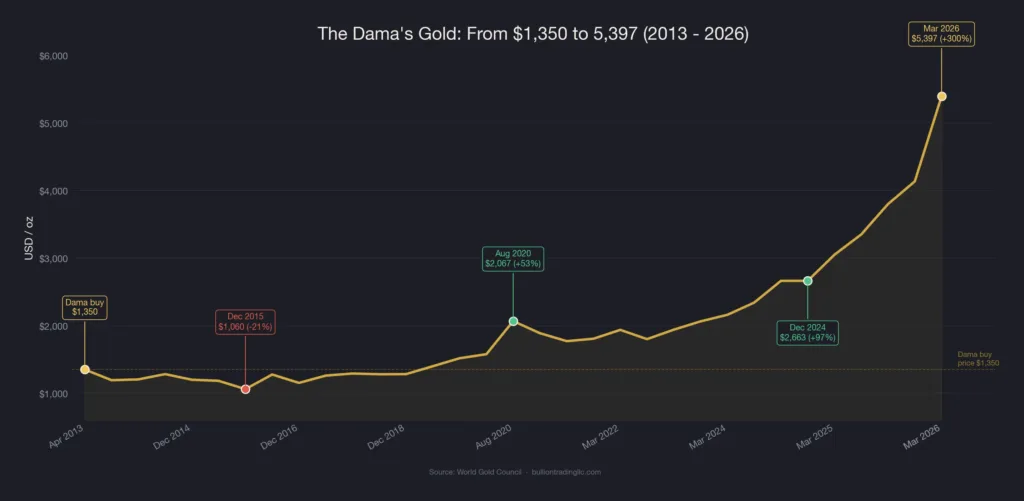
The numbers tell a remarkable story. If the Chinese dama bought gold at an average price of around $1,350 per ounce in April 2013, here is how that investment has grown based on World Gold Council pricing data:
By August 2020, gold crossed $2,000 per ounce for the first time, giving the dama a roughly 48% return. By the end of 2024, the annual average gold price reached $2,386 per ounce according to the World Gold Council’s Gold Demand Trends Full Year 2024 report, representing about a 77% gain. Then 2025 happened. Gold set 53 new all-time highs during the year, with the annual average soaring to $3,431 per ounce and Q4 averaging $4,135 per ounce. That pushed the dama’s return past 150%.
As of early March 2026, gold is trading around $5,397 per ounce. A dama who bought one kilogram of gold in April 2013 at roughly $1,350 per ounce paid about $43,400. That kilogram is now worth approximately $173,500. That is a return of over 300%, or roughly 11% annualized over 13 years, all without leverage, without derivatives, without a single management fee.
For comparison, Goldman Sachs’ April 2013 call to sell gold and their $1,390 price target looked prescient for a couple of years. But anyone who followed that advice and stayed out of gold missed one of the most powerful commodity rallies in modern history.
Why the Dama Strategy Worked: Lessons for Today’s Investors
The dama’s success was not luck. Several factors explain why their approach worked so well, and these same factors remain relevant for precious metals investors today.
The first factor is that they bought physical metal. Unlike ETF shares or futures contracts, physical gold has no counterparty risk, no expiration date, and no management fee eroding your returns over time. The dama bought bars, coins, and jewelry they could hold in their hands, which also meant they were far less likely to panic-sell during temporary dips.
The second factor is their time horizon. The dama were not buying gold for a quarterly earnings report. Many were buying for weddings, retirement, or to pass wealth to the next generation. That multigenerational thinking gave them the patience to ride out the 2013-2015 downturn, which turned out to be nothing more than a pause before the next major leg higher.
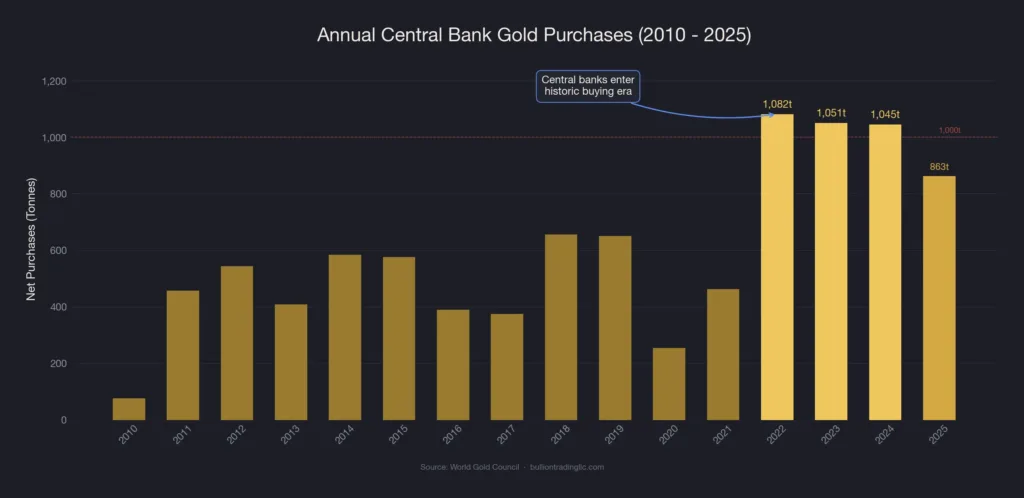
The third factor is the global macroeconomic backdrop. Since 2013, the forces that support gold have only intensified. Central banks around the world have been buying gold at a historic pace. According to the World Gold Council’s 2025 annual report, central bank gold purchases totaled 863 tonnes in 2025, following over 1,000 tonnes in both 2023 and 2024. Total gold demand exceeded 5,000 tonnes for the first time in recorded history, valued at an unprecedented $555 billion.
China’s Gold Appetite Has Only Grown
The dama’s buying spree in 2013 was not an isolated incident. It was a preview of a much larger structural shift in China’s relationship with gold. The People’s Bank of China (PBOC) has been steadily increasing the nation’s official gold reserves, which stood at 2,306 tonnes as of Q4 2025, representing 8.64% of China’s total foreign exchange reserves. That is still well below the 60-70% gold allocation held by Western central banks like the United States and Germany, suggesting significant room for further accumulation.
At the consumer level, Chinese demand for gold remains among the strongest in the world. The 2025 Gold Demand Trends report showed global bar and coin investment hit a 12-year high of 1,374 tonnes, with Chinese investors representing a significant share of that demand. Gold ETFs globally attracted 801 tonnes of inflows in 2025, the second-strongest year on record, and Chinese-listed gold ETFs were among the fastest growing.
The World Gold Council’s 2025 Central Bank Survey found that 95% of responding central banks expected global gold reserves to increase over the following 12 months, the highest level of optimism in the survey’s eight-year history. A record 43% of central banks planned to increase their own gold holdings, up from 29% in 2024.
What the Dama Can Teach Every Gold Investor
The Chinese dama story is ultimately about the power of buying quality assets during periods of fear and holding them with conviction. It is about ignoring the noise of short-term price movements and focusing on the fundamental reasons you own something in the first place.
In 2013, Wall Street had models, algorithms, and decades of financial theory telling them gold should be sold. The dama had something simpler: a cultural memory that gold protects wealth through uncertain times, and the patience to wait for that thesis to play out.
As gold trades above $5,000 per ounce in early 2026, with geopolitical tensions rising, central banks buying at near-record levels, and global gold demand at all-time highs, the dama’s instinct looks more prescient than ever. They did not just buy gold. They bought a timeless principle: that when everyone else is selling in panic, it might be the best time to buy.
