

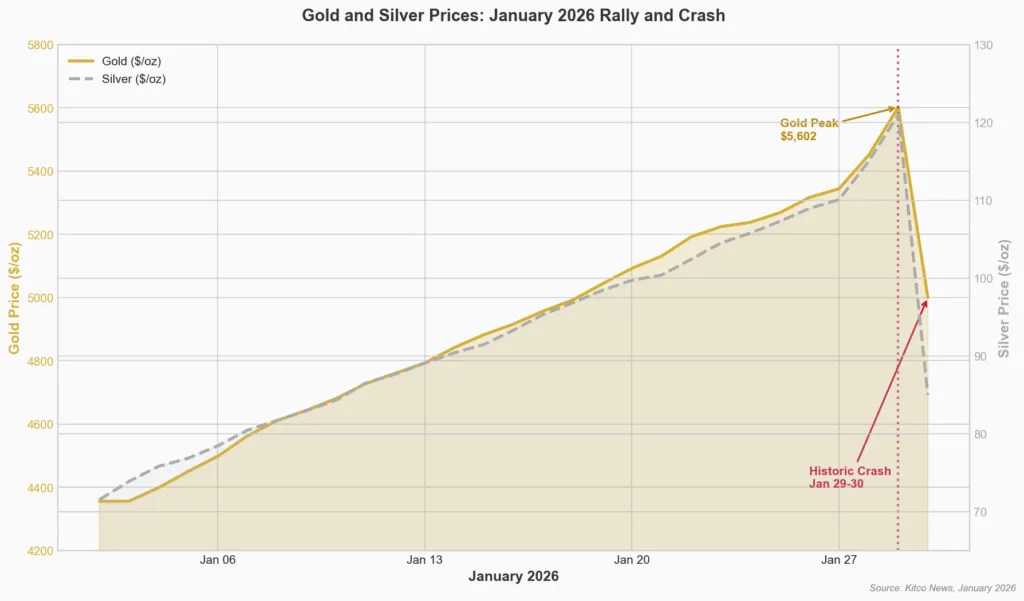
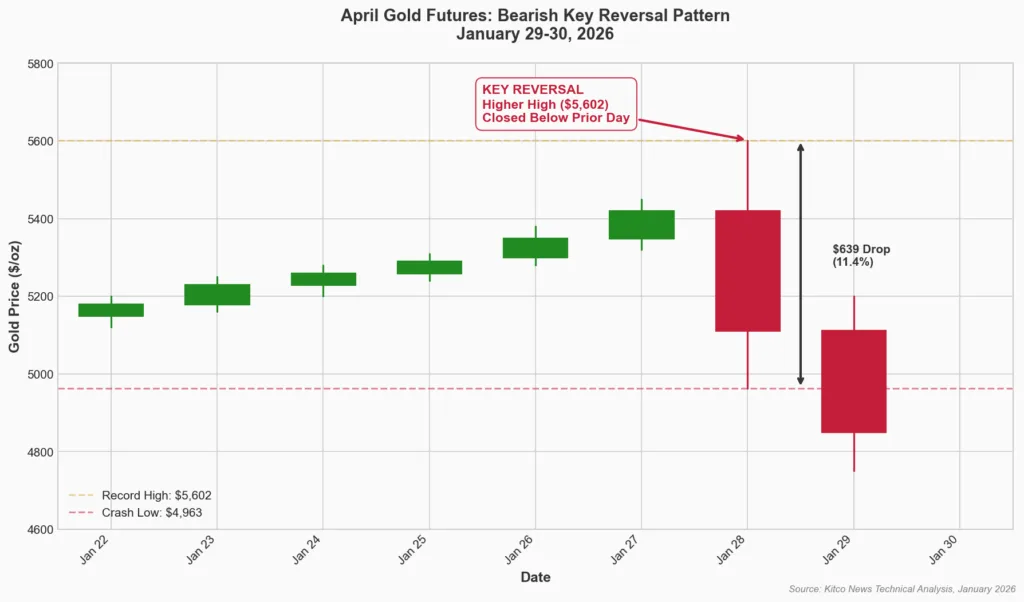
The precious metals market experienced one of its most turbulent weeks in history at the end of January 2026. Gold prices plunged $380, nearly 7%, in just 28 minutes on January 29, while silver collapsed an astonishing 11% in the same timeframe. By January 30, gold had fallen more than 10% and silver over 30% from their recent record highs.
The dramatic reversal came just days after both metals reached all-time peaks. Gold touched $5,602 per ounce on Thursday, representing a stunning 29.5% gain for January alone. Silver, meanwhile, surged to an intraday record above $121 per ounce, marking gains of 68.5% in the first month of 2026. Such momentum, concentrated in such a short period, was destined to hit a wall.
The Catalyst: Trump’s Fed Chair Nomination Shifts Market Expectations
While the precious metals market had become technically overextended, the immediate trigger for the selloff was the nomination of Kevin Warsh as the next Federal Reserve Chair. President Trump announced the selection on social media on the morning of January 30, sending shockwaves through financial markets.
Warsh, who previously served as a Fed governor in 2006, is widely viewed as an inflation hawk with a history of warning about inflation risks and advocating for the Federal Reserve to reduce its balance sheet. Markets reacted swiftly to the news. U.S. Treasury yields pushed higher, the dollar index strengthened, and stocks dropped sharply alongside the precious metals rout.
“He’s a hawk,” noted CNBC commentator Joe Kernen, describing Warsh’s monetary policy stance. “That’s good for the stock market longer-term, but not right now.”
The market’s reaction reflected speculation that Warsh may be less inclined to cut interest rates than other potential Fed chair candidates. However, analysts note that Warsh has more recently echoed Trump’s criticism of the Fed for being too slow to ease monetary policy, adding complexity to the outlook. Thu Lan Nguyen, Head of Commodity and FX Research at Commerzbank, pointed out that Trump “has made it sufficiently clear that he wants to see significantly lower interest rates” and “is unlikely to abandon this position any time soon.”
Technical Factors Amplified the Decline
Beyond the Fed chair news, the selloff was exacerbated by technical factors that had been building throughout January’s explosive rally. Gold and silver had become severely overextended, with positioning, leverage, and options activity all reaching levels typical of short-term peaks.
Neil Welsh, Head of Metals at Britannia Global Markets, explained the technical setup. “For the precious metals, the pullback is probably not unexpected given the speed and magnitude of January’s rally,” he said. “Gold and silver had become technically overextended, with gains of nearly 20% and over 40% respectively.”
Ole Hansen, Head of Commodity Strategy at Saxo Bank, described how the rapid gains had fundamentally altered market conditions. “Market makers have grown reluctant to take and hold risk, resulting in thinner liquidity and wider bid-offer spreads,” he noted. “The move today in isolation is pretty crazy, but if we zoom out just one week it’s unfortunately perfectly normal for a gold market that has gone from being the adult in the room to behaving like an angry teenager, just like silver.”
The 28-Minute Crash: Algos and Thin Liquidity
The sheer speed of Thursday’s decline left even veteran traders stunned. Kevin Grady, president of Phoenix Futures and Options, has traded gold and silver on the CME for over 30 years. Even he struggled to make sense of what had happened.
“It seems to me that maybe there were some big stops placed below the market,” Grady told Kitco News. “They went for those stops, and got the stops, which just exacerbated that move. But it’s insane. Real traders are just looking at this like, ‘How are we supposed to trade this?'”
Grady identified algorithmic trading as a major factor in the violent price swings. The metals’ parabolic rise had attracted a flood of algorithmic trading systems into the market at the same time that many traditional traders had stepped back. “So any type of business that goes through, it’s just like going through a washing machine,” he said. “It’s incredible. You can’t trade.”
The technical chaos was extreme. “I was looking at the DOM [depth of market] trader when this whole thing was going on,” Grady recalled. “There’s no way you can humanly put an order in on that system. You couldn’t do it. If you don’t have an algo or something trading for you, the only thing you can do is hit ‘sell at market’ and pray.”
He described watching traders get filled $150 below their stop prices. “You’re not getting filled around your price. I’m telling you, I was looking at the screen and I had to stop. I thought I was going to get vertigo. It was insane; you couldn’t find the market. I’ve never seen anything like that.”
Understanding January’s Unprecedented Rally
To understand the magnitude of the correction, it helps to appreciate just how far and fast gold and silver had risen. The rally was driven by a confluence of powerful factors that had converged in early 2026.
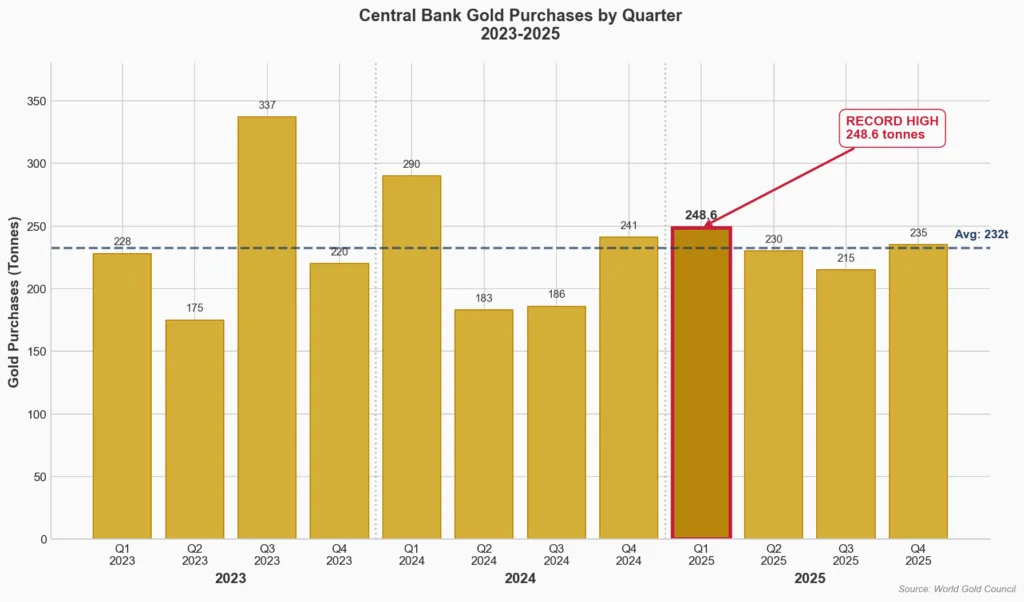
Central bank buying continued at a robust pace, with institutions around the world adding to their gold reserves. According to World Gold Council data, central banks purchased 248.6 tonnes of gold in Q1 2025 alone, the highest quarterly purchase ever, and that momentum carried into 2026. Joe Cavatoni of the World Gold Council noted that gold’s record run in 2025 represented “a structural shift, not a speculative peak”.
Geopolitical tensions remained elevated, with ongoing uncertainty about trade policy, U.S. foreign policy actions, and global conflicts driving safe-haven demand. Concerns about U.S. government debt levels and dollar stability also supported precious metals buying. Matthew Piepenburg of Metals Focus described January’s rally as “irrational exuberance” but noted that the factors driving demand remained firmly in place.
Where Do Prices Go From Here?
Despite the dramatic selloff, analysts remain broadly constructive on gold and silver’s longer-term prospects. Most view the correction as a necessary reset within a continuing bull market rather than the end of the rally.
“I believe the broader trend remains intact,” said Neil Welsh of Britannia Global Markets. “The macro forces that drove gold, silver, and copper are still firmly in place. This episode appears to be a positioning correction within an ongoing uptrend, not the end of one. In my opinion, the outlook for precious metals is to remain well supported through 2026, albeit with wider trading ranges.”
Hansen of Saxo Bank maintained that gold still has a path to $6,000 per ounce by the end of 2026. And despite the extreme volatility, Piggott of Metals Focus said it is difficult to envision what would create a sustained selloff. “At any moment, we could see an unpredictable policy decision instantly upend the status quo again,” he noted. “As long as that threat remains in play, it will continue to drive bullish sentiment in gold and silver.”
For technical support levels, Ipek Ozkardeskaya, Market Strategy at Swissquote, identified potential support around $4,600 per ounce for gold. Alex Kuptsikevich, Chief Market Analyst at FxPro, was watching initial support at $4,700.
Ozkardeskaya emphasized that the fundamental drivers remain intact: “Price pullbacks, however, will likely be seen as opportunities to strengthen long positions, as the major drivers of the metals rally, unsustainable-but-still-rising G7 debt, waning appetite for the US dollar, trade and geopolitical uncertainties, the search for supranational assets able to preserve value in case of further geopolitical chaos, and potentially rising price pressures, remain fully in play.”
The Inflation Picture Complicates Fed Policy
Adding to market uncertainty, inflation data released on January 30 showed that price pressures remain sticky. The U.S. Labor Department reported that the headline Producer Price Index increased 3.0% for 2025, while core PPI, which strips out volatile food and energy prices, rose 3.3%, suggesting inflation is becoming embedded in the broader economy.
The Federal Reserve held interest rates steady at 3.5% to 3.75% at its January 27-28 meeting, following three consecutive rate cuts at the end of 2025. The decision reflected solid economic growth and easing concerns about employment. Economists at BNP Paribas now expect the Fed to leave interest rates unchanged throughout 2026.
Despite Trump’s continuous pressure on the central bank to push rates lower, markets remain reluctant to price in aggressive easing. According to the CME FedWatch Tool, markets still see the first rate cut of 2026 in June and are only pricing in two cuts for the full year.
Nguyen of Commerzbank suggested this sets up a continuing tug-of-war: “This suggests that the gold price will remain well supported” as the central bank potentially “yields to pressure to at least some extent and cuts interest rates more than is currently priced in by the market.”
What Investors Should Consider
The unprecedented volatility in precious metals markets carries important lessons for investors. First, the speed of the selloff demonstrates that even established safe-haven assets can experience dramatic short-term moves, particularly when prices have risen rapidly and markets have become technically stretched.
Kevin Grady, despite witnessing some of the most extreme volatility in his 30-year career, remained constructive on the fundamental outlook. “You’re seeing a tremendous amount of volatility, and I think that’s because a lot of speculators have entered the market,” he said. “But I do think that ultimately gold is going higher. I think silver’s going higher.”
For those investing with a long-term horizon, the underlying drivers of precious metals demand remain compelling. Central bank buying continues, geopolitical uncertainty shows no signs of abating, and questions about government debt levels and currency stability persist. The correction, while jarring, may present opportunities for those with patience and conviction.
However, the recent volatility also underscores the importance of appropriate position sizing and having a clear investment plan. In markets moving this fast, emotional decision-making can lead to poor outcomes. Professional traders like Grady noted that “the manual traders definitely stepped back. This market today was not meant for individual traders.”
Looking Ahead: Key Events to Watch
The week ahead brings several important economic data releases and central bank meetings that could influence precious metals direction.
The U.S. labor market takes center stage with January’s nonfarm payrolls report on Friday. Earlier in the week, the ISM Manufacturing PMI on Monday, JOLTS job openings on Tuesday, and ADP employment data on Wednesday will provide additional context on economic conditions.
Central bank watchers will focus on monetary policy meetings from the Reserve Bank of Australia, the European Central Bank, and the Bank of England, all holding their first meetings of 2026. Any signals about the global interest rate trajectory could influence precious metals sentiment.
The market will also be digesting the implications of the Warsh nomination and what it means for Fed policy going forward. While confirmation is not immediate, the nomination sets the stage for a transition at the central bank that markets will be pricing in throughout the year.
The Bottom Line
The gold silver price crash of January 2026 will be remembered as one of the most dramatic corrections in precious metals history. Gold’s $380 plunge in 28 minutes and silver’s 30% decline from its record peak represent the kind of volatility that typically occurs only during major market dislocations.
Yet the selloff came in the context of an extraordinary rally that had pushed both metals to unprecedented heights. Technical indicators had flashed warning signs of overextension, and the Warsh nomination provided the catalyst for a rapid repricing of interest rate expectations.
Most analysts view this correction as a reset within a continuing secular bull market rather than the end of precious metals’ upward trajectory. The fundamental drivers, from central bank buying to geopolitical uncertainty to concerns about fiat currency stability, remain firmly in place.
For investors, the key takeaway may be that precious metals can offer portfolio diversification and protection against various risks, but they are not immune to short-term volatility. A disciplined approach focused on long-term fundamentals rather than short-term price moves is likely to serve investors well through the inevitable ups and downs ahead.
Whether you are looking to build a position after this correction or simply want to understand the dynamics driving precious metals markets, Bullion Trading LLC offers comprehensive precious metals solutions backed by market expertise. Our extensive inventory of gold, silver, platinum, and palladium products provides options across the spectrum, from large investment bars to popular retail coins, allowing investors to build positions that match their specific needs and risk tolerance.
