


Every gold bar produced by a reputable refinery carries a set of markings that function as its permanent identity. They are standardized identifiers governed by industry rules, and understanding them is one of the most practical things a bullion investor can do.
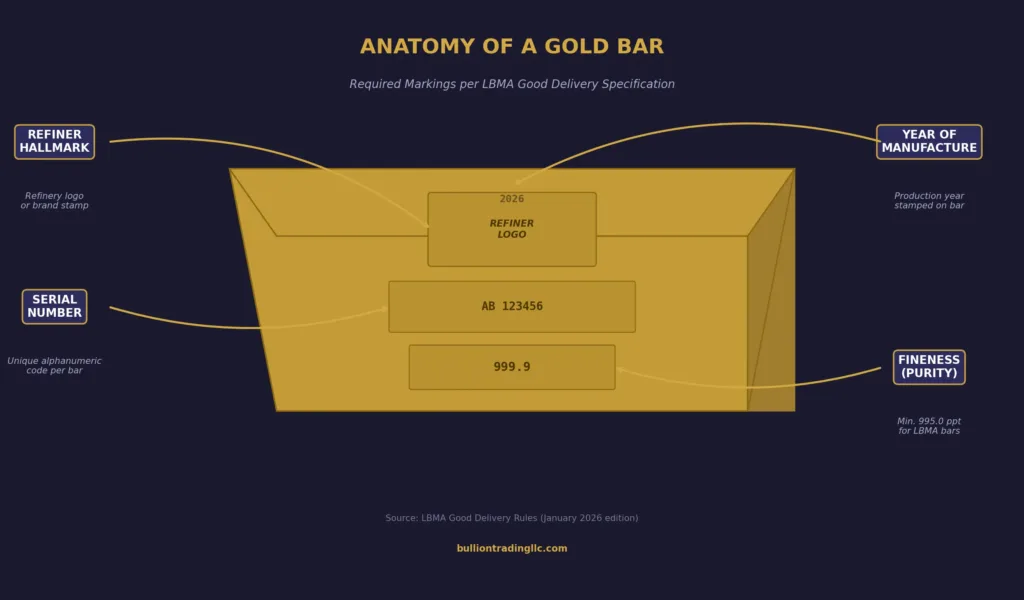
According to the LBMA Good Delivery specification, the global standard for bars traded in the London wholesale market, every gold bar must display four key markings: a unique serial number, the refiner’s hallmark (or logo), the fineness (purity level), and the year of manufacture. For LBMA Good Delivery bars, the minimum fineness is 995.0 parts per thousand, and the weight must fall between 350 and 430 troy ounces (roughly 11 to 13 kilograms).
Smaller retail bars, such as 1 oz, 10 oz, or 1 kilo bars from refiners like PAMP Suisse, Valcambi, or the Perth Mint, follow similar conventions. They typically display the refiner’s name and logo, the bar’s weight, the purity (usually .9999 fine gold), and a unique serial number. Some bars also include an assay card sealed in tamper-evident packaging that certifies the bar’s specifications at the time of production.
The serial number is the most important marking for individual investors. It is the one element that makes your bar uniquely identifiable among all the bars that refiner has ever produced.
How Gold Bar Serial Numbers Work
A gold bar serial number is a unique alphanumeric code assigned during production. No two bars from the same refinery should ever share the same number.
The format varies from one refinery to another. Some use purely numeric sequences (for example, a six- or seven-digit number), while others combine letters and numbers. PAMP Suisse, for instance, assigns serial numbers to its minted bars and pairs them with CertiPAMP assay cards that record the same number alongside weight and purity details. Valcambi follows a similar system, stamping a unique number on each bar and matching it to an assay certificate.
For LBMA Good Delivery bars, the serial number is one of four mandatory markings specified in the Good Delivery List Rules published in January 2026. These bars are used in the wholesale market and stored in London vaults that held 9,210 tonnes of gold at the end of February 2026, according to LBMA data. Each bar’s serial number allows it to be tracked through the chain of custody as it moves between vaults, banks, and trading counterparties.
It’s worth noting that weight is not recommended to be stamped on Good Delivery bars. That might seem odd, but there’s a practical reason: bars are officially weighed on delivery, and the weighed result prevails over any marking. A bar’s weight can also change slightly through handling or sampling, which would make the stamped figure inaccurate.
Why Gold Bar Serial Numbers Matter for Investors
For retail investors buying bars from one ounce to one kilogram, the serial number serves several important functions that directly affect the security and value of your investment.
Proof of authenticity. A serial number ties your bar to a specific production run at a specific refinery. If you ever need to verify that your bar is genuine, the serial number is the starting point. Reputable dealers like Bullion Trading LLC record serial numbers on invoices and can confirm the provenance of bars they sell.
Insurance documentation. If you store gold at home or in a private vault, your insurance provider will almost certainly ask for serial numbers. Without them, proving ownership and value after a loss becomes significantly harder. A detailed inventory with serial numbers makes the claims process much smoother.
Resale and buyback. When it comes time to sell, bars with matching serial numbers on the bar itself, the assay card, and your purchase receipt command higher confidence from buyers. A bar that can be traced cleanly back to its refinery of origin is easier to sell and often fetches a better price than one lacking documentation. This is especially true for bars from highly regarded refiners on the LBMA Good Delivery List, which currently includes 66 accredited gold refineries worldwide.
Theft recovery. In the unfortunate event of theft, serial numbers are the primary tool law enforcement uses to identify and recover stolen bullion. Gold bars without recorded serial numbers are, for all practical purposes, untraceable.
Modern Verification Technologies
The traditional serial number is now just one layer in a broader security ecosystem. As counterfeiting has grown more sophisticated, especially for kilogram bars where fake and counterfeit bars have become a real market concern, refineries have developed advanced technologies that go well beyond stamped numbers.
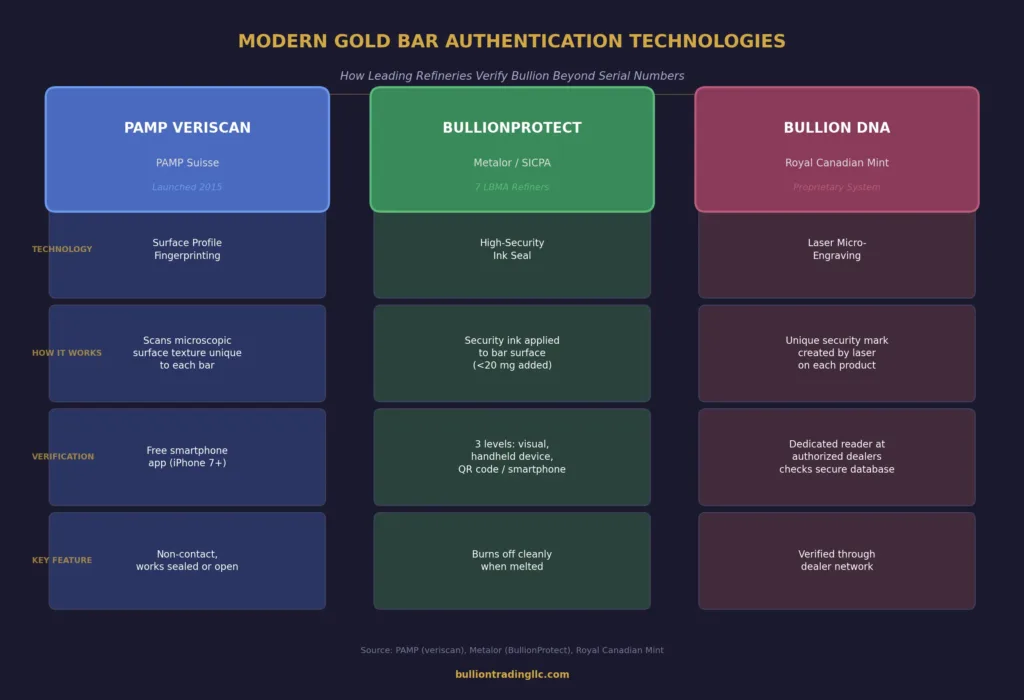
PAMP VERISCAN. In 2015, PAMP Suisse launched VERISCAN, a proprietary authentication system that works on a simple but powerful principle: even man-made products have microscopic surface profiles as unique as a fingerprint. VERISCAN uses advanced scanning technology to capture the surface profile of each PAMP bar at production. Investors can then use the free VERISCAN app (available on iPhone 7 and later) to scan their bar and compare it against the digital record. The system works with bars still sealed in their CertiPAMP assay card packaging or removed from it.
Metalor BullionProtect. Developed in partnership with Swiss security firm SICPA, BullionProtect takes a different approach. A special high-security ink is applied directly to each bar’s surface, adding negligible weight (less than 20 milligrams). Verification happens on three levels: a visual check, a rapid validation using a handheld blinking-light device, and a QR code readable by any smartphone. The system was specifically developed in response to the rising number of counterfeit kilogram bars, and seven LBMA Good Delivery refiners have adopted it. The ink burns off cleanly during melting without adding impurities, so it doesn’t affect the gold’s purity at any stage.
Royal Canadian Mint Bullion DNA. The Royal Canadian Mint developed its Bullion DNA anti-counterfeiting technology, which uses laser micro-engraving to create a unique security mark on each product. Authorized dealers can verify products using a dedicated reader that checks the mark against the Mint’s secure database. These technologies don’t replace serial numbers; they build on them. The serial number remains the universal baseline, while proprietary systems add layers that make counterfeiting progressively harder.
The LBMA Gold Bar Integrity Initiative
At the wholesale level, tracking gold bars by serial number is part of a broader industry push toward full chain-of-custody transparency. The LBMA’s Gold Bar Integrity (GBI) initiative aims to create a secure, digital record for every Good Delivery gold bar, tracking it from the refinery through every vault transfer and ownership change.
The concept is straightforward: if every bar’s serial number, weight, and assay data are recorded in a tamper-proof digital ledger, it becomes much harder for conflict gold or counterfeit bars to enter the legitimate supply chain. The initiative aligns with the LBMA’s broader Responsible Sourcing Programme, which requires accredited refiners to demonstrate that their gold comes from legitimate, non-conflict sources.
The Swiss precious metals industry has moved in a similar direction. In January 2026, the Swiss Precious Metals Association (ASMP) officially launched the Swiss Precious Metals Transparency Platform (SPMTP), a major milestone in strengthening transparency and trust within the industry. The platform reflects a broader trend across the sector toward digitized tracking and accountability.
For retail investors, these wholesale-level efforts have a practical impact: they strengthen the overall integrity of the gold supply chain, which in turn supports the trustworthiness and resale value of the bars in your own collection.
How to Track and Record Your Gold Bar Serial Numbers
Keeping proper records of your gold bar serial numbers doesn’t require any special software or expertise. It just takes a bit of discipline. Here is what a solid documentation practice looks like.
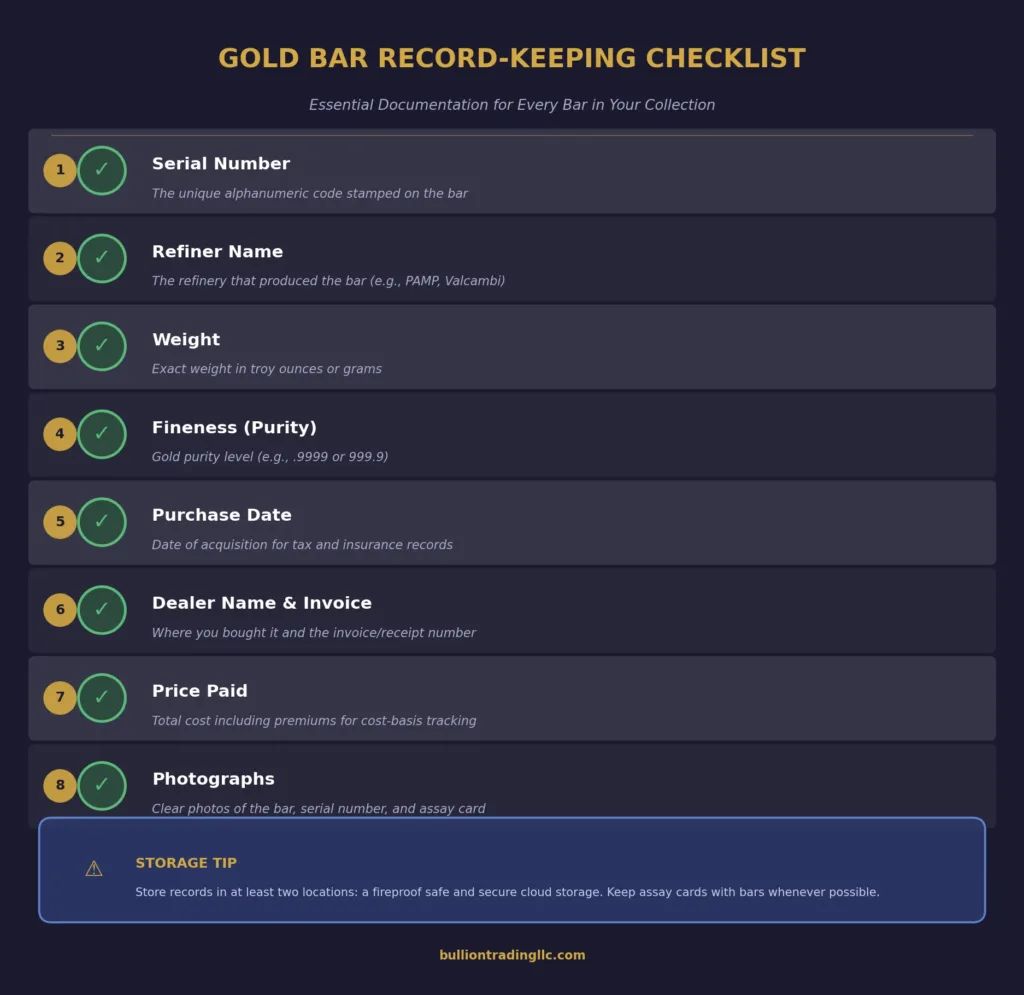
When you purchase a gold bar, immediately record the serial number along with the refiner’s name, weight, fineness, purchase date, the dealer’s name, and the price you paid. Take clear, high-resolution photographs of the bar itself (showing the serial number and all markings), the assay card if included, and your purchase receipt or invoice.
Store this information in at least two separate locations. A fireproof home safe and a secure cloud storage service are a sensible combination. A simple spreadsheet with columns for each field works well and makes your records easy to search as your collection grows.
If your bars came with assay cards or certificates, keep them together with the bars whenever possible. A bar that arrives at a dealer’s counter with its matching assay card intact commands more confidence and potentially a better buyback price than a loose bar. For PAMP products sealed in CertiPAMP packaging, keeping the sealed package intact is ideal since the VERISCAN app can authenticate bars both within and outside their packaging.
For insurance purposes, provide your insurer with a complete list of serial numbers, along with current market valuations updated periodically. Some insurers offer specialized precious metals coverage, and they will expect detailed serial number records as a condition of the policy.
What About Bars Without Serial Numbers?
Not every gold bar on the market carries a serial number. Generic cast bars, secondary market bars, and some older products may lack individual serialization. This doesn’t necessarily mean the gold isn’t real, but it does present practical challenges.
Bars without serial numbers are harder to authenticate, more difficult to insure individually, and may trade at a discount because buyers have less confidence in their provenance. If you’re purchasing gold as a serious investment rather than just for its melt value, choosing serialized bars from LBMA-accredited refiners is worth the typically modest premium. The 66 gold refineries on the current LBMA Good Delivery List include major names like PAMP, Valcambi, Argor-Heraeus, The Perth Mint, and the Royal Canadian Mint, all of which produce retail-sized bars with unique serial numbers and assay documentation.
Conclusion
Gold bar serial numbers are a small detail that carries real weight. They connect your physical gold to its refinery of origin, provide the foundation for insurance and legal documentation, and support authentication through modern technologies like VERISCAN and BullionProtect.
As the industry pushes toward full digital traceability through initiatives like the LBMA Gold Bar Integrity programme and the Swiss Precious Metals Transparency Platform, serial numbers will only become more important. Whether you’re buying your first gold bar or adding to an established collection, paying attention to serial numbers is one of the simplest steps you can take to protect your bullion investment.
