


If you’re new to buying gold, you’ve probably noticed two terms that seem almost interchangeable at first glance: gold rounds vs gold coins. Both are circular, both contain gold, and both show up in dealer inventories side by side. But these two products serve different purposes and come with distinct characteristics that can significantly impact your investment strategy. Understanding the difference between gold rounds and gold coins isn’t just about semantics. It’s about making informed decisions that align with your financial goals.
The precious metals market offers investors numerous options for acquiring physical gold, and choosing between rounds and coins represents one of the most fundamental decisions you’ll make. Whether you’re building a retirement portfolio, hedging against inflation, or simply diversifying your assets, knowing what sets these products apart will help you get the most value for your investment dollar.
What Defines a Gold Coin?
Gold coins are produced exclusively by government mints and carry official legal tender status in their country of origin. This distinction is more than ceremonial. According to established numismatic definitions, a bullion coin must be minted by a government authority and bear a face value denomination, even though that face value is typically far below the coin’s actual metal content value.
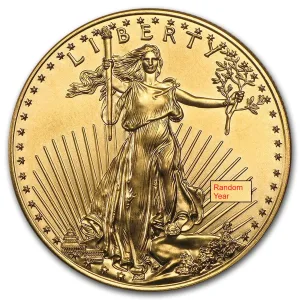
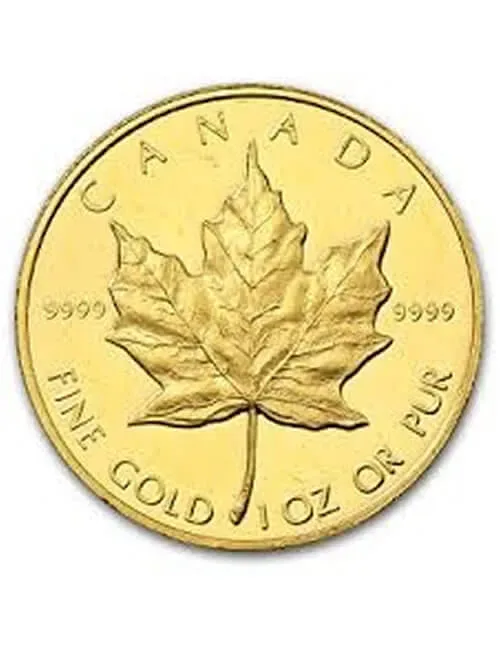
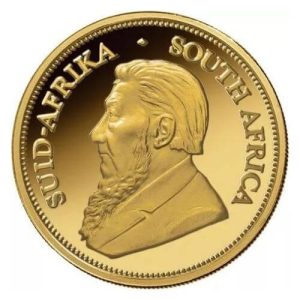
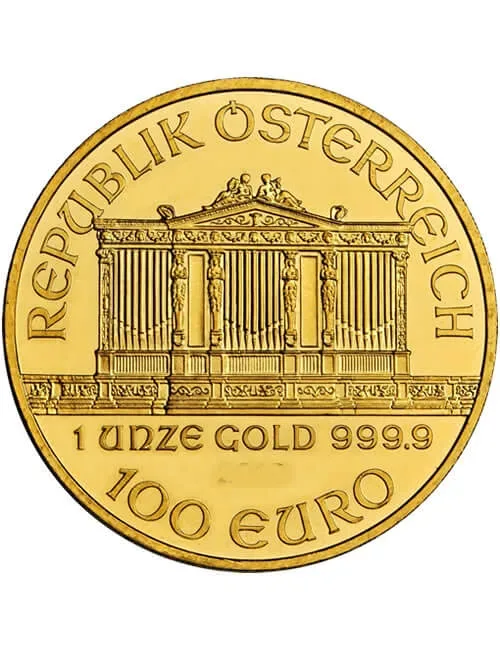
The most widely recognized gold coins in the world include the American Gold Eagle from the U.S. Mint, the Canadian Maple Leaf from the Royal Canadian Mint, the South African Krugerrand, the Austrian Philharmonic, and the Australian Kangaroo from the Perth Mint. Each of these coins carries the backing of its issuing government, which guarantees the weight and purity specifications stamped on the coin.
Take the American Gold Eagle as an example. Each one-ounce coin contains exactly one troy ounce of pure gold and carries a face value of $50. Of course, nobody would spend a Gold Eagle at a store for fifty dollars when the gold content alone is worth thousands. But that legal tender status provides something intangible yet valuable: government authentication and the implicit guarantee that comes with sovereign backing.
Government-minted coins undergo rigorous quality control processes and meet strict specifications established by law. The U.S. Mint produces coins under congressional authorization, with each coin’s specifications codified in federal statute. This level of oversight provides investors with confidence in the product’s authenticity and metal content.
Popular government-minted gold bullion coins from around the world
What Defines a Gold Round?
Gold rounds, by contrast, are produced by private mints and refineries rather than government institutions. They look remarkably similar to coins and contain the same precious metal content, but they lack legal tender status and don’t carry a face value denomination. Under United States law, products not stamped by authority of the government cannot legally be called “coins” and must be marketed as “rounds” instead.
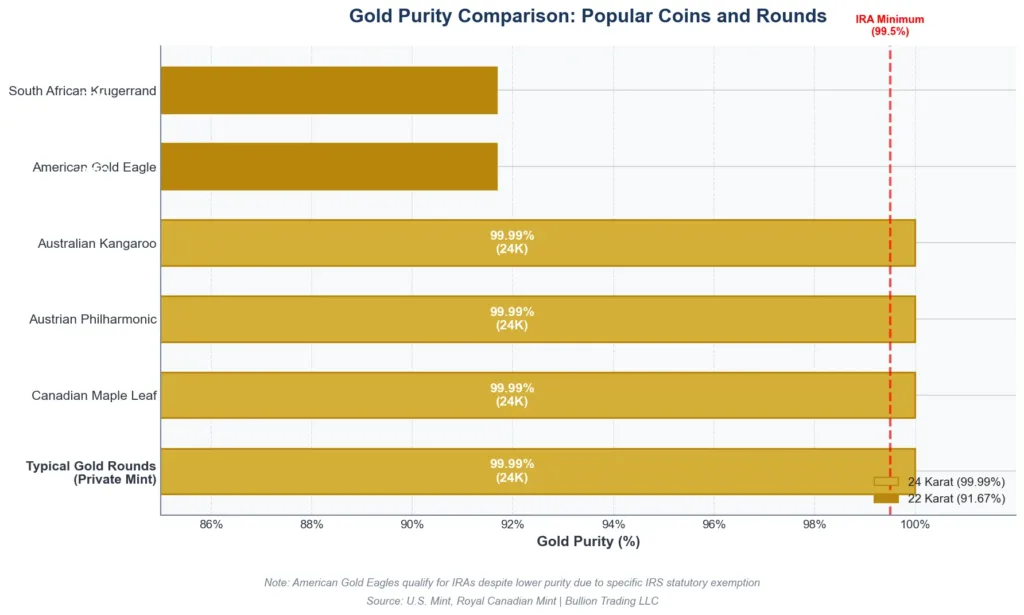
Private mints producing gold rounds include well-known names like SilverTowne, Sunshine Minting, and Asahi Refining. These companies manufacture products that meet or exceed the purity standards of government coins. A typical gold round contains .9999 fine gold (24 karat), matching the purity of the Canadian Maple Leaf, while some government coins like the American Gold Eagle use .9167 fine gold (22 karat) alloyed with copper and silver for durability.
The absence of legal tender status doesn’t diminish a round’s intrinsic value. A one-ounce gold round contains exactly the same amount of pure gold as a one-ounce government coin of equivalent fineness. What differs is the source of authentication and the premium charged above the spot price of gold.
The Premium Difference: Where Your Money Goes
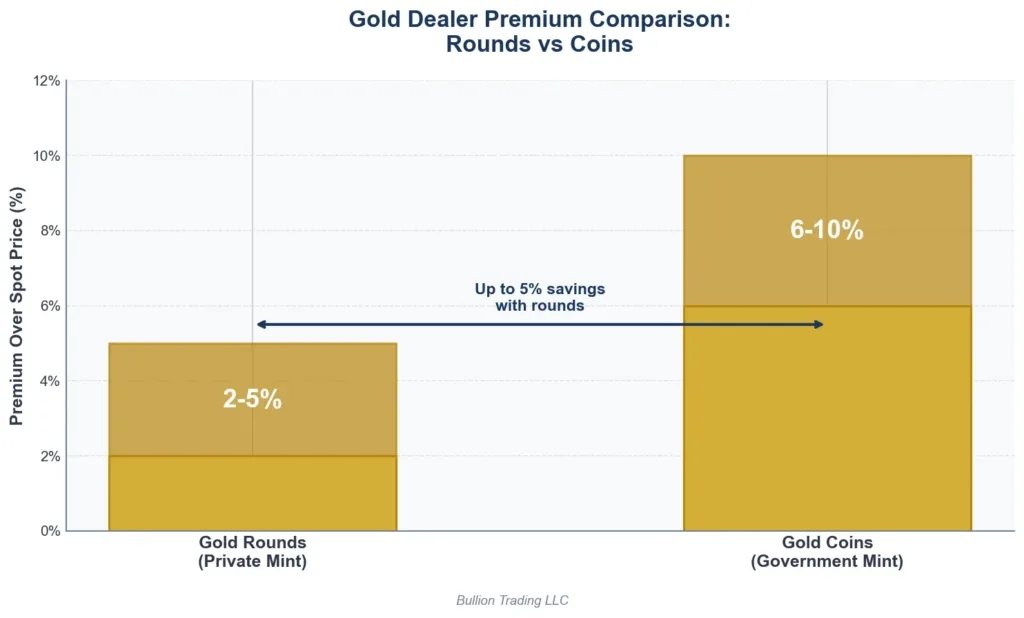
One of the most practical distinctions between rounds and coins involves the premium you pay over spot price. Government-minted coins consistently carry higher premiums than private mint rounds, and understanding why can save you money or help you maximize resale value depending on your objectives.
Gold coins typically trade at premiums of 6-10% above the underlying gold price when purchased in small quantities from dealers. When selling, investors often face another 2-6% discount from spot. Rounds, however, generally carry premiums of just 2-5% over spot, offering more gold for the same dollar amount.
Why do coins command higher premiums? Several factors contribute. Government mints have limited production capacity and face higher operational costs than private facilities. The legal tender status and sovereign guarantee add perceived value. Coins also enjoy broader international recognition and liquidity, making them easier to sell across borders. Additionally, certain coins carry collectible appeal that extends beyond their metal content.
For investors focused purely on accumulating the maximum amount of gold for their budget, rounds often represent the more efficient choice. A buyer purchasing $10,000 worth of gold could acquire noticeably more metal by choosing rounds over coins, assuming similar purity levels.
IRA Eligibility: Rules That Matter
If you’re considering gold for a self-directed Individual Retirement Account, the distinction between rounds and coins becomes critically important. The Internal Revenue Service maintains specific requirements for precious metals held in qualified retirement accounts.
According to IRS guidance under IRC Section 408(m), gold held in IRAs must meet minimum fineness standards of .995 (99.5% pure) for most bullion products. However, certain U.S. coins described in 31 USC Section 5112, including American Gold Eagles at .9167 fineness, qualify despite being below this threshold due to specific statutory exemptions. Coins issued under the laws of any state also qualify, as does gold bullion meeting the fineness requirement when held by an approved custodian.
Many gold rounds meet the .9995 purity standard required for IRA inclusion, but not all do, and some custodians maintain stricter requirements or approved product lists. Before purchasing rounds for retirement accounts, investors should verify both IRS compliance and custodian approval. Government coins like American Gold Eagles enjoy universal acceptance among IRA custodians, eliminating this uncertainty.
Recognition and Liquidity
When you eventually decide to sell your gold, recognition matters. Government coins from major mints are instantly identifiable to dealers, collectors, and investors worldwide. A Canadian Maple Leaf or South African Krugerrand requires no explanation or extended authentication process. The design, weight, and specifications are universally known.
Gold rounds, while containing identical metal value, may face slightly more scrutiny during resale. Dealers unfamiliar with a particular private mint’s products might verify authenticity more carefully or offer marginally lower prices to account for perceived risk. That said, rounds from established private mints with strong reputations typically sell without significant discount, especially when accompanied by original packaging and assay certificates.
The London Bullion Market Association maintains accreditation standards for refiners that serve as a mark of quality in the wholesale market. Rounds produced by LBMA-accredited refiners command strong confidence among buyers.
Purity Considerations
Gold coins vary in purity depending on their country of origin and design. The American Gold Eagle contains 91.67% gold (22 karat), alloyed with copper and silver to create a more durable coin resistant to scratching and wear. The Canadian Maple Leaf, by contrast, contains 99.99% pure gold (24 karat), as does the Austrian Philharmonic. The South African Krugerrand matches the Eagle at 22 karat.
Most gold rounds are manufactured at 99.99% purity, matching or exceeding the fineness of the purest government coins. This means a one-ounce round typically contains slightly more pure gold than a one-ounce American Eagle, though both products are priced based on their stated gold content rather than total weight.
When comparing products, always verify the actual gold content rather than assuming equivalence. A one-ounce American Gold Eagle actually weighs approximately 1.0909 troy ounces total, with exactly one ounce being pure gold. A one-ounce .9999 fine round weighs exactly one troy ounce total, all of which is essentially pure gold.
Design and Collectibility
Government coins often feature iconic national symbols and artistic designs that carry historical significance. Lady Liberty on American Eagles, the maple leaf on Canadian coins, the springbok antelope on Krugerrands, and the Vienna Philharmonic orchestra instruments all connect buyers to national heritage and tradition. Some investors value this aesthetic and cultural dimension alongside the metal content.
Private mints have responded by producing rounds with increasingly sophisticated and artistic designs. Limited edition rounds featuring historical themes, wildlife, or commemorative subjects attract buyers who appreciate variety. However, these designs rarely develop the numismatic premium that certain government coins achieve, and the primary value remains the underlying gold content.
For investors interested purely in gold as a financial asset, design differences are largely irrelevant. For those who appreciate the artistry of precious metals or plan to gift coins to family members, the aesthetic appeal of government coins may justify their higher premiums.
Making Your Decision
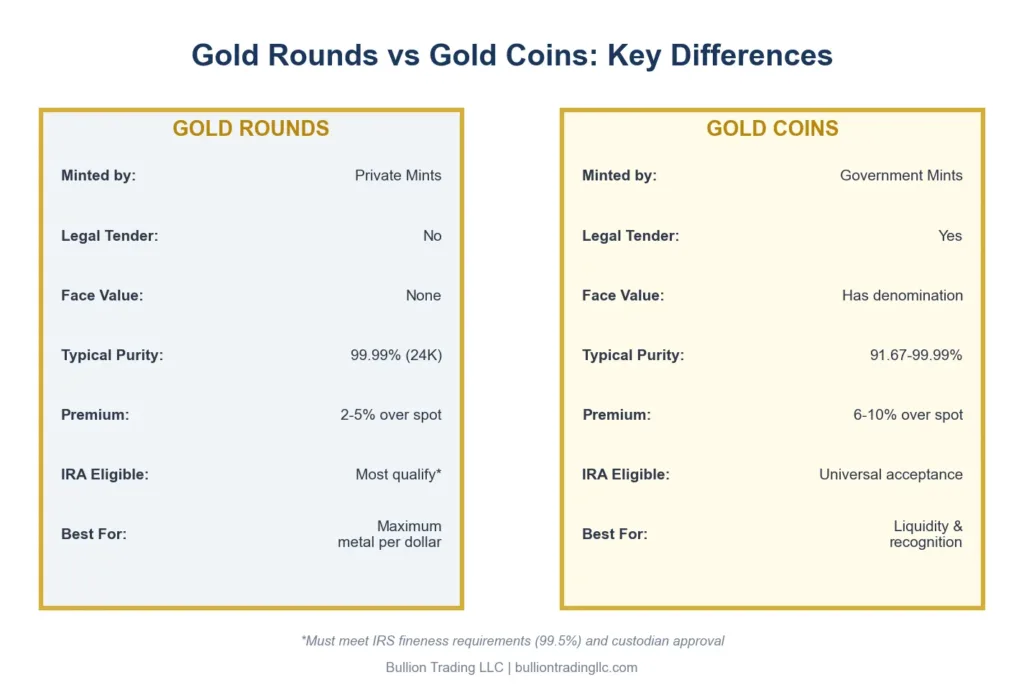
The choice between gold rounds and gold coins ultimately depends on your specific investment objectives. If you prioritize maximum metal acquisition for your dollar and plan to hold long-term, rounds from reputable private mints offer excellent value. The lower premiums translate directly into more gold in your portfolio.
If international recognition, guaranteed liquidity, and universal acceptance matter most, particularly for retirement accounts or potential cross-border transactions, government coins provide certainty that rounds cannot fully match. The premium you pay buys peace of mind and established market infrastructure.
Many experienced investors maintain both products in their portfolios. They might acquire rounds for the bulk of their gold holdings while keeping government coins for their most liquid positions. This balanced approach captures the cost efficiency of rounds while maintaining access to the world’s most recognized gold products.
Whatever you choose, focus on purchasing from established dealers who guarantee authenticity and offer transparent pricing. Bullion Trading LLC maintains comprehensive inventory of both government coins and private mint rounds, allowing investors to compare options and select products that match their investment strategy. Our team can help you understand the specific characteristics of different products and guide you toward choices that align with your financial goals.
