


Gold has been faked for as long as humans have valued it. The methods have evolved from crude alloy swaps in ancient mints to precision-engineered tungsten cores in modern bars, but the motivation has never changed: gold is worth a fortune, and someone, somewhere, is always trying to pass off a convincing imitation.
The story of counterfeit gold bars is not just a tale of fraud. It is a lens through which we can see how trust, technology, and greed have shaped the precious metals market across millennia. From emperors debasing their own coinage to fund wars, to sophisticated criminal rings selling fake bars on consumer marketplaces, the battle between gold counterfeiters and those trying to stop them is one of the longest-running conflicts in economic history.
Nero and the First Great Gold Debasement
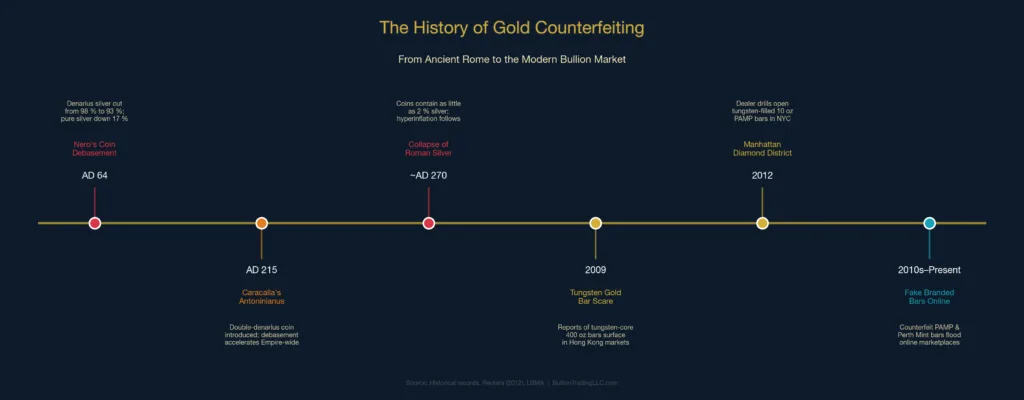
The Roman Empire may have produced the most powerful counterfeiter in history, and he wore a crown. Emperor Nero, who ruled Rome from AD 54 to 68, implemented a monetary reform around AD 64 that fundamentally altered the composition of Roman coinage. It was, in modern terms, state-sponsored counterfeiting.
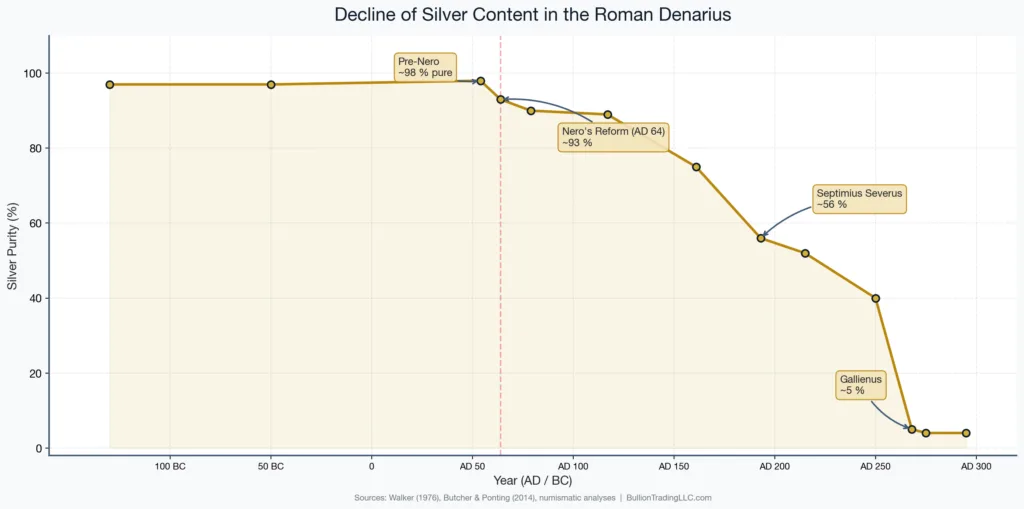
Before Nero’s reform, the Roman denarius weighed roughly 3.9 grams at approximately 98% silver purity, meaning it contained about 3.8 grams of pure silver. The gold aureus was struck at a standard of approximately 8 grams (1/42 of a Roman pound). These coins had maintained relatively stable metal content since the late Roman Republic, giving merchants and citizens across the Empire a reliable medium of exchange.
Nero changed that. According to historical records of Roman coinage, the denarius was reduced in overall weight to roughly 3.4 grams (1/96 of a Roman pound) and its silver purity dropped from about 98% to around 93%. The aureus was lightened from 1/42 to roughly 1/45 of a Roman pound. While that purity reduction was only about 5 percentage points, the combined effect of lighter weight and lower fineness meant that the actual pure silver content fell from roughly 3.8 grams to about 3.16 grams, a steep decline of around 17%. The most commonly cited reason was the enormous cost of rebuilding Rome after the Great Fire of AD 64, which devastated large portions of the city.
What makes Nero’s debasement historically significant is that it set a precedent that every subsequent emperor would follow. The coin debasement accelerated under later emperors, particularly Septimius Severus and Caracalla. By the mid-third century, the antoninianus (a double-denarius coin) contained as little as 2% silver. The Roman currency had essentially become base metal with a thin silver wash, a transformation that contributed to rampant inflation and economic instability across the Empire.
The lesson from Rome is sobering and still relevant: when governments debase money, it erodes trust in the entire system. And while modern governments no longer clip coins, the psychology of debasement, getting less real value than what the label promises, is exactly what modern gold counterfeiters exploit.
The Tungsten Gold Bar Scare
Fast forward nearly two thousand years, and gold counterfeiting resurfaced in a form that shook the modern bullion market. In late 2009 and into the early 2010s, rumors began circulating through precious metals trading circles about gold bars with tungsten cores being discovered in various locations around the world.
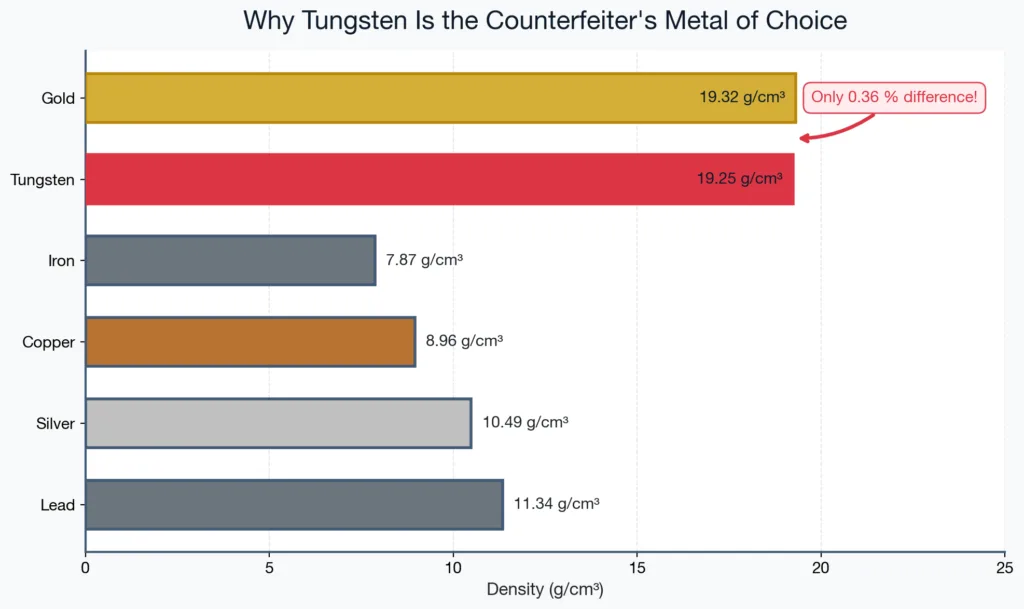
The concept is elegant in its simplicity. Tungsten has a density of 19.25 grams per cubic centimeter, which is remarkably close to gold’s 19.32 grams per cubic centimeter. A bar made with a tungsten core and a thick gold shell would weigh correctly for its size. It would look right, feel right, and even pass a basic surface scratch test. Only more sophisticated testing methods could reveal the deception.
The story gained widespread traction in October 2009, when reports emerged from Hong Kong and other Asian trading hubs about counterfeit 400-ounce (approximately 12.4 kg) good delivery bars. A Reuters investigation in March 2012 documented the growing threat of counterfeit gold bars entering the global supply chain. The investigation highlighted cases of tungsten-filled bars surfacing in the secondary market, raising serious concerns about the integrity of gold held outside the established London Bullion Market Association (LBMA) chain of custody.
One of the most widely reported incidents occurred in Manhattan’s Diamond District in September 2012. Ibrahim Fadl, a dealer who had purchased counterfeit 10-ounce PAMP bars from a merchant, was tipped off by a fellow jeweler who had been burned by a similar fake. Fadl discovered the tungsten cores by physically drilling into the bars himself. Industry experts noted at the time that had Fadl used an ultrasonic scanner before buying, he could have avoided the scam entirely.
The tungsten scare was a turning point for the industry. It forced refiners, dealers, and vaults to upgrade their authentication procedures and reinforced the importance of buying from dealers who maintain a verified chain of custody. It also demonstrated that counterfeit gold bars were no longer a niche problem for a few unlucky buyers; they represented a systemic risk to the global bullion market.
Fake PAMP Suisse and Perth Mint Bars: The eBay Problem
If tungsten-core bars represented the high end of gold counterfeiting, the flood of fake branded bars on online marketplaces represents the volume end. Over the past decade, counterfeit bars bearing the names and logos of respected refiners, particularly PAMP Suisse and the Perth Mint, have become a persistent problem on platforms like eBay, Amazon, and various overseas e-commerce sites.
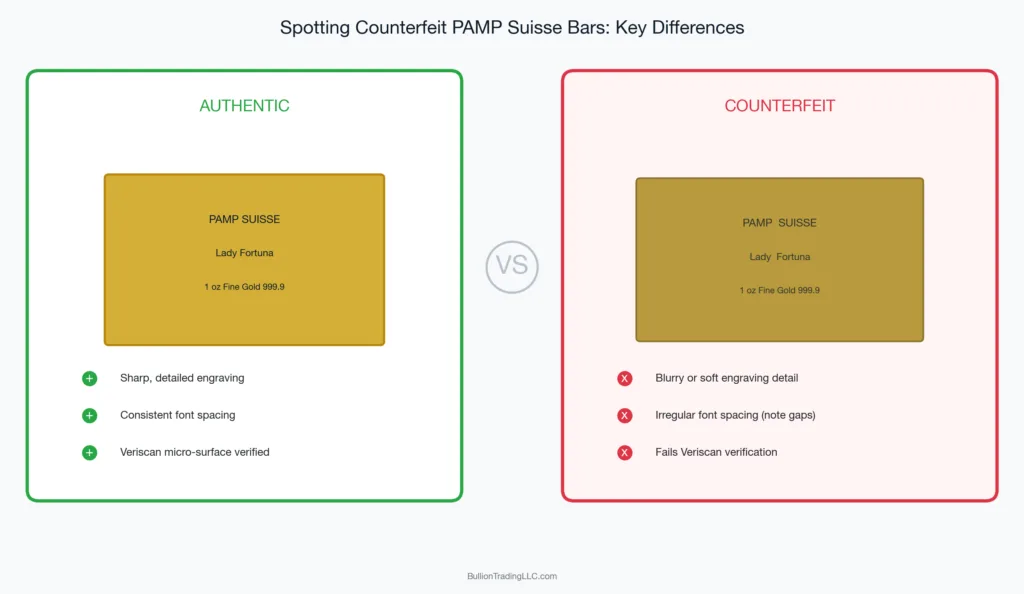
These counterfeits are typically manufactured in China and Southeast Asia. They range from crude fakes that an experienced collector would spot immediately to surprisingly convincing reproductions that replicate holograms, serial numbers, assay card formatting, and even packaging. The most common targets are 1-ounce gold bars, particularly the iconic PAMP Suisse Lady Fortuna design, because the premium these bars command over spot price makes them especially profitable to counterfeit.
The LBMA, which maintains the Good Delivery List of approved refiners, has documented the rising frequency of counterfeit bars appearing in the retail market. In response, PAMP Suisse developed its proprietary Veriscan technology, which uses microscopic surface imaging to create a unique digital fingerprint for each bar at the point of manufacture. Buyers can verify a bar’s authenticity through a smartphone app by scanning the bar’s surface and comparing it against PAMP’s database.
The Perth Mint has similarly enhanced its security features, including serialized bars with tamper-evident packaging and unique design elements that are difficult to replicate with standard manufacturing equipment.
Despite these advances, counterfeits continue to circulate. The U.S. Commodity Futures Trading Commission (CFTC) and various state attorney general offices have pursued cases against sellers of fake precious metals products. In 2017, the FBI’s Internet Crime Complaint Center (IC3) reported precious metals fraud as a growing category of online financial crime.
The practical takeaway for buyers is straightforward: purchasing gold bars from verified, reputable dealers with established supply chains is the single most effective protection against counterfeits. Marketplace platforms with anonymous or pseudonymous sellers carry inherent risks that no amount of listing photos can mitigate.
How Refiners and Dealers Catch Counterfeits Today
The good news in this long history of gold counterfeiting is that detection technology has advanced dramatically in recent years. Reputable dealers and refiners now use multiple layers of authentication that make it extremely difficult, and in many cases essentially impossible, for sophisticated fakes to pass undetected.
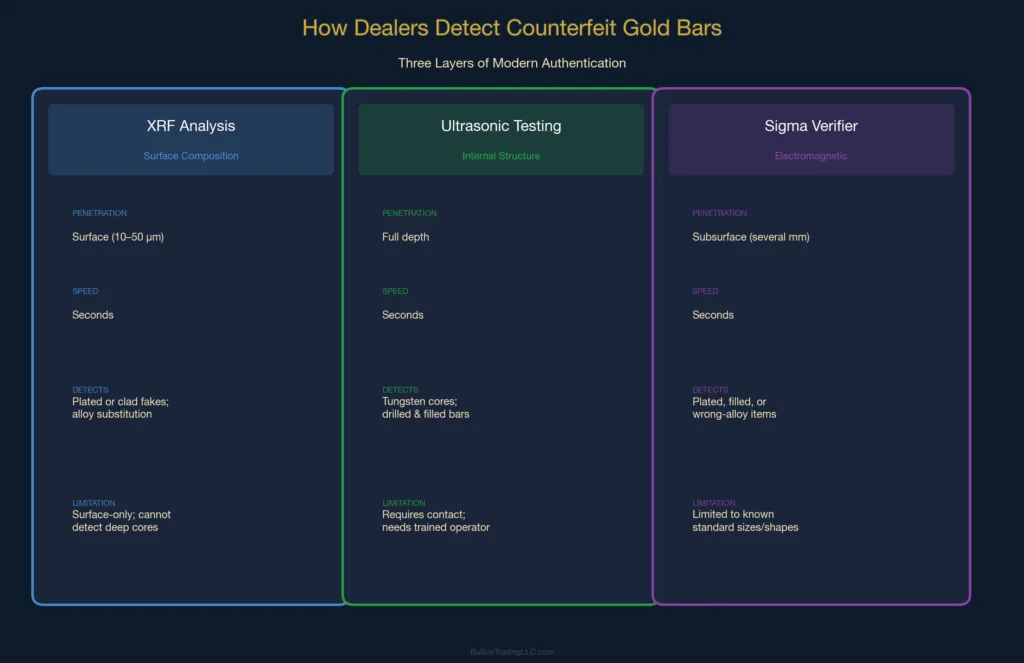
X-Ray Fluorescence (XRF) Analysis is the most widely used professional testing method. An XRF spectrometer fires X-rays at the surface of a bar or coin and measures the fluorescent radiation emitted by the metal atoms. This reveals the exact elemental composition of the material, identifying not just gold content but also any unexpected metals like tungsten, copper, or zinc. Modern handheld XRF devices can provide results in seconds and are now standard equipment at every major bullion dealer. However, XRF only tests the surface layer (typically the top 10-50 micrometers), which is why it must be combined with other methods.
Ultrasonic thickness testing addresses the limitation of surface-only analysis. By sending sound waves through a bar and measuring the speed at which they travel, ultrasonic testers can detect internal inconsistencies. Gold and tungsten transmit sound at very different speeds (gold at approximately 3,240 m/s versus tungsten at about 5,180 m/s), so a tungsten core inside a gold shell produces a dramatically different reading. This is the exact method that would have instantly caught the 2012 Manhattan tungsten bars had the dealer used it before purchasing.
The Sigma Metalytics Precious Metal Verifier uses electromagnetic properties to test whether the internal composition of a bar or coin matches known standards for gold, silver, or platinum. Unlike XRF, it reads below the surface and can detect filled or plated items. It has become a standard desk tool for many coin shops and bullion dealers across the United States.
Specific gravity testing remains one of the simplest and most reliable basic checks. Because gold has a very specific density (19.32 g/cm³), measuring both the weight and the water displacement of a piece reveals whether its density matches real gold. A gold-plated lead bar, for instance, would be noticeably lighter than expected for its size.
The LBMA Good Delivery system provides an additional layer of institutional protection for the wholesale market. Bars produced by LBMA-accredited refiners are tested to verified standards and tracked through a chain of integrity from refiner to vault. When a bar leaves this chain (for example, by being stored privately), it must be re-assayed before re-entering the system.
For individual investors, the combination of buying from established dealers, verifying physical characteristics, and using at least one form of instrumental testing makes the risk of getting stuck with a counterfeit bar extremely low. The technology and the dealer infrastructure exist to protect buyers, but only if buyers choose to use them.
Why This History Matters for Today’s Gold Buyers
The thread connecting Nero’s coin-clipping workshops to a modern Chinese factory producing fake PAMP bars is thinner than you might expect. At every point in history, counterfeiters have exploited the gap between what gold looks like and what gold actually is. The tools change, but the vulnerability stays the same: gold’s value depends on trust, and trust can be manufactured more cheaply than gold can be mined.
For today’s gold investors, this history carries practical significance. With gold trading at historically elevated levels and demand for physical metal surging globally, the financial incentive to produce and sell counterfeit gold bars has never been higher. Every dollar increase in the gold price makes counterfeiting more profitable and worth the criminal risk.
The defense against this risk is not complicated. Buy from reputable, established dealers with transparent supply chains. Insist on products from LBMA-accredited refiners. Verify any secondary market purchases with at least one instrumental testing method. And be deeply skeptical of gold deals on consumer marketplaces that seem too good to be true, because they almost certainly are.
Gold has survived every counterfeiter who ever tried to fake it. But the buyers who thrive are the ones who know the history, understand the risks, and choose their dealers wisely.
