
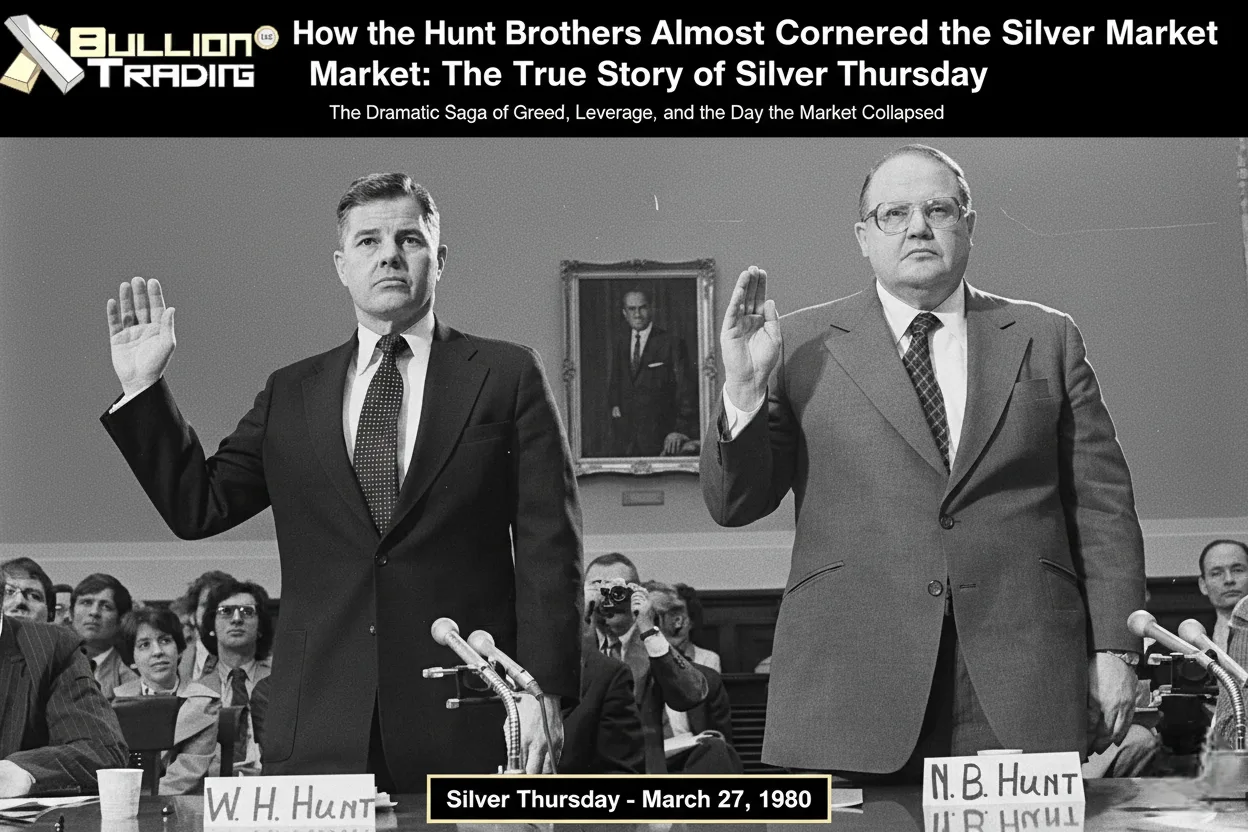

In the late 1970s, two Texas brothers with deep oil money and even deeper convictions about inflation managed to do something that still sounds unbelievable today. Nelson Bunker Hunt and William Herbert Hunt accumulated roughly one-third of the entire world’s privately held silver supply, sent prices soaring over 700%, and very nearly brought down parts of Wall Street in the process. Their story is one of the most dramatic episodes in the history of commodities trading, and it reshaped how the Hunt Brothers silver market saga is understood to this day.
Whether you are a seasoned silver investor or just curious about the forces that shape precious metals prices, the Hunt Brothers story offers lessons that remain deeply relevant more than four decades later.
Who Were the Hunt Brothers?
Nelson Bunker Hunt and William Herbert Hunt were sons of H.L. Hunt, a Texas oil tycoon who was once considered one of the richest men in the world. When H.L. Hunt died in 1974, he left his sprawling family a fortune built on petroleum. But Bunker and Herbert had different ideas about where to put that money.
Bunker Hunt, in particular, was deeply concerned about inflation. The 1970s were a turbulent time for the U.S. economy. The 1973 oil crisis had sent energy prices through the roof, the dollar was weakening after President Nixon ended the gold standard in 1971, and consumer prices were climbing at a pace that made anyone holding cash nervous. Bunker believed that paper currency was heading for serious trouble, and he saw silver as the answer. Unlike gold, which was still heavily regulated for private ownership at the time, silver was freely tradable and, in his view, grossly undervalued.
The Strategy: Buy Everything
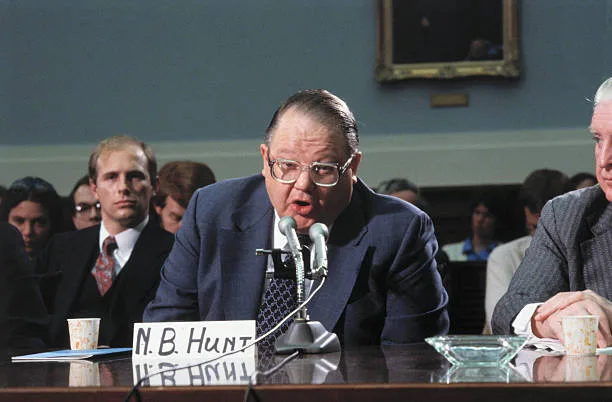
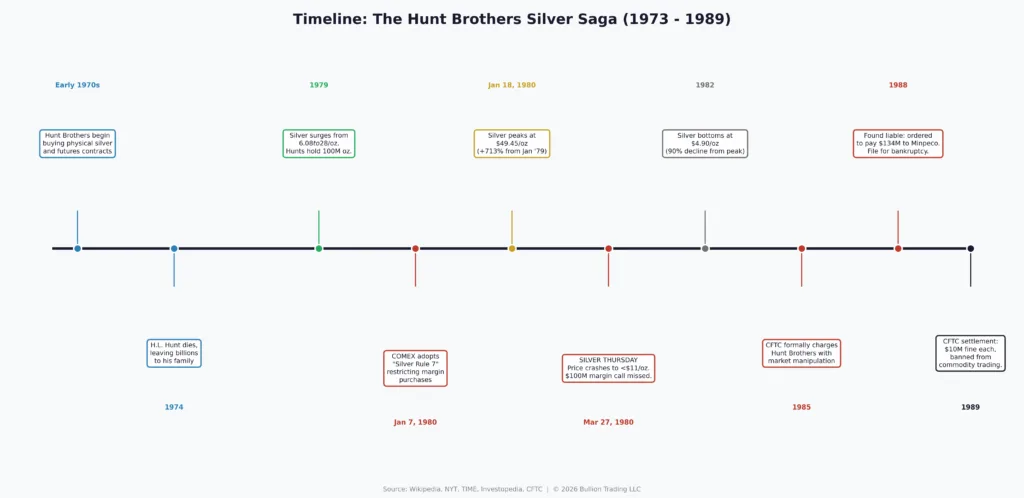
Beginning in the early 1970s, the Hunt brothers started quietly buying physical silver and silver futures contracts on the COMEX exchange through various brokers, including the firm Bache Halsey Stuart Shields (later Prudential-Bache Securities). What made their approach unusual was that, instead of closing out futures contracts with the standard cash settlement that most traders used, the Hunts took physical delivery of the silver. They wanted the actual metal.
They stockpiled that silver in vaults and used their massive cash reserves to buy even more futures. When their immediate cash was tied up, they borrowed heavily against their existing holdings. The Hunt name carried enormous weight with banks, and they were able to secure loans at lower rates than most other speculators could dream of. This leverage allowed them to amplify their buying power far beyond their already substantial fortune.
The brothers did not stop there. They evangelized their silver thesis to wealthy investors around the world, pooling funds to buy additional silver and futures contracts. Most notably, they brought in Saudi Arabian investors, a detail that would later attract the attention of U.S. government officials who were still wary from the 1970s oil embargo.
Silver Prices Go Parabolic
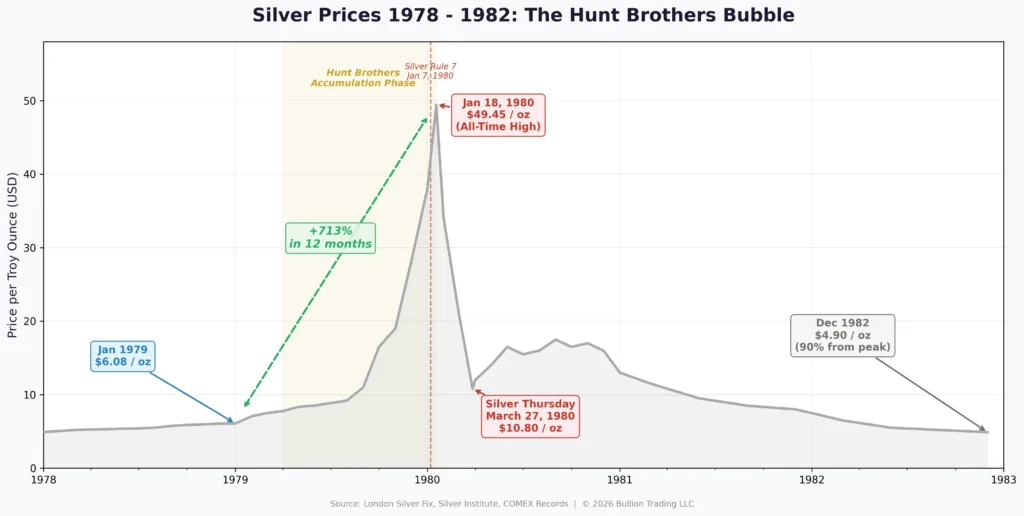
The impact of the Hunt Brothers’ buying spree was staggering. According to historical price records, silver was trading at $6.08 per troy ounce on January 1, 1979, based on the London Fix. By January 18, 1980, it had reached a record high of $49.45 per troy ounce, an increase of 713%. On the same day, silver futures on COMEX hit an intraday all-time high of $50.35 per ounce, while gold peaked at $850 per ounce.
By the last nine months of 1979, the Hunt brothers were estimated to be holding over 100 million troy ounces of silver. That was roughly one-third of the entire world’s supply of silver not held by governments. Their position was valued at approximately $4.5 billion at peak prices.
The squeeze was felt everywhere. Regular people started pawning silverware, coins, and jewelry to cash in on the sky-high prices. Jewelers and industrial silver users were paying prices that seemed absurd. On March 26, 1980, luxury jeweler Tiffany & Co. took out a full-page advertisement in The New York Times, publicly condemning the Hunts. “We think it is unconscionable for anyone to hoard several billion, yes billion, dollars’ worth of silver and thus drive the price up so high that others must pay artificially high prices for articles made of silver”, the ad read.
The Regulators Step In
The U.S. government was watching. What the Hunt brothers were doing looked to regulators like a textbook attempt to corner the silver market, and the involvement of Saudi investors added a geopolitical dimension that made officials even more uncomfortable.
On January 7, 1980, COMEX adopted what became known as “Silver Rule 7”. This rule placed heavy new restrictions on the purchase of commodities on margin. In practical terms, it meant that new buyers could no longer enter long positions in silver futures. Existing longs like the Hunts were frozen in place, while short sellers were free to pile on. The fundamental rules of the market had been changed mid-game, and they were changed specifically in response to the Hunts’ activity.
The Federal Reserve took it a step further. It strongly encouraged banks to stop issuing loans for speculative purposes. This was aimed squarely at the Hunts, whose entire strategy depended on leverage. When the banks pulled back, the brothers’ ability to maintain and roll over their enormous positions started to crumble.
Silver Thursday: March 27, 1980
With buying power cut off and short sellers flooding into the market, silver prices began to fall fast. In just four days, the price of silver dropped by more than 50%. The Hunts, who were deeply leveraged, started receiving margin calls, demands from their brokers to put up additional cash to cover the declining value of their positions.
Then came the day that cemented this story in financial history. On March 27, 1980, known as Silver Thursday, the Hunt brothers failed to meet a margin call of $100 million from their brokerage firm. Silver plunged to under $11 per ounce, a catastrophic fall from the $50.35 peak just weeks earlier. The panic spread beyond silver into broader financial markets, and government officials genuinely feared that if the Hunts defaulted on their obligations, several major Wall Street brokerages and banks could collapse along with them.
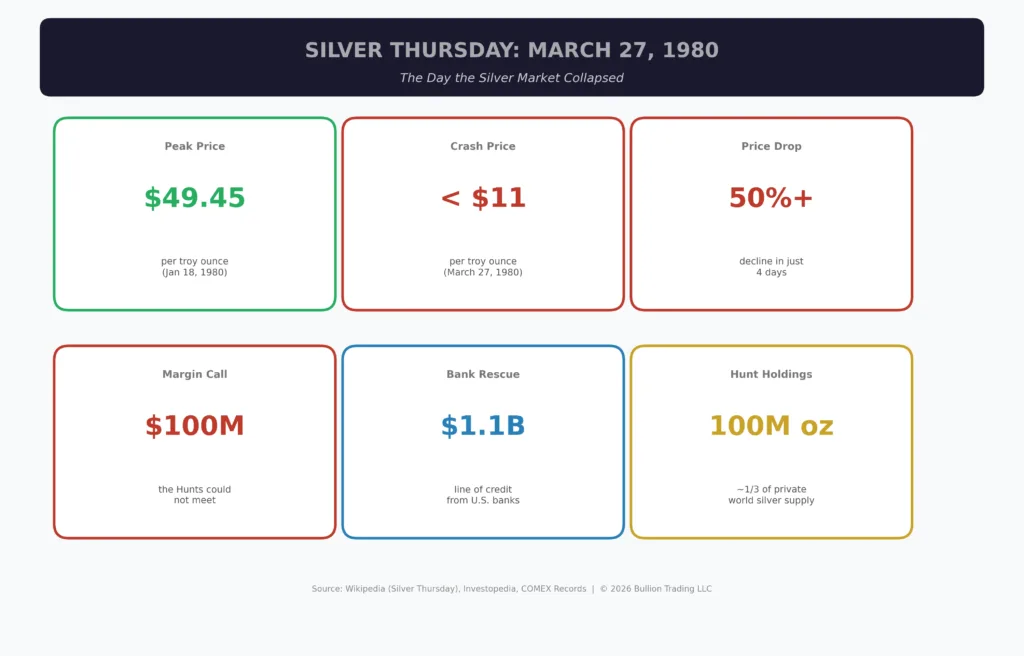
The situation was dire enough that government officials briefly discussed a bailout. They ultimately decided against it, not wanting to appear as if they were underwriting reckless speculation. Instead, a consortium of U.S. banks stepped in with a private rescue, extending the Hunt brothers a $1.1 billion line of credit that allowed them to pay their brokerage obligations and prevent a cascading financial disaster.
The Aftermath: Fines, Bankruptcy, and Lasting Consequences
The rescue saved the financial system from a meltdown, but it did not save the Hunts. The legal and financial consequences were enormous and played out over nearly a decade.
In February 1985, the U.S. Commodity Futures Trading Commission (CFTC) formally charged the brothers with “manipulating and attempting to manipulate the prices of silver futures contracts and silver bullion during 1979 and 1980”. In 1988, they were found liable in a civil case for conspiracy to corner the silver market and were ordered to pay $134 million in compensation to Minpeco, a Peruvian state-owned mineral company that had suffered losses as a result of the Hunts’ market manipulation. This judgment forced the brothers to file for bankruptcy in September 1988, one of the largest bankruptcy filings in Texas history at the time.
In 1989, in a final settlement with the CFTC, Nelson Bunker Hunt and William Herbert Hunt were each fined $10 million and permanently banned from trading on commodity markets. They also faced multimillion-dollar settlements with the IRS for back taxes, fines, and interest related to the same period.
The family’s estimated net worth fell from around $5 billion in 1980 to less than $1 billion by 1988, according to TIME Magazine. By 1982, the London Silver Fix had collapsed by 90% from its peak, settling at just $4.90 per troy ounce. Nelson Bunker Hunt died on October 21, 2014, at the age of 88.
What Silver Investors Can Learn Today
The Hunt Brothers episode is more than just a colorful piece of financial history. It carries real lessons for anyone investing in silver or other precious metals today.
The first and most obvious takeaway is that no single player, no matter how wealthy, can sustainably control a global commodity market. The forces that opposed the Hunts were not just other traders. They included regulators, central banks, and the basic mechanics of supply and demand. When silver hit $50 an ounce, everyday people started melting down family heirlooms and selling silver coins. The high prices unlocked supply that the Hunts simply could not absorb forever.
The second lesson is about leverage. The Hunt brothers did not lose because they were wrong about silver’s long-term potential. They lost because they borrowed enormous sums to build their position, and when the market turned against them, they could not survive the margin calls. For modern investors, this is a reminder that even if your thesis about a metal’s value is correct, the way you structure your investment matters just as much. Owning physical silver outright carries no margin call risk. Leveraged futures positions can wipe you out even if you are ultimately right about the direction of prices.
There is also a regulatory lesson. The rules of commodity markets can change, and they sometimes change in response to the very conditions that speculative activity creates. Silver Rule 7 was written specifically to stop the Hunts. Investors today should be aware that CFTC regulations and exchange rules exist precisely because of events like this one, and those rules continue to evolve.
Finally, the Hunt Brothers story is a useful reminder of why physical precious metals ownership remains a fundamentally different proposition from trading paper contracts. The brothers’ downfall was rooted in their reliance on leveraged futures, not in the physical silver itself. Investors who buy and hold physical silver as a long-term store of value, whether in coins, bars, or rounds, are positioned very differently from speculators betting on price movements with borrowed money.
Silver Since the Hunt Brothers
Silver has had a fascinating journey since 1980. After the post-Hunt crash bottomed out in the single digits, prices remained relatively subdued for two decades. Silver did not meaningfully approach the $50 level again until April 2011, when it briefly touched $49.51 per ounce amid the post-2008 precious metals rally, only to pull back again. In 2025, silver finally broke through the $50 barrier for the first time since the Hunt era, driven by a genuine confluence of industrial demand (particularly from the solar energy sector) and investment buying, a very different dynamic from the artificial squeeze of 1980.
The contrast is instructive. The 2025 silver rally was driven by structural factors like surging industrial demand from solar photovoltaic manufacturing and electronics, combined with years of supply deficits documented by the Silver Institute. That is fundamentally different from two brothers trying to buy every ounce on the planet. And that difference matters for anyone thinking about silver’s long-term investment case.
Conclusion
The Hunt Brothers’ attempt to corner the silver market remains one of the most dramatic stories in the history of commodities trading. It drove silver from $6 to nearly $50 in barely a year, triggered a government intervention, crashed prices on Silver Thursday, and ended in bankruptcy and criminal penalties. But the story is not just about hubris and speculation. It is about understanding how markets work, why leverage is dangerous, and how regulatory structures protect market integrity.
For today’s silver investors, the takeaway is clear: the fundamentals of silver as a precious metal and industrial commodity remain strong, but the way you invest matters enormously. Physical ownership, diversification, and a long-term perspective are the strategies that have stood the test of time, long after the Hunt Brothers’ silver empire turned to dust.
