

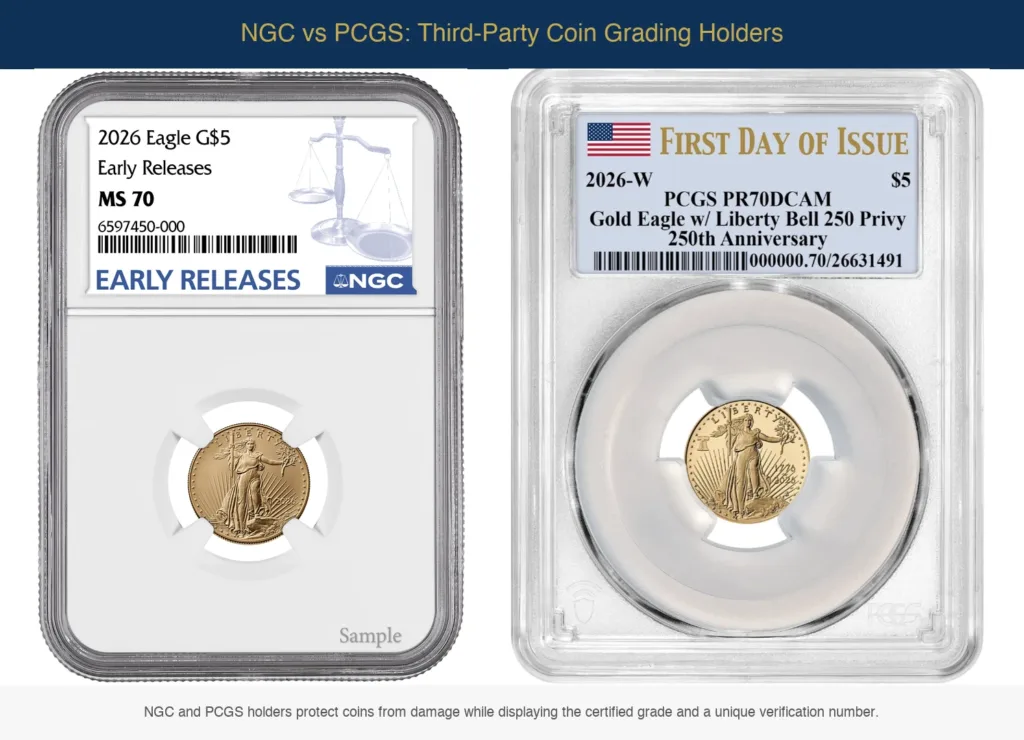
If you have ever bought or sold a collectible coin, you have probably seen those small, tamper-evident plastic holders with labels that read “NGC MS-65” or “PCGS PR-69.” Those labels are not just marketing. They represent an independent, expert assessment of a coin’s authenticity and physical condition, and they can mean the difference between a $50 coin and a $50,000 coin. Understanding how NGC and PCGS Coin Grading and authentication actually works is one of the most practical things a collector or precious metals investor can learn.
Third-party grading transformed the rare coin market in the 1980s. Before that, buyers had to trust a dealer’s word about a coin’s condition. Price disagreements were constant, and counterfeits slipped through more easily. Today, coins certified by Numismatic Guaranty Company (NGC) or Professional Coin Grading Service (PCGS) trade with far more confidence, backed by financial guarantees that put real money behind every grade assigned.
The Origins of Third-Party Coin Grading
PCGS came first. In 1985, a group of leading numismatic experts recognized that the rare coin market needed a universal grading standard. At the time, one dealer might call a coin “Gem Uncirculated” while another called the same coin “Choice.” This inconsistency made it nearly impossible to buy sight-unseen with any confidence. PCGS launched in 1986 as the first service to encapsulate coins in sealed holders with a standardized grade printed on the label. The concept was simple but powerful: remove the subjectivity by having impartial experts examine every coin, then seal their verdict in a tamper-evident package.
NGC followed in 1987, and the two services have operated as the industry’s dominant grading authorities ever since. NGC is now the world’s largest third-party coin grading service, having certified more than 70 million coins from virtually every country. PCGS, a division of Collectors Universe, Inc., maintains a similarly enormous database and is known for its PCGS3000 index, which tracks the overall performance of the rare coin market much like the S&P 500 tracks stocks.
Both companies are headquartered in the United States. NGC operates out of Sarasota, Florida, as part of the Certified Collectibles Group. PCGS is based in Newport Beach, California. Neither company buys or sells coins commercially. NGC explicitly states that its full-time graders do not trade coins, and strict internal procedures prevent consultants from influencing grades on their own submissions. This separation between grading and dealing is what gives the system its credibility.
The Sheldon Scale: The Language of Coin Grading
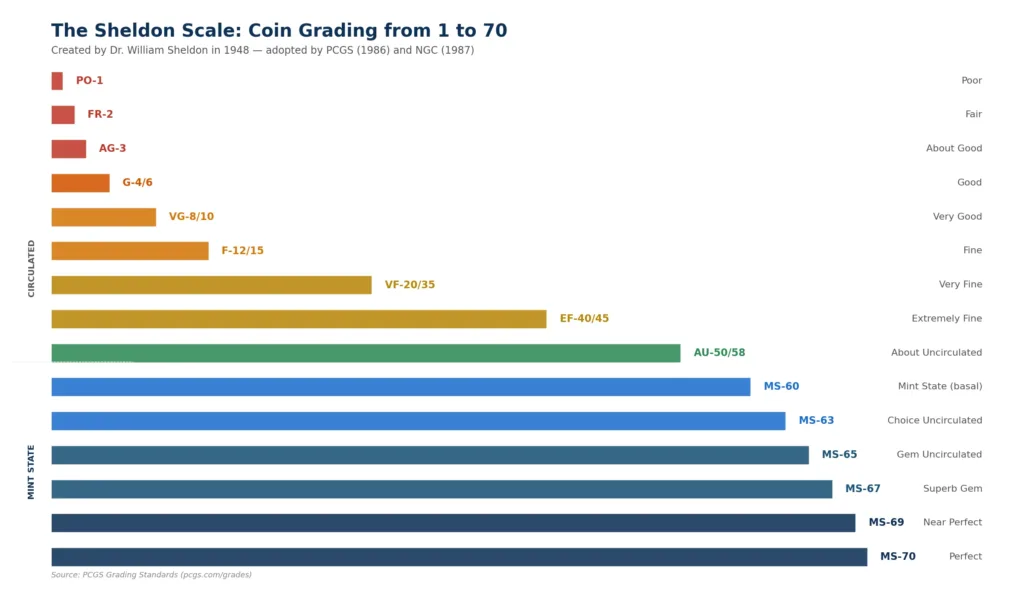
Every grade assigned by NGC and PCGS is based on the Sheldon Scale, a 70-point system created by Dr. William Sheldon in 1948. Sheldon originally designed the scale so that a coin graded 70 would be worth roughly 70 times more than one graded 1. While the math no longer works that neatly, the coin grading scale 1 to 70 remains the universal language of numismatics.
At the bottom, a coin graded Poor-1 (PO-1) is barely identifiable as to type. At the top, Mint State 70 (MS-70) or Proof 70 (PR-70) is considered perfect: fully struck and lustrous with no visible marks even under magnification. Most collectible coins fall in between. An MS-65 (“Gem Uncirculated”) is well struck with only minor marks outside focal areas, while an MS-63 (“Choice Uncirculated”) might show moderate contact marks or slightly reduced luster.
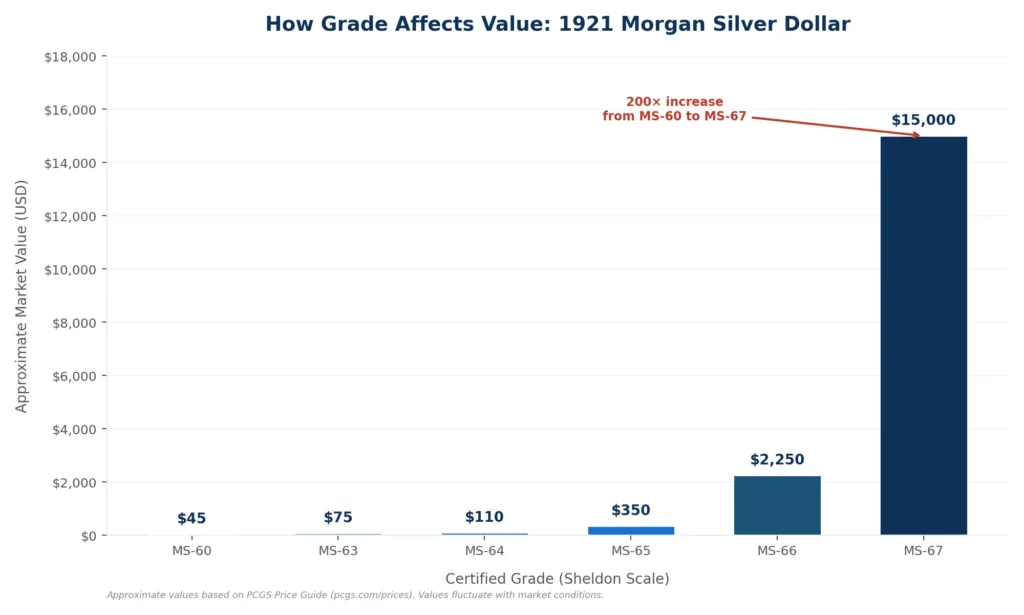
What makes grading so consequential is that seemingly small differences in grade can produce enormous differences in price. According to PCGS Price Guide data, a 1921 Morgan Silver Dollar in MS-63 might sell for around $75, while the same coin in MS-67 can command $15,000 or more. That is the power of two or three grade points on the Sheldon Scale.
How the Grading Process Works
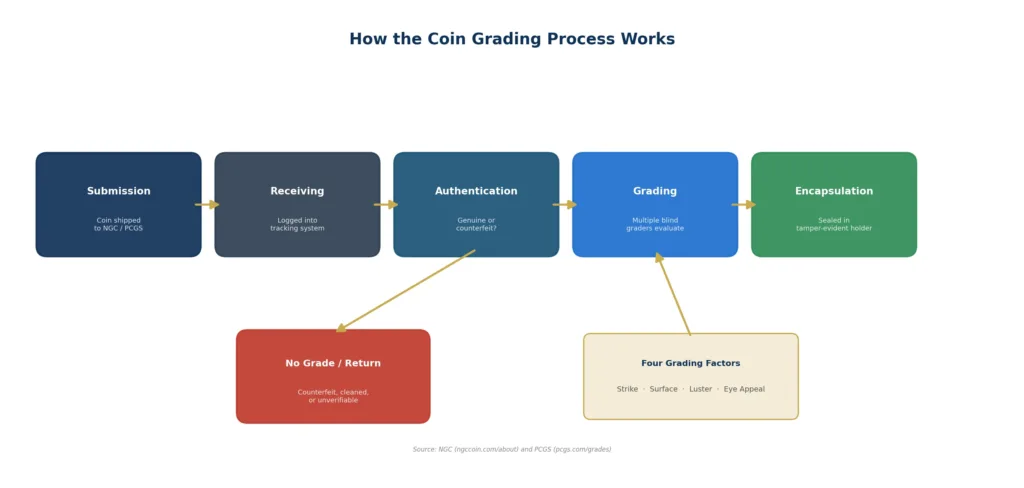
When you submit a coin to NGC or PCGS, it goes through a multi-step process designed to ensure accurate and consistent results. The workflow at both companies follows a similar pattern, though the exact internal details are proprietary.
First, the coin is received and logged into the company’s tracking system. At NGC, for example, coins are securely stored upon arrival until the contents of each submission are confirmed and entered into the database. Next, multiple expert graders examine the coin independently. NGC employs more than 30 full-time graders plus outside consultants, and the grading team evaluates each coin without knowing what grade the others have assigned. This “blind” approach reduces the potential for bias. PCGS follows a comparable multi-grader process.
The graders assess four main factors: strike quality (how well the design was impressed into the metal), surface preservation (marks, scratches, and hairlines), luster (the original mint shine), and eye appeal (the overall visual impression). For proof coins, the mirror-like fields and the frosted design elements receive special attention. Once the graders reach a consensus, the coin is assigned a numerical grade and sealed in the company’s proprietary tamper-evident holder, sometimes called a “slab.”
If the graders determine that the coin is not genuine, the submission is returned unholdered. PCGS uses a “No Grade” system with specific codes: code 90 indicates a counterfeit, code 92 indicates cleaning, and code 86 means authenticity could not be verified. Coins that are genuine but have been improperly cleaned, repaired, or otherwise altered receive a “Details” grade, which describes how much wear the coin shows but signals that something about the coin’s surfaces is not original.
Authentication and Counterfeit Detection
Grading is only half the equation. The other critical function that NGC and PCGS perform is coin authentication, which means verifying that a coin is genuinely what it claims to be. This has become increasingly important in recent years as sophisticated counterfeits, particularly those produced in China, have flooded online marketplaces.
Professional graders use a combination of techniques to spot fakes. They examine weight and dimensions for deviations from known specifications, study die characteristics under magnification against authenticated reference examples, and evaluate the metal’s surface texture and luster. Counterfeit coins struck from cast molds or transfer dies often show telltale “mushy” details or incorrect surface flow lines. NGC also offers a metallurgic analysis service that performs a composition surface scan for coins with non-standard metal composition.
Both services offer free online verification tools. Anyone who purchases a certified coin can visit PCGS Cert Verification or NGC Cert Lookup and enter the certification number from the holder’s label. The database returns the coin’s description, grade, and often high-resolution images, allowing buyers to confirm that the coin in hand matches the coin that was actually graded. This verification step is essential for counterfeit coin detection, because fraudsters sometimes create counterfeit holders or swap coins after certification.
Why Certified Coins Command Higher Prices
The market consistently pays more for certified coins than for “raw” (ungraded) coins of similar quality. There are several reasons for this, and they all come back to trust and liquidity.
First, certification removes the guesswork. When a dealer buys a raw coin, they have to make their own assessment of its grade and authenticity, and they factor in a margin for error. With a graded coin, that uncertainty disappears. The PCGS Guarantee backs every graded coin with a commitment to pay current market value if a certification is later found to be inaccurate or if the coin turns out to be counterfeit. NGC offers a comparable guarantee that provides remedies including full market value payment in the rare event of an overgrade or misidentification. These financial backstops give dealers and auction houses the confidence to trade certified coins sight-unseen.
Second, population data creates transparency. Both PCGS and NGC publish population reports showing exactly how many coins of each date and grade they have certified. The PCGS Population Report is publicly searchable, and it helps collectors understand just how rare a particular grade is for a given issue. When you know that only 12 examples of a specific coin have ever been graded MS-67, you understand why that coin commands a premium far beyond the next grade down.
Third, auction records consistently show that NGC and PCGS coins achieve stronger prices. NGC notes that many of its certified coins have broken the $1 million barrier at auction, including the first Chinese coin ever to achieve that milestone. PCGS Auction Prices Realized provides a searchable database of past sales for certified coins, giving buyers and sellers real market data to inform their decisions.
NGC vs PCGS: Choosing a Grading Service
Collectors and dealers often ask which service is “better,” and the honest answer is that both NGC and PCGS are highly respected and widely accepted. The choice often comes down to personal preference, specific collecting goals, and practical considerations like turnaround times and fees.
NGC’s current fee structure starts at $20 per coin for modern issues (1965 to present) with a 24-day turnaround, and goes up to $350 plus 1% of fair market value for unlimited WalkThrough service with a 3-day turnaround. A $10 handling fee applies to all NGC submissions. PCGS fees follow a similar tiered model, with economy non-gold submissions at 45 business days, regular service at 30 business days, and WalkThrough at 5 business days.
NGC is the official grading service of the American Numismatic Association (ANA), the only coin collecting organization chartered by the U.S. Congress, and the Professional Numismatists Guild (PNG). PCGS is known for innovations like its plus grades (awarded to coins with exceptional eye appeal in the top 30% of a grade, available from XF-45 through MS/PR-68) and its CoinFacts research database. NGC invested more than $1 million in developing its holder, which is used by the Smithsonian Institution and other museums for long-term coin preservation.
In practical terms, most serious collectors submit to both services depending on the coin and the market. Some series trade at slight premiums in one holder versus the other, but these differences tend to be minor. What matters most is that the coin is in a genuine holder from either company, properly graded and authenticated.
What This Means for Precious Metals Investors
If you primarily buy gold and silver bullion for its metal value, you might wonder whether third-party coin grading is relevant to you. The answer depends on what you are buying. Standard bullion coins like American Gold Eagles or Silver Maple Leafs in typical uncirculated condition do not usually justify the cost of professional grading, unless they are in exceptional MS-69 or MS-70 condition and you plan to sell to collectors rather than simply redeeming the metal content.
However, if you are building a collection that includes older or rarer coins, or if you are buying coins in the secondary market where the risk of counterfeits is higher, certification from NGC or PCGS provides essential protection. The coin authentication alone is worth the grading fee when you consider that a single counterfeit coin could represent a loss of thousands of dollars.
Conclusion
The coin grading system built by NGC and PCGS over the past four decades has fundamentally changed how collectors and investors buy and sell coins. By establishing transparent, standardized grading on the Sheldon Scale and backing every certification with a financial guarantee, these two companies have brought trust and liquidity to a market that once operated largely on handshake deals. Whether you are purchasing your first silver dollar or evaluating a six-figure rarity, understanding how authentication and grading work is not just useful knowledge. It is essential protection for your investment.
