
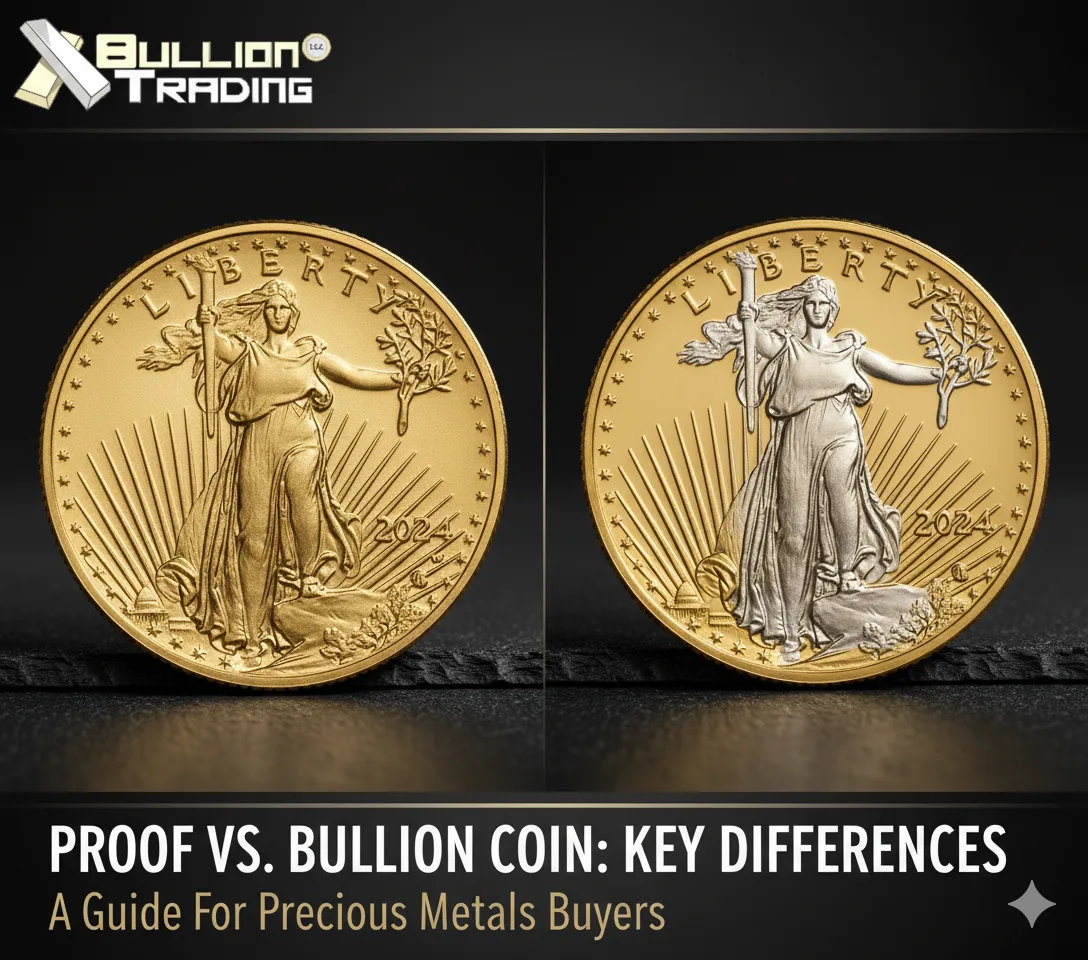

If you’ve ever browsed a dealer’s inventory and wondered why two coins that look nearly identical carry wildly different price tags, you’ve probably stumbled into the proof coin vs bullion coin divide. Both contain the same precious metal. Both are legal tender. And both come from the same government mints. Yet a proof coin can cost significantly more than its bullion counterpart, and the reasons go well beyond simple aesthetics.
Understanding the difference between a proof coin and a bullion coin is one of the most practical things you can learn as a precious metals buyer. Whether you’re building a collection for the long haul or stacking ounces purely for their metal value, knowing what you’re actually paying for helps you avoid overpaying and make decisions that align with your goals.
What Exactly Is a Bullion Coin?
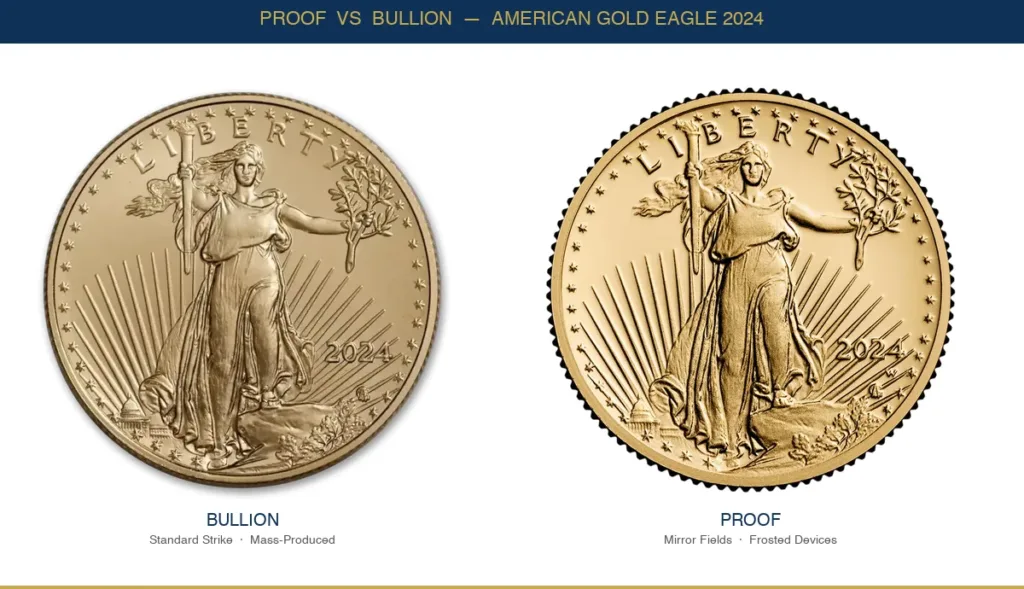
A bullion coin is a coin produced by a government mint whose value is tied primarily to its precious metal content rather than any collector premium. When investors talk about buying gold or silver, they’re almost always referring to bullion coins. These coins are mass-produced, widely available, and priced based on the current spot price of the underlying metal plus a dealer markup.
The American Gold Eagle, first released by the United States Mint in 1986, is a textbook example. Available in 1/10 oz, 1/4 oz, 1/2 oz, and 1 oz denominations, these coins contain their stated weight in gold alloyed with small amounts of silver and copper for durability. The coin carries a face value ($5 to $50 depending on size), but its actual market value reflects the gold content. In March 2026, a one-ounce American Gold Eagle trades at a price tied to the gold spot market, currently well above $4,500 per ounce.
Other well-known bullion coins include the Canadian Gold Maple Leaf, the South African Krugerrand, the British Britannia, and the Austrian Philharmonic. On the silver side, the American Silver Eagle has been the U.S. government’s official silver bullion coin since its debut in November 1986.
Bullion coins are not sold directly to the public by the U.S. Mint. Instead, they’re distributed through a network of authorized purchasers, typically large banks, brokerage firms, and wholesale dealers, who then sell to retailers. Authorized purchasers must maintain a net worth of at least $5 million and order a minimum of 25,000 Silver Eagles per transaction, according to U.S. Mint distribution guidelines.
What Makes a Proof Coin Different?
The word “proof” refers to a minting process, not the condition of a coin. This is one of the most common misunderstandings among newer buyers. A proof coin isn’t simply a coin in excellent shape. It’s a coin that was manufactured using a specialized, labor-intensive technique that produces a distinctly superior visual result.
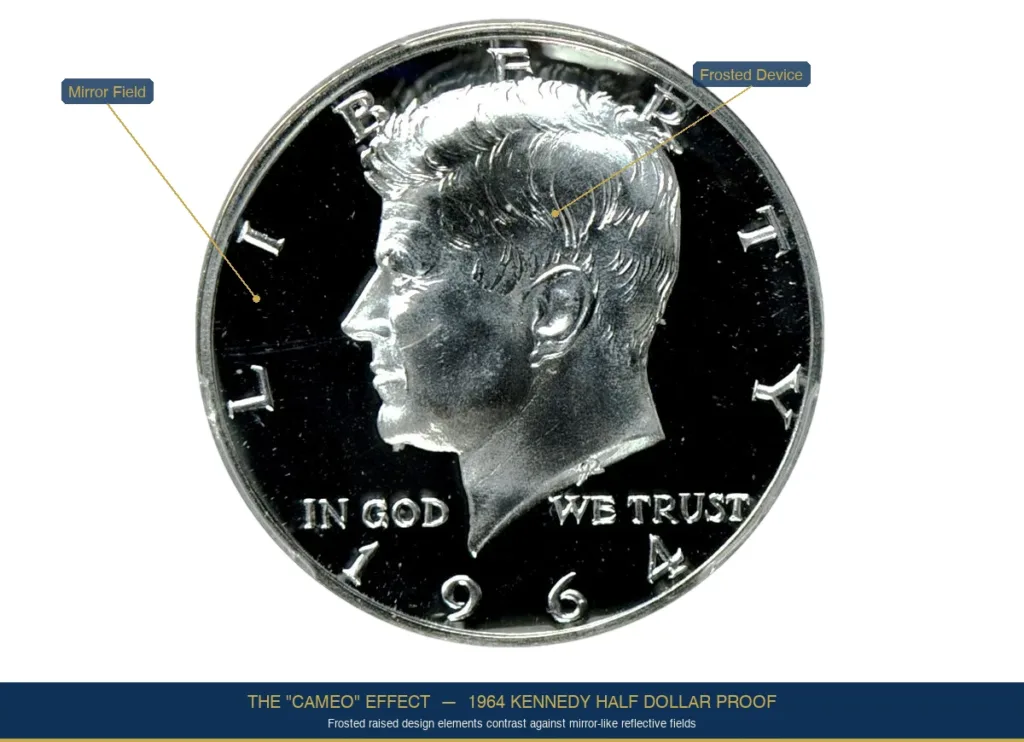
According to numismatic standards, proof coins are struck using dies that have been specially polished, often chemically treated, to create a contrast between frosted design elements and mirror-like fields (the flat background areas). The planchets, or blank metal discs, are also individually polished before striking. Most proof coins are then double-struck under higher pressure than standard bullion coins, which produces sharper, more fully realized design details.
After being struck, each proof coin is individually handled and inspected, a stark contrast to bullion coins, which are collected in bins by the hundreds. This careful handling is why proof coins consistently exhibit pristine surfaces free of the bag marks and contact abrasions that are common on bullion pieces.
The result is visually striking: the raised portions of the design appear frosted, almost white, while the background gleams like a mirror. Collectors call this the “cameo” effect, and when the contrast is especially deep and consistent, grading services designate it “deep cameo” (DCAM) or “ultra cameo,” which can add further value.
The Minting Process: Where the Real Difference Lies
To really understand why proof coins command higher premiums, it helps to look at how both types move through the mint. A standard bullion coin follows an efficient, high-volume production line. Metal blanks are fed into coining presses, struck once at standard pressure, and dropped into large bins. Speed and volume are the priorities. The U.S. Mint has produced over a million American Silver Eagle bullion coins in a single month during periods of strong demand, and in years like 2015, total Silver Eagle bullion production exceeded 47 million coins.
Proof coin production is essentially the opposite philosophy. The San Francisco Mint has been used almost exclusively for proof coinage since 1975, and the West Point Mint handles proof American Eagle production. At these facilities, each proof blank is hand-loaded into the press, struck multiple times to ensure every design element is fully rendered, and then carefully removed by hand. The dies themselves receive frequent replacement because the polishing and chemical treatment that creates the mirror finish degrades faster than on standard dies.
This labor-intensive process is reflected in mintage numbers. While the U.S. Mint has produced hundreds of thousands to millions of bullion Gold Eagles annually (1,362,650 one-ounce bullion coins in 1986 alone), proof Gold Eagle mintages are dramatically lower. In 2024, the Mint produced only 8,129 one-ounce proof Gold Eagles, compared to 308,000 one-ounce bullion versions. That ratio, roughly 38 bullion coins for every single proof, illustrates just how limited proof production really is.
Pricing and Premiums: What You’re Actually Paying For
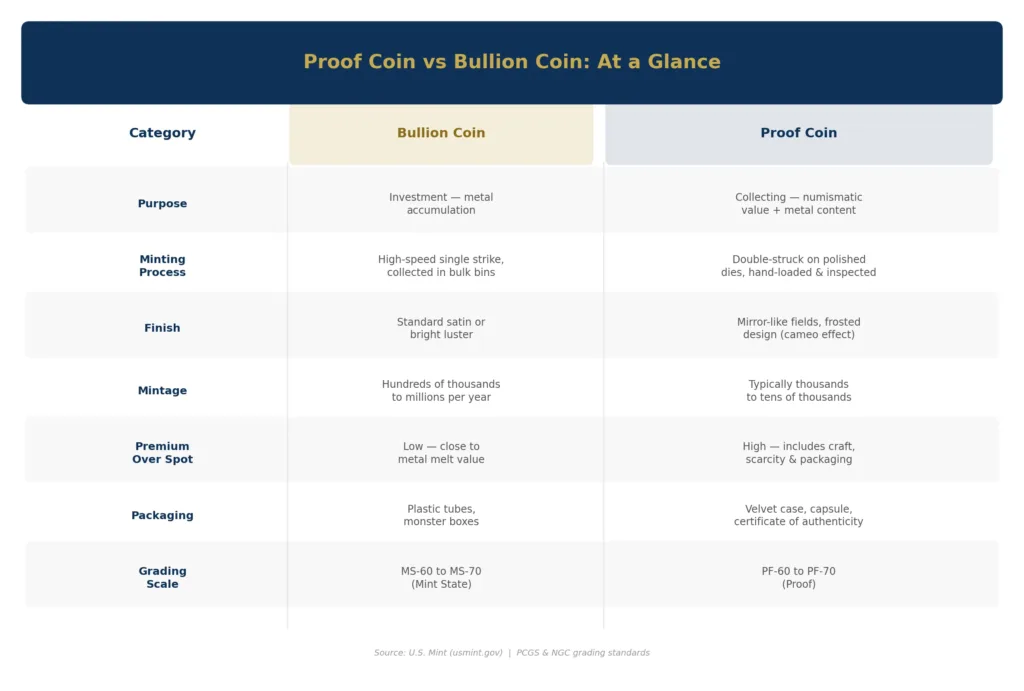
The premium on a bullion coin is relatively straightforward. You pay the current spot price of the metal plus a small markup that covers the mint’s production cost, the dealer’s margin, and shipping. For popular coins like the American Gold Eagle or Silver Eagle, this premium over spot is typically modest and transparent. Bullion investors focus on getting as close to spot as possible because their return depends on the metal price rising over time.
Proof coin pricing works differently. You’re paying for the metal content, yes, but also for the craftsmanship, the limited mintage, the special packaging, and the certificate of authenticity that comes directly from the mint. The U.S. Mint sells proof coins at a fixed price that already includes a substantial premium over spot.
Here’s where it gets interesting for buyers weighing their options. A bullion American Gold Eagle’s resale value tracks closely with the gold price. If gold goes up 10%, your coin’s value goes up roughly 10%. A proof coin’s value, however, can move independently of the metal price. Low-mintage proof issues can appreciate significantly based on collector demand alone. The 1995-W Proof Silver Eagle, which was sold only as part of a 10th Anniversary set with a mintage of just 30,125, has traded for thousands of dollars on the secondary market, far above the value of its one ounce of silver.
That said, proof premiums can also shrink. If you buy a common-date proof coin at a high premium and collector interest fades, you could find yourself underwater even if the metal price holds steady. This is the fundamental trade-off: bullion gives you pure metal exposure with low premiums, while proof coins offer potential numismatic upside alongside metal value but at a higher entry cost.
Grading and Authentication
Both proof and bullion coins can be professionally graded by services like PCGS (Professional Coin Grading Service) and NGC (Numismatic Guaranty Company), but the grading scales are different. Bullion coins are graded on the Mint State (MS) scale, from MS-60 to MS-70, where MS-70 represents a perfect coin with no visible imperfections under 5x magnification. Proof coins are graded on the Proof (PF or PR) scale, from PF-60 to PF-70, using criteria specific to proof characteristics like the quality of the mirror fields and the depth of the cameo contrast.
A PF-70 Deep Cameo (or Ultra Cameo) coin sits at the top of the grading hierarchy for proofs, indicating a perfect coin with maximum contrast between frosted devices and mirror-like fields. These top-graded coins can carry significant premiums above even their standard proof counterparts, particularly for older or lower-mintage dates.
For bullion investors who plan to hold coins long-term without grading, the distinction is mostly academic. But if you’re buying proof coins with an eye toward resale value, understanding grading becomes essential because the difference between a PF-69 and PF-70 can translate to hundreds or even thousands of dollars on key dates.
Packaging and Presentation
Another visible difference between proof and bullion coins is how they arrive. Bullion coins are functional. Silver Eagles ship in green “monster boxes” containing 500 coins packed into 25 plastic tubes. Gold Eagles come sealed in rolls. There’s nothing fancy about the packaging because the value is in the metal, not the presentation.
Proof coins are treated like the premium products they are. The U.S. Mint packages proof American Eagles in protective plastic capsules mounted in satin-lined, velvet-covered presentation cases, accompanied by a certificate of authenticity. This packaging isn’t just aesthetic. It protects the coin’s delicate mirror finish from the handling damage that would lower its grade and therefore its value.
Special Variants: Reverse Proof and Burnished Uncirculated
Beyond the standard proof and bullion categories, the U.S. Mint also produces special finishes that occupy a middle ground. Reverse proof coins flip the standard proof finish: the fields are frosted and the design elements are mirror-like, the exact opposite of a regular proof. The Mint first released a Reverse Proof Silver Eagle in 2006 to celebrate the program’s 20th anniversary, and these limited releases have become highly sought after.
Burnished Uncirculated coins (sometimes called “W Uncirculated”) represent another category. Produced at West Point since 2006, these coins are struck on specially burnished blanks that give them a soft, satin-like finish distinct from both proof and standard bullion coins. They carry the “W” mint mark and are sold directly by the Mint, with mintages that are typically even lower than proofs. The 2025-W Uncirculated Gold Eagle, for example, had a last known sales figure of just 2,194 coins, making it one of the lowest-production Gold Eagle issues of any type.
Which Should You Buy?
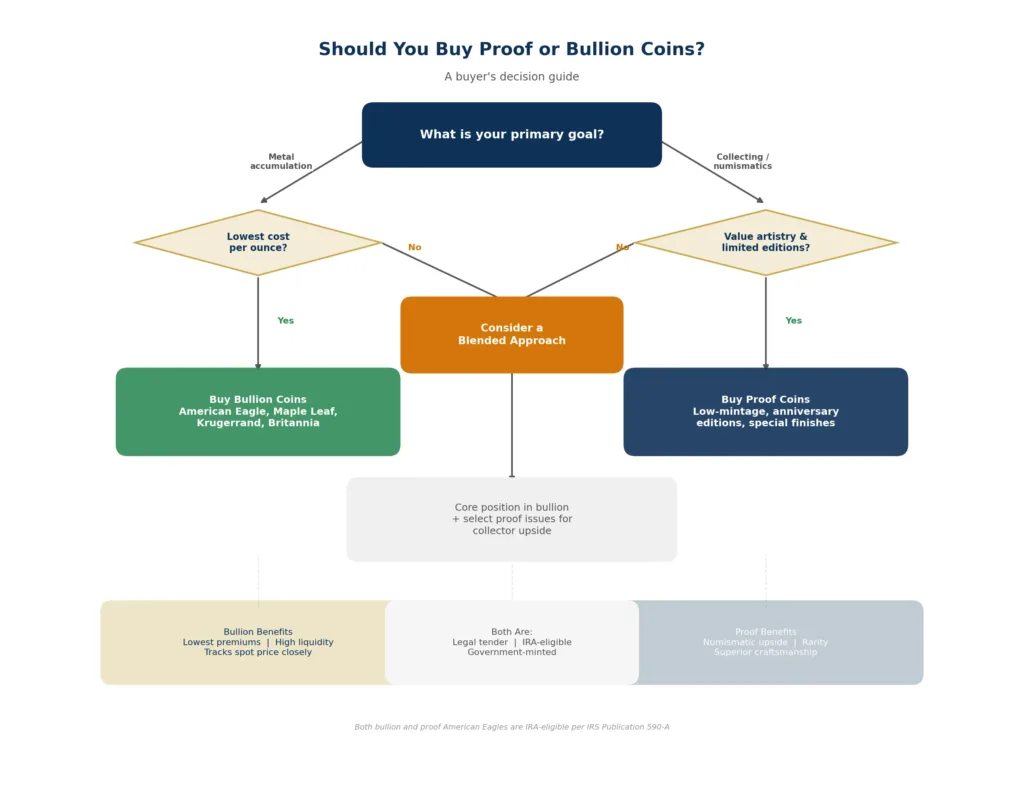
The answer depends entirely on what you’re trying to accomplish. If your primary goal is accumulating precious metal at the lowest possible cost per ounce, bullion coins are the clear choice. Their lower premiums mean more of your money goes directly into metal, and their high liquidity makes them easy to buy and sell at prices closely tied to the spot market. Dealers worldwide recognize and trade American Gold Eagles, Silver Eagles, Maple Leafs, and other major bullion coins without hesitation.
If you enjoy the artistry of coins, appreciate limited-edition pieces, or want to build a collection that may appreciate beyond the metal’s value, proof coins offer something bullion doesn’t. The combination of superior craftsmanship, lower mintages, and collector demand creates a secondary market value that can, in certain cases, far exceed the underlying metal content. Just recognize that this numismatic premium is not guaranteed to grow and can be influenced by factors unrelated to precious metals markets.
Many experienced buyers take a blended approach. They build a core position in bullion coins for their metal exposure and supplement it with select proof issues, particularly low-mintage or anniversary editions, that they believe carry long-term collector appeal. This strategy allows you to benefit from rising metal prices while also participating in the potentially lucrative world of numismatics.
One practical consideration worth mentioning: both bullion and proof American Eagles are eligible for inclusion in a precious metals IRA, as confirmed by IRS Publication 590-A. This means your choice between proof and bullion doesn’t limit your retirement account options, though IRA custodians may have specific product requirements worth confirming in advance.
The Bottom Line
The difference between a proof coin and a bullion coin comes down to how it was made, why it was made, and what you pay for it. Bullion coins are straightforward investment vehicles designed to deliver precious metal exposure at the lowest possible premium. Proof coins are precision-struck collectibles that combine metal value with numismatic craftsmanship and limited-production appeal. Neither is inherently “better” than the other. They serve different purposes, and the right choice depends on your goals.
