


The relationship between Federal Reserve policy and gold prices has never been more closely watched than it is today. With gold recently trading around $3,374 per ounce after a solid 25% surge since early 2025, investors are asking a critical question: what happens next when the Fed finally moves on interest rates?
[IMAGE SUGGESTION: Interactive chart showing gold price movement from January 2024 to August 2025, with key Fed meeting dates marked as vertical lines and annotations for major policy announcements]
The answer isn’t straightforward, but understanding the mechanics behind this relationship can help investors position themselves for whatever comes next.
The Current Landscape: A Fed Signaling Potential Cuts
The Federal Reserve held its benchmark rate in the 4.25 ato 4.5 percent range during its most recent July meeting, but recent communications suggest a shift in tone. Federal Reserve Chair Jerome Powell recently indicated at Jackson Hole that conditions “may warrant” interest rate cuts, sending markets higher and signaling a more dovish stance than previously maintained.
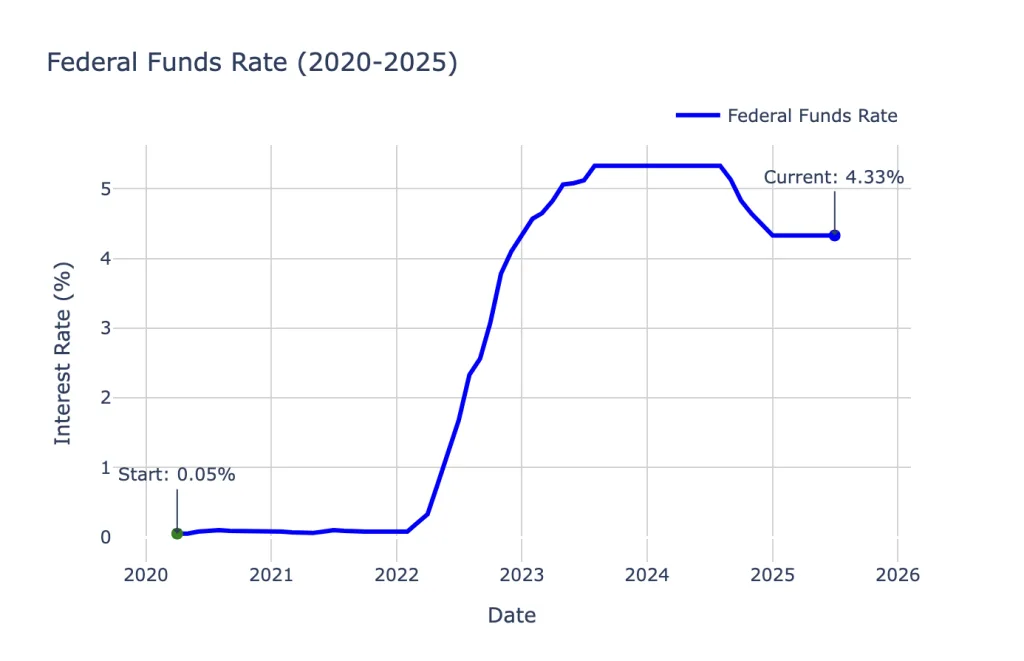
This measured but increasingly accommodative approach reflects the complexity of the current economic environment. Fed officials have expressed growing concerns about labor market conditions while inflation pressures have shown signs of moderating. The July Fed meeting minutes revealed a divergence of opinion among central bankers, with some governors advocating for cuts despite the majority’s decision to hold rates steady.
For gold investors, this evolving Fed stance has created both opportunity and anticipation. When Powell hinted at possible rate cuts in late August, gold prices responded favorably, demonstrating the market’s sensitivity to even subtle shifts in Fed communications. The precious metal has maintained strength around current levels, suggesting investor confidence in gold’s outlook amid potential policy changes.
Understanding the Interest Rate-Gold Dynamic
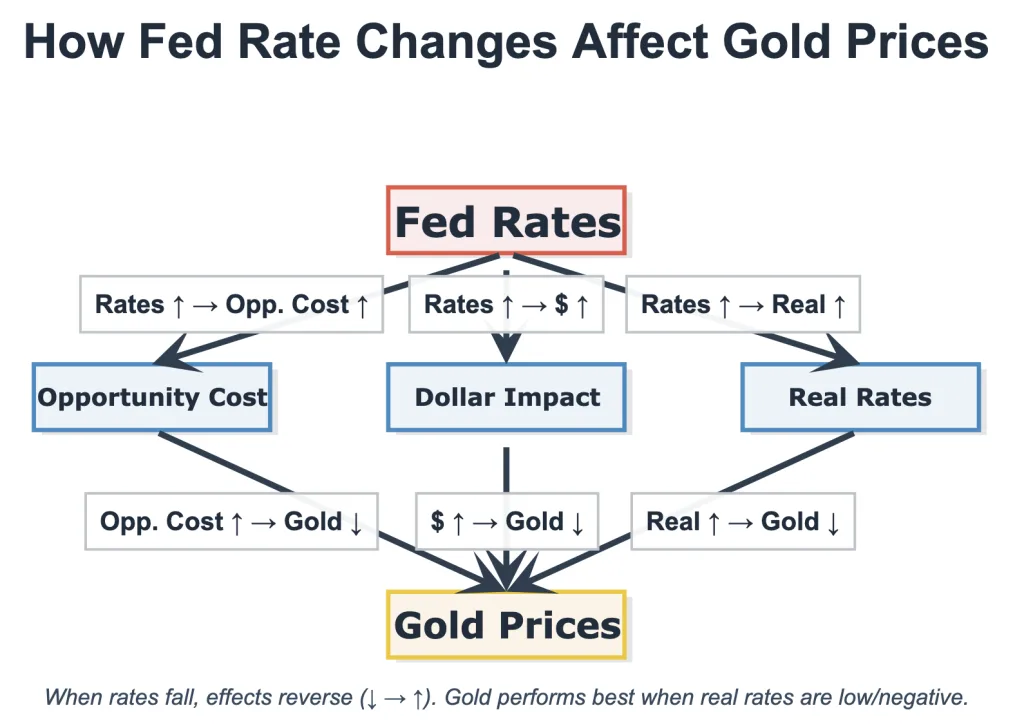
The relationship between interest rates and gold prices operates through several interconnected channels, each worth understanding for investors trying to time their precious metals allocations.
The Opportunity Cost Factor
When interest rates rise, bonds and savings accounts become more attractive relative to gold, which doesn’t pay interest or dividends. This creates what economists call an “opportunity cost” for holding gold. Conversely, when rates fall, that opportunity cost diminishes, making gold more appealing.
This principle has played out consistently throughout monetary history. During the 1970s, when real interest rates (rates minus inflation) were negative, gold soared from $35 to over $800 per ounce. In contrast, the high real interest rates of the 1980s and 1990s kept gold subdued for decades.
The Dollar Connection
Fed policy also affects gold through its impact on the U.S. dollar. Higher interest rates typically strengthen the dollar by making dollar-denominated assets more attractive to international investors. Since gold is priced in dollars globally, a stronger dollar makes gold more expensive for buyers using other currencies, reducing demand.
Recent market action has demonstrated this relationship clearly, though geopolitical tensions and trade concerns have complicated the traditional correlation patterns, sometimes supporting both the dollar and gold simultaneously.
Inflation Expectations and Real Rates
Perhaps most importantly for current markets, Fed policy shapes inflation expectations, which directly influence real interest rates. Gold tends to perform best when real rates are low or negative, as this preserves gold’s role as an inflation hedge while minimizing the opportunity cost of ownership.
The Data That Drives Fed Decisions
To anticipate Fed moves and their gold market impact, investors need to understand what data policymakers prioritize when making their decisions.
Employment Reports: The Fed’s Primary Focus
Monthly jobs reports carry enormous weight in Fed deliberations. Recent labor market data has shown signs of softening, which has contributed to the Fed’s more dovish recent rhetoric. The Fed’s dual mandate requires balancing employment and inflation objectives, and current data suggests growing concern about the employment side of that equation.
[EMPLOYMENT CHART SUGGESTION: Multi-panel chart showing key employment metrics (unemployment rate, job openings, wage growth) over the past 3 years, with trend lines and Fed meeting dates marked]
This employment data creates a complex dynamic for gold. Weaker job growth supports the case for rate cuts, which would be bullish for gold. However, if employment weakness signals broader economic problems, it could also create complex cross-currents in precious metals markets.
Inflation Metrics: Progress Toward the 2% Target
Recent inflation data has provided some relief to policymakers, showing progress toward the Fed’s 2% target. This improvement in inflation metrics, combined with labor market concerns, has created the conditions that Powell referenced when suggesting rate cuts may be warranted.
The Fed uses multiple inflation measures, with the personal consumption expenditures price index being their preferred gauge, though CPI and producer price index data also feed into their calculations.
For gold investors, the key isn’t just the headline inflation number, but how it compares to interest rates. When inflation runs above interest rates, creating negative real rates, gold becomes significantly more attractive as a store of value.
What Fed Rate Cuts Could Mean for Gold
Market participants are increasingly focused on when, not if, the Fed will begin cutting rates. Powell’s recent comments have shifted expectations, with many now anticipating cuts in the coming months. The implications for gold depend heavily on the reasons behind those cuts and the broader economic context.
The Goldilocks Scenario
The most bullish scenario for gold would be Fed rate cuts driven by confidence that inflation is under control, combined with a desire to support economic growth while maintaining full employment. This would lower opportunity costs while maintaining gold’s inflation-hedging appeal.
Historical precedent supports this view. During previous rate-cutting cycles that occurred amid stable economic conditions, gold has often performed exceptionally well. The current environment, with inflation showing progress and the Fed signaling flexibility, could mirror these favorable conditions.
The Recession Hedge Consideration
However, if rate cuts come in response to serious economic deterioration, the initial market reaction might be more complex. While gold often benefits from monetary easing, severe economic stress can initially drive investors toward cash and Treasury securities.
The key difference in 2025 is that gold has already established itself at elevated levels, suggesting investors are positioned for various scenarios, including both soft-landing and recession outcomes.
Central Bank Behavior: A Supporting Factor
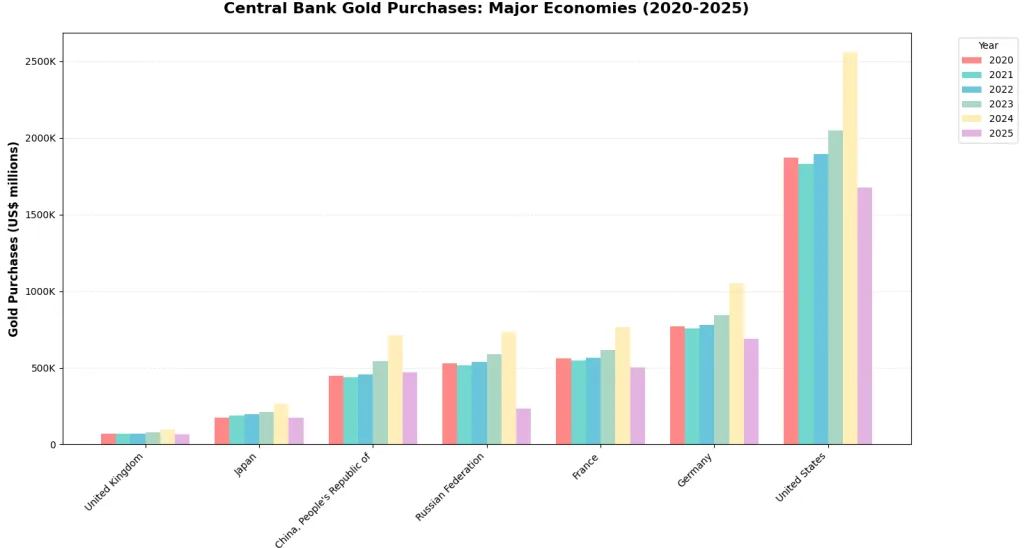
Beyond Fed policy, the actions of other central banks around the world provide crucial context for gold’s outlook. Central bank gold demand has been a major supporting factor for gold prices in recent years, as countries seek to diversify their reserves away from dollar-denominated assets.
While this demand may fluctuate in the short term, the underlying drivers—concerns about currency debasement, geopolitical tensions, and financial system stability—remain intact. The combination of potential Fed rate cuts and ongoing central bank interest creates a supportive backdrop for gold.
Practical Implications for Investors
Understanding these dynamics helps inform practical investment decisions, though timing the market perfectly remains challenging even for professional traders.
Dollar-Cost Averaging vs. Tactical Timing
For many investors, the complexity of Fed policy timing argues for a dollar-cost averaging approach to gold accumulation. Rather than trying to predict exactly when rate cuts will occur, systematic purchases can smooth out volatility while ensuring exposure to gold’s long-term benefits.
However, investors comfortable with tactical positioning might consider the current environment favorable, given Powell’s recent dovish signals and the technical strength gold has shown at current levels.
Portfolio Context Matters
Gold’s response to Fed policy also depends on what’s happening with other assets. In an environment where traditional correlations are breaking down due to geopolitical stress and monetary policy uncertainty, gold’s diversification benefits become more pronounced.
The current backdrop of elevated geopolitical tensions, ongoing concerns about debt sustainability, and central bank policy divergence suggests gold may maintain its appeal across various Fed policy scenarios.
Looking Ahead: Key Dates and Catalysts
Several upcoming events will provide crucial insights into Fed thinking and gold’s likely trajectory:
The next Fed meeting in September will be closely watched for any concrete moves toward rate cuts, especially given Powell’s recent comments about conditions potentially warranting such action.
Monthly employment and inflation reports will continue shaping market expectations for Fed action. The Fed has indicated they’re watching these data points closely as they consider their next moves.
International developments, including ongoing trade tensions and geopolitical conflicts, may also influence both Fed calculations and gold demand simultaneously.
The Historical Perspective
We’re living through an unprecedented period in monetary history, with global debt levels at record highs and central banks operating with limited traditional policy tools. This environment suggests that regardless of Fed policy in the short term, the longer-term case for gold remains compelling.
The same forces that drove ancient civilizations to value precious metals—the need for assets that maintain value across different political and economic systems—remain relevant today. Modern investors can benefit from this historical perspective when building portfolios designed for uncertain times.
The Bottom Line for Gold Investors
The Fed’s evolving stance toward potential rate cuts creates a generally supportive environment for gold, especially given current price levels around $3,374 per ounce represent a more moderate advance than initially reported. Powell’s recent dovish signals suggest the policy backdrop is becoming more favorable for precious metals.
What seems clear is that the current environment of policy uncertainty, elevated debt levels, and ongoing geopolitical tensions creates a supportive backdrop for gold ownership. Investors focused on long-term wealth preservation may find that gold’s historical role as portfolio insurance remains as relevant today as it was for previous generations.
For those considering precious metals investments, the key is understanding that Fed policy is just one factor among many that influence gold prices. While it’s an important factor, the broader case for portfolio diversification and protection against monetary risk transcends any single policy cycle.
Whether interest rates rise or fall, the fundamental case for owning real, tangible assets remains compelling, particularly in an era of unprecedented monetary policy experimentation and geopolitical uncertainty.
