
In late January 2021, a group of retail traders on Reddit’s r/WallStreetBets forum had just sent GameStop’s stock price into the stratosphere. Energized by the power of collective action, a new idea began circulating on the subreddit: what if they could do the same thing to silver? The posts spread fast. Within hours, the iShares Silver Trust ETF saw record inflows, coin dealers were overwhelmed with orders, and the spot price of silver climbed to an eight-year high above $30 per ounce. The WallStreetBets silver squeeze of 2021 became the biggest story in precious metals that year. But the outcome was nothing like GameStop, and the reasons why say a lot about how the silver market actually works.
The GameStop Frenzy That Lit the Fuse
To understand how Reddit came for silver, you have to understand what happened with GameStop first. In January 2021, the subreddit r/WallStreetBets, which had grown from a niche community of roughly two million members to more than six million over the course of a single week, launched what became the most headline-grabbing short squeeze in a generation. Traders on the forum noticed that hedge funds had shorted roughly 140% of GameStop’s available float, a staggering level of short interest that made the stock a textbook candidate for a squeeze.
By coordinating their buying, WallStreetBets users drove GameStop’s share price from under $20 to nearly $500 in a matter of days. Short sellers, most prominently Melvin Capital, suffered billions of dollars in losses. The episode became a cultural flashpoint. When Robinhood and other brokerages restricted GameStop purchases on January 28, the backlash was fierce enough to trigger a congressional hearing on February 18, with Robinhood CEO Vlad Tenev, Citadel CEO Ken Griffin, and investor Keith Gill all called to testify.
The GameStop saga convinced millions of retail investors that collective action could move markets. And it was not long before someone asked: what’s next?
How the Silver Squeeze Took Shape
On January 28, 2021, the same day that brokerages restricted GameStop trading, posts began appearing on WallStreetBets urging members to turn their attention to silver. The argument was simple on its surface: silver had been “manipulated” by major banks for years, the short interest in silver futures was enormous, and a coordinated buying campaign could force a short squeeze similar to what had happened with GameStop.
The idea spread rapidly beyond Reddit. By January 31, the iShares Silver Trust (SLV), the world’s largest silver-backed exchange-traded fund, had absorbed roughly $1 billion in new inflows in a single trading session, one of the largest single-day inflows in the ETF’s history. That flood of money required the fund to purchase millions of additional ounces of physical silver to back its shares.
At the retail level, the response was immediate. Coin-selling websites across the United States and Europe reported unprecedented demand for silver coins and silver bars. Some dealers temporarily suspended new orders. Others added premiums of 30% or more above spot price on popular products like American Silver Eagles and Canadian Maple Leafs.
Why Silver Was a Fundamentally Different Target
The enthusiasm was real, but it overlooked a critical problem: the silver market is nothing like a single stock. GameStop had a relatively small market capitalization and an absurdly overextended short position. Silver, by contrast, is a global commodity market with an estimated value exceeding $1.4 trillion. As FXTM strategist Hussein Sayed told the BBC, the total silver market was roughly “1,000 times the total value of GameStop’s share capital.”
This scale mismatch meant that even billions of dollars in retail buying represented a tiny fraction of the silver market’s overall trading volume. The COMEX futures market alone regularly sees daily volumes equivalent to hundreds of millions of ounces. A large portion of the silver market also operates off-exchange through over-the-counter contracts, making it functionally impossible for retail traders to corner.
The structure of the short interest was also different. In GameStop’s case, short sellers had borrowed more shares than existed in the float, creating a classic squeeze setup. In the silver futures market, short positions are backed by the ability to deliver physical metal or roll contracts forward. Bullion banks use shorts as hedging tools, not naked directional bets, so squeezing them would require absorbing a quantity of physical metal that no retail movement could realistically acquire.
Silver’s Wild Week in Numbers
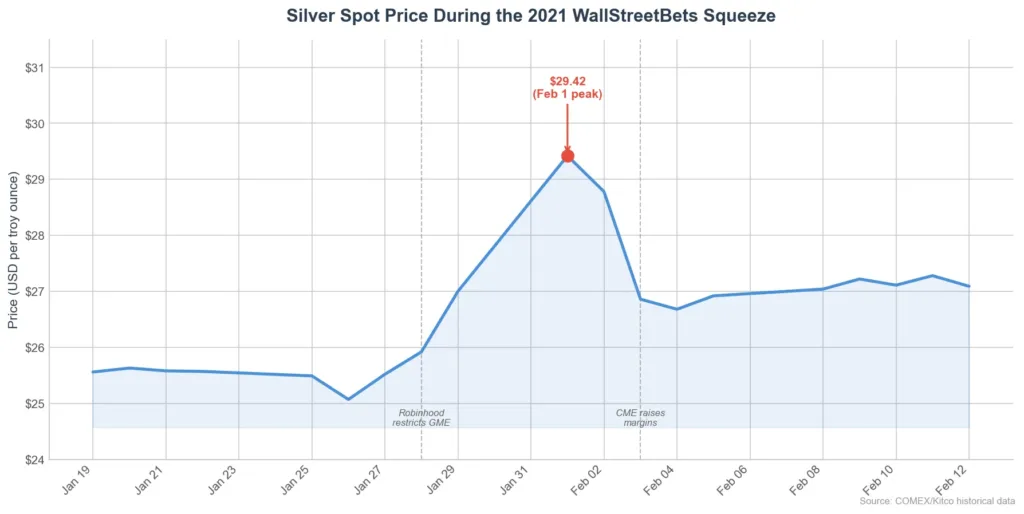
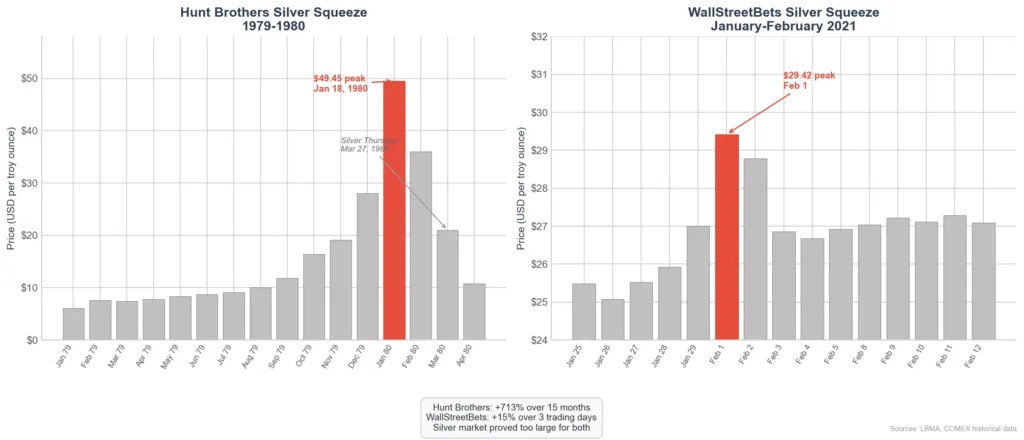
Despite the structural obstacles, the buying frenzy was intense enough to move the needle. On February 1, 2021, silver opened sharply higher and rose as much as 11% to touch $30 per ounce, its highest price in eight years. Silver futures on COMEX surged in early trading, and wall-to-wall media coverage amplified the excitement.
But the rally was short-lived. CME Group, which operates COMEX, raised margin requirements on silver futures, increasing the cost of holding leveraged positions. The move had a chilling effect. By the end of the first trading week of February, silver had retreated to the mid-$26 range, giving back most of its gains.
For physical silver buyers, however, the squeeze had a longer tail. Premiums on retail silver products stayed elevated for weeks, and some dealers reported shipping delays stretching into March. The disconnect between the spot price, which fell quickly, and physical premiums, which lingered, highlighted a recurring theme in precious metals markets: paper prices and physical availability do not always move in lockstep.
“This Is Not Us” – WallStreetBets Pushes Back
One of the most fascinating aspects of the WallStreetBets silver squeeze of 2021 was the fierce backlash it generated within the forum itself. Many prominent users on the subreddit quickly disavowed the silver trade, calling it a distraction planted by hedge funds and institutional players to divert retail attention and capital away from GameStop. Posts calling for a silver squeeze were downvoted, and moderators reportedly removed several of them.
The skeptics had a point. Citadel, the hedge fund at the center of the GameStop controversy due to its relationship with Robinhood and its market-making activities, was known to hold positions in SLV. Some WallStreetBets users argued that buying silver would not hurt Wall Street but would actually help it, enriching the very banks and hedge funds that retail traders believed they were fighting. As documented accounts of the episode note, users on r/WallStreetBets denied involvement in the silver push, instead blaming the increase on institutions and hedge funds with positions in silver, such as Citadel.
The debate over who was really behind the silver push was never fully resolved. Both genuine retail enthusiasm and institutional positioning likely contributed. What is clear is that the WallStreetBets community did not rally behind silver the way it had behind GameStop, and without that unified buying pressure, the squeeze never had the fuel it needed.
The Long Shadow of Silver Manipulation
The silver squeeze tapped into a deep well of public frustration with precious metals markets, and that frustration was not without basis. In September 2020, just four months before the Reddit episode, JPMorgan Chase agreed to pay a record $920.2 million to settle charges brought by the Commodity Futures Trading Commission for manipulative and deceptive conduct in precious metals futures markets. The CFTC found that JPMorgan traders had placed “hundreds of thousands of spoof orders” in gold, silver, platinum, and palladium futures over a period of at least eight years.
The settlement, the largest monetary relief ever imposed by the CFTC, included $311.7 million in restitution, $172 million in disgorgement, and a $436.4 million civil monetary penalty. Several individual traders from JPMorgan’s precious metals desk, including the head of the desk, faced separate criminal prosecution.
For many Reddit traders, the JPMorgan case confirmed what they had long suspected: that major banks were suppressing precious metals prices for profit. Whether or not the silver squeeze could fix this, the anger behind it was rooted in documented institutional misconduct.
How the Squeeze Unraveled
By mid-February 2021, the silver squeeze was over. The spot price had settled back into the $26 to $27 range, retail premiums were slowly normalizing, and the media had moved on. No major short sellers were reported to have suffered forced liquidation.
Several factors contributed to the rapid unraveling. The sheer size of the silver market absorbed the buying pressure. CME Group’s margin hikes discouraged leveraged speculation. And the internal divisions within WallStreetBets, where many users actively opposed the silver trade, meant the movement never built the sustained buying pressure that had powered the GameStop squeeze.
The parallels to an earlier attempt at cornering silver were hard to miss. In 1979 and 1980, the Hunt brothers attempted to corner the silver market by accumulating an estimated 200 million ounces, driving the price from roughly $6 to nearly $50 per ounce before exchange rule changes and margin calls brought the scheme crashing down on Silver Thursday, March 27, 1980. More than four decades later, the lesson had not changed: squeezing the global silver market is extraordinarily difficult.
What the Silver Squeeze Means for Precious Metals Investors
The WallStreetBets silver squeeze of 2021 was a remarkable episode, one part grassroots rebellion, one part market misconception, and one part accidental lesson in precious metals market structure. For long-term investors in gold and silver, it reinforced several important truths.
Physical silver and paper silver are not the same thing. The disconnect between spot prices and retail premiums during the squeeze highlighted the importance of understanding what you are actually buying. Exchange-traded funds like SLV provide price exposure, but they do not deliver the same direct ownership as physical coins and bars purchased from a trusted dealer. When the market gets volatile, that distinction matters.
Retail demand alone cannot overwhelm a market as deep and well-regulated as silver. But that does not mean retail buying is irrelevant. Consistent demand from individual investors contributes to the kind of steady physical drawdowns that the Silver Institute has documented for years, drawdowns that now contribute to persistent supply deficits in the global silver market.
And the silver market’s history of documented manipulation, from the Hunt Brothers to JPMorgan’s spoofing settlement, means that skepticism about price discovery is not unfounded. Investors who hold physical silver own an asset that sits outside the derivatives and banking system, a system that has, on multiple documented occasions, been used to distort prices.