
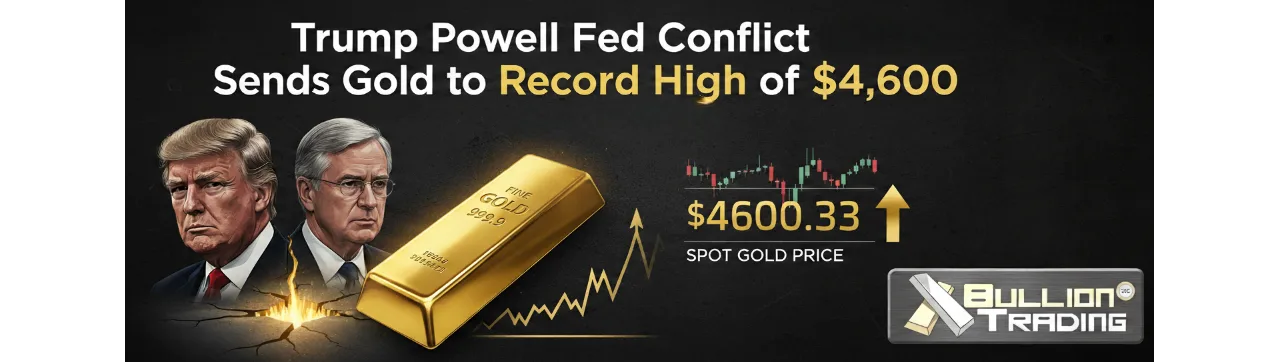

The Trump Powell Fed conflict has reached a critical turning point, sending gold to a record high as global markets navigate uncharted territory. The standoff between President Donald Trump and Federal Reserve Chair Jerome Powell escalated dramatically this week. On January 12, 2026, the Department of Justice opened a Jerome Powell criminal investigation, sending shockwaves through financial markets and driving the gold price to $4,600 per ounce.
The developments mark a significant escalation in a conflict that dates back to Powell’s first years as chair in 2018. But unlike previous clashes, this one carries potential legal consequences and raises fundamental questions about the independence of America’s central bank. For investors, the implications are substantial, touching everything from currency valuations to the case for holding precious metals.
What Sparked the Market Reaction
The immediate trigger came on Friday, January 10, when the Department of Justice served the Federal Reserve with grand jury subpoenas. According to Powell’s official statement released on January 11, prosecutors threatened criminal indictment related to his testimony before the Senate Banking Committee last June concerning a multi-year project to renovate historic Federal Reserve office buildings.
In an unusually direct video statement posted to social media, Powell did not mince words. “This unprecedented action should be seen in the broader context of the administration’s threats and ongoing pressure” he said. “The threat of criminal charges is a consequence of the Federal Reserve setting interest rates based on our best assessment of what will serve the public, rather than following the preferences of the President.”
Powell called the investigation a “pretext” aimed at pressuring the Fed to cut interest rates more aggressively. “This is about whether the Fed will be able to continue to set interest rates based on evidence and economic conditions, or whether instead monetary policy will be directed by political pressure or intimidation” he added.
Markets React to Central Bank Independence Concerns
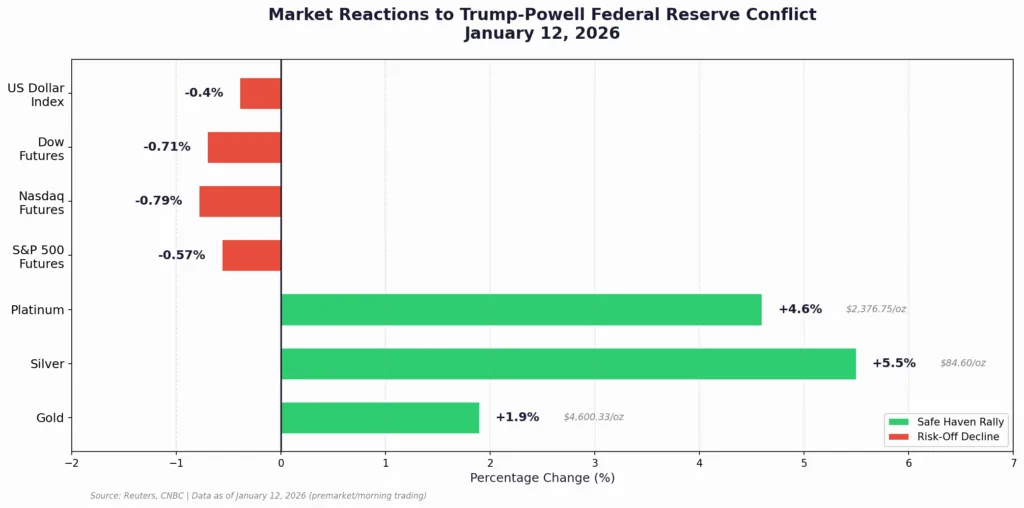
Financial markets responded swiftly and decisively. Wall Street futures dropped before the market open on Monday, with S&P 500 futures falling 0.57% and Nasdaq 100 futures sliding 0.79%. The Dow Jones Industrial Average futures dropped about 350 points.
The banking sector bore the brunt of the selling pressure. Citigroup tumbled 4.2%, JPMorgan Chase fell 2.8%, and Bank of America dropped 2.1% in premarket trading. The losses were compounded by Trump’s separate call on Friday for a one-year cap on credit card interest rates at 10%.
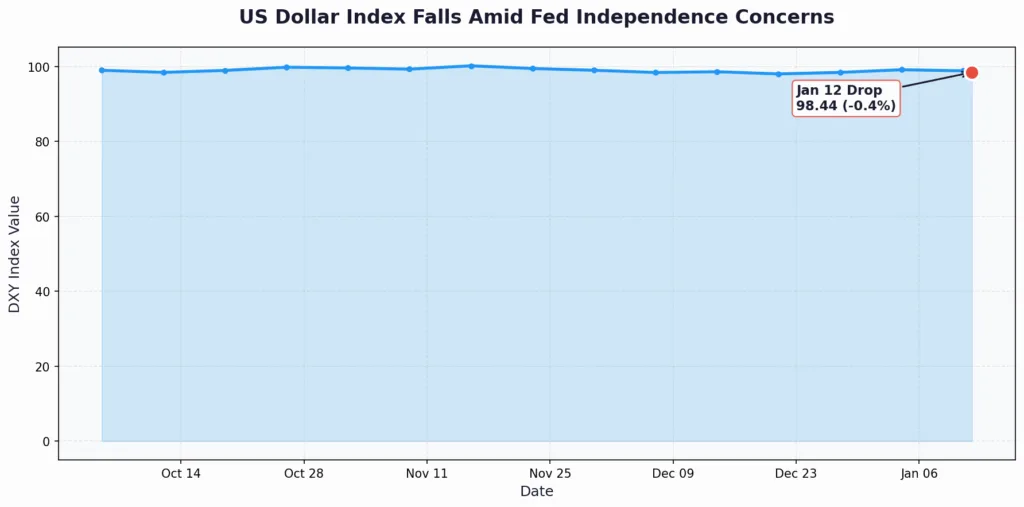
The U.S. dollar decline accelerated sharply in response. According to Reuters, the dollar fell against major currencies and was on track for its biggest one-day drop since mid-December. This continues a miserable stretch for the greenback, which dropped more than 9% against major peers in 2025 due to shrinking interest rate differentials and mounting concerns about U.S. fiscal deficits and political uncertainty.
“This open warfare between the Fed and the U.S. administration… it’s clearly not a good look for the U.S. dollar” said Ray Attrill, head of currency strategy at National Australia Bank. Meanwhile, MUFG strategist Lee Hardman noted that “the repeated attacks on the Fed’s independence” continue to pose downside risks for the dollar.
Gold Surges to Record Territory
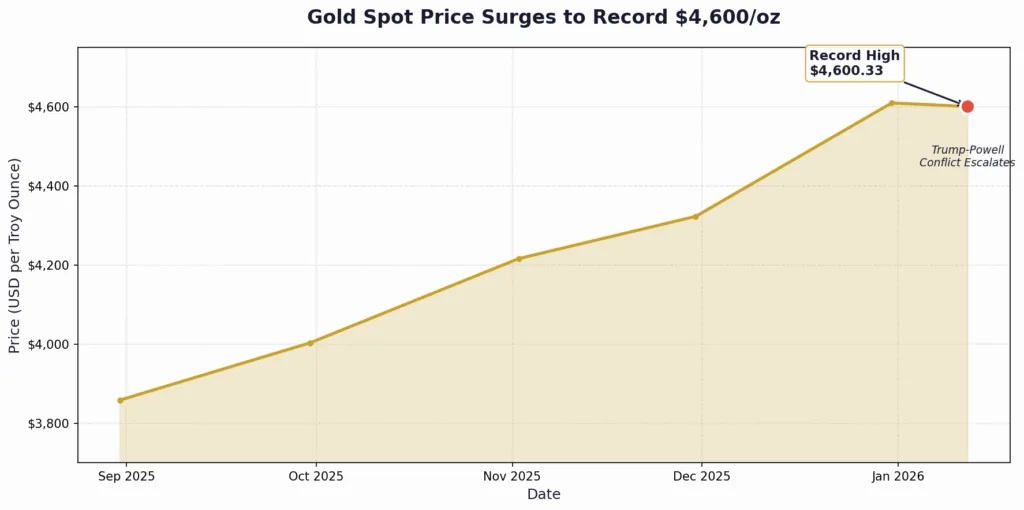
As risk sentiment weakened across equity markets, gold safe haven demand surged dramatically. Spot gold jumped 1.9% to $4,596.05 per ounce, after touching a record high of $4,600.33 earlier in the session. U.S. gold futures for February delivery gained 2.3% to $4,606.20.
The rally extended to other precious metals as well. Silver climbed 5.5% to $84.32 per ounce after hitting an all-time high of $84.60. Spot platinum rose 4.6% to $2,376.75 per ounce.
“With the Fed’s independence now openly contested, the ‘political risk’ discount usually reserved for emerging markets is bleeding into the U.S. dollar, driving investors toward hard assets” explained Zain Vawda, analyst at MarketPulse by OANDA. The analyst noted that silver could potentially reach $90 or even $100 per ounce if the industrial squeeze continues to tighten.
Gold mining stocks reflected the bullion rally. Harmony Gold rose 6.6% in premarket trading, while Barrick Mining and Kinross Gold each gained about 3%.
The strength in precious metals reflects a convergence of factors beyond the Trump-Powell clash. Geopolitical tensions, including instability in Iran and Trump’s recent capture of Venezuelan President Nicolas Maduro, add another layer of uncertainty that traditionally benefits safe-haven assets. Non-yielding assets like gold tend to perform well during periods of economic or political instability and in low-interest-rate environments.
Bond Markets Price in Rate Cut Expectations
Treasury markets also moved in response to the developments. Treasury prices rose, pushing yields slightly lower as investors sought the relative safety of government bonds. Bond markets began pricing in a slightly higher chance of interest rate cuts 2026, although the policy path remains uncertain.
Major brokerages have been adjusting their rate expectations. According to Reuters, J.P. Morgan, Barclays, and Goldman Sachs joined Morgan Stanley in pushing back their U.S. rate cut forecasts after jobs data on Friday suggested the labor market was not rapidly deteriorating.
Goldman Sachs and Morgan Stanley currently expect two 25-basis-point rate cuts each in June and September. However, the path forward depends heavily on how the political situation evolves and its impact on Fed decision-making.
Goldman Sachs chief economist Jan Hatzius said the indictment threat against Powell has heightened concerns over the Fed’s independence, though he expects policy decisions to remain data-driven. “The downside risks to U.S. employment continue to rise, which underscores the need for additional Fed funds rate cuts” added Elias Haddad, global head of markets strategy at Brown Brothers Harriman.
Political Pushback From Both Parties
The Trump administration’s move against Powell has drawn criticism from lawmakers on both sides of the aisle. Republican Senator Thom Tillis of North Carolina announced he would block any Trump appointees to the Federal Reserve, including candidates for the upcoming chair vacancy.
“If there were any remaining doubt whether advisers within the Trump Administration are actively pushing to end the independence of the Federal Reserve, there should now be none. It is now the independence and credibility of the Department of Justice that are in question” Tillis said in a statement.
This position substantially complicates the road to replacing Powell, whose term as chair expires in May. The Senate Banking Committee has 13 Republicans and 11 Democrats, meaning even one defection could create a stalemate on any nominee.
Senator Elizabeth Warren, Democrat from Massachusetts, accused Trump of wanting a “sock puppet” to lead the Fed and do his bidding by lowering interest rates. “Trump is abusing the authorities of the Department of Justice like a wannabe dictator so the Fed serves his interests, along with his billionaire friends” Warren said.
The Broader Context of Fed Independence
The conflict between elected officials and central bankers over interest rate policy is not new, but this escalation raises questions that go beyond typical political disagreements. The Federal Reserve’s independence from political pressure has been a cornerstone of U.S. monetary policy credibility since the 1950s.
“Trump is pulling at the loose threads of central bank independence” observed Andrew Lilley, chief rates strategist at Barrenjoey, an investment bank based in Sydney. “Investors won’t be happy about it, but it shows actually Trump has no other levers to pull. The cash rate will stay what the majority of the FOMC wants them to be.”
Powell emphasized his commitment to serving without political bias in his statement. “I have served at the Federal Reserve under four administrations, Republicans and Democrats alike. In every case, I have carried out my duties without political fear or favor, focused solely on our mandate of price stability and maximum employment.”
The investigation is being handled by the office of U.S. Attorney Jeanine Pirro, a Trump confidant and former Fox News host. While Powell’s term as chair ends in May, he can remain as a governor until 2028. He has not yet indicated whether he will do so.
What This Means for Gold Investors
The current market environment reinforces several key themes that have supported gold’s remarkable performance over the past year. Central bank credibility concerns, currency weakness, geopolitical uncertainty, and expectations for easier monetary policy all create favorable conditions for precious metals.
The “political risk” discount that Vawda mentioned, typically associated with emerging markets rather than the United States, represents a significant shift in how global investors perceive U.S. assets. When confidence in a country’s institutional framework weakens, hard assets like gold become more attractive as stores of value that exist outside the political system.
Krishna Guha, head of global policy and central bank strategy at Evercore ISI, described the market reaction as “unambiguously risk off.” He expects the dollar, bonds, and stocks to all face selling pressure in what he termed a “sell-America trade” similar to April of last year during the tariff shock and earlier threats to Powell’s position.
“Gold and other safe havens should rally” Guha added.
For investors considering their precious metals allocation, the current environment suggests that the fundamental drivers supporting gold remain firmly in place. Portfolio diversification, inflation hedging, currency debasement concerns, and geopolitical uncertainty all continue to support the case for physical precious metals ownership.
Looking Forward
The coming weeks will be critical in determining how this situation evolves. The White House has been conducting an extensive search for a new Fed chair, with the candidate field reportedly narrowed to five finalists. Trump has indicated he will put forth a nominee this month.
However, Tillis’s announcement complicates that timeline considerably. Any nominee would face scrutiny not just on their qualifications but on the circumstances surrounding Powell’s departure and the broader question of Fed independence.
Markets will also be watching Tuesday’s U.S. consumer price inflation report closely for signals about the Fed’s likely policy path. The interplay between inflation data, employment trends, and political developments will shape expectations for rate cuts throughout 2026.
The VIX volatility index, often called Wall Street’s fear gauge, rose the most since November on Monday, reflecting increased uncertainty about the market outlook. While the S&P 500 and Dow both finished the previous week at record highs, the path forward appears considerably less certain.
For precious metals investors, these dynamics underscore why gold has historically served as portfolio insurance during periods of uncertainty. Whether the current tensions escalate further or eventually subside, the questions raised about central bank independence and institutional credibility will likely linger in investors’ minds.
At Bullion Trading LLC, we provide access to a comprehensive range of gold, silver, platinum, and palladium products to help investors navigate uncertain market conditions. From American Gold Eagles to investment-grade bars, our inventory offers options for both new and experienced precious metals investors seeking to diversify their portfolios.
