

Gold is trading above $4,500 per ounce in March 2026. Silver has been surging alongside it. For many investors watching these prices climb, there is a nagging question: is it too late to buy?
The honest answer is that nobody knows where prices are headed next week, next month, or next year. Gold set 53 new all-time highs during 2025 alone, and every single one of those records felt like it might be the top at the time. Investors who waited for a pullback missed much of the rally. Those who went all-in at one moment took on unnecessary risk. There is, however, a middle path that has served disciplined investors well for decades: dollar cost averaging.
Dollar cost averaging into gold and silver is not a complicated strategy, but it is one of the most effective ways to build a precious metals position without losing sleep over timing. This guide covers how it works, why it is particularly suited to physical metals, and how to put it into practice using real data.
What Dollar Cost Averaging Actually Means
Dollar cost averaging, or DCA, is the practice of investing a fixed dollar amount into an asset at regular intervals, regardless of the current price. The concept is straightforward: instead of trying to pick the perfect moment to buy, you commit to a schedule and let time work in your favor. Investopedia defines it as a strategy that “removes the uncertainty of market timing by adhering to a fixed investment schedule.”
When the price of gold drops, your fixed dollar amount buys more metal. When the price rises, it buys less. Over time, this mechanical approach tends to produce a lower average cost than what most investors achieve when they try to time their purchases. More importantly, it removes the emotional component that causes so many investors to buy high and sell low.
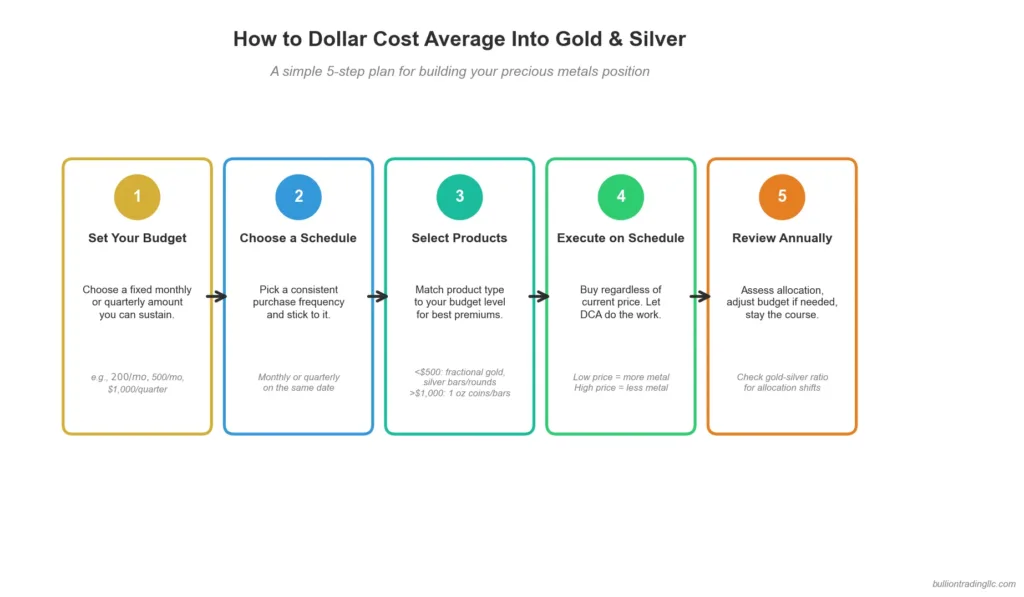
In the context of physical precious metals, DCA means buying a set dollar amount of gold or silver on a regular schedule, whether that is $200 a month, $500 a quarter, or whatever fits your budget. The amount matters less than the consistency.
Why DCA Works Especially Well for Precious Metals
Dollar cost averaging was originally popularized for stock market investing through retirement accounts like 401(k) plans. But there are specific reasons why this approach is particularly well suited to gold and silver.
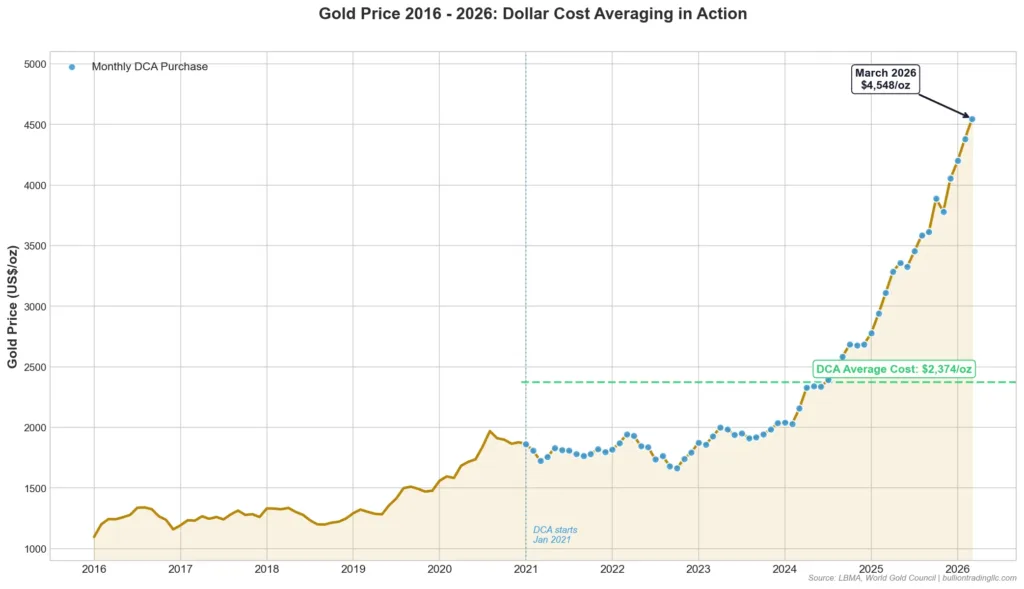
First, precious metals are volatile in the short term but have demonstrated strong long-term appreciation. Gold’s annual average price rose from roughly $1,800 per ounce in 2021 and 2022 to $2,386 in 2024, and then jumped to $3,431.50 in 2025, a 44% year-over-year increase. That kind of price movement in a single year makes timing nearly impossible, even for professionals. DCA lets you participate in the trend without betting everything on one price point.
Second, physical precious metals carry premiums over spot price. As we explored in our analysis of gold and silver lease rates and market tightness in 2025, premiums on retail products like coins and small bars fluctuate based on supply chain conditions. By buying at regular intervals, you also average out premium fluctuations, not just spot price changes.
Third, purchasing physical gold and silver involves real logistical considerations. You cannot simply click a button and instantly acquire an ounce of gold at the exact quoted spot price. Spreading purchases over time gives you flexibility to select the best product types and take advantage of favorable premium environments when they appear.
What the Data Shows: DCA Into Gold Over the Past Five Years
Numbers tell the story better than theory. Consider an investor who committed to purchasing $500 worth of gold every month starting in January 2021. Using the LBMA annual average gold prices reported by the World Gold Council’s Gold Demand Trends Full Year 2025 report, let’s trace what happened.
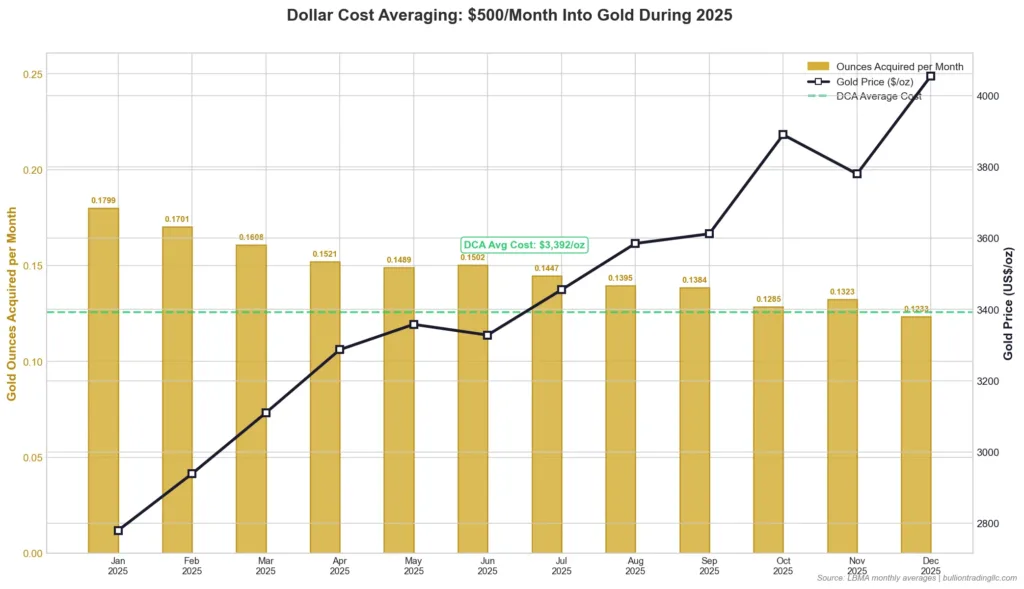
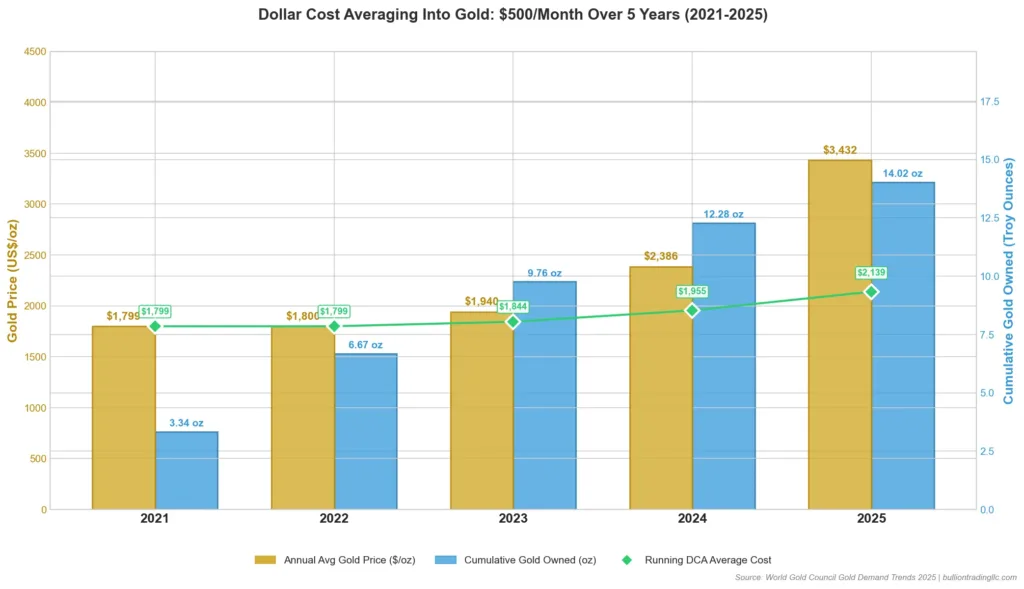
In 2021 and 2022, with gold averaging around $1,800 per ounce, that monthly $500 bought roughly 0.278 ounces each time. In 2023, as the average climbed to around $1,940, each purchase acquired slightly less metal, about 0.258 ounces. By 2024, with the average at $2,386, the same $500 purchased about 0.210 ounces. And in 2025, as gold’s average surged to $3,431, each monthly installment bought just 0.146 ounces.
Over those five years, this investor would have deployed $30,000 total and accumulated approximately 14 ounces of gold. Their blended average cost would come to roughly $2,140 per ounce. With gold now trading above $4,500 per ounce, that position would be worth approximately $63,000, representing a gain of over 110%. The investor never needed to predict a single price move. They just showed up every month.
Now, would a lump-sum investment at the start of 2021 have performed even better? Mathematically, yes, because gold has been in a sustained bull market. An investor who put $30,000 into gold in January 2021 at roughly $1,800 per ounce would have acquired about 16.7 ounces, worth over $75,000 today. But this comparison misses the point in two important ways. First, most investors do not have $30,000 sitting around to invest all at once. DCA turns a large commitment into manageable monthly installments. Second, nobody in January 2021 knew gold would nearly triple over the following five years. As we discussed in our piece on gold bull market corrections, there were plenty of scary pullbacks along the way that would have tempted a lump-sum investor to sell at the wrong time.
Applying DCA to Silver
Silver offers its own compelling case for dollar cost averaging, though the dynamics differ from gold. Silver is more volatile, with larger percentage swings in both directions, which actually enhances the mathematical advantage of DCA. When silver drops sharply, your fixed dollar amount scoops up significantly more metal, and those larger purchases at lower prices pull down your average cost aggressively.
Silver also has a dual nature as both a monetary metal and an industrial commodity. According to data from the Silver Institute, industrial demand now accounts for approximately 59% of total silver usage, driven heavily by solar photovoltaics, consumer electronics, and 5G infrastructure. The silver market has operated in a structural supply deficit for seven consecutive years, creating a fundamental backdrop that supports long-term appreciation.
For investors considering a DCA approach to silver, it is worth understanding the gold-silver ratio as a supplementary tool. When the ratio is historically high, meaning silver is relatively cheap compared to gold, investors might allocate a larger share of their DCA budget toward silver. When the ratio compresses, shifting more toward gold can make sense. This is not market timing in the traditional sense; it is using a well-known valuation metric to optimize an already systematic approach.
How to Set Up a DCA Plan for Physical Precious Metals
Implementing dollar cost averaging for physical gold and silver is simpler than many investors assume, though it does require a bit more planning than DCA into an ETF or mutual fund.
Start by determining a monthly or quarterly budget that you can sustain comfortably. Consistency is the foundation of this strategy, so choose an amount you will not skip during difficult months. For context, at current prices a $500 monthly budget would acquire roughly 0.11 ounces of gold or about 15 ounces of silver each month, depending on premiums and product type.
Product selection matters with physical metals. As detailed in our fractional gold buying guide, smaller denominations like 1/10 oz or 1/4 oz gold coins carry higher premiums per ounce but offer accessibility at lower dollar amounts. If your monthly budget is under $1,000, fractional gold coins or silver bullion (bars and rounds) often make the most practical sense. Investors with larger monthly allocations can access 1 oz gold coins or bars, which carry lower premiums and thus deliver more metal per dollar spent.
For those new to precious metals, our first-time buyer’s checklist for 2026 covers the practical fundamentals of purchasing, storing, and insuring physical bullion.
The Emotional Advantage
Perhaps the most underappreciated benefit of dollar cost averaging is psychological. Precious metals markets can be emotional. Gold dropped 8% in January 2026 before rebounding, as documented in our analysis of the gold and silver price crash in January 2026. Investors who were dollar cost averaging through that period automatically bought more gold at those lower prices, turning a nerve-wracking correction into an opportunity.
Contrast this with the typical investor behavior pattern. Many people watch gold climb from $2,000 to $3,000 and decide to wait for a pullback. When it pulls back to $2,800, they are afraid it might drop further, so they wait. Then it rallies to $3,500 and they feel priced out. Eventually, they buy at $4,000 out of frustration or fear of missing out entirely. This is human nature, and DCA is designed specifically to override it.
The World Gold Council’s 2026 Gold as a Strategic Asset report emphasizes that gold’s value as a portfolio asset comes from maintaining “a long-term allocation and taking advantage of its safe-haven status during periods of economic uncertainty.” DCA is arguably the simplest and most reliable way to build and maintain that long-term allocation.
Common Pitfalls to Watch For
DCA is a powerful approach, but it is not foolproof. One common mistake is abandoning the discipline when prices appear elevated. Remember, every price level in 2025 looked expensive compared to 2024, and every price in 2024 looked expensive compared to 2023. With total gold demand exceeding 5,000 tonnes for the first time in 2025, bar and coin demand hitting a 12-year high at 1,374 tonnes, and central banks purchasing 863 tonnes, the structural drivers behind gold’s rise are deep and broad. Skipping purchases because prices “feel” high defeats the entire purpose of the strategy.
Another pitfall is ignoring premiums entirely. While DCA smooths out spot price exposure over time, consistently overpaying on premiums erodes returns. Shop around, understand the premium structures of different product types, and consider whether cast bars versus minted bars or rounds versus government-minted coins offer better value at your budget level.
Finally, do not confuse DCA with “set and forget.” While the buying schedule should be automatic, you should review your overall precious metals allocation at least annually. As your portfolio grows, your needs may shift. Our guide on how much gold and silver you should own provides a framework for right-sizing your allocation as circumstances change.
Bringing It All Together
Dollar cost averaging into gold and silver will not make you wealthy overnight, and it will not protect you from every market downturn. What it will do is systematically build a meaningful precious metals position over time, at an average cost that almost certainly beats what emotional, reactive buying would produce.
In a market where gold has nearly doubled in two years and geopolitical uncertainty shows no signs of easing, the question for most investors is not whether to own precious metals, but how to acquire them intelligently. DCA answers that question with elegant simplicity: pick a number, pick a schedule, and stick with it.
