


With gold trading at $4,672 per troy ounce as of May 2026, a number that would have seemed improbable five years ago, more people are asking a straightforward question: how do I actually start owning some? The concept of “gold stacking” has been around for decades among collectors and hard-money investors, but it gained serious momentum in 2025. According to the World Gold Council’s full-year 2025 Gold Demand Trends report, global bar and coin demand reached a 12-year high at 1,374 tonnes, up 16% from the prior year. That is not a niche trend. That is a widespread behavioral shift toward holding physical metal.
This guide is for people starting from zero. Not from zero savings, but from zero gold. If you have never held a gold coin and you are trying to figure out whether to begin with a 1 oz bar or a 1/10 oz Maple Leaf, this is the piece to read first. The goal here is not to inspire you with price predictions or fear. It is to give you a practical framework for building a private reserve, sensibly and without overpaying.
What gold stacking actually means
“Stacking” is an informal term for the practice of accumulating physical gold (or silver) in small increments over time. It implies regularity, buying a coin or a bar every month or every paycheck, rather than making one large, perfectly timed purchase. The goal is to build a personal reserve of metal held outside the banking and brokerage system.
What separates stacking from simply “buying gold” is the mindset. Stackers are not trying to catch a short-term price move. They are building something. A few ounces becomes ten, ten becomes twenty-five, and at some point the reserve starts to feel substantial. The accumulation itself is the strategy.
There is real logic behind this approach. The gold price averaged $3,431 per ounce across all of 2025, up 44% year-over-year, and set 53 new all-time highs during that calendar year. Investors who were buying consistently through 2023 and 2024, when spot prices ranged between $1,900 and $2,600, locked in an average cost well below where the market sits today. That is not luck. That is what patient, systematic buying in a supply-constrained asset class looks like in practice.
The “private reserve” framing matters too. Gold held in physical form, whether at home or in a specialized vault, is not subject to the counterparty risks that come with paper assets. It cannot be inflated away, frozen by a bank, or written down in a corporate restructuring. That combination of liquidity, portability, and independence is why people who have been doing this for decades rarely stop.
Coins versus bars, and why the choice matters more than you think
The first real decision every new stacker faces is the format: coins or bars? Both are legitimate ways to own physical gold, and either can serve a beginner well, but they behave differently once you decide to sell or trade.
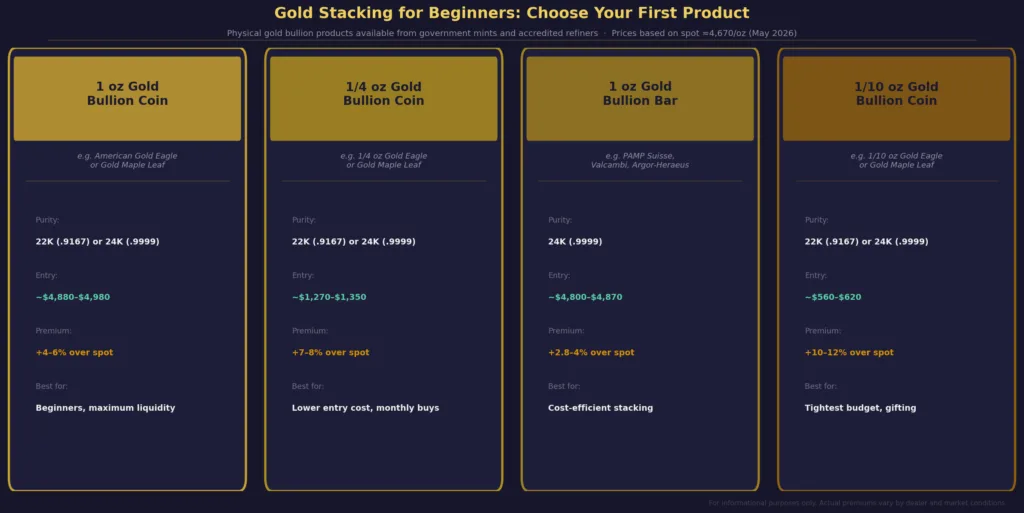
Government-issued gold bullion coins, like the American Gold Eagle from the United States Mint or the Canadian Gold Maple Leaf from the Royal Canadian Mint, carry legal tender status in their home countries. That status is largely ceremonial at current prices, but it matters for one practical reason: it makes coins easier to verify and sell. A dealer looking at a Gold Eagle or a Maple Leaf knows exactly what they are holding. The verification is faster, the trust is established, and the buyer pool is wide across the United States and internationally.
Gold bars tend to carry lower premiums per ounce than coins, particularly in sizes of 1 oz and larger. This makes them marginally more cost-efficient for buyers whose only goal is to acquire the most metal per dollar spent. However, bars from smaller or lesser-known refineries can be harder to liquidate, especially outside of major financial centers. If you stick to bars from LBMA Good Delivery accredited refiners, such as PAMP Suisse, Valcambi, or Perth Mint, the liquidity concern largely disappears. LBMA accreditation is the international gold standard for refinery credibility, and bars carrying this provenance are recognized by dealers worldwide.
For most beginners, coins are the safer starting point. They are more universally recognized, easier to transact in small increments, and they tend to hold their liquidity better during market stress when buyers become selective about product provenance.
One thing to sort out early is purity. Standard investment-grade gold bullion runs at either .999 or .9999 fine. The Canadian Gold Maple Leaf is .9999 fine, meaning 99.99% pure gold content. The American Gold Eagle is 22-karat (91.67% gold), but its gross weight is calibrated precisely so each coin contains exactly one full troy ounce of pure gold. When comparing products, always compare on the basis of pure gold content, not the gross face weight of the coin or bar.
Why fractional gold deserves a place in every beginner’s reserve
At $4,672 per ounce, buying a full 1 oz gold coin is a significant commitment for a first-time buyer. That price point is real, and pretending it is not does no one any favors. Fractional gold, meaning coins or bars denominated in 1/10, 1/4, or 1/2 troy ounce, makes it possible to start building a reserve even when capital is limited.
The trade-off is the premium. Fractional coins cost more per ounce of gold than full-ounce coins, because the minting cost is spread across less metal. A 1/10 oz American Gold Eagle typically carries a premium of roughly 10 to 15% over spot, compared to around 3 to 5% for a standard full-ounce coin. Over a long accumulation period, that gap adds up in a way that matters.
That said, for a beginner whose goal is to start holding physical gold rather than waiting six months to save up for a full ounce, fractional products are a reasonable entry point, provided the premium math is understood going in. The fractional gold buying guide goes deeper into the premium structure across different sizes and product types, which is worth reading before your first purchase.
The practical takeaway: use fractional sizes to get started, but do not build your entire reserve this way. As your budget allows, shift toward full-ounce products and above to bring down your average cost per ounce of pure gold. The 1/10 oz coin is a useful tool for a beginner; it should not be the permanent buying vehicle throughout a multi-year accumulation plan.
Building consistently: the case for a stacking schedule
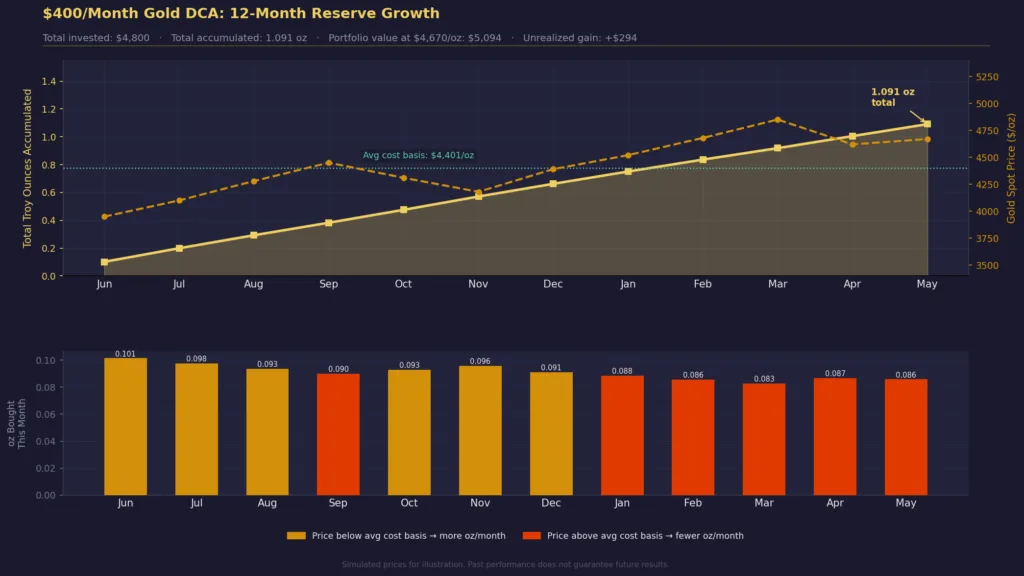
One of the most common mistakes beginners make is attempting to time their gold purchases. They watch the spot price, wait for a dip, and then wait again when a smaller dip follows. Weeks turn into months. No gold gets bought. Meanwhile, anyone who was simply buying on schedule has been adding to their reserve at prices that, looking back, now appear cheap.
The alternative is to decide on a stacking schedule and stick to it. Determine in advance how much you will spend per month or per paycheck, then buy at whatever the spot price happens to be. When the price is elevated, you acquire fewer ounces. When it pulls back, you acquire more. Across a multi-year accumulation period, the average purchase price smooths out. This is the same logic behind dollar-cost averaging in equities, and it applies cleanly to physical metal.
A sensible starting point for someone beginning from zero is a fixed monthly purchase of whatever amount fits the actual budget. Whether that is $250 or $2,500 per month, the specific figure is far less important than the discipline of buying on schedule without second-guessing the current price environment. Gold set 53 all-time highs in 2025 alone. Investors who spent that year waiting for a pullback watched the annual average price rise 44%. The calendar punishes hesitation.
It also helps to track the reserve in ounces rather than in dollars. The dollar value of your stack will move with the spot price every day. The ounce count only changes when you add to it. Measuring progress in ounces keeps the focus on accumulation, which is the actual goal.
Where to keep your reserve
Storage is the variable most first-time buyers underestimate. A few gold coins in a quality home safe are probably adequate. Twenty ounces are a different matter. At current prices, twenty ounces of gold is worth roughly $93,000. That is a meaningful sum of wealth concentrated in a portable physical object, and it deserves a thoughtful storage plan before it arrives at your door.
Home storage in a quality safe, properly anchored to a wall or floor, is the most private and accessible option. It keeps the metal entirely within your control and outside any institution. The limitation is insurance: standard homeowner’s and renter’s policies generally do not cover bullion adequately without a specific endorsement or rider. If you hold a significant reserve at home, verify that coverage in writing before assuming it exists.
Bank safe deposit boxes are widely used, though they carry their own constraints. Contents inside safe deposit boxes are typically not insured by the bank or covered by federal deposit insurance. Access depends entirely on the bank’s operating hours, and in circumstances involving a bank holiday or a legal hold, that access could be restricted without notice.
Private vault storage through a specialized bullion custodian offers the most robust solution for larger reserves: institutional-grade security, segregated holdings, and insurance coverage written specifically for precious metals. The precious metals storage guide covers the practical differences between these three options and helps match the right approach to your reserve size.
One logistical step that many people skip: document your holdings carefully. Photographs of each coin or bar, purchase receipts, and serial numbers for any numbered bars should be stored separately from the metal itself, whether digitally in a secure location or in a physical folder kept elsewhere.
How much is actually enough?
There is no universal answer. Some investors allocate 5% of net worth to physical metals; others hold 20% or more. The right level depends on your broader financial picture, your tolerance for illiquidity, and what specific function you want the reserve to serve.
What most long-term holders agree on is that a few coins is a start, not a strategy. The protective qualities of physical gold tend to matter most when you hold enough to offset meaningful losses elsewhere in a portfolio. For most people, that threshold falls somewhere between 10 and 30 ounces, though it varies by net worth. If you want a structured way to think through this, the piece on how much gold and silver you should own offers a practical allocation framework.
Set a target ounce count. Build toward it consistently. That is the complete stacking strategy, even if it sounds almost too simple to be useful.
Getting started without overcomplicating it
The decisions involved in gold stacking for beginners can feel overwhelming: which product, which size, where to store it. In practice, the path is narrower than it appears. Start with a government-issued bullion coin in a recognizable denomination from a reputable dealer. Buy what you can afford without stretching. Set a monthly schedule and follow it. Sort out your storage before the first purchase arrives, not after.
The reserve builds itself from there. One ounce at a time.
