

On the morning of January 24, 1848, a carpenter named James Marshall knelt beside the American River at a sawmill construction site in Coloma, California, and picked up a few flakes of metal from the water. He bit one, checked its color, and felt his pulse quicken. “It made my heart thump”, he wrote later, “for I was certain it was gold”.
What followed was one of the strangest episodes in American history. A mass migration pulled over 300,000 people from around the world to a remote corner of the continent within a few years. A new American state appeared almost overnight. Entire Native nations were destroyed. More than $2 billion in gold was extracted from California’s rivers and hills at 19th-century prices. The California Gold Rush of 1849 is one of those events that shaped nearly everything and gets simplified into almost nothing.
Here is what actually happened.
The discovery at Sutter’s Mill
Marshall was building a water-powered sawmill for John Sutter, a German-born Swiss citizen who had carved out a private empire in the Sacramento Valley under a land grant from Mexico. His operation, called Nueva Helvetia (“New Switzerland”), was built largely on the forced labor of Native Americans. Sutter wanted a sawmill on the American River’s south fork, and he hired Marshall to build it in the settlement of Coloma.
Both men understood immediately that the discovery would ruin them. Sutter’s land claims had no firm legal standing under American law, and gold would draw exactly the kind of uncontrollable population that would overwhelm any claim he had. They tried to keep it quiet. They failed within six weeks.
By mid-March 1848, the San Francisco press had already begun reporting on large gold finds at Sutter’s Mill. The story that Marshall and Sutter hoped to contain was already loose.
How word actually spread
The real ignition came from a merchant named Sam Brannan. In late May 1848, Brannan walked through the streets of San Francisco holding a glass vial of gold dust and shouting about the discovery at Sutter’s Mill. He had already stocked his store near the mines with every pick, shovel, and pan he could find before he made that walk. He was selling, not just announcing.
The effect was immediate. By mid-June 1848, three-quarters of San Francisco’s male population had abandoned the city for the mines. By August, roughly 4,000 miners were working the American River and its tributaries. Early arrivals, who could still find gold sitting on the surface in the streambeds, were pulling out $300 to $400 a day at a time when a skilled American worker might earn a dollar.
News reached the East Coast slowly and met with skepticism, until President James K. Polk addressed Congress in December 1848 and confirmed the accounts from California’s military governor, Colonel Richard Mason. “The accounts of abundance of gold are of such an extraordinary character as would scarcely command belief”, Polk told Congress, “were they not corroborated by the authentic reports of officers in the public service”. That speech opened the floodgates.
Who the 49ers actually were
The term “49ers” refers to the roughly 80,000 people who arrived in California in 1849. They came from everywhere. Among the first to show up were Chileans, Mexicans, Peruvians, Hawaiians, and Chinese, all of whom could reach California by sea before most Americans had even confirmed the news. When East Coast Americans finally arrived in large numbers, they found a global workforce already operating in the hills.
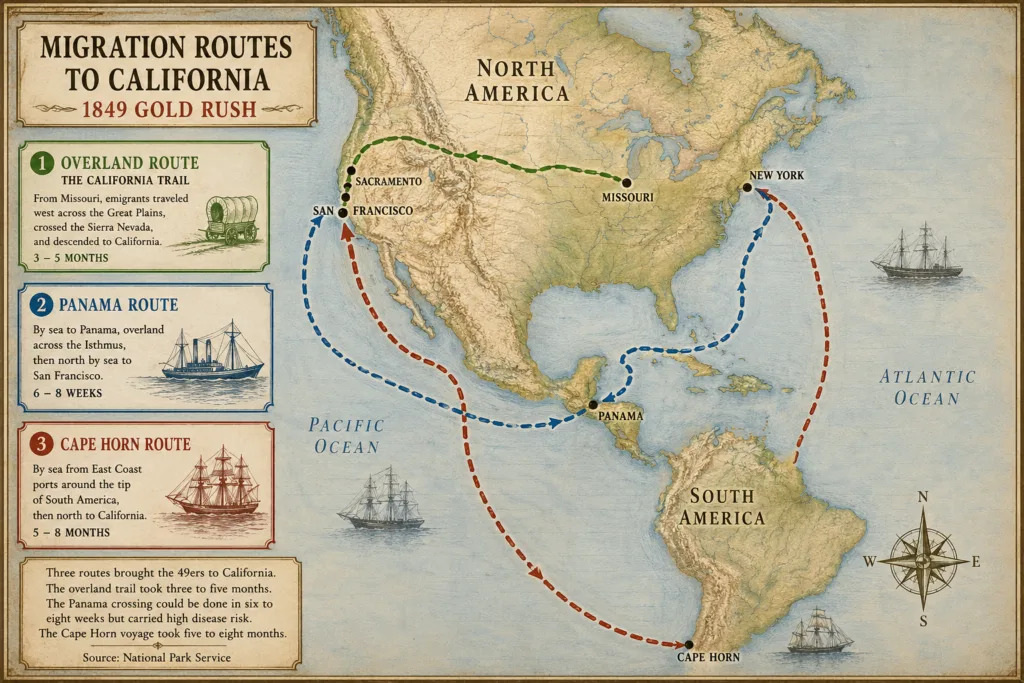
The routes to California were dangerous. Those crossing overland on the California Trail faced deserts, the Sierra Nevada passes, and the risk of early snowfall trapping them in the mountains. Those traveling by sea could sail around Cape Horn at the tip of South America, a journey of roughly 17,000 miles that could take five to eight months. A faster option was to cross the Isthmus of Panama on foot and mule, but that route ran through jungle and exposed travelers to yellow fever and cholera. Thousands died before reaching California at all.
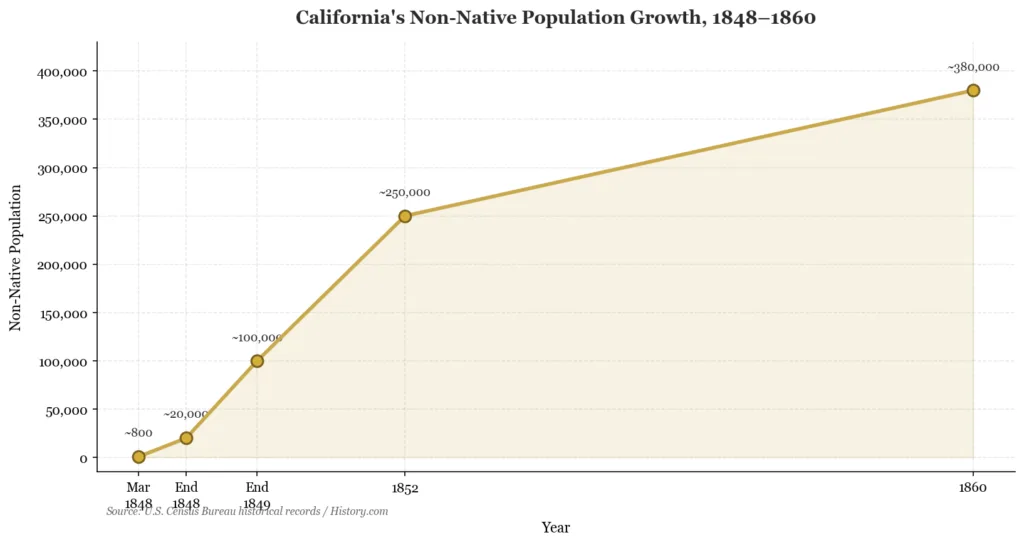
By the end of 1849, California’s non-native population had gone from roughly 800 in early 1848 to an estimated 100,000. The mining camps that appeared across the Sierra Nevada foothills had no legal structure, no courts, and no functioning law enforcement. They had names like Rough and Ready, Whiskey Flat, and Murderer’s Bar. The names were accurate.
The economics of the rush (who actually got rich)
The miners, in general, were not the ones who made lasting fortunes.
The average daily yield per miner fell sharply after 1848. With tens of thousands of men chasing the same rivers and streams by 1849, the easy surface gold was largely gone. Miners were earning a few dollars a day if they were fortunate, while the cost of living in the camps ran far beyond anything in the rest of the country. A dozen eggs cost $1. A blanket could run $30. A shovel that sold for 75 cents in New York sold for $10 at the mines. Most miners spent roughly what they earned, and a significant number went home poorer than they had left.
The people who built real wealth were the merchants and service providers. Sam Brannan, who had positioned himself before making his famous vial-and-shout walk through San Francisco, became one of the wealthiest men in California without ever working a mine. Levi Strauss arrived in San Francisco in 1853 to sell dry goods to the mining trade, eventually building the company whose name still appears on blue jeans. Henry Wells and William Fargo started a banking and freight operation that still carries their names. Philip Armour, who sold provisions to miners in California, used his profits to eventually build one of the largest meatpacking businesses in American history.
The phrase “mining the miners” describes what actually generated wealth during the Gold Rush. The money was made selling things to the people chasing gold, not by chasing it.
The people who paid the price
California’s Native American population numbered roughly 150,000 when gold was discovered. By 1870, that number had fallen to around 30,000. Disease, starvation, direct violence, and state-funded military campaigns killed the rest. The California legislature appropriated funds specifically to pay for militia operations against Native communities throughout the 1850s. Historians have called this period a genocide. In 2019, the state of California formally agreed, with Governor Newsom issuing a formal apology to Native Americans and acknowledging what had occurred during the Gold Rush era.
The rush also brought systematic economic discrimination against non-Anglo miners. California’s Foreign Miners’ Tax, passed in 1850, targeted Chinese, Mexican, and Chilean workers specifically. Enforcement was selective and often violent. Entire communities of experienced Latin American miners, many of whom had arrived before most Americans, were driven out of the most productive areas by combination of law and force.
The Gold Rush created immense wealth. The distribution of that wealth, and the costs it imposed on those who never shared in it, is the part of the history that gets mentioned less often.
California statehood and the politics of gold
The speed of California’s population growth forced a political crisis in Washington. In late 1849, California drafted a constitution and applied for statehood. The document banned slavery, which was the crux of everything that followed.
Admitting California as a free state threatened the Senate balance between free and slave states that had kept the country’s internal tensions from boiling over. The resolution came through the Compromise of 1850, brokered by Senator Henry Clay of Kentucky. California entered the Union as the 31st state on September 9, 1850.
The same compromise included the Fugitive Slave Act, which required Northern states to return escaped enslaved people to their owners, a provision that outraged abolitionists and intensified sectional conflict. The Gold Rush did not cause the Civil War, but it pushed the unresolved question of slavery back onto the national agenda at a moment when neither side was ready to settle it, and that acceleration had consequences.
The end of placer mining and the rise of hydraulic extraction
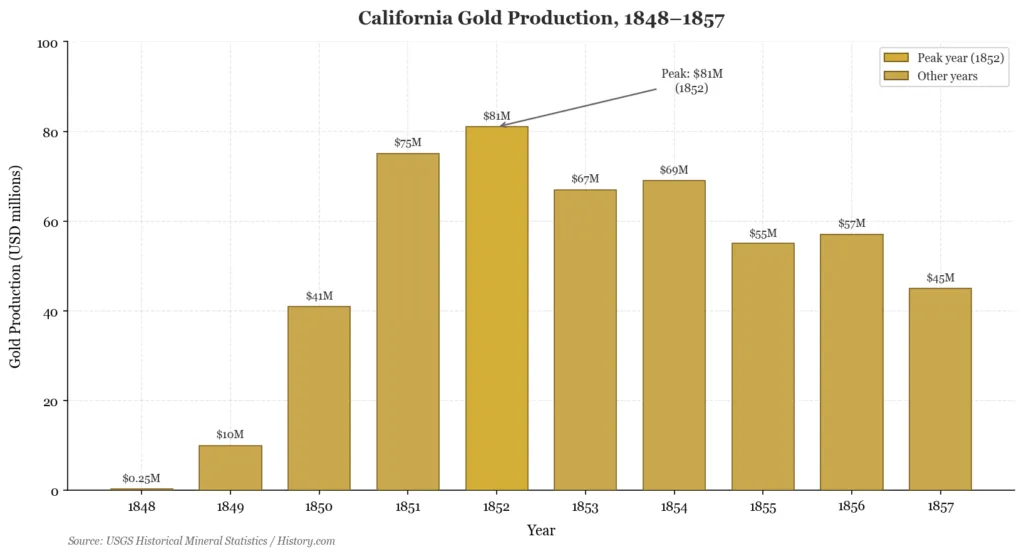
Surface gold, the flakes and small nuggets that miners could find with a pan and basic tools, was largely exhausted by 1852. That was the year California’s gold production peaked at roughly $81 million. What remained was locked in quartz and deep gravel deposits embedded in the hillsides above the rivers.
Hydraulic mining, developed in 1853 by Edward Matteson near Nevada City, California, answered that problem. The technique used pressurized water jets to blast entire hillsides into slurry, which was then processed for gold. The results were extraordinary in terms of gold production, and catastrophic in terms of the landscape. Billions of cubic yards of sediment washed down from the Sierra Nevada into the Sacramento Valley, burying farmland, raising riverbeds, and triggering floods that destroyed agricultural communities.
Farmers eventually sued. In 1884, federal judge Lorenzo Sawyer ruled hydraulic mining illegal in Woodruff v. North Bloomfield, one of the earliest significant federal environmental rulings in American history. By then, the great years of California gold production were long past. Annual yields had stabilized around $45 million by 1857, and the population that had come for gold had largely shifted into agriculture, commerce, and other industries.
What the Gold Rush left behind
The California Gold Rush moved 300,000 people across the world in roughly five years. It created a major American state from near-nothing, produced more than $2 billion in gold at 19th-century values (equivalent to roughly $80 billion in today’s purchasing power), and permanently changed the country’s relationship with the West. San Francisco went from a small port settlement of a few hundred people to a city of 25,000 by 1850, and 150,000 by 1870. The infrastructure built to support the rush, roads, ports, banks, telegraph lines, laid the foundation for California’s eventual emergence as one of the largest economies on earth.
It also demonstrated something that precious metals investors have been rediscovering ever since: gold does not distribute its benefits evenly. The people who made lasting money from the California Gold Rush were overwhelmingly not the miners. They were the people who understood what the surge in demand for everything around gold would require, and positioned themselves to supply it.
That pattern has repeated itself throughout gold’s history. The value of physical gold lies not in the chase, but in what you hold when the fever breaks. The miners who arrived in California in 1849 learned that lesson the hard way. The merchants who sold them their tools retired comfortably.
For anyone interested in understanding gold as an asset, rather than a rumor of easy wealth, the California Gold Rush is the clearest American illustration of how the metal actually works.
Conclusion
The California Gold Rush was not what most people picture. It was not a story of simple riches or frontier freedom. It was a story of extraordinary movement, brutal economics, political transformation, and severe human cost. The 49ers who made it to California found something very different from what they had been promised.
What the rush ultimately delivered was the raw material for a new American economy and a new American state, built on gold, but not in the way anyone planned. The discovery on January 24, 1848, at a sawmill on the American River remains one of the most consequential moments in the country’s history, not because of the gold that came out of the ground, but because of everything it set in motion.
