

The precious metals market reached extraordinary heights in 2025, with gold prices surpassing $4,000 per ounce in October and delivering over 45% returns year-to-date from January levels. Yet amid this remarkable rally, a familiar question echoes through investment forums and financial advisor offices: “Should I sell my gold now?”
According to recent data from the World Gold Council, central banks purchased 244 tonnes of gold in Q1 2025 alone, representing highly elevated official sector buying. Individual investors added 95 million ounces to silver-backed ETPs in the first half of 2025. These aren’t the actions of those preparing to sell. They’re the actions of those who understand a fundamental truth that Harvard Business School professor Clayton Christensen articulated best: we don’t buy products for their own sake. We hire them to do a job.
Understanding whether to hold or sell your gold begins not with price charts or analyst predictions, but with a simpler, more powerful question: Why did you buy gold in the first place?
The Jobs-to-Be-Done Framework: A New Lens for Gold Investment
Clayton Christensen’s Jobs-to-Be-Done theory, published in the Harvard Business Review, revolutionized how businesses think about product development. The core insight? Customers don’t simply buy products, they hire them to accomplish specific jobs in their lives.
Consider Christensen’s famous milkshake example: A fast-food chain noticed that many customers bought milkshakes early in the morning. Why? Not because they wanted a milkshake specifically, but because they needed something to make their boring commute more interesting while keeping them full until lunch. The milkshake was hired to do a job, competing not against other beverages but against bananas, bagels, and boredom.
This framework applies powerfully to gold investment. When you purchased gold or silver, whether physical bullion or other forms, you weren’t simply buying a shiny metal. You were hiring it to perform a specific function in your financial life.
What Jobs Can Gold Actually Do?
Gold’s résumé includes several distinct capabilities, each addressing different financial challenges. Understanding which job you hired it for is crucial for evaluating its performance.
Job 1: Protecting Against Inflation
Gold has served as an inflation hedge for millennia because unlike paper currency, it cannot be created at will by central banks. When inflation erodes the purchasing power of dollars, euros, or yen, gold typically maintains or increases its value in those currency terms.
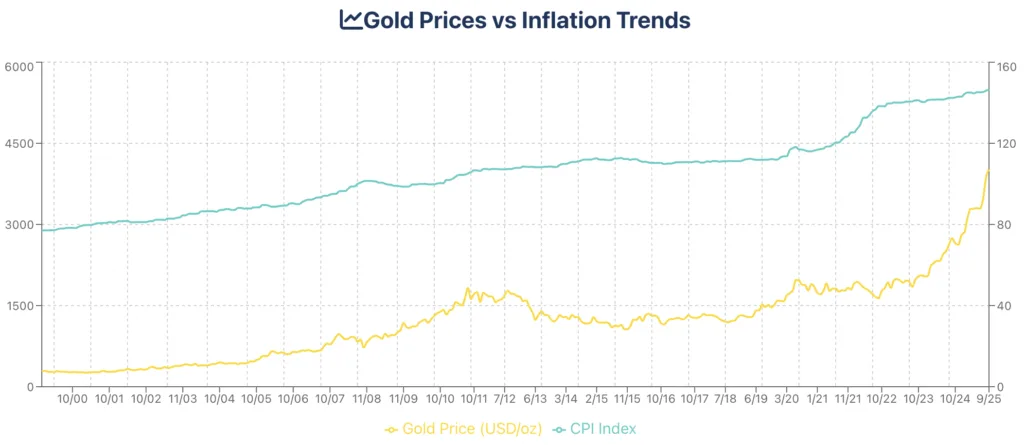
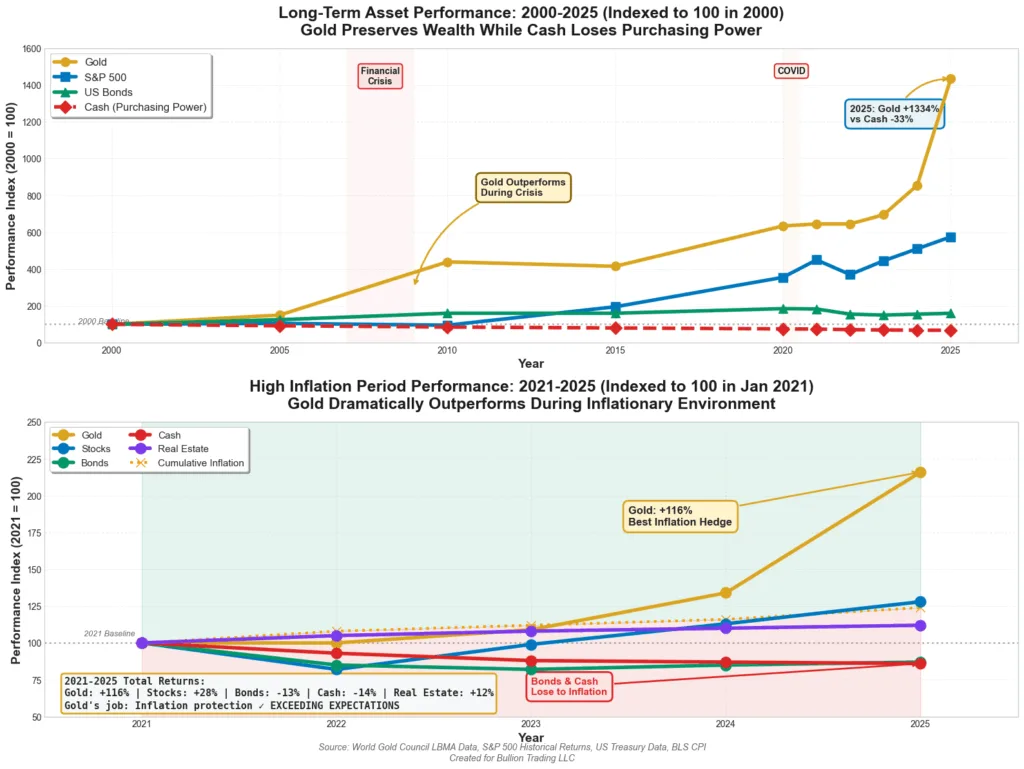
The evidence speaks clearly. From January 2021 to October 2025, the U.S. Consumer Price Index rose approximately 24%, meaning a dollar today buys what 76 cents bought in 2021. During this same period, gold prices increased from approximately $1,850 to nearly $4,000 per ounce, a gain exceeding 116%.
If you hired gold to protect your savings from inflation, it has performed spectacularly. The metal hasn’t just preserved purchasing power, it has enhanced it significantly.
Job 2: Preserving Wealth Across Generations
Gold’s role as wealth preservation transcends quarterly earnings reports or annual performance reviews. Families who purchased gold in 1971 when President Nixon ended dollar-gold convertibility at $35 per ounce have watched it appreciate to over $4,000 today, a return that accounts for multiple periods of currency debasement, geopolitical upheaval, and economic crisis.
According to LBMA research, gold has maintained its purchasing power for thousands of years. An ounce of gold could buy a fine toga and belt in ancient Rome, a quality suit in early 20th century London, and a quality suit today. The same cannot be said for any paper currency.
Job 3: Providing Independence from Banking Systems
Physical gold offers something increasingly valuable in our digital age: financial independence from the banking system. When you hold gold in your possession, you own an asset that requires no intermediary, carries no counterparty risk, and remains accessible regardless of bank hours, system outages, or institutional failures.
This job became particularly relevant during the 2023 banking crisis when several regional U.S. banks collapsed within days. Gold and silver lease rates spiked as investors sought assets outside the banking system. Those who had previously hired gold for this independence job found their foresight validated.
Job 4: Hedging Geopolitical and Economic Uncertainty
Gold prices often rise during periods of geopolitical tension, economic crisis, or currency instability. This isn’t coincidence. When investors question the stability of governments, currencies, or financial systems, they increasingly turn to assets with intrinsic value and no embedded counterparty risk.
The recent Federal Reserve rate cuts and policy shifts have created exactly this environment. With central banks worldwide cutting rates amid persistent inflation concerns, gold’s role as a hedge against policy uncertainty has proven valuable.
Conducting Gold’s Performance Review
Now that we’ve identified the jobs gold can perform, the critical question becomes: Is your gold still doing the job you hired it to do?
This requires honest self-assessment. Consider these scenarios:
Scenario 1: You Bought Gold as Inflation Protection
Current Status: EXCEEDING EXPECTATIONS
Gold has dramatically outperformed inflation. With prices up over 116% while inflation rose 24%, gold hasn’t just preserved purchasing power, it has multiplied it. The job is being performed excellently.
Action: Keep gold. It’s doing exactly what you hired it to do, and with industry forecasts from the LBMA annual conference projecting delegate consensus prices near $5,000 within 12 months and persistent inflation concerns, the job isn’t finished.
Scenario 2: You Bought Gold for Long-Term Wealth Preservation
Current Status: PERFORMING AS EXPECTED
Generational wealth preservation isn’t measured in months or years, but in decades. Short-term price volatility is irrelevant to this job. What matters is gold’s fundamental role as a store of value independent of any government or institution.
Action: Continue holding. Consider whether recent gains warrant rebalancing your overall portfolio, but don’t fire a good long-term employee because of short-term market noise. As discussed in our analysis of stock market valuations reaching extreme levels, having wealth preservation assets becomes even more critical during periods of overvaluation elsewhere.
Scenario 3: You Bought Gold for Banking Independence
Current Status: ESSENTIAL AND IRREPLACEABLE
Physical gold’s role as a non-system asset cannot be fulfilled by any bank account, bond, or digital promise. If you value the ability to hold wealth outside the financial system, nothing else can do this job.
Action: Keep your physical holdings. Price appreciation is a bonus; the core job, providing financial independence, remains unfulfilled by any alternative.
Scenario 4: You Bought Gold as a “Get Rich Quick” Investment
Current Status: WRONG JOB FOR THIS EMPLOYEE
If you expected gold to behave like a technology stock or cryptocurrency, delivering 10x returns in months, you hired the wrong employee for the job. Gold is not designed for speculation or rapid wealth creation. It’s designed for wealth preservation and protection.
Action: Reconsider your strategy. If you need high-risk, high-reward investments, gold isn’t the right tool. However, before selling, ensure you have other assets properly addressing wealth preservation and protection needs.
When Market Conditions Change: Is Gold Still Needed?
Some investors argue that when gold prices rise significantly, it’s time to sell and take profits. This reasoning misses a crucial point: the conditions that drove gold higher are often the same conditions that make holding gold even more important.
Consider the current environment in October 2025:
- Federal Reserve Policy: Despite recent rate cuts, inflation remains persistent and real interest rates are negative in many scenarios
- Central Bank Behavior: Record official sector buying continues, with central banks purchasing gold at unprecedented rates
- Geopolitical Tensions: Ongoing conflicts and trade disputes maintain elevated uncertainty
- Currency Concerns: Major central banks continue expansionary monetary policies, raising long-term currency debasement risks
- Market Valuations: With the CAPE ratio hitting 39.51, stock market risks remain elevated
These factors suggest that the jobs gold was hired to perform, inflation protection, wealth preservation, system independence, remain as relevant as ever. The price increase reflects gold doing its job well, not a reason to fire a good employee.
Avoiding the Wrong Expectations Trap
The most common reason investors “fire” gold prematurely is that they hired it to do the wrong job in the first place. Gold is not:
- A growth stock designed to double every year
- A trading vehicle for short-term profits
- A replacement for retirement savings vehicles like IRAs (though precious metals IRAs serve a different purpose)
- A way to “beat the market” on a quarterly basis
Gold is designed for:
- Long-term wealth preservation
- Protection against currency debasement
- Portfolio diversification and risk management
- Insurance against systemic financial risks
- Maintaining purchasing power across time
When investors expect growth stock performance from a wealth preservation asset, disappointment is inevitable. The solution isn’t to sell the gold but to adjust expectations to match the job the asset was designed to perform.
The “Fire and Hire” Decision Framework
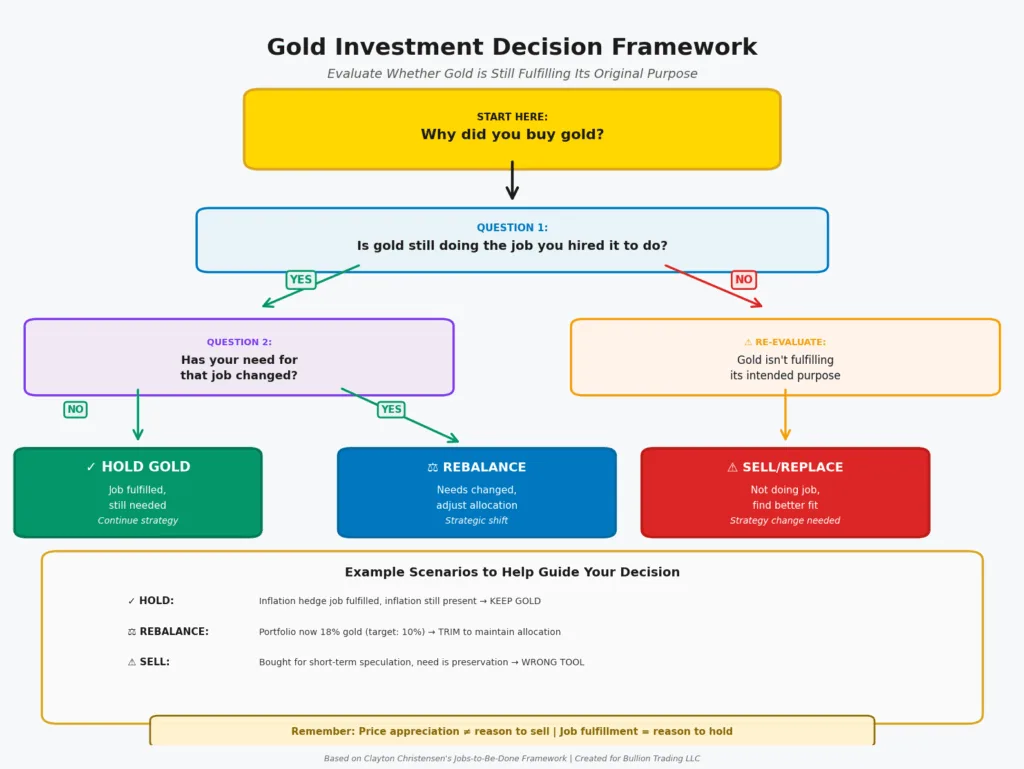
Understanding when to sell gold requires asking two sequential questions:
Question 1: Is gold still doing its job?
Evaluate honestly whether gold continues fulfilling the purpose for which you bought it. If you hired it for inflation protection and inflation remains a concern, it’s still doing its job. If you hired it for wealth preservation and nothing fundamental has changed about fiat currency risks, it’s still needed.
Question 2: Has your need for that job changed?
Life circumstances evolve. Perhaps you needed banking independence when buying, but now prioritize liquidity for an upcoming purchase. Or maybe you sought inflation protection, but your time horizon has shortened significantly.
Only if you answer “no” to Question 1 or “yes” to Question 2 does selling make logical sense. And even then, consider whether you’re replacing gold with something that performs the same job better, or simply eliminating that job from your financial strategy altogether.
Strategic Rebalancing vs. Abandoning Strategy
There’s an important distinction between strategic rebalancing and abandoning a sound strategy due to market noise.
Strategic Rebalancing involves selling some gold after significant appreciation to maintain target portfolio allocations. If your investment plan calls for 10% in precious metals and gold’s gains pushed that to 18%, selling some gold to rebalance back to 10% makes sense. You’re maintaining the job gold was hired to do while managing overall portfolio composition.
Abandoning Strategy means selling all your gold because prices rose, markets are “calling a top,” or you’re worried about short-term volatility. This is firing a good employee who’s doing excellent work simply because others are speculating about future market conditions.
Looking Forward: Gold’s Job in 2025 and Beyond
As we progress through late 2025, several factors suggest gold’s core jobs remain highly relevant:
Persistent Monetary Expansion
Despite rate normalization attempts, global debt levels continue rising. The U.S. national debt now exceeds $38 trillion, having grown rapidly throughout 2024-2025. This mathematical reality ultimately requires either default, inflation, or both, scenarios where gold’s wealth preservation job becomes critical.
Geopolitical Fragmentation
The ongoing realignment of global power structures, with China’s strategic reserves strategy and emerging multipolar order, suggests currency uncertainties will persist. Gold’s role as neutral reserve asset gains importance as trust in any single currency system declines.
Financial System Complexity
Banking sector concentration, derivative exposure, and systemic interconnections create risks that gold’s independence from the financial system directly addresses. Recent tight market conditions demonstrate how quickly confidence can shift, making physical asset ownership increasingly valuable.
Inflation Psychology Shift
After decades of low inflation expectations, public psychology has shifted. People now expect ongoing currency debasement, fundamentally altering gold’s role from “crisis hedge” to “normal portfolio component.” This psychological shift supports sustained demand independent of short-term price movements.
Conclusion: Keep Good Employees, Fire Bad Strategies
The question “Should I sell my gold?” cannot be answered without first asking “Why did I buy gold?” Understanding that you hired gold to do a specific job in your financial life transforms the sell decision from speculation about future prices into rational evaluation of ongoing job performance.
If gold is still doing the job you hired it to do, and you still need that job done, selling makes no more sense than firing a star employee because they got a raise. The price increase reflects excellent job performance, not a reason for termination.
Conversely, if you hired gold to do a job it was never designed for, rapid wealth creation, speculation, or short-term trading, then you need to either adjust your expectations or acknowledge you hired the wrong asset for your needs.
The remarkable gold rally of 2025, with prices surpassing $4,000 and year-to-date gains exceeding 45%, validates the decisions of those who understood gold’s proper role. Central banks purchasing at highly elevated rates, investors adding to ETPs at historic pace, and persistent inflationary pressures all confirm that gold’s core jobs, wealth preservation, inflation protection, and system independence, remain as relevant as ever.
Before you consider selling your gold, ask yourself: Is it still doing the job I hired it to do? If the answer is yes, you haven’t found a reason to sell. You’ve found a reason to hold.
At Bullion Trading LLC, we encourage every client to begin their precious metals journey by clearly identifying what job they need gold to perform. This clarity transforms precious metals from a speculation into a strategy, from a trade into a tool, and from market timing into sound financial planning.
