

Update, 21 October 2026: This analysis was written in September 2025; its prices, figures and outlook are as of that date. On 3 November 2026 the gold Ask was $3,966 an ounce and silver $50.07, 27% and 58% below the records both set on 29 January 2026. For the record and the crash that followed, see gold price in 2026.
Gold has shattered expectations and records alike in 2025, surging past the formidable $3,600 barrier to establish unprecedented highs that few analysts predicted just months ago. Many analysts linked the move to shifts in monetary policy and in global economic alignments.

The yellow metal’s extraordinary performance stems from a perfect confluence of factors. At the heart of this rally lies the growing conviction that the Federal Reserve is set to pivot toward monetary accommodation. Some analysts also argued that the U.S. dollar was entering a long-term down-cycle, driven by persistent tariffs and global trade friction, which they saw as bullish for gold.
The September FOMC Meeting: A Pivotal Moment for Gold Markets
Market participants have positioned themselves with remarkable certainty ahead of the Federal Open Market Committee‘s September 17 meeting. With Fed cuts virtually guaranteed and political pressure mounting, the question is not if the central bank will act, but by how much. This expectation of easing represents a dramatic shift from the restrictive stance of recent years.
The transformation in market sentiment reflects deteriorating economic data that has forced even the most hawkish Fed officials to acknowledge the need for policy adjustment. A pivotal US payrolls report showed a slowdown in hiring, while unemployment rose to the highest level since 2021. These developments have essentially locked in the first rate cut of this easing cycle, with implications extending far beyond September.

Markets also expected further cuts after the first. An aggressive easing path would have been the largest policy accommodation since the pandemic, which analysts saw as supportive for non-yielding assets like gold.
Breaking Through Resistance: Gold’s Technical Triumph
Technical analysts described the breakout above $3,600 as significant, saying it triggered buying by trend-following funds and algorithmic trading systems and that the speed of the move, on sustained volume, showed strong momentum.
Analysts now see spot gold, which hit a record high past $3,600, in a 3,600 – 3,900 range in the near to medium term, with potential to test the $4,000 level in 2026 if economic and geopolitical uncertainties persist. This ability to hold gains near historic highs demonstrates robust underlying demand that extends beyond speculative positioning.
The Dollar’s Decline: A Paradigm Shift Unfolds
The traditional inverse relationship between gold and the US Dollar Index (DXY) is not just reasserting itself—it’s entering a new phase. For years, the dynamic has been unconventional; since 2016, gold has rallied even while the dollar was strong. Now, the tide may be turning as the dollar looks to be entering a long-term down cycle.
This downturn is being disrupted by tariffs, trade wars, and a shifting global alignment. Even with a federal appeals court ruling in August 2025 that the emergency tariffs exceeded the President’s powers, steel, aluminum, and auto tariffs remain in force. Some analysts expected these tariffs to stay and to weigh on the dollar’s global standing.
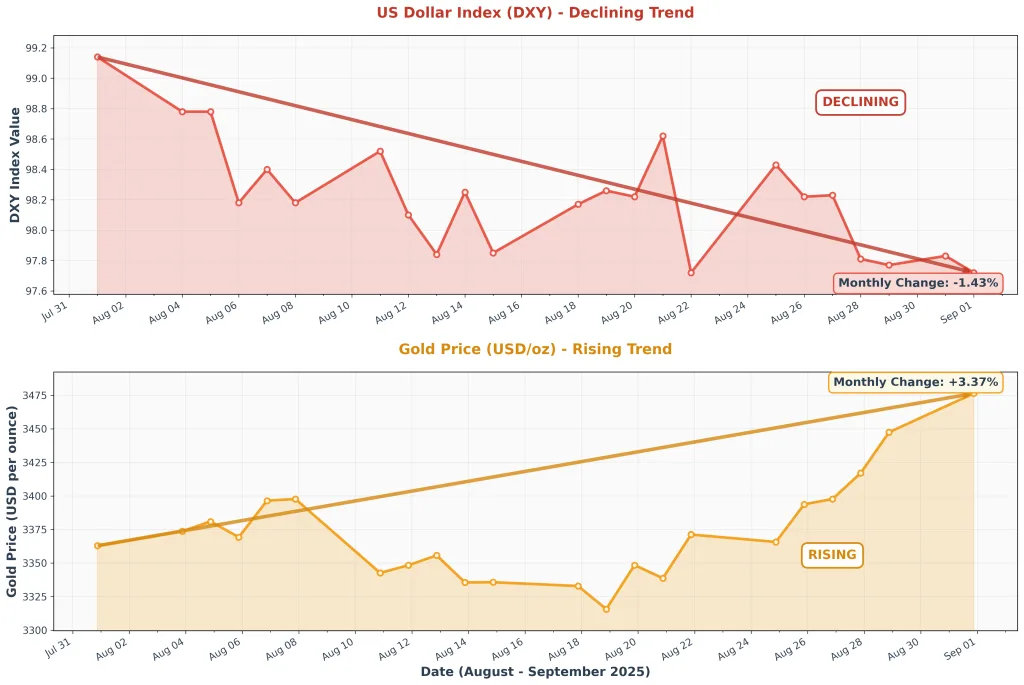
Central banks have taken note, accelerating their gold accumulation programs to diversify away from the dollar. Analysts saw this structural demand as support under prices that could keep pullbacks shallow, and argued that gold was rising not only on the dollar’s weakness at the time but on expectations that it could weaken further.
Beyond Rate Cuts: The Convergence of Bullish Catalysts
While Fed rate cuts dominate headlines, gold’s rally reflects a broader convergence of supportive factors. Geopolitical tensions continue to simmer, reinforcing gold’s safe-haven appeal. Many investors view gold as insurance against monetary mistakes and fiscal missteps.
Institutional and retail adoption has reached new heights. Exchange-traded funds (ETFs) have seen dramatic inflows, with holdings jumping by 397 tons in the first half of 2025 alone. At the same time, physical demand remains incredibly robust, with bar and coin demand rising 6.4% year-over-year. Analysts read this broad-based buying as a sign that the rally was not purely speculative.
Rate Cut Mechanics: Understanding Gold’s Sensitivity to Monetary Policy
The relationship between Fed rate cuts and gold prices operates through multiple transmission mechanisms. Lower interest rates reduce the opportunity cost of holding non-yielding assets, making gold relatively more attractive.
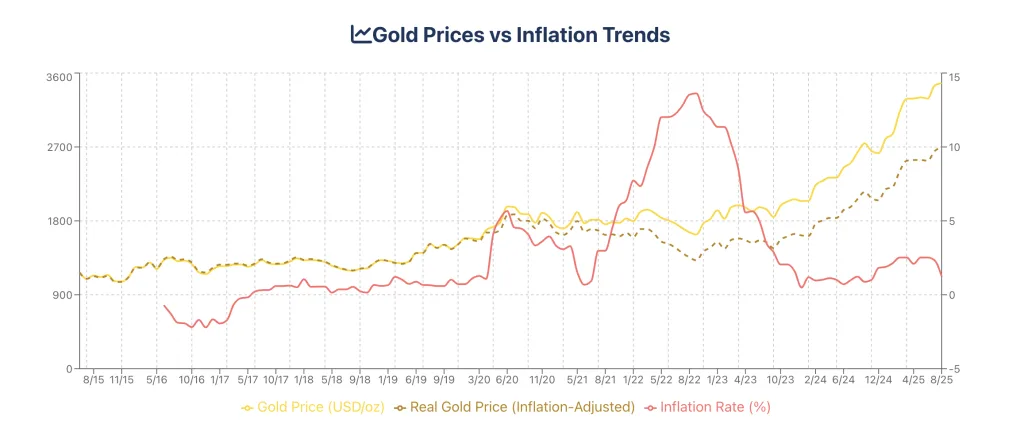
Rate cuts typically weaken the currency of the cutting central bank, and given gold’s inverse correlation with the dollar, this creates a double tailwind for prices. Additionally, lower rates often signal central bank concerns about economic growth, triggering safe-haven flows into gold as investors seek portfolio protection. Perhaps most importantly, rate cuts influence inflation expectations, bolstering demand for gold as a proven inflation hedge.
How Investors Were Positioned
Investors who wanted gold exposure in September 2025 could choose physical coins and bars, which they own directly, or ETFs, which trade like shares.
Some used dollar-cost averaging to spread purchases over time. Short-term corrections were widely expected; whether a correction is a pause or a turn is only clear afterwards.
The Case Analysts Made for Gold
Gold bulls argued that the case extended beyond monetary policy, to currency debasement concerns, the fallout from trade wars and gold’s long role as financial insurance.
As the Federal Reserve prepared to cut rates, some analysts described the move past $3,600 as the early stage of what could become one of history’s great gold bull markets.
At Bullion Trading LLC, we sell physical gold and silver coins and bars online and at our New York store. How much precious metal to hold, if any, depends on your own circumstances; this article is not investment advice.