


Have you ever driven past a gold buyer and seen a sign that says “We Pay Top Dollar”? It shows up in shop windows, on sandwich boards, in the radio spot that runs between traffic reports. The phrase lands like a promise. Read it a second time, though, and notice what it actually commits to: nothing you can measure. “We pay top dollar” is one of the most repeated lines in the business of buying gold, and on its own it tells you almost nothing about the check you will walk out with.
That is not an accusation aimed at anyone. It is how the phrase is built. Before you hand over a single ring, it helps to understand why the slogan can be technically true no matter who says it, and what to ask so the number in front of you reflects your gold’s real value instead of someone’s marketing budget.
“We pay top dollar” compared to what?
Every meaningful price is a comparison. Cheap compared to what, expensive compared to what, top compared to what. The slogan leaves the second half of that sentence blank, and your imagination fills it in with the most flattering version. Top dollar compared to another dealer down the street? Compared to what they offered yesterday? Compared to the live gold price on the screen? Compared to the actual melt value of the metal in your hand? Those are four completely different benchmarks, and the sign commits to none of them.
There is a reason the wording stays vague, and it is not necessarily sinister. Under federal law, an advertising claim that can be measured has to be backed up. In its advertising FAQ for small businesses, the Federal Trade Commission is blunt about it: advertisers “must have evidence to back up their claims,” and that applies to implied claims as much as explicit ones. Subjective claims that consumers can judge for themselves, the agency’s own example is “ABC Cola tastes great,” receive less attention. Advertising lawyers call that second category puffery, and “we pay top dollar” sits squarely inside it. Say instead “we pay more than any dealer in the city,” or “we pay 95 percent of the spot price,” and you have made a measurable claim the FTC expects you to prove. The slogan survives precisely because it promises nothing checkable.
Take “compared to yesterday.” Gold does not sit still. It is priced continuously on global markets and settled through benchmarks like the twice daily London price, so the honest melt value of your ring at four in the afternoon can differ from what it was at nine in the morning. A buyer who quotes you against yesterday’s lower number, or last week’s, can still call it top dollar while paying you below what the market says your gold is worth this afternoon. The word “top” hides which day it refers to, and which day can be real money when the metal moves this much.
Why almost every buyer can claim record prices right now
Here is where the phrase gets genuinely slippery, and it has to do with the metal itself rather than any one shop. Gold has been on a tear. On July 14, 2026 it traded at $4,074 an ounce, according to Fortune’s daily price tracking. Rewind to 2023 and gold sat near $2,000. The metal has roughly doubled in about three years.
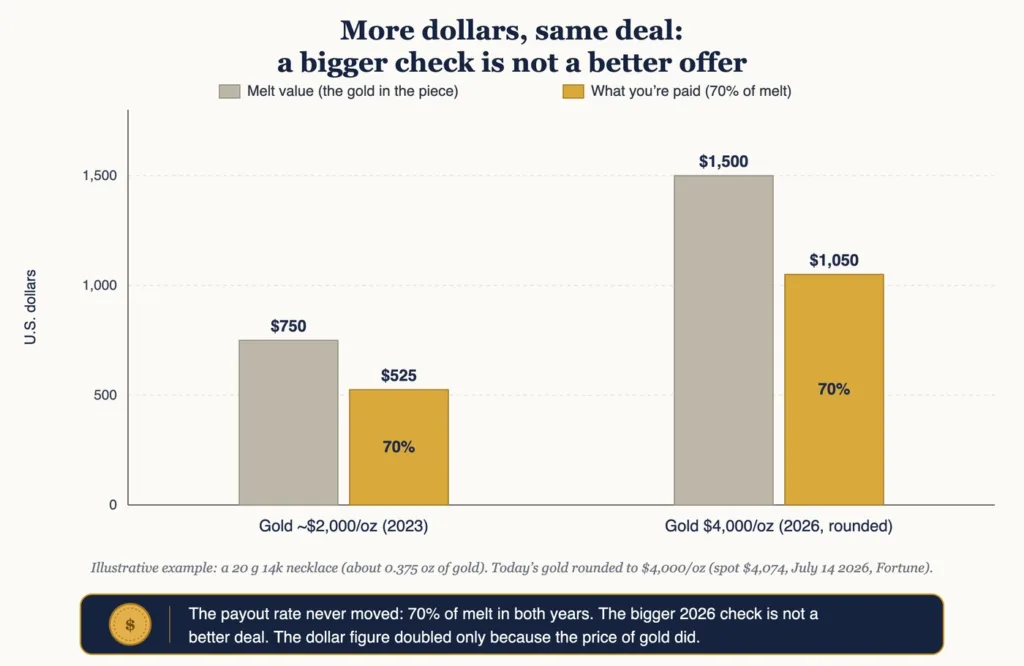
Think about what that does to every “highest prices ever” claim. If an ounce is worth twice what it was, then a buyer paying the exact same stingy percentage they always paid is now handing out twice as many dollars. The figure on the check really is the highest it has ever been, and the shop can advertise that with a completely straight face, because the number climbed on its own. The rising gold price did the work. The generosity did not budge.
Put numbers on it. Say you have a 20 gram, 14 karat gold necklace. Fourteen karat is about 58 percent pure gold, so the piece holds about 0.375 troy ounces of actual gold. With gold near $2,000 back in 2023, that melt value was about $750, and a buyer paying 70 percent handed you around $525. Call today’s gold a round $4,000 to keep the math honest. The same necklace now melts for about $1,500, and that same 70 percent buyer writes a check for $1,050. The check doubled to the dollar. Nothing about the offer improved. The buyer is no more generous than before. Your payout simply doubled because the metal doubled.
So a shop can pay you a smaller slice of your gold’s value today than it paid a customer five years ago and still, truthfully, run an ad shouting record payouts. Both things are true at once. That is the trap folded inside the slogan: a bigger check feels like a better deal, and it often is not.
Dollars are not the same as percentage
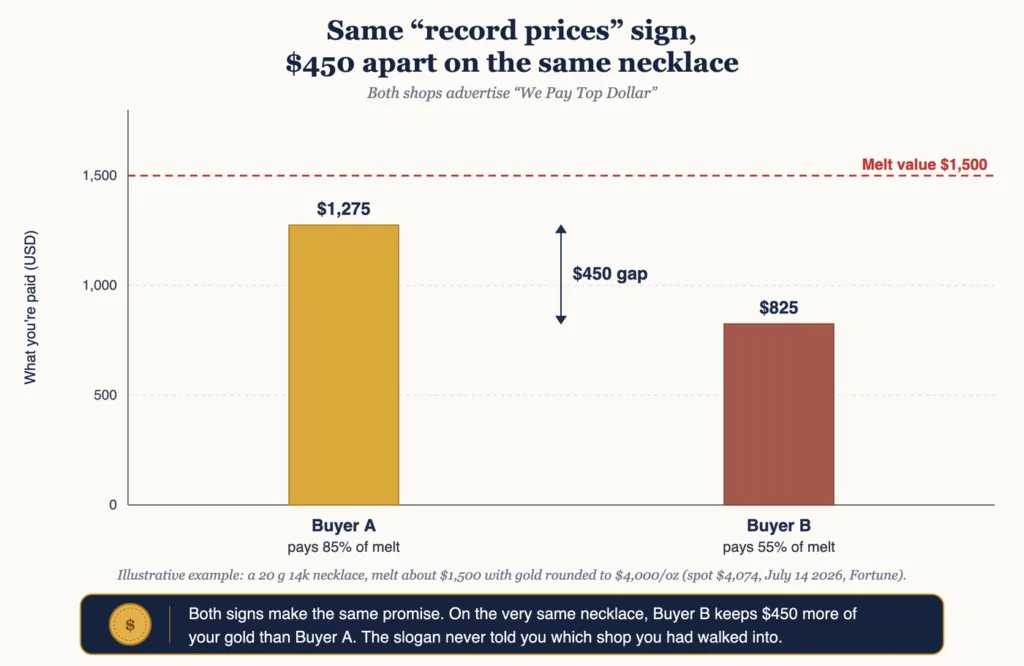
The distinction that actually matters is the one the advertising is built to blur. There are two very different things you can mean when you say a buyer paid a lot. One is the raw dollar amount, which mostly reflects where the gold price happens to be that week. The other is the percentage of your gold’s real market value that you kept. Only the second one is under anyone’s control, and only the second one tells you whether you got a fair shake.
Start with the honest baseline: melt value. That is the weight of pure gold in your item multiplied by the current price, and it is the number every offer should be measured against. Working it out is not hard once you know your item’s purity and weight, and it is worth doing before you sell anything. Our guide on how to calculate melt value walks through the arithmetic, and the piece on the gap between the spot price and the physical price explains why no buyer pays the full screen price.
Nobody pays 100 percent of melt, and nobody should have to. A buyer has to test the metal, refine it, cover overhead, and carry the price risk while it sits in the safe. The question is how much of your value all of that eats. AARP’s reporting on getting the most cash for gold and silver found reputable dealers paying up to 98 percent of market value for pure gold coins, while scrap jewelry pays less because it still has to be refined, and refiners have at times been backlogged enough to hold those offers down. AARP’s rule of thumb is blunt and useful: if someone offers you 50 cents on the dollar for your gold, that is probably a bad deal, and you should walk. A calculator, they note, is the fastest way to see what percentage of the real price you are actually being handed.
This is why the same slogan can sit above wildly different deals. Picture two shops on the same block, both advertising record payouts, both looking at your $1,500 necklace. One pays 85 percent of melt and offers $1,275. The other pays 55 percent and offers $825. Same sign, same metal, $450 apart. Here is the part that should stick: back when gold was $2,000, the generous shop paying 85 percent would have given you around $640 for that necklace. So the stingy shop’s $825 today is a bigger number than the generous shop’s offer a few years ago, which means the stingy shop can honestly claim it pays more than it used to, more than its neighbors did, more than ever. The slogan is satisfied. Your wallet is not.
What a gold buyer is actually required to tell you
It is worth knowing where the law does protect you, because it is not where the slogan operates. The FTC’s Jewelry Guides, backed by the rules in 16 CFR Part 23, require anyone describing precious metal to be truthful about the things that can be measured: the metal, its fineness, its weight, the karat. A buyer cannot legally call a 10 karat piece 14 karat or misstate what it weighs. Those are objective facts with consequences behind them.
Now notice what is missing from that list. Nothing requires a buyer to tell you their margin, the percentage of melt value they are paying, or how their offer stacks up against the shop next door. That information is theirs to keep, and the cheerful slogan is designed to fill the silence where it would otherwise go. The law makes them honest about your gold’s specifications. It does not make them volunteer anything about their own generosity. That gap is exactly the space you have to cover yourself, by asking.
The questions that actually price your gold
Swap the slogan for a number and the whole transaction changes. You do not need to be an expert or memorize the spot price to the penny. You need to make the offer explain itself, and a fair buyer will not flinch at any of this.
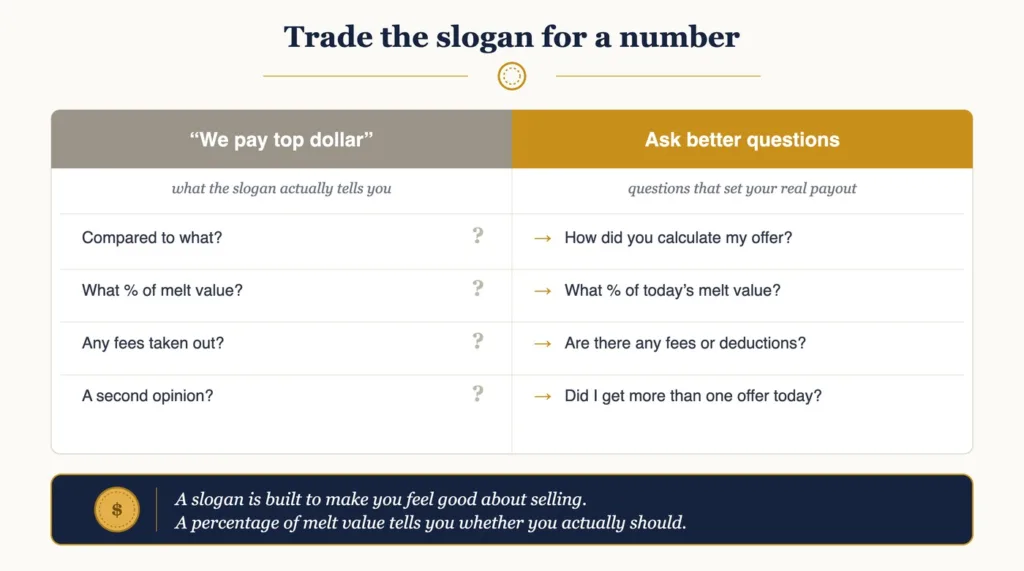
Ask how the offer was calculated. A straight answer sounds like a formula: this weight, at this purity, at today’s price, times this percentage. If the reply is a vague “that’s our best price today,” you have your answer about how carefully the number was set. Ask what percentage of today’s melt value you are being paid, and measure it against the baseline rather than against the sign in the window. Ask whether any fees, testing charges, or deductions come out before you are paid, because a strong headline percentage means little if it gets quietly trimmed at the register.
Then do two simple things the pros do. Know your melt value before you walk in, so you are checking their math instead of trusting it. And get more than one offer on the same day, since the gold price moves and a single quote tells you nothing about whether it is competitive. If you are selling coins or bars rather than scrap, it also helps to understand what a safe, straightforward dealer transaction looks like before you hand anything over. The same instinct that makes buyers overpay on the way in, chasing a headline price, makes sellers underperform on the way out. The premium trap on the buying side is the mirror image of the top dollar trap on the selling side, and the cure for both is the same: look past the advertised number to the real one.
Trade the slogan for a number
None of this means gold buyers are out to cheat you, and it does not mean “we pay top dollar” is a lie. The phrase is legal, common, and mostly harmless on its own. The problem is that it is empty, and an empty phrase is easy to lean on when you are holding jewelry you inherited or a coin you were never taught to value. A slogan is built to make you feel good about selling. A percentage of melt value tells you whether you actually should.
So let the sign say whatever it wants. Your job is to translate it into the only terms that matter: what is my gold worth today, what share of that am I being offered, and what comes out before I get paid. Ask those three questions and the marketing goes quiet, because there is nothing left for it to stand on. That is a far better place to sell from than hoping top dollar means what you want it to mean.
