

On July 2, 2026, one of the most heavily advertised names in retail gold filed for bankruptcy. Rosland Capital, the Los Angeles precious-metals dealer whose television commercials ran for years on cable news, filed a voluntary Chapter 11 petition in the U.S. Bankruptcy Court for the Central District of California (Case No. 2:26-bk-16650). The Rosland Capital bankruptcy is not a reorganization meant to keep the doors open. According to the filing, it is a liquidation: a court-supervised wind-down of a company that, by its own accounting, owes far more than it owns.
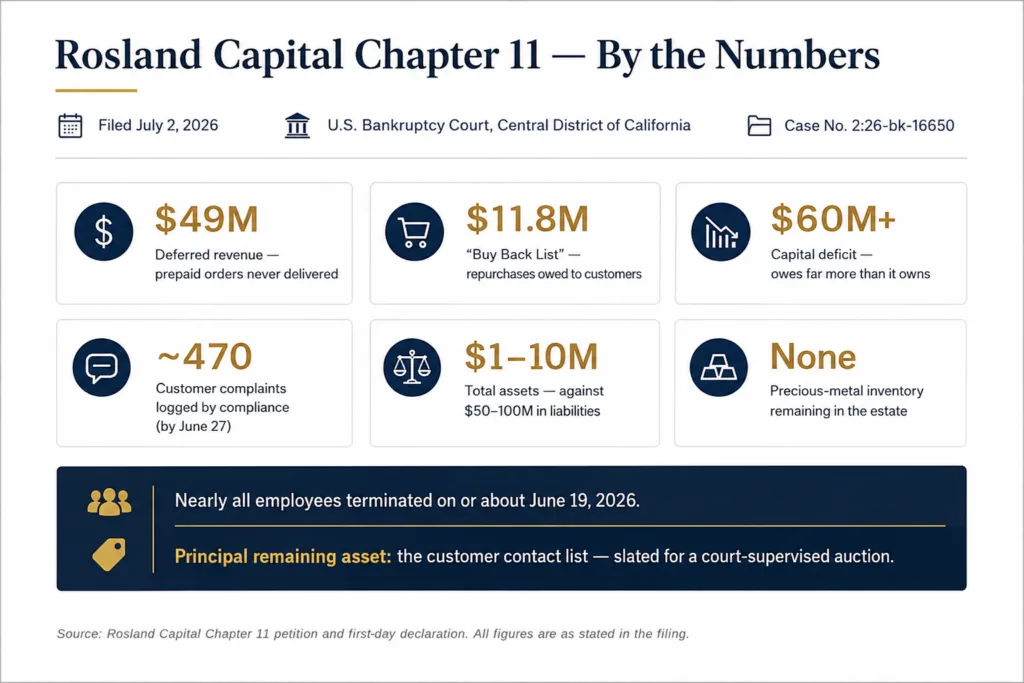
The numbers in the petition are stark. Rosland reported assets in the $1 million to $10 million range against liabilities of $50 million to $100 million, and a capital deficit its own declaration puts at more than $60 million. It holds no remaining inventory of coins or bullion, only limited cash. And the single largest thing it has left to sell is not gold. It is you, or rather your data: the company’s principal remaining asset is a list of past, active, and prospective customers that it intends to auction off under court supervision.
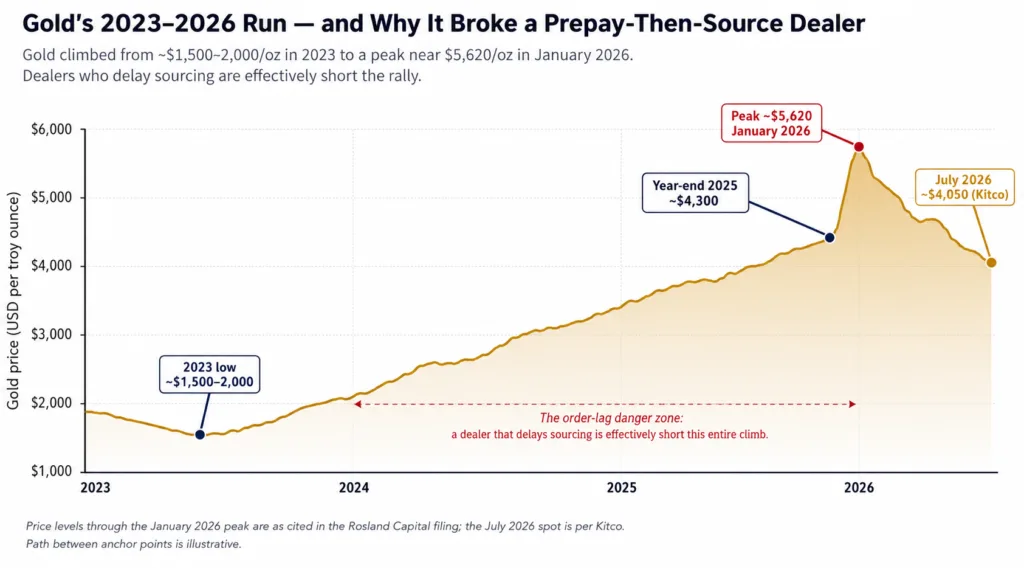
It would be easy to read this as a story about gold going wrong. It is the opposite. Gold did exactly what a gold bull market does, running from roughly $1,500 an ounce in 2023 to a peak near $5,620 in January 2026, per figures cited in the filing. What broke was not the metal. It was the way one dealer sold it. That distinction is the whole point of this piece, because the mechanism that took Rosland down is one that any physical gold buyer can learn to spot, and avoid, in the dealer they choose next.
What the filing actually says
Strip away the television-ad familiarity and the petition describes a business that had already stopped functioning weeks before it reached court. The company’s first-day declaration states that substantially all of its employees were terminated on or about June 19, 2026. By late June, according to the same materials, roughly 470 customer voicemails, emails, and demands had been routed through its compliance department, and at least one customer had already filed suit. These are the fingerprints of a dealer that had taken money and not delivered.
Two line items explain why. The first is an approximately $49 million balance the filing labels Deferred Revenue, which is an accounting term for money customers had already paid for orders the company had not yet shipped. The second is an approximately $11.8 million Buy Back List, representing repurchase promises Rosland had made to customers who wanted to sell metal back and could no longer be paid. Together, those two figures are the shape of the hole: tens of millions of dollars owed to ordinary buyers who were waiting either for gold they had purchased or for cash they had been promised.
The detail that deserves the most attention is the one about your personal information. The filing describes the company’s “Customer Information Assets,” its past, active, and potential customer lists, relationship records, and marketing data, as the principal asset remaining in the estate, to be sold through a competitive, court-supervised process. Read that plainly: a company built on selling gold to trusting buyers has so little left that its most valuable remaining property is the contact list of those same buyers, now headed to the highest bidder. If you ever transacted with Rosland or even requested one of its information kits, that is a concrete, near-term consequence worth knowing about.
The marketing machine, and the product mix that fed it
Rosland built its brand the way many national gold sellers do, through relentless television advertising and celebrity endorsement. Its commercials, fronted for more than a decade by a well-known actor, were a fixture of cable-news programming, and the company also marketed commemorative coin products tied to a famous professional golfer. None of that is a criticism of the endorsers. There is no suggestion anywhere in the filing that a paid spokesperson had any role in, or knowledge of, the company’s finances or fulfillment. They were the face of a marketing model, and the marketing model is what matters here.
National ad campaigns, celebrity deals, lead-generation funnels, and large commissioned sales teams are expensive, and that expense has to be paid for out of gross margin. Independent reporting on the filing describes a product mix that leaned heavily on numismatic and semi-numismatic “collectible” coins carrying premiums of 30% to 50% or more over their melt value, well above the low-single-digit premiums on standard bullion. Those fat markups are what funded the advertising. They are also, as we have written before, the exact opposite of what most buyers should want, a dynamic we walk through in detail in the gold premium trap.
This was not a small operation running on fumes from day one. According to figures cited from the company’s declaration, annual sales exceeded $150 million in 2021 and still ran near $98 million in 2025, yet the company recorded net losses of more than $24 million across 2022 through 2025. A business can post nine-figure revenue and still be quietly bleeding, and that combination, big top line, negative bottom line, high fixed marketing cost, is exactly the setup that a sudden change in market conditions can turn fatal.
The order-lag model: how prepaid orders became a $49 million hole
Here is the mechanism at the center of the collapse, and it is worth slowing down for, because it is the part that generalizes to every dealer you will ever consider.
Reporting on the filing describes an order-fulfillment model in which Rosland took prepaid customer orders but did not immediately source the corresponding metal from its own suppliers. The metal was often bought to fill the order later, sometimes months later. In a flat or falling gold market, that lag is a nuisance at worst and a small profit opportunity at best: the company holds the customer’s cash, buys the metal cheaper down the line, and pockets the difference. It is a float. It works right up until the moment it doesn’t.
The moment it doesn’t is a fast-rising market. When you accept a customer’s payment today but agree to deliver metal you have not yet bought, you have effectively sold gold short. Every dollar the price climbs before you actually source the ounce is a dollar you lose. As gold ran higher through 2024 and 2025, the filing indicates that Rosland’s replacement cost, what it now had to pay suppliers to fill old orders, repeatedly rose above the price the customer had already locked in. Each delayed order got more expensive to honor with every uptick in the metal. The deferred-revenue balance was not just money owed. It was a growing pile of promises that cost more to keep every single week.
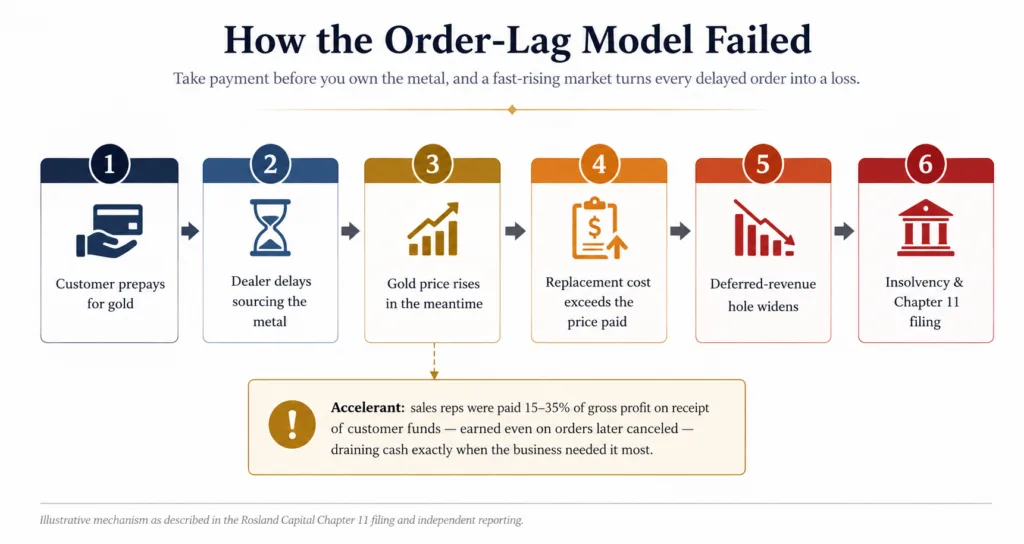
One more detail poured accelerant on this. According to the filing, sales representatives were paid a commission of 15% to 35% of gross profit upon receipt of a customer’s funds, and that commission was earned even when the underlying order was later canceled or never fulfilled. So cash came in, a large slice went straight out the door to the sales floor, and if the order fell through, the company had already spent margin it would now have to claw back or eat. In a rising market with a lengthening delivery backlog, that structure drains liquidity at precisely the moment the business needs it most.
Why a rising gold market broke this specific model
It is genuinely counterintuitive that a gold dealer would be destroyed by gold going up. The resolution is that Rosland, through its order-lag model, was structurally short the very thing it sold. The bigger and faster the rally, the deeper underwater its unfilled order book went.
And this was a big, fast rally. The figures cited in the filing trace gold from a low around $1,500 an ounce in 2023 to roughly $4,300 by the end of 2025, and then to a peak near $5,620 in January 2026. It has since cooled to just above $4,000 an ounce, but the damage was done on the way up. A dealer that had taken a customer’s $10,000 in 2024 for coins it had not yet sourced could easily find, a year later, that the metal to fill that order cost several thousand dollars more than the customer had paid. Multiply that across an order book large enough to generate a $49 million deferred-revenue balance, and the arithmetic becomes unsurvivable. The high-premium numismatic mix made it worse, not better: those products are the hardest to source cheaply and the slowest to resell, so the lag and the loss both ran longer.
Notice what this explanation does not require. It does not require that anyone set out to defraud customers. A dealer that held its inventory, or that sourced metal the same day it took an order, would have passed the price rise straight through to the buyer and been fully hedged. Rosland’s problem was baked into the timing of its model, and a rising market simply exposed it. That is why the takeaway here is structural, not moral, and why it should change how you evaluate a dealer rather than how you feel about this one.
What happens when a gold dealer goes bankrupt
This is the part every physical buyer should internalize, because it reframes what “buying gold from a dealer” actually means when the metal is not in your hands.
When you prepay a dealer that does not yet hold your specific metal, and does not deliver it promptly, you are not really the owner of gold. You are a creditor. You have handed over cash in exchange for a promise, and your position depends entirely on the dealer staying solvent long enough to keep that promise. If the dealer fails, you do not get to walk into the vault and collect your coins, because in a case like this there is no vault and there are no coins. You get in line.
And in a bankruptcy, that line has an order. In general terms under U.S. law, secured lenders and the costs of administering the estate get paid first, certain priority claims come next, and general unsecured creditors, the category that ordinary prepaid customers and buyback claimants typically fall into, sit near the back. There is a narrow consumer-deposit priority for individuals who prepaid for personal-use goods, but it is capped at a relatively small amount per person, so most of a sizable prepaid order lands in the general unsecured pool with everyone else. That pool is paid from whatever is left after the higher tiers, which, when assets are $1 million to $10 million against tens of millions in claims, is usually cents on the dollar, if that.
How many cents, and by when, is not yet knowable here. As of the filing, the record does not establish any recovery percentage for customers, and no claims-bar date, the deadline by which creditors must file to be counted, has been reported. Anyone who is owed money or metal by Rosland should watch the court docket for that deadline and file a proof of claim, and should treat this article as general information rather than legal advice; an attorney or the appointed trustee is the right source for case-specific guidance. The broader lesson, though, is not case-specific at all. Undelivered, unallocated metal is a claim on a company, and a claim on a company is only as good as the company. It is the same reason we spend so much time on the difference between owning your specific bars and merely being owed them in allocated versus unallocated gold storage.
The regulators are circling, but nothing is proven
The Rosland Capital Chapter 11 filing also discloses two government inquiries, and both deserve to be described precisely, because an investigation is not a finding. According to the petition, the New York Attorney General has been looking into Rosland’s sales to New York customers through 2023, a matter reporting characterizes as relatively inactive, and the U.S. Securities and Exchange Commission has an inquiry touching the company’s metal-backed IRA products. As of the filing, neither inquiry had produced a public enforcement action, and nothing has been adjudicated. They are disclosures under oath, part of the public record, and no more than that. We note them for completeness, not as a verdict.
How to protect yourself: a buyer’s checklist
The value of a story like this is not the schadenfreude. It is the checklist it leaves behind. None of the following is exotic. It is simply the difference between owning gold and owning a promise.
- Take prompt delivery. The single most protective habit is to buy from dealers that settle and ship in days, not weeks or months, and then to actually take possession or place the metal in genuinely allocated, segregated storage. A long gap between your payment and your metal is the exact window in which a dealer’s solvency becomes your problem.
- Buy recognized bullion near spot, not “exclusive” collectibles. Standard, widely traded products like American Gold Eagles, Maple Leafs, and recognized bars carry small premiums and resell instantly. The high-premium numismatic and “special edition” coins that pay for celebrity ad campaigns are the hardest to resell and the easiest place to overpay, a trap we break down in the gold premium trap.
- Favor dealers that hold real inventory. Ask directly whether the product is in stock and ships now, or whether it is sourced after you pay. A dealer that ships from inventory it already owns is not running the order-lag risk that sank Rosland. Our guide on how to choose the best gold bullion dealer covers the specific questions to ask.
- Treat long delivery delays as a red flag. Backlogs happen in fast markets, but multi-week or multi-month delays, vague ship dates, or pressure to “lock in the price now and receive it later” are warning signs, not normal service. If the metal is not on its way quickly, ask why.
- Be skeptical of IRA hard-sells. Metal-backed retirement accounts are legitimate, but they are also where the highest-pressure, highest-premium sales tactics tend to concentrate. Understand the fees, the custodian, and exactly what metal is being purchased before you move retirement money; our precious metals IRA guide lays out how these accounts are supposed to work.
The lesson gold buyers should actually take away
Rosland Capital did not fail because gold was a bad investment. Gold was, on the filing’s own numbers, one of the best-performing assets of the decade over exactly this period. The company failed because it sold that gold on terms that quietly made its customers into unsecured creditors, and then a rally it had bet against came for the gap between what it had promised and what it could deliver.
That is the durable takeaway, and it will outlast the headlines about this one dealer. How you buy gold matters as much as whether you buy it. Owning a specific, recognized coin or bar that is in your possession or truly allocated to your name is ownership. Prepaying a promise from a company you are trusting to stay solvent is credit. Most of the time the difference is invisible. In a bankruptcy filing, it is the only thing that matters.
This article is based on Rosland Capital’s Chapter 11 petition and first-day declaration and on independent reporting on the filing. Figures and characterizations attributed to the filing are allegations and statements from the company’s own materials, not adjudicated facts. It is general information about physical precious-metals purchasing and U.S. bankruptcy, not legal, tax, or investment advice.
