
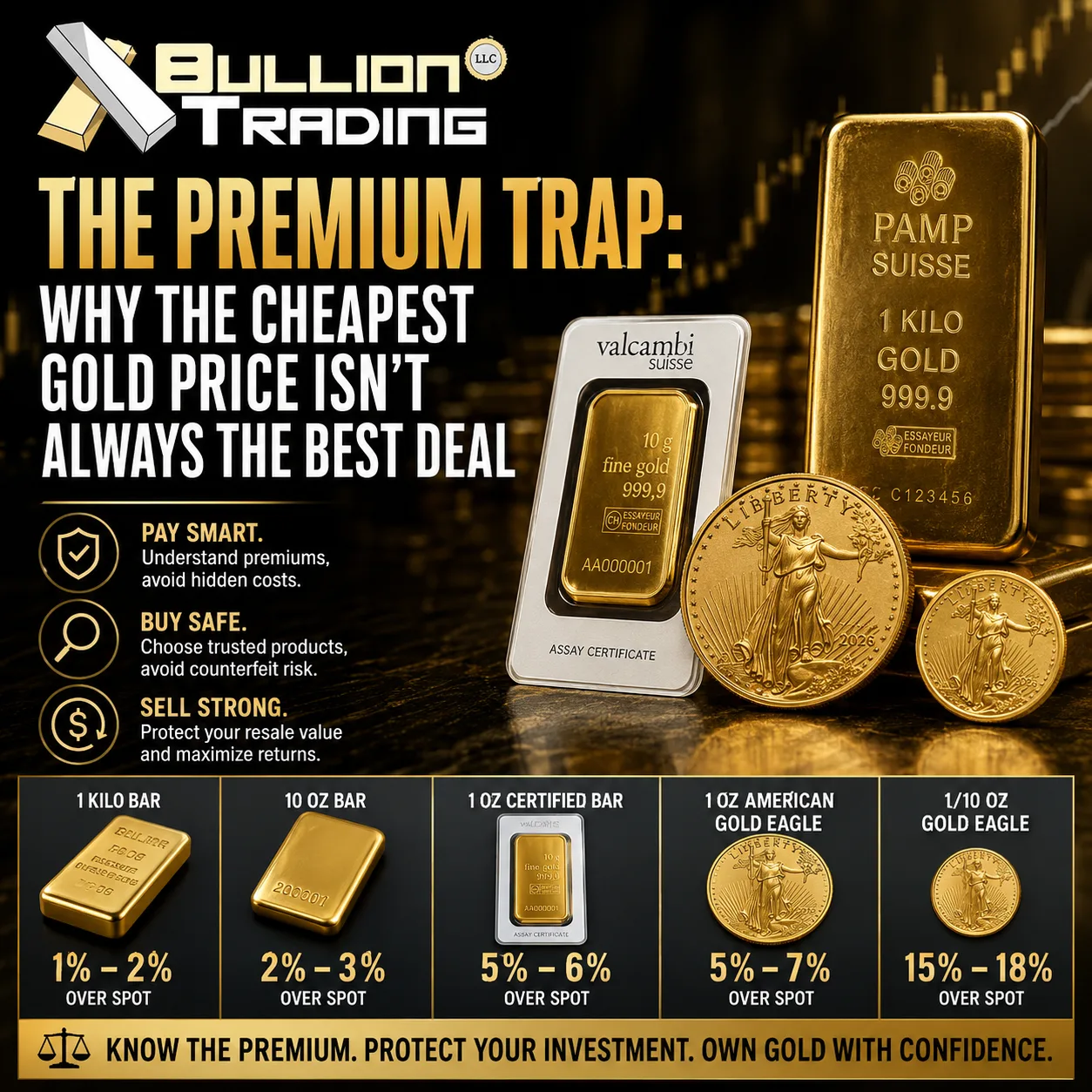

Gold is trading at $4,559 per troy ounce today, up roughly 40% over the past twelve months. That number gets quoted everywhere. It shows up on your phone, on financial news tickers, and in every conversation about whether to buy. But here’s the thing: that price has almost nothing to do with what you’ll actually pay.
Physical gold always sells at the spot price plus a gold premium, the percentage above spot that dealers charge to cover manufacturing, authentication, shipping, and their own operating margins. That premium varies by product, brand, size, and source in ways that can swing your total cost by more than 15 percentage points per ounce. The cheapest headline price you find while shopping around may turn out to be the most expensive gold you ever bought, once counterfeit risk, resale friction, and fees that appear only at checkout are all factored in.
Most first-time buyers don’t realize this until after the fact. They compare advertised prices, find the lowest one, and feel like they’ve done their homework. Understanding the gold premium structure before your first purchase is what separates buyers who get full value from those who overpay without knowing it.
What the gold premium actually covers
The premium exists for real reasons, and understanding them helps you evaluate whether any given markup is fair.
Every physical gold product has a manufacturing history before it reaches you. A refinery processed raw ore, cast or pressed metal into a standardized form, stamped hallmarks, verified purity through assaying, packaged the finished piece, insured it during warehousing, and shipped it through a distribution chain. That chain of custody is not free. For government-minted coins, there are additional production costs in the die work, security features, and quality controls that sovereign mints invest in with each issue.
Dealers carry their own costs on top of that. They maintain inventory that can gain or lose thousands of dollars in value on a bad day, manage customer service, maintain secure facilities, absorb payment processing fees, and assume counterparty risk on every transaction. Their margin comes out of the premium.
For a deeper look at how these costs break down across product categories, this overview of how gold premiums are structured covers the mechanics well.
The premium is not a rip-off. It’s the cost of converting an abstracted commodity price into a physical, verifiable, storable object you actually own. The question to ask is not how to avoid paying a premium but which premiums are buying you something of real value in return.
When a low premium is a red flag
Here’s the uncomfortable reality: physical gold cannot legitimately be sold at or near zero premium over spot by any dealer operating normally. The fixed costs of production, authentication, and distribution make that mathematically impossible unless the margin is being recovered somewhere else.
Somewhere else is the problem. Some sellers recover their margin through hidden fees. Others through less reputable products. And some through outright fraud.
Tungsten weighs 19.25 grams per cubic centimeter. Gold weighs approximately 19.3. The two metals are so close in density that a properly dimensioned gold-plated tungsten bar passes a scale test, a visual inspection, and a basic magnet test without raising flags. With gold at $4,559 per ounce, the payoff for successfully placing a fake bar is enormous, and that incentive has supported a growing counterfeiting operation that has expanded alongside gold’s price over the past several years.
U.S. Customs and Border Protection has publicly documented seizures of counterfeit gold bullion at ports of entry, and the London Bullion Market Association has issued repeated guidance to its members on detecting sophisticated bar forgeries. High-quality fakes have appeared at small dealers, on secondary resale platforms, and in private-party sales. The common thread across nearly all confirmed counterfeiting cases is that they originate outside established dealer channels, often accompanied by suspiciously low pricing.
Guidance on how to detect fake gold covers the specific tests available to buyers. But the most effective defense starts before the purchase. Reputable mints invest heavily in anti-counterfeiting technology precisely because their brand recognition gives their products consistent resale value. The premium you pay for a government-minted coin or a certified bar from a recognized Swiss refinery includes, among other things, a meaningful degree of fraud assurance.
The products and what they actually cost per ounce
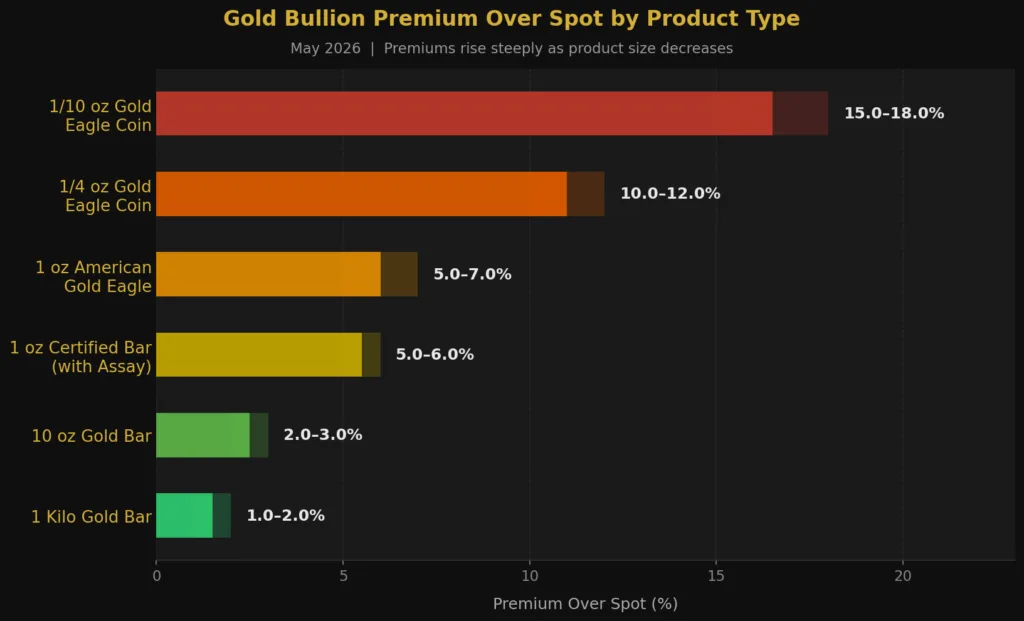
Premium rates vary by product type more than most buyers expect, and knowing the rough ranges before you shop changes how you evaluate any listing.
Large format bars, 10 oz or 1 kilo, carry the smallest premiums, often 1-2% over spot for brands like PAMP Suisse, Valcambi, and Credit Suisse. At today’s prices, a 10 oz bar runs roughly $45,600 to $46,500 delivered. The appeal is clear: you get the most gold per dollar of premium paid. The catch is concentration. Selling a single asset worth that much means finding a buyer for the entire piece at once, and dealer buyback spreads on large bars tend to be wider than on standard 1 oz products, partially offsetting the buy-side savings.
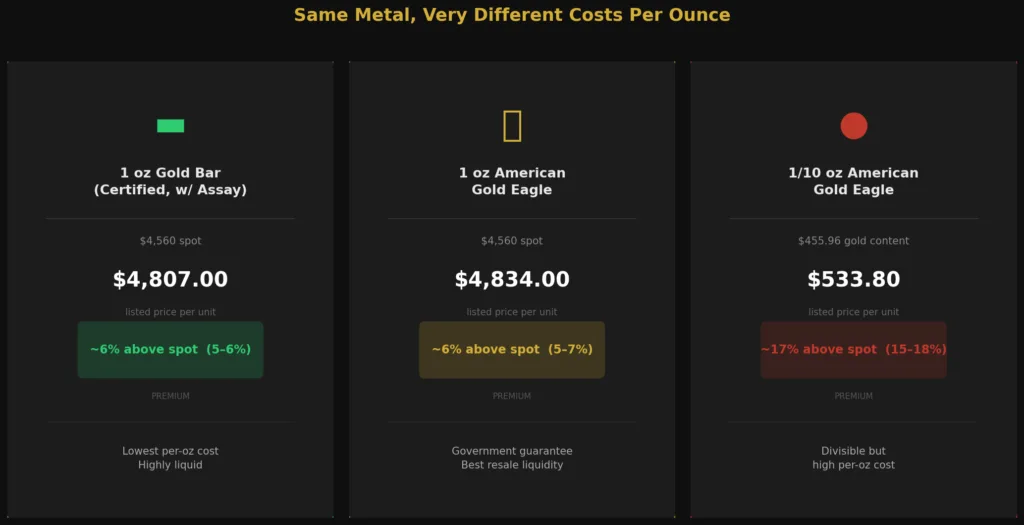
The 1 oz tier, across both certified bars and government-minted coins, is the practical sweet spot for most individual investors. A 10-gram Valcambi certified bar with assay card currently lists at $1,556.41 on major dealers, about 6% over the current spot value for that weight. A 1 oz American Gold Eagle from the U.S. Mint runs roughly 4-7% over spot. These products trade quickly, are instantly verifiable, and command consistent buyback pricing.
Fractional coins are where premiums become genuinely expensive. A 1/10 oz American Gold Eagle is currently listed at $533.80 on major dealers. The actual gold content at today’s spot ($4,559.57 per troy ounce, so $455.96 for one-tenth of an ounce) means you’re paying a 17% premium over bullion value. Buy ten of them to build a full ounce and the total reaches $5,338, compared to roughly $4,760-$4,900 for a single 1 oz coin. The divisibility and flexibility of fractional coins have real value for some buyers, but a realistic look at fractional gold buying costs is useful reading before committing to smaller denominations.
The round-trip calculation: what you pay to buy, and what you get back to sell
The premium you pay on entry is only half the equation. The other half is what you give back when you sell.
When dealers buy gold from the public, they offer the bid price, which is spot minus a discount. The gap between their buy price and sell price is the spread, and it reflects how easily and quickly they can resell the product. For highly recognizable products, American Gold Eagles, PAMP Suisse bars, Royal Canadian Maple Leafs, that spread is tight. Dealers can move these products almost immediately because buyers come ready for them. For obscure brands, unusual bar sizes, or pieces with unclear provenance, the buyback discount is wider because the dealer faces more friction finding the next buyer.
Consider two 1 oz purchases side by side: an obscure private brand bar at 1.5% over spot, and a 1 oz American Gold Eagle at 5.5% over spot. If the Eagle sells back at spot, which is routine during normal market conditions, and the unknown bar sells at 3% under spot due to provenance uncertainty, the round-trip costs are 6% on the Eagle and 4.5% on the seemingly cheaper bar. That 1% headline advantage has already narrowed to a 1.5 percentage point gap, and it disappears entirely on the first modest price appreciation.
Why brand recognition is worth paying for
The U.S. Mint has produced American Gold Eagles under the Gold Bullion Coin Act of 1985. Each coin carries a statutory guarantee of gold content and weight backed by the U.S. government. The Royal Canadian Mint’s Maple Leaf program is equally established, with each coin minted to 99.99% purity and incorporating advanced holographic security features on recent issues. PAMP Suisse, founded in Ticino, Switzerland in 1977, remains one of the most recognized assay marks in the global gold market. Every major bullion dealer worldwide accepts these products without hesitation.
When you buy from this tier of products, you are buying something that any gold dealer in any country recognizes immediately and prices without question. That instant recognition is a genuine financial asset. It means selling quickly and getting a fair price with minimal back-and-forth about authenticity or market acceptance. An obscure product from a lesser-known private mint doesn’t offer that reliability, particularly if market conditions tighten and dealers become more selective about what they buy.
The small additional premium for a recognized product over an unknown one is, in practical terms, insurance against the friction cost of selling something that requires extra verification and persuasion.
What the price tag doesn’t show you
The listed premium per ounce is not the final number at checkout. Most dealers charge a 3-4% surcharge for credit card purchases over cash-equivalent methods like wire transfer, personal check, or e-check. On a $4,600 transaction, that surcharge adds $138-$184 before any other fees are applied.
Shipping and insurance stack on top. A single 1 oz coin shipped with signature confirmation and insurance runs $15-$30 at most dealers. Buy larger quantities to qualify for free shipping thresholds and this line item disappears, but on small purchases it adds real percentage points to the total cost per ounce. Some dealers also charge handling fees, account creation fees, or minimum order surcharges that are buried in terms and conditions rather than the product listing.
The cleanest comparison is total delivered cost: the final number in your cart, including every fee, expressed as a percentage over spot. Comparing that number across two or three established dealers for the same specific product tells you far more than advertised per-ounce prices alone.
Getting the math right before you commit
Gold investing rewards patience and clarity. The framework that holds up is simple: know the product category you want based on your holding horizon and resale goals, get total all-in delivered quotes from at least two dealers for the exact same product and payment method, and check each dealer’s stated buyback price on the same day to understand the round-trip spread before any money changes hands.
The cheapest advertised price almost never wins that analysis. Recognized products from established dealers, bought at market-rate premiums, consistently deliver better full-cycle results than low-premium alternatives once resale conditions and total costs are accounted for.
Gold has gained more than 40% over the past twelve months, which means the dollar cost of buying impulsively is larger than ever. On a $4,559 per ounce base, a 3% overpayment on premium costs $137 per ounce. The spot price may be what everyone quotes, but the premium is where the real buying decision gets made.
