
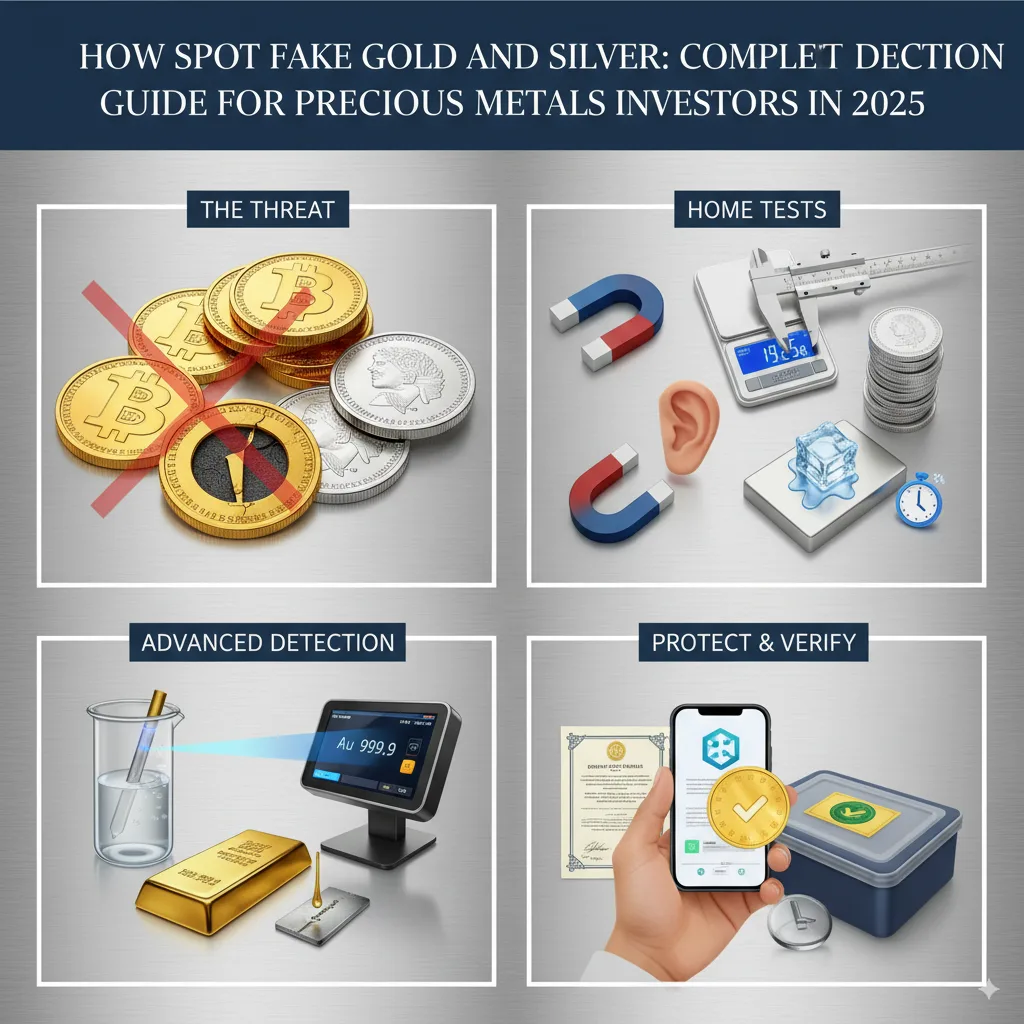
The counterfeit gold bar detection methods that work are the ones that see inside the metal: an electromagnetic conductivity verifier, ultrasound and, as the final word, a drilled sample sent for fire assay. Weight, size and specific gravity catch copper, brass and lead fakes but not tungsten, which at 19.30 g/cm³ is within 0.1% of gold’s 19.32 g/cm³, according to NIST’s table of element densities. Bullion Trading LLC research using official mint specifications and those NIST figures found that a tungsten copy the exact size of a 1 oz Gold Maple Leaf would weigh within 0.03 g of the real coin, less than many pocket scales display. With the gold Ask at $3,967.78 an ounce on 3 November 2026, one convincing fake ounce is worth more than $3,500 to whoever sells it, so the order in which you test matters.
| Key finding | Result |
|---|---|
| Gold vs tungsten density | 19.32 vs 19.30 g/cm³ (NIST), a 0.1% gap |
| Same-size tungsten copy of a 1 oz Gold Maple Leaf | 31.08 g vs the official 31.11 g |
| Same-size copper, brass, steel or lead copy of the same coin | 41% to 59% too light |
| Home specific-gravity test on 1 oz, 0.01 g scale | Density to about ±0.25 g/cm³: separates gold from base metals and 24k from 22k, not from tungsten |
| Tests that can find a tungsten core | Conductivity verifier (within its reading depth), ultrasound, drilled sample with fire assay |
| What XRF reads | The surface only, so a plated fake reads as gold |
| Cheapest genuine 1 oz gold on our list, 3 November 2026 | 1.68% over the Ask; none of 38 in-stock 1 oz gold coins and bars was below it |
What does counterfeit bullion mean?
Counterfeit bullion is a bar, coin or round that misrepresents its metal, its weight or its maker. Four kinds turn up: base metal plated with gold or silver; a filled or cored piece, with tungsten or lead inside a real gold or silver shell; real metal of lower fineness sold as higher; and genuine-looking packaging, such as a forged assay card, around the wrong contents. Fake gold coins tend to use tungsten because its density is close to gold’s, while fake silver coins more often have centers of lead or copper, or layers of both.
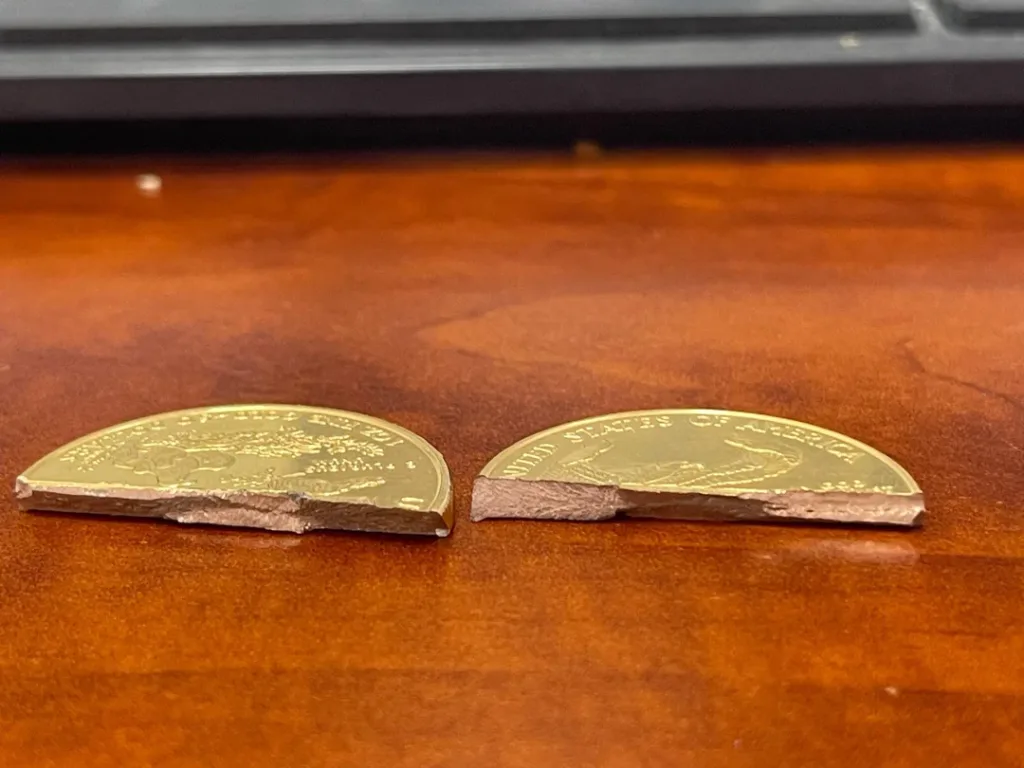
A replica is not automatically a crime. The U.S. Hobby Protection Act lets imitation coins be made and sold only if they are plainly and permanently marked “COPY”, and the FTC’s rule under the Act sets how. Counterfeiters simply leave the mark off. For famous cases, see our history of the greatest gold counterfeiters.
Which metals are used to fake gold and silver?
Mostly copper, brass, steel, lead and tungsten, and density decides which one fools which test. Copper (8.96 g/cm³), cartridge brass (8.53) and iron (7.87) are less than half as dense as gold, so a plated copy of the right size is far too light or, at the right weight, visibly too big. Lead (11.35) is denser than silver (10.50), which is why it turns up inside fake silver: a lead core makes a silver copy slightly heavy rather than light.
To show what that means in grams, we computed the weight of a copy with exactly the volume of a genuine coin, using the mint’s official weight and alloy and NIST densities. A copper, brass, steel or lead copy of a 1 oz Gold Maple Leaf comes out 41% to 59% too light. For a 1 oz Silver Eagle, copper and brass copies are 15% to 19% too light and a lead copy about 8% too heavy. Only tungsten, inside fine gold, lands within a tenth of a percent.
Does weighing a bar catch tungsten? The common advice, tested
No: a tungsten core changes neither the weight nor the size of a fine-gold bar, which makes tungsten the hard case. NIST lists tungsten at 19.30 g/cm³ and gold at 19.32, and many handbooks round both to 19.3. On a 1 oz bar, that 0.1% gap is 0.03 g, below what most pocket scales can resolve.
Specific gravity (weighing a piece in air, then hanging in water) does not close the gap either. We worked through the error: on a 1 oz piece, the water reading is only about 1.6 g lighter than the air reading, so a scale that reads to 0.01 g pins density to about ±0.25 g/cm³, more than ten times the gold-tungsten difference. Even a 0.001 g laboratory balance gets only to about ±0.025 g/cm³, still wider than NIST’s 0.02 gap. The test exposes copper, brass, lead and the wrong karat, and is blind to tungsten, as a GIA study of gold testing methods also noted for dense fillers. The other popular home checks don’t help: tungsten is not magnetic, and ping apps publish no independent accuracy data for cored coins.
Tungsten does differ from gold in two ways that professional tools use. Its electrical resistivity is 5.28 µΩ·cm against gold’s 2.21, per NIST’s reference data, so it conducts less than half as well, and sound travels through it at about 5,460 m/s against 3,240 m/s in gold, according to measurements by Japan’s Customs Central Laboratory. A test that reaches the core can see either difference; one that reads only the surface cannot.
Counterfeit gold bar detection methods compared
No single test catches every kind of fake, so professionals pair a cheap screen with a test that sees below the surface. The matrix shows which method catches which fake when the piece is plated with real gold or silver; the table adds cost and whether the test leaves a mark.
| Method | What it measures | Misses | Typical cost | Leaves a mark? |
|---|---|---|---|---|
| Magnet | Magnetism | Copper, brass, lead and tungsten, which are not magnetic | A few dollars | No |
| Weight and dimensions | Mass and size against the official spec | Tungsten inside fine gold | 0.01 g scale and digital calipers | No |
| Ping (acoustic) | The ring frequency of a coin | Bars, coins in holders; not proof on its own | Free apps; experience | No |
| Specific gravity | Density by weighing in air and water | Tungsten | The same scale plus a cup of water | No |
| Conductivity verifier | Electrical resistivity below the surface, or right through thinner pieces | A core deeper than the sensor reads | $999 to $3,499 (Sigma’s store, October 2026) | No |
| Ultrasound | Sound velocity and echoes through the full thickness | Coins and irregular pieces; needs a known genuine bar to compare | $1,295 to $2,495 for a DeFelsko gauge (one supplier) | No (uses a coupling gel) |
| XRF analyzer | Elemental makeup of the surface | Anything under the plating | $16,599 for one handheld model; Bruker has quoted $18,000 to $50,000 | No |
| Acid or touchstone | How the surface reacts to acid | Cores; thickly plated fakes | An inexpensive kit | Yes, a scratch |
| Drilled sample and fire assay | Precious-metal content of the sample | Nothing in the sample, but it damages the piece | Laboratory fee | Yes |
Measured against what a single fake would cost you, most of these tools are cheap. On 3 November 2026 the most expensive Sigma verifier, at $3,499, cost about 86% of the price of a 1 oz gold coin, or as much as 58.6 one-ounce silver coins, so it would pay for itself the first time it stopped a fake gold coin, or after 59 fake silver ones.
Conductivity verifiers
Electromagnetic verifiers such as the Sigma Metalytics Precious Metal Verifier induce a small current in the metal and measure how strongly it resists. Each alloy has its own value (Sigma’s 2026 reference guide lists .999 gold at 2.25 µΩ·cm, 22-karat gold at 10.16 and .999 silver at 1.66), so a coin is tested on the setting for its alloy. Handheld wands read below the surface to a depth that varies with sensor and metal, and Sigma’s manual says to test both sides. The PRO model can also read right through pieces up to 12.5 mm thick, or 45 mm with an external bridge, enough for a 400 oz bar.
Ultrasound
An ultrasonic gauge sends a pulse into a bar and times the echo from the far side. Because tungsten carries sound about 70% faster than gold, a tungsten core shortens the timing, and its boundary can send back an echo of its own. Evident, a maker of the instruments, describes setting the test up on a known genuine bar and watching for any echo ahead of the back wall, and notes that inserted slugs are often impossible to find by weight or by eye. It suits bars with flat faces, not coins.
XRF analyzers
X-ray fluorescence identifies the elements in the metal and their proportions in seconds without damage, which makes it the standard tool for checking fineness. The catch is depth: the signal comes from only the first few micrometers below the surface, according to the same GIA study, so a plated core reads as gold.
Acid and touchstone tests
The acid test scratches the piece and applies nitric acid to the mark: no reaction suggests high-karat gold, a green fizz points to base metal under plating, and a milky reaction to lower-karat gold or silver. It reads only the surface, can miss thick plating, damages bullion and needs protective equipment, so treat it as a last resort or leave it to professionals.
Fire assay
Fire assay, or cupellation, melts a small sample, as little as 50 mg according to the Sheffield Assay Office, separates the gold and weighs it to about one part per thousand. It is the reference method, standardized for gold as ISO 11426, but it measures only the sample: finding a filled bar means drilling or cutting into the core, and a drilled bar no longer sells as a sealed, recognizable product.
At our store on 47th Street, Isaac Kahan, the owner, describes buying a standard bar or coin in person this way: “The first step is a visual inspection… We then verify the item using our precious-metals testing equipment and weigh it to confirm the weight.” For a recognizable bar or coin, he says, the whole process from inspection to payment typically takes 3 to 6 minutes.
Are there ways to check a gold coin besides a balance?
Yes: measure its size, try a magnet, listen to its ring and, for silver, watch how fast it melts ice. Each check catches a different kind of fake and none proves a coin genuine alone. A basic kit is a scale that reads to 0.01 g, digital calipers, a strong neodymium magnet, a 10x loupe and the official specifications below; lab-brand scales and calipers cost about $125 to $240 each at industrial suppliers in October 2026, and hobby versions less.
Weight and dimensions
Weigh the coin and measure its diameter, then compare with the issuing mint’s figures. Most mints do not publish thickness or tolerances; the Perth Mint is the exception, with a minimum weight and maximum size. Remember that 22-karat coins weigh more than an ounce: the American Gold Eagle and the Krugerrand contain one troy ounce (31.1035 g) of gold but weigh about 33.93 g.
| Coin | Fine metal | Weight | Diameter |
|---|---|---|---|
| American Gold Eagle, 1 oz | 22k: 91.67% gold, 3% silver, copper | 33.931 g | 32.70 mm |
| American Gold Buffalo, 1 oz | 99.99% gold | 31.103 g | 32.70 mm |
| Canadian Gold Maple Leaf, 1 oz | 99.99% gold | 31.11 g | 30.00 mm |
| South African Krugerrand, 1 oz | 22k: 11/12 gold, 1/12 copper | 33.93 g | 32.69 mm |
| Britannia gold, 1 oz | 99.99% gold | 31.10 g | 32.69 mm |
| Vienna Philharmonic gold, 1 oz | 99.99% gold | 31.10 g | 37.00 mm |
| Perth Mint gold Kangaroo, 1 oz | 99.99% gold | 31.107 g minimum | 32.60 mm maximum; 2.95 mm maximum thickness |
| American Silver Eagle, 1 oz | 99.9% silver | 31.103 g | 40.60 mm |
| Canadian Silver Maple Leaf, 1 oz | 99.99% silver | 31.11 g | 38.00 mm |
| Britannia silver, 1 oz | 99.9% silver | 31.10 g | 38.61 mm |
| Vienna Philharmonic silver, 1 oz | 99.9% silver | 31.10 g | 37.00 mm |
| Perth Mint silver Kangaroo, 1 oz | 99.99% silver | 31.107 g minimum | 40.90 mm maximum; 3.50 mm maximum thickness |
The magnet test, including the slide
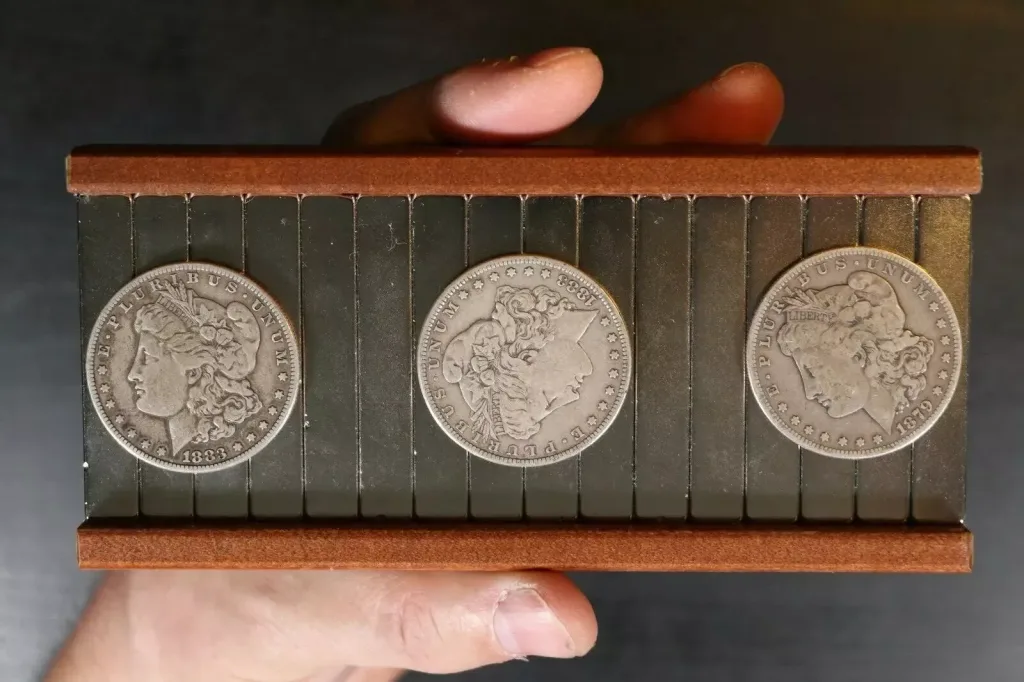
Gold and silver are not magnetic, so a coin that jumps to a strong magnet has iron, nickel or steel in it. Passing proves little, because copper, brass, lead and tungsten are not magnetic either. Silver adds one more clue: it conducts electricity so well that a magnet sliding over it, or a silver coin sliding down a magnet ramp, is slowed by eddy currents, while a poorly conducting fake slides fast.
The ping test
A genuine coin balanced on a fingertip and tapped gives a clear, sustained ring at a pitch set by its metal and shape; a fake of different composition rings differently or thuds. Apps such as PingCoin compare three resonant frequencies with recordings of 23 silver and 14 gold coins. It works for loose coins of known types, not bars or coins in holders, and no independent accuracy data has been published.
The ice cube test for silver
Silver conducts heat better than any other common metal, 406 W/m·K against brass at 109 and lead at 34.7, according to Georgia State University’s HyperPhysics tables, so ice melts visibly faster on a large silver coin or bar. Copper, at 385, behaves almost the same, so the test cannot tell silver from a copper fake.
Specific gravity
Weigh the piece dry, then hanging from a thread fully under water without touching the cup. Density is the dry weight divided by the difference between the two readings, times the density of water (0.9982 g/cm³ at 20 °C, per NIST). The calculator does the arithmetic and shows the error from your scale; its second tab checks a coin against the mint’s figures.
Visual inspection
Under a loupe, look for soft or blurry design detail, uneven lettering, irregular edge reeding, a date that does not match the design, and plating worn through at high points. On bars, check that the serial number on the metal matches the assay card and that the card is sealed. A forged card is possible, so packaging is a check, not a guarantee; our guides to assay certificates and gold bar serial numbers go further.
What to check on gold coins, gold bars and silver
The weak spots differ by product, so the checks that matter most differ too.
| Product | Fakes to expect | Checks that matter most |
|---|---|---|
| Gold coins (Eagle, Krugerrand, Maple Leaf, Philharmonic, Britannia) | Plated copies; tungsten-cored copies of popular coins | Weight and diameter against the mint’s spec; ping; a conductivity verifier set for that coin; the mint’s security features |
| Gold bars | Tungsten-filled bars; forged assay cards; genuine-looking cards around the wrong bar | Serial number against the card and, where offered, the refiner’s verification; dimensions; conductivity verifier or ultrasound; XRF at several points for fineness |
| Silver coins, rounds and bars | Copper, brass or lead cores; plated copies | Weight and size (silver fakes are often well off); magnet slide; ice; conductivity verifier |
What anti-counterfeiting technologies do mints and refiners use?
As of October 2026, mints build features into the metal that are hard to copy and, increasingly, can be checked against a database. None replaces a physical test, but each makes a casual fake easier to spot.
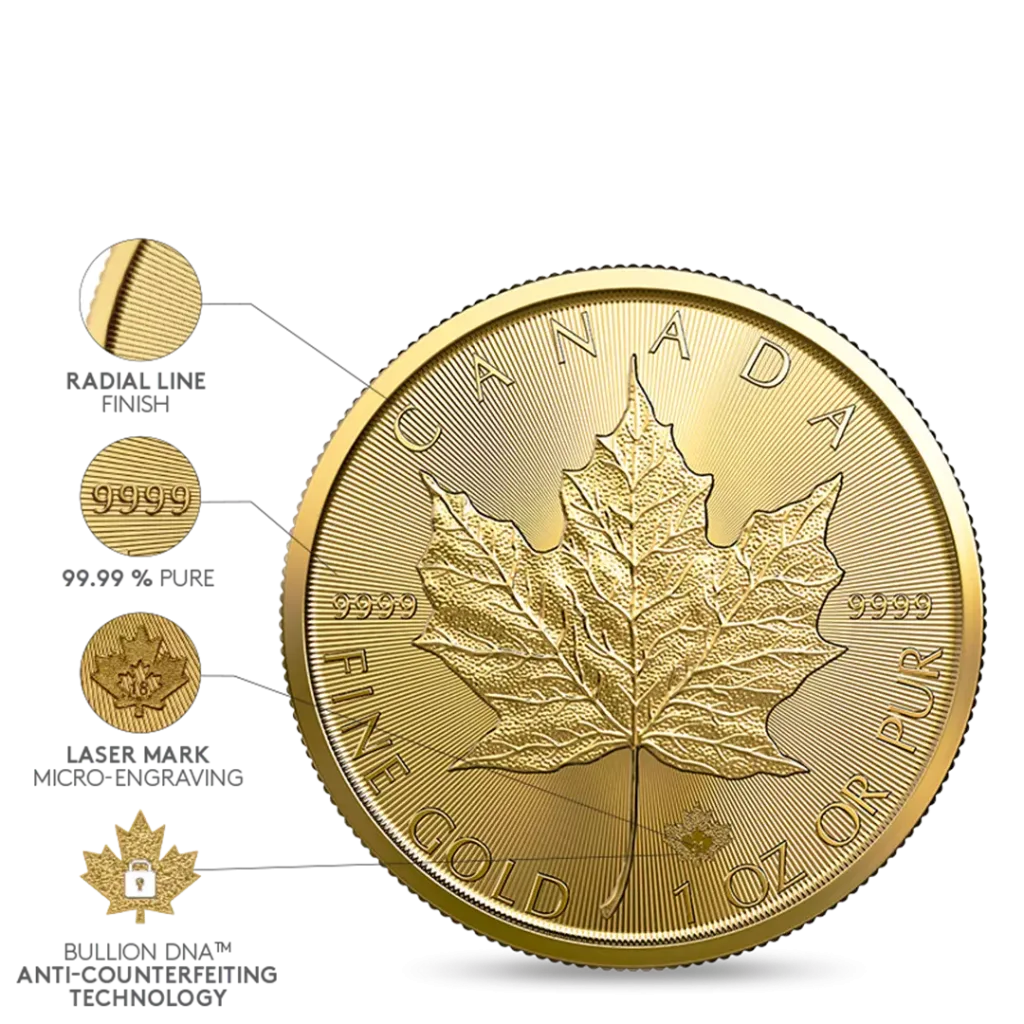
- Royal Canadian Mint: Gold and Silver Maple Leafs carry radial lines machined to within microns, which create a light-diffracting pattern, and a small maple leaf micro-engraved by laser on the reverse with the year’s last two digits visible under magnification (on gold since 2013). Its Bullion DNA system lets approved dealers photograph that mark and match it to the mint’s database, for 1 oz Gold Maple Leafs dated 2014 or later and Silver Maple Leafs from 2015. MintShield, often listed alongside, is a treatment against milk spots on silver, not a security feature.
- The Royal Mint: since the 2021-dated coins, Britannias have a latent image that switches between a padlock and a trident as the coin tilts, laser-cut waves that seem to move, micro-text and tincture lines, on every size except the quarter- and tenth-ounce silver coins.
- U.S. Mint: the Gold and Silver Eagles redesigned in 2021 added enhanced security features, including a reeded-edge variation.
- Perth Mint: Kangaroo bullion coins carry a micro-laser-engraved letter visible only under magnification, and the mint publishes minimum weights and maximum dimensions, used in the calculator above.
- PAMP Suisse: Veriscan records the microscopic surface of each registered bar at production; a phone app scan, in or out of the assay card, compares the bar with that record, much like a fingerprint reader. Argor-Heraeus builds a Kinegram optical element into the metal of its KineBars.
- LBMA: the London Bullion Market Association’s Gold Bar Integrity database, launched in 2025, now receives data from every Good Delivery refiner (as of the start of 2026), and all London custodians are due to report by December 2026. It covers large wholesale bars, not the coins and small bars most people buy, and the LBMA itself calls the chance of a counterfeit Good Delivery bar entering the London market “extremely low”.
In what order should you test gold and silver?
Cheapest and least invasive first, stopping at the first clear failure. The first two steps cost nothing, and nothing damages the piece until the last.
2012: the tungsten bars that passed the easy tests
In September 2012, New York merchant Ibrahim Fadl drilled into gold bars he had bought from a regular source and found them filled with grey tungsten, NBC News reported: a 10 oz bar bought for almost $18,000 was worth about $3,600. Six months earlier in the U.K., a 1 kilo bar with a tungsten core read as nearly pure gold on a handheld XRF analyzer, came with its certificate and was just 2 g underweight, according to a report crediting ABC Bullion.
Both cases test the simple story that weighing and scanning a bar settles it. Two grams on a kilo is 0.2%, and the surface reading was gold, because the surface was gold. Japan’s Customs Central Laboratory later ran the experiment on purpose: a tungsten plate electroplated with 10 µm of gold read 99.74% gold by XRF and had a density of 19.19 g/cm³, so on those two tests it could be taken for gold. An ultrasonic gauge measured 5,052 m/s, the speed of tungsten, and identified it at once. In each case the fake was caught by a test that reached inside: a drill in New York, sound in the lab.
How common are such fakes? Nobody publishes a reliable count. In a 2018 survey by the Anti-Counterfeiting Task Force of the Industry Council for Tangible Assets, 57.8% of responding dealers said they had seen counterfeit gold PAMP bars and 43.3% counterfeit Silver Eagles, CoinWeek reported. Not every fake is base metal, either: in 2019 Reuters found bars of real, high-purity gold worth at least $50 million stamped with forged Swiss refinery logos, used to move gold of unknown origin.
Red flags when buying gold and silver
Most fakes are avoided before any test, by refusing deals that look wrong. On 3 November 2026, none of the 38 in-stock 1 oz gold coins and bars on our list was priced below the value of their gold at the gold Ask: premiums over the Ask ran from 1.68% to 14.40%, with a median of 3.3%. Those are our check/wire prices, one dealer’s snapshot, but an offer well below melt from anyone is a reason to walk away.
- The price is at or above melt value, not below it.
- The seller has a verifiable street address, licenses and a complaint record you can look up.
- Payment can be traced, and you are not asked for gift cards, crypto or a wire to a personal account.
- Nobody is pushing a deadline or refusing to let you inspect or test the piece.
- The listing does not say “replica”, “tribute”, “clad”, “layered” or “plated”.
- The brand is one you recognize (see our guide to gold bar brands), and the bar has a serial number that matches its card.
- Return terms are written down before you pay.
Keep the evidence that protects a later sale or claim: receipts with the dealer’s details, the assay card or mint packaging, grading certificates from NGC or PCGS for graded coins, and dated photos of what you own. Our article on gold scams covers payment and impersonation fraud.
Common counterfeiting myths
Myth: “All gold from China is fake.” Fact: Origin is not a test. Fakes and genuine products both come from many countries; verify the piece, not the passport.
Myth: “Expensive equipment guarantees detection.” Fact: An XRF analyzer reads only the surface, and a conductivity verifier reads only to its depth. Confidence comes from combining tests that see different things.
Myth: “Dealers always catch fakes” and “fakes are always obvious.” Fact: Well-made fakes have fooled professionals, as the 2012 case above shows. Test methodically, and use a dealer whose testing you can see.
What to do if you think you have a fake
- Stop handling it and keep everything: the piece, packaging, listing, messages and receipts.
- Get it tested by a dealer or assay office, without damaging it.
- Contact the seller and your payment provider quickly; card disputes have deadlines.
- Report it to local police, the FTC at ReportFraud.ftc.gov and, for online purchases, the FBI’s Internet Crime Complaint Center.
Federal and state law back the buyer. Making, selling or knowingly passing counterfeit U.S. coins worth more than 5 cents, or counterfeit foreign gold and silver coins in circulation, carries up to 15 years in prison under 18 U.S.C. § 485, and the Secret Service has authority over U.S. laws on coins. A merchant’s goods also carry an implied warranty that they are what they are sold as, under the Uniform Commercial Code’s § 2-314, as adopted by each state.
How we did the research
Densities of the pure metals come from NIST’s X-ray mass attenuation tables; brass is the Copper Development Association’s figure for cartridge brass. Coin weights, diameters and alloys come from each issuing mint (sources below); where a mint states only fine content, we used 31.10 g. For each coin we computed the alloy’s density from its composition (assuming ideal mixing, which can be off by a few tenths of a percent for real alloys), divided the official weight by that density to get the coin’s volume, and multiplied the volume by each metal’s density to get the weight of a same-size copy.
The specific-gravity error assumes only scale rounding (half a step on each of two readings, worst case); thread, bubbles and temperature add more. Prices are Bullion Trading LLC check/wire prices captured on 3 November 2026 with spot gold at $3,967.78 (Ask; premiums are over the gold at the Ask), for products in stock that contain one troy ounce, excluding numismatic and collectible items. The table is a model, not a description of any real counterfeit, and passing it does not prove a piece genuine.
| Coin | Official weight (g) | Alloy density (g/cm³) | Tungsten copy (g) | Lead copy (g) | Copper copy (g) | Brass copy (g) |
|---|---|---|---|---|---|---|
| American Gold Eagle, 1 oz | 33.931 | 17.78 | 36.84 (+8.6%) | 21.66 (-36.2%) | 17.10 (-49.6%) | 16.28 (-52.0%) |
| American Gold Buffalo, 1 oz | 31.103 | 19.32 | 31.07 (-0.1%) | 18.27 (-41.3%) | 14.42 (-53.6%) | 13.73 (-55.8%) |
| Canadian Gold Maple Leaf, 1 oz | 31.11 | 19.32 | 31.08 (-0.1%) | 18.28 (-41.3%) | 14.43 (-53.6%) | 13.74 (-55.8%) |
| South African Krugerrand, 1 oz | 33.93 | 17.62 | 37.16 (+9.5%) | 21.85 (-35.6%) | 17.25 (-49.2%) | 16.42 (-51.6%) |
| Britannia gold, 1 oz | 31.10 | 19.32 | 31.07 (-0.1%) | 18.27 (-41.3%) | 14.42 (-53.6%) | 13.73 (-55.8%) |
| Vienna Philharmonic gold, 1 oz | 31.10 | 19.32 | 31.07 (-0.1%) | 18.27 (-41.3%) | 14.42 (-53.6%) | 13.73 (-55.8%) |
| Perth Mint gold Kangaroo, 1 oz | 31.107 | 19.32 | 31.07 (-0.1%) | 18.27 (-41.3%) | 14.43 (-53.6%) | 13.73 (-55.8%) |
| American Silver Eagle, 1 oz | 31.103 | 10.50 | 57.17 (+83.8%) | 33.62 (+8.1%) | 26.54 (-14.7%) | 25.27 (-18.8%) |
| Canadian Silver Maple Leaf, 1 oz | 31.11 | 10.50 | 57.18 (+83.8%) | 33.63 (+8.1%) | 26.55 (-14.7%) | 25.27 (-18.8%) |
| Britannia silver, 1 oz | 31.10 | 10.50 | 57.16 (+83.8%) | 33.62 (+8.1%) | 26.54 (-14.7%) | 25.27 (-18.8%) |
| Vienna Philharmonic silver, 1 oz | 31.10 | 10.50 | 57.16 (+83.8%) | 33.62 (+8.1%) | 26.54 (-14.7%) | 25.27 (-18.8%) |
| Perth Mint silver Kangaroo, 1 oz | 31.107 | 10.50 | 57.18 (+83.8%) | 33.63 (+8.1%) | 26.54 (-14.7%) | 25.27 (-18.8%) |
The bottom line on spotting fake gold and silver
Weight, size, a magnet and specific gravity are worth doing because they catch the fakes most people meet: plated copper, brass, steel and lead. They cannot catch tungsten inside fine gold, which is as dense as gold to within a tenth of a percent. For that, the test has to see beneath the surface (a conductivity verifier or ultrasound), and only a drilled sample sent for fire assay settles it beyond doubt. Buying from a dealer you can verify, at a price that makes sense, avoids most of the problem before any test.
Frequently asked questions
What is the specific gravity of gold?
Fine gold is 19.32 g/cm³ (NIST), so its specific gravity is about 19.3. A 22-karat coin such as the Gold Eagle computes to about 17.8, and fine silver is 10.50.
Can a magnet detect fake gold?
Only fakes with iron, nickel or steel inside. Copper, brass, lead and tungsten are not magnetic, so a magnet is a quick first screen, never proof.
Will an XRF analyzer detect a plated fake?
Not on its own. XRF reads the surface layer, so a well-plated fake reads as gold; pair it with a test that reaches the core.
Are tungsten-filled bars common?
No reliable public count exists. They are uncommon but well documented, including the 2012 New York case, and they are the reason professionals do not rely on weight alone.
Sources
- NIST, X-Ray Mass Attenuation Coefficients, Table 1 (densities of gold, tungsten, lead, silver, copper, iron).
- U.S. Mint, Bullion Coin Programs (archived 14 July 2026) and 31 U.S.C. § 5112 (Eagle and Buffalo specifications).
- Royal Canadian Mint, 2026 Gold Maple Leaf, 2026 Silver Maple Leaf and Bullion DNA (specifications, radial lines, laser mark, dealer verification).
- The Royal Mint, Britannia security features and 1 oz gold Britannia (latent image, micro-text, specifications).
- South African Mint, 2026 range and bullion coins; Austrian Mint, Vienna Philharmonic; Perth Mint, 2026 gold Kangaroo (specifications, published limits, laser-engraved letter).
- MKS PAMP, Veriscan press release (archived); LBMA, Gold Bar Integrity and gold bar security features.
- Copper Development Association, C26000 cartridge brass (density 8.53). NIST, resistivity of copper, gold and silver and of selected elements (tungsten).
- Japan Customs Central Laboratory, Analysis of gold products, fourth report (sound velocities; XRF and density of gold-plated tungsten).
- Sigma Metalytics, PMV PRO manual, Resistivity Reference Guide 2026 and store pages (how verifiers read, prices).
- Evident, Ultrasonic testing of gold bars; Penn Tool Co., PosiTector UTG (method and price).
- GIA, Mercer (1992), Methods for Determining the Gold Content of Jewelry Metals (XRF depth, hydrostatic weighing limits); Gesswein, GemOro XRF listing (price).
- ISO, ISO 11426:2021; Sheffield Assay Office, history of cupellation (fire assay).
- HyperPhysics (Georgia State University), Faraday’s law and Lenz’s law (eddy-current braking behind the magnet slide).
- NBC News, Counterfeit gold bars discovered in New York City (2012); MINING.COM, Gold bar with tungsten core found in UK (2012) and Reuters: fake-branded bars (2019); CoinWeek, ACTF dealer survey (2018).
- Georgia State University, HyperPhysics: thermal conductivity table (ice test comparison).
- Legal Information Institute (Cornell), 15 U.S.C. § 2101, 18 U.S.C. § 485, 18 U.S.C. § 3056 and UCC § 2-314 (replica marking, counterfeiting penalties, Secret Service authority, implied warranty).
- eCFR, 16 CFR Part 304 (FTC rules for the Hobby Protection Act).
- Federal Trade Commission, ReportFraud.ftc.gov; FBI, Internet Crime Complaint Center (where to report).
- Bullion Trading LLC, check/wire prices on 3 November 2026 (premium benchmark) and computations described in the methodology.