
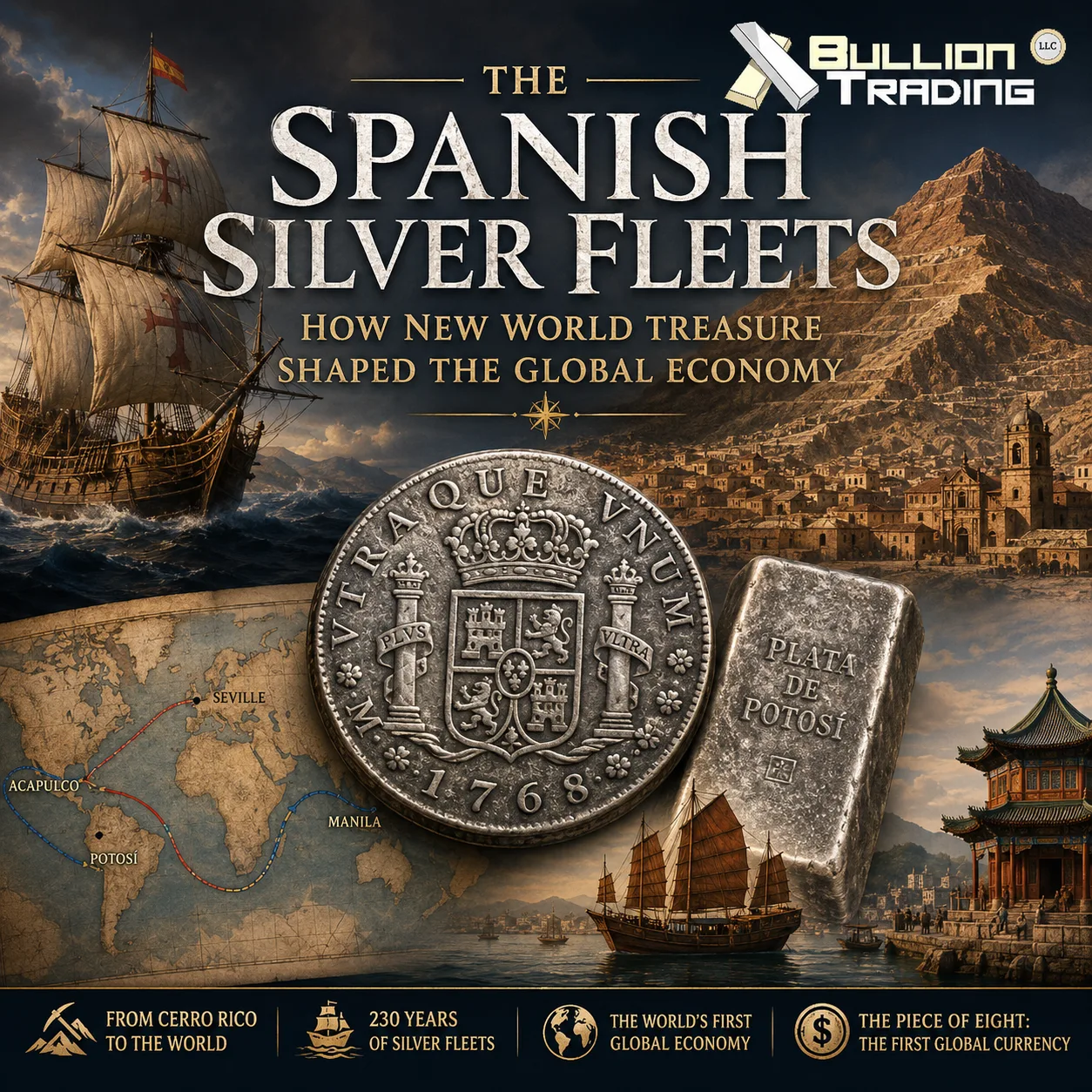

One of the most consequential economic events in human history began not in a bank or a royal court, but inside a wind-battered mountain in the Bolivian Andes. When a Quechua herder named Diego Huallpa stumbled upon veins of silver ore at Cerro Rico in 1545, he triggered a chain of events that would reshape commerce on every continent, inflate prices across Europe, flood China with American silver, and give the world its first truly global currency. The Spanish Silver Fleets carried this wealth across two oceans for more than two centuries, connecting the mines of Potosí to the markets of Seville, Manila, and beyond.
The mountain that bankrolled an empire
Cerro Rico, meaning “Rich Mountain” in Spanish, towers approximately 4,824 meters at its peak above the windswept plateau of present-day Bolivia (the city of Potosí itself sits at roughly 4,000 meters, placing it among the highest cities in the world). When Spanish authorities learned of its silver deposits, Potosí grew within decades from a handful of huts into one of the world’s largest cities. By the early 17th century, an estimated 160,000 settlers lived there alongside roughly 13,500 indigenous workers forced into service under the mita system, a colonial adaptation of an Inca labor draft that assigned workers to the mines for fixed periods in exchange for wages that rarely compensated for the danger. UNESCO, which inscribed the City of Potosí as a World Heritage Site in 1987, describes it as “the example par excellence of a major silver mine of the modern era, reputed to be the world’s largest industrial complex in the 16th century”.
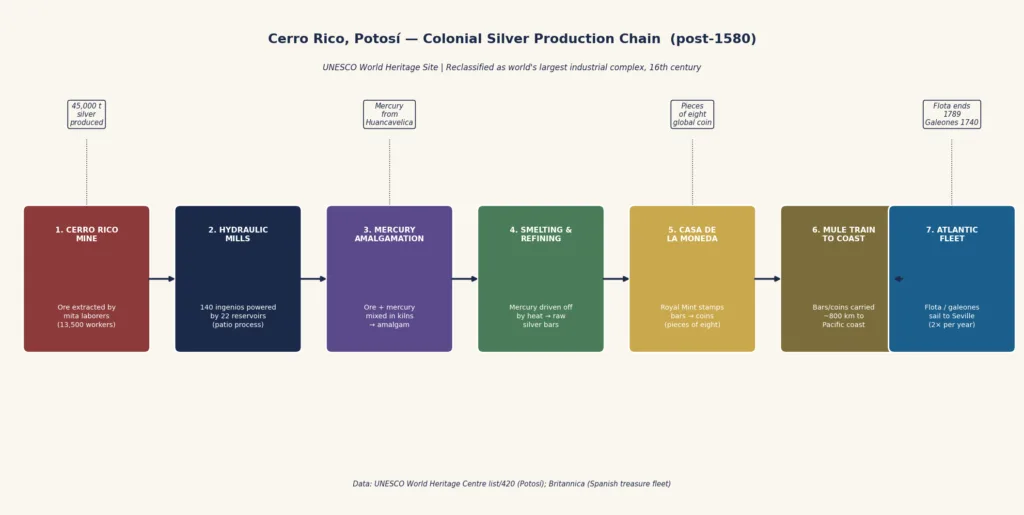
The scale of production was staggering. Cerro Rico reached its full industrial capacity after 1580, when Spanish engineers implemented the patio process, a technique using mercury amalgamation to extract silver from ore. At peak operation, 22 artificial reservoirs supplied hydraulic power to 140 grinding mills. Workers crushed ore, mixed it with mercury, rinsed out the resulting amalgam, and heated it in earthen kilns to drive off the mercury and leave behind raw silver bars. Those bars were then stamped at the Casa de la Moneda, Potosí’s Royal Mint, and loaded onto mule trains for the long journey to the Pacific coast.
Historians estimate that over three centuries of colonial mining, Cerro Rico produced somewhere in the range of 45,000 metric tons of refined silver. Together with Zacatecas in Mexico, founded in 1546 after its own rich silver lode discovery, Spanish American mines collectively produced the large majority of the world’s silver output during the 16th and 17th centuries. The human cost was severe. Working conditions in the mines were brutal, with mercury poisoning, rockfalls, and extreme altitude taking the lives of hundreds of thousands of indigenous workers. A 17th-century friar described Potosí as having consumed more Indian lives than silver it produced. That observation captures something important about the system: it was enormously productive and enormously destructive at the same time, and those two things cannot be separated.
The fleet system: organizing an empire’s wealth
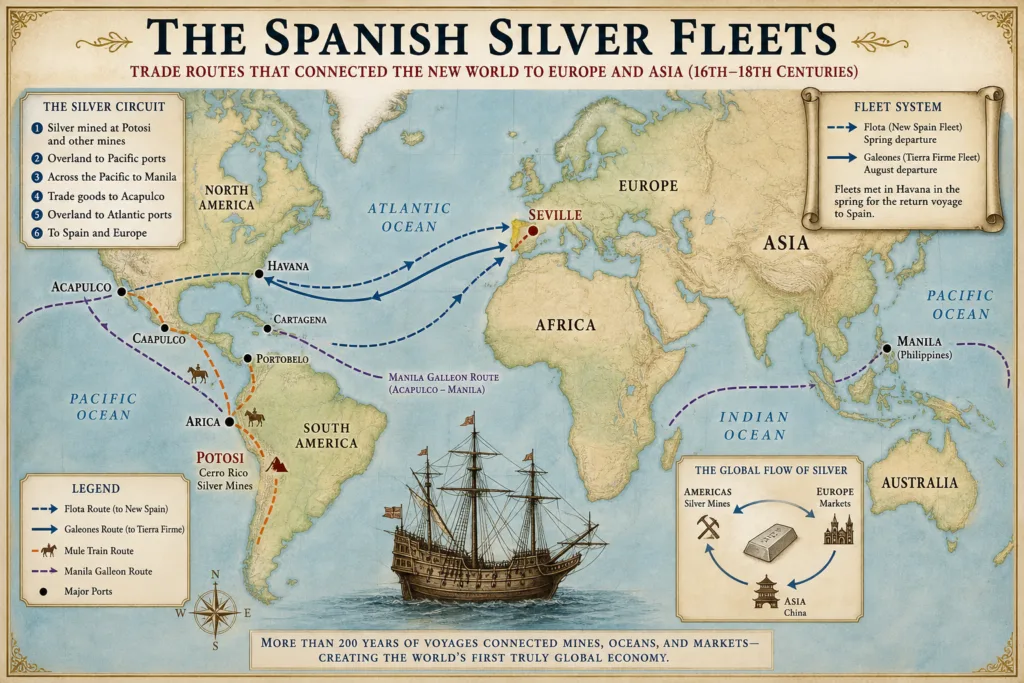
Getting silver from the Andes to Seville was itself an enormous logistical undertaking. From the 1560s onward, Spain organized a formal convoy system that would govern transatlantic trade for more than two centuries. As Britannica’s account of the Spanish treasure fleet details, two main fleets of between 30 and 90 vessels sailed from Seville each year. The flota left in spring bound for Vera Cruz in New Spain (present-day Mexico), dropping off ships at the West Indies and Honduras along the way. A second fleet, the galeones or Tierra Firme fleet, departed in August for Cartagena and Portobelo in present-day Colombia and Panama. Both fleets wintered in the Americas, then converged at Havana the following spring before making the return Atlantic crossing together, escorted by heavily armed warships.
The system was designed as much to protect silver as to move goods. The combined fleets were a serious military force, and outright seizure was rare enough to be remarkable when it happened. Dutch admiral Piet Heyn managed to capture an entire fleet off Cuba in 1628, a windfall so large it directly financed the Dutch West India Company’s subsequent military campaigns. The English admiral Robert Blake intercepted another fleet near the Azores in 1657. But these were exceptions. Most convoys completed their voyages, and losses to pirates and storms, though legendary in popular history, represented a small fraction of total tonnage transported over two centuries of operation.
The fleet system formally ended in stages: the galeones were discontinued in 1740, and the flota in 1789, when Spain shifted to a policy allowing freer trade among its ports. For roughly 230 years, however, the fleets provided the financial backbone of the Spanish empire and funneled a river of silver into European circulation. The pieces of eight, the silver coin minted at Potosí and other colonial mints, became the first currency to circulate truly globally. It was accepted from Cadiz to Canton, the dollar sign itself a probable descendant of the peso de ocho symbol stamped on those colonial coins.
Europe’s first inflation crisis
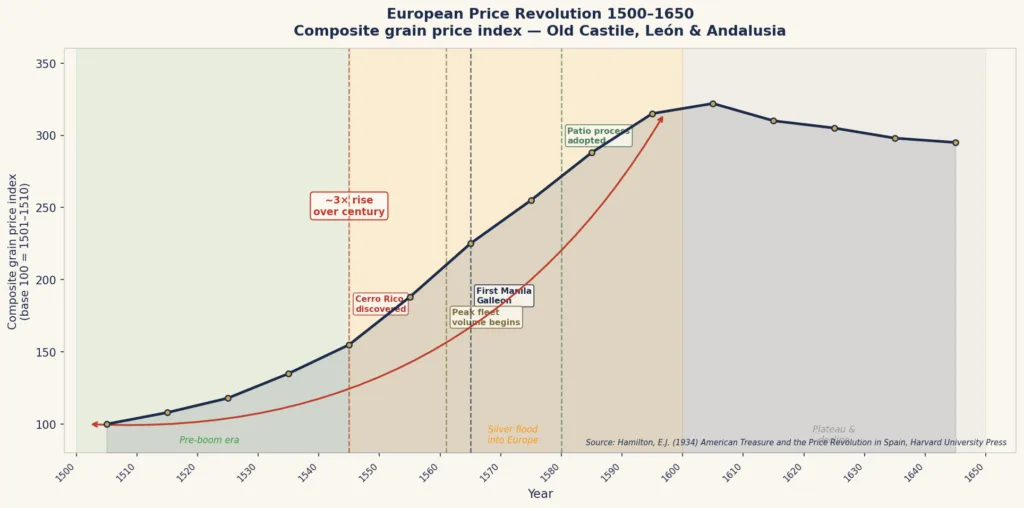
The effects of all that silver arriving in Europe were not immediately obvious, but they became impossible to ignore by the mid-16th century. Prices across the continent began rising at rates Europeans had never experienced. The phenomenon, studied in depth by economic historian Earl Hamilton in his landmark work American Treasure and the Price Revolution in Spain (Harvard University Press, 1934), showed that Spanish prices roughly tripled between 1500 and 1600, with the inflation spreading outward through trade networks to France, England, the Dutch Republic, and the Ottoman Empire.
The mechanism isn’t complicated. More money chasing the same quantity of goods means higher prices. The flood of American silver dramatically expanded Europe’s money supply at a time when agricultural and industrial output could not keep pace. Landlords who received fixed rents saw their real incomes collapse while merchants holding goods profited. Wages for ordinary workers fell in real terms. The disruption reshuffled European wealth in ways that contributed to social unrest, the erosion of feudal obligations, and the slow rise of a commercial class whose power rested on trade rather than land.
The parallels to other monetary expansions are worth noting. The dynamics of a sudden surge in money supply outrunning productive capacity echo the inflationary episodes analyzed in histories of hyperinflation from Weimar Germany to Venezuela. In each case, those holding fixed incomes or paper claims saw their purchasing power erode, while those holding tangible assets fared better. The Spanish Price Revolution was history’s first documented case of monetary inflation on a continental scale, and it took several generations to fully work through the system.
The Pacific circuit: how Potosí silver reached China
Less discussed in most accounts of the Spanish silver story is where much of the metal ultimately ended up. China’s Ming dynasty, in the process of consolidating tax collection under the Single Whip reform of 1581, had standardized tax payments in silver. A country of roughly 100 million people now required silver for taxation, but China produced relatively little domestically. That gap between supply and demand was enormous, and New World mining was uniquely positioned to fill it.
Spain had established a Pacific trade route in 1565 when navigator Andrés de Urdaneta, as Britannica documents, charted a favourable west-to-east return crossing from the Philippines back to Acapulco on Mexico’s Pacific coast, after five earlier attempts had failed. Spanish galleons then began annual round trips between Acapulco and Manila that ran from 1565 to 1815, where Potosí silver was exchanged for Chinese silk, porcelain, and luxury goods. The volume of silver they carried was extraordinary. Scholars now estimate that somewhere between one-third and one-half of all silver mined in the New World eventually flowed into China, absorbed by its economy as a medium for tax collection and trade.
This created the world’s first genuinely global trade circuit. Silver left the Andes and Mexico, crossed the Atlantic to Seville, circulated through European markets, and simultaneously crossed the Pacific to Manila and into Chinese commerce. A single bar of Potosí silver might facilitate transactions on three continents before coming to rest in a Chinese treasury. The monetary historian Dennis Flynn described this Pacific silver trade as the moment when a truly global economy began, connecting the Americas, Europe, and Asia into a single, interdependent system of exchange for the first time. That framing is hard to argue with. Before the Spanish Silver Fleets, trade was largely regional. After them, a price shock in a Bolivian mine could ripple through markets in Beijing.
This context also clarifies why the gold-to-silver ratio shifted so dramatically during the colonial period. As American silver poured into global markets at a pace that dwarfed all previous supply, it became progressively less valuable relative to gold, and the ratio between the two metals widened substantially over the 16th and 17th centuries. Investors who track the gold-to-silver ratio today are, in a sense, watching the long tail of decisions made in those Andean mines more than four centuries ago.
The paradox of plenty: Spain’s silver didn’t make Spain rich
Spain’s experience tells the counterintuitive part of this story. The country that controlled the world’s richest silver deposits for two and a half centuries did not become the world’s dominant commercial power. That distinction went to the Dutch and the English, nations with no mines but with productive manufacturing sectors, large merchant fleets, and banking systems capable of multiplying wealth through credit.
Spain used its silver primarily to fund wars. The Habsburg dynasty, which ruled Spain through most of the colonial silver era, spent lavishly on military campaigns in Italy, the Netherlands, and against the Ottoman Empire. The silver financed these campaigns temporarily but also generated domestic inflation that made Spanish goods expensive relative to those of its neighbors. It became cheaper for Spaniards to import cloth and hardware from France and the Low Countries than to produce them domestically. Silver flowed in from the Americas and flowed right back out to pay for imports and service war debts.
Economists recognize this dynamic as the “resource curse”, the tendency for economies with abundant natural resources to develop more slowly than those forced to innovate and manufacture. King Philip II suspended payments to his bankers in 1557, 1560, 1575, and 1596 (four declared insolvencies in under forty years), even as the fleets continued delivering silver to Seville without interruption. The wealth was real, but the institutional capacity to convert it into lasting economic strength was absent. The comparison with the California Gold Rush of 1849 is instructive: that later precious metals windfall enriched a region that already possessed property rights, functioning courts, and a commercial infrastructure capable of channeling sudden wealth into lasting economic development. Spain’s colonial system, built on forced labor and mercantilist extraction, lacked those foundations.
The lesson embedded in the Spanish case is one that monetary historians return to repeatedly: the value of a precious metal depends not just on its scarcity, but on the institutional environment in which it circulates. Silver is a store of value, but only if the system around it is capable of preserving and deploying that value. Spain had the silver and squandered it. The Dutch, who captured a single fleet in 1628 and used that windfall to fund strategic military and commercial expansion, demonstrated what capable management of precious metals wealth could actually accomplish.
What the silver ships left behind
The Spanish Silver Fleets transported more than bars of metal across the Atlantic and Pacific. They carried the mechanisms by which local economies became a global one. The silver from Cerro Rico and Zacatecas provided the first currency that merchants on three continents accepted without question, the foundation on which international trade at scale became possible.
The lessons embedded in that history are not abstract. Sudden expansions of a monetary base distort prices and redistribute wealth in ways that favor those holding tangible assets over those holding cash or fixed income. Resource wealth without institutional capacity tends to produce short-term spending and long-term fragility. And silver, as a monetary metal, carries a documented record going back five centuries of holding value across continents and political systems that have since collapsed entirely.
The galleons stopped sailing more than 200 years ago. The Cerro Rico is still there, heavily mined and geologically unstable, a hollow mountain that once held much of the world’s monetary system inside its ore. The silver it produced is still circulating, in coins, in jewelry, in industrial components, and in the portfolios of investors who understand that its history as a global store of value runs far deeper than any particular market cycle.
