
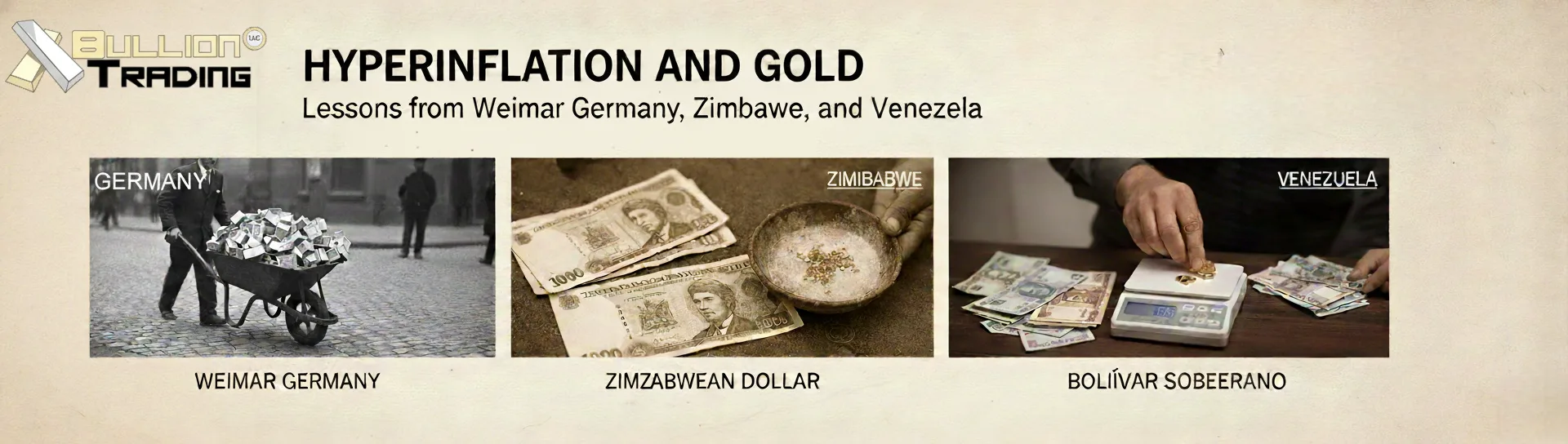

When a currency collapses, people don’t just lose their savings. They lose their ability to buy bread, pay rent, or plan for the future. Over the past century, hyperinflation has destroyed the purchasing power of national currencies in countries as different as 1920s Germany, 2000s Zimbabwe, and 2010s Venezuela. In each case, the pattern was remarkably similar: governments printed money to cover debts and deficits, confidence evaporated, and citizens watched their life savings become worthless practically overnight.
What also remained consistent across each of these crises was the role of gold. While paper money lost virtually all its value, gold held its purchasing power and, in many cases, became the only reliable medium of exchange. Understanding the relationship between hyperinflation and gold is not just a history lesson. It offers practical insight for anyone thinking about how to protect wealth during periods of monetary instability.
Weimar Germany: The Textbook Case
The hyperinflation in the Weimar Republic remains the most studied episode of currency collapse in modern economic history. After World War I, Germany faced enormous war debts totaling 156 billion marks by 1918, compounded by the reparations obligations set out in the 1921 London Schedule of Payments. Rather than raising taxes, the German government chose to borrow and print money to finance its obligations.
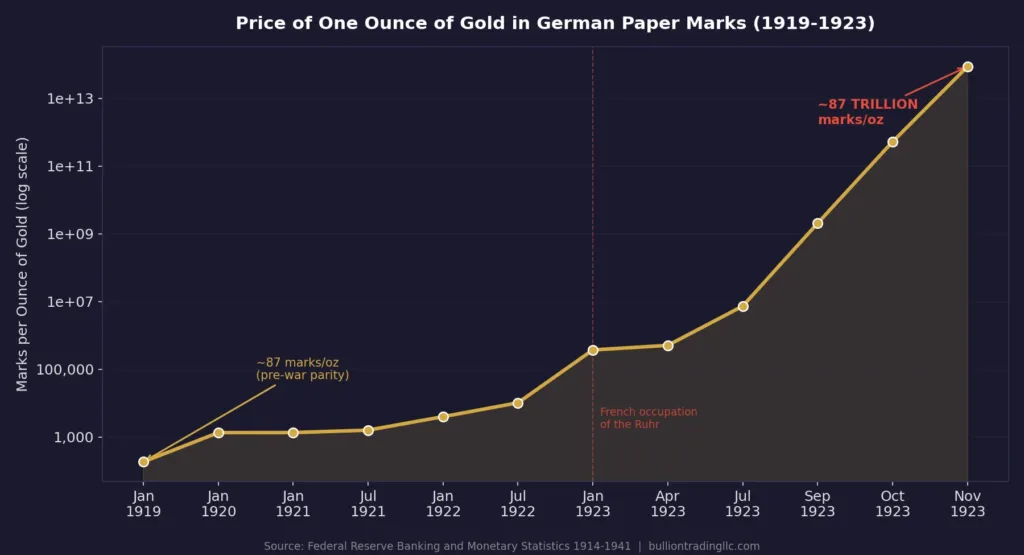
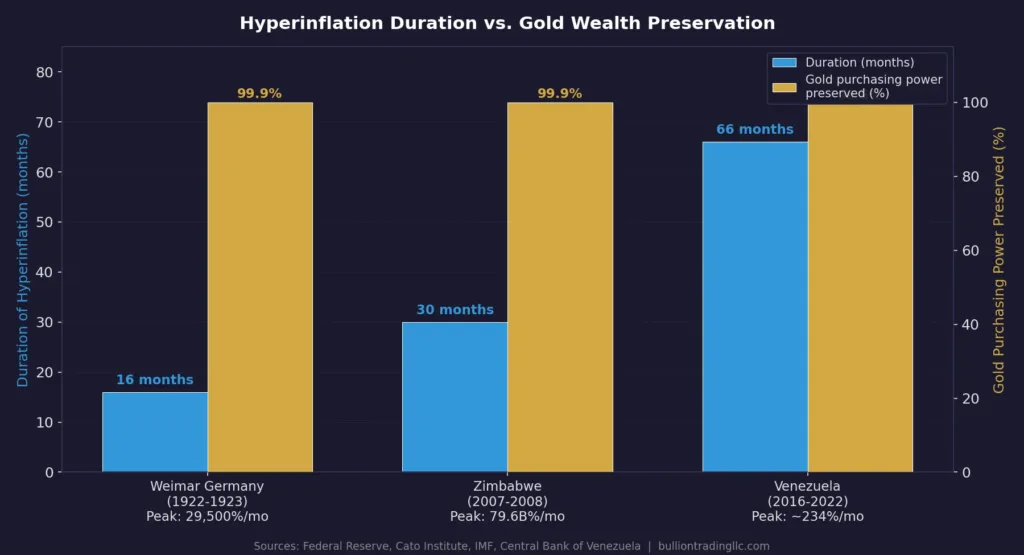
The results were catastrophic. In mid-1922, the exchange rate stood at roughly 320 marks per US dollar. By December 1922, it had plummeted to 7,400 marks per dollar. When French and Belgian troops occupied the Ruhr Valley in January 1923, the German government printed even more money to pay striking workers, and the currency went into free fall. By November 1923, one US dollar was worth 4,210,500,000,000 (4.2 trillion) marks. A loaf of bread that cost 160 marks at the end of 1922 cost 200 billion marks by late 1923.
For anyone holding gold, however, the picture looked entirely different. Before the war, one ounce of gold cost approximately 86 marks, based on the pre-war rate of 4.2 marks per dollar and the gold price of $20.67 per ounce. By November 1923, that same ounce of gold was worth roughly 87 trillion marks. Gold didn’t just preserve its value in real terms; it maintained almost perfect purchasing power parity with the US dollar throughout the crisis, while the paper mark became literally more useful as wallpaper than as currency. Germans who held gold coins or jewelry could still buy food, property, and goods at fair prices, while those holding paper currency were wiped out.
It’s no coincidence that Germany ultimately stabilized its currency by pegging it to gold. The Rentenmark, introduced in November 1923, was indexed to gold bonds at the pre-war rate. By 1924, the exchange rate returned to 4.2 Rentenmarks per dollar, confirming that the crisis was never about the absence of wealth, but about the collapse of confidence in paper money.
Zimbabwe: When 79 Billion Percent Monthly Inflation Meets Gold
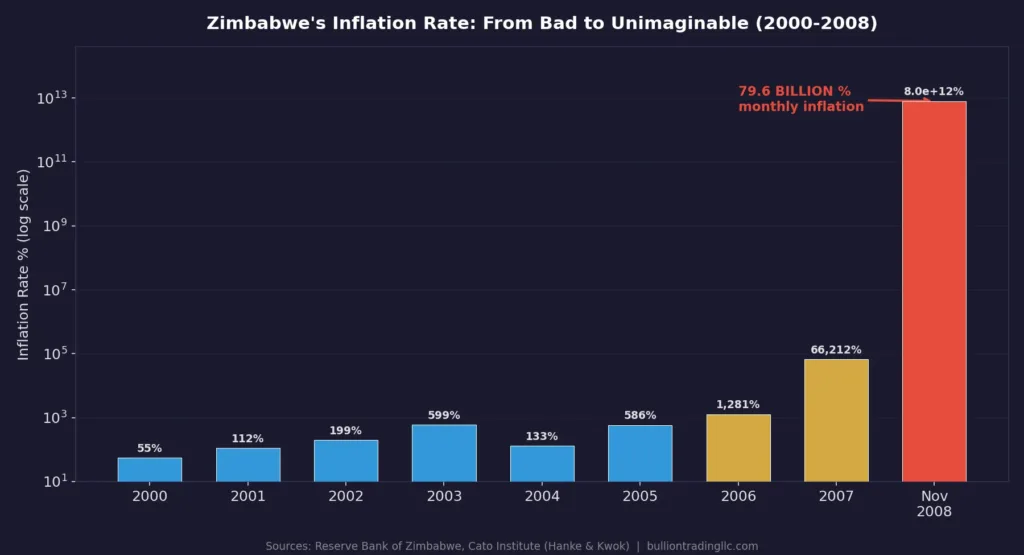
Zimbabwe’s hyperinflation, which peaked in November 2008, was triggered by a very different set of circumstances but followed the same fundamental pattern. Beginning in the late 1990s, the government’s land reform program disrupted agricultural production, and manufacturing output fell dramatically. Food output dropped 45%, and unemployment soared to 80%. The Reserve Bank of Zimbabwe responded by printing more money to fund government operations and military involvement in the Congo, including under-reporting war spending to the IMF by $22 million per month.
At its peak in mid-November 2008, Zimbabwe’s monthly inflation rate reached an estimated 79.6 billion percent, according to economists Steve Hanke and Alex Kwok of the Cato Institute. The year-over-year rate hit 89.7 sextillion percent. A $100 trillion banknote could not cover a simple bus fare. The government eventually abandoned its currency entirely in 2009, and Zimbabweans switched to the US dollar and South African rand for daily transactions.
Throughout this crisis, gold became a crucial survival tool. Artisanal gold mining exploded as ordinary citizens panned for gold in rivers and informal mines to obtain something with actual purchasing power. Small quantities of gold dust could buy groceries when trillion-dollar banknotes could not. The lesson was so deeply ingrained that when Zimbabwe attempted to restore its own currency in subsequent years, it repeatedly turned to gold as an anchor. In April 2023, the government introduced a digital currency backed by gold reserves, and in April 2024, it launched the ZiG (Zimbabwe Gold), a new currency explicitly anchored to the country’s gold holdings.
Venezuela: A 21st-Century Spiral
Venezuela’s hyperinflation began in November 2016 and lasted until early 2022, making it one of the longest sustained episodes in recent history. The roots were familiar: heavy government spending funded by money printing, strict currency controls imposed since 2003, and an over-reliance on oil revenue that collapsed alongside global oil prices. Under President Nicolás Maduro, the Central Bank of Venezuela reported that cumulative inflation between 2016 and April 2019 reached 53,798,500%.
The human cost was staggering. By early 2019, the monthly minimum wage was worth approximately $5.50, less than the price of a McDonald’s Happy Meal. The Wall Street Journal reported in 2019 that Venezuela’s economic contraction was “one of the biggest in Latin American history”, and the IMF estimated that the economy had shrunk by more than half in just five years. Roughly 30% of the population fled the country.
In this environment, gold once again proved its worth. Venezuela’s citizens turned to informal gold mining in the Arco Minero del Orinoco region as a way to earn income that held actual value. Small amounts of gold dust became an informal currency in mining towns and border areas. Even the government recognized gold’s importance, though not always constructively: Maduro’s administration sold off portions of the country’s gold reserves held at the Bank of England to raise foreign currency, and attempted to launch the Petro cryptocurrency, supposedly backed partially by gold, which was widely regarded as a scam.
The broader pattern in Venezuela confirmed what Weimar Germany and Zimbabwe had already demonstrated: when a government destroys confidence in its paper currency through excessive money creation and fiscal mismanagement, gold re-emerges naturally as a trusted store of value.
Why Gold Works When Currencies Fail
The reason gold performs so well during hyperinflation comes down to something fundamental about what gives money value. Paper currencies work because people trust the institutions that issue them. When that trust disappears, whether because of wartime debt, political mismanagement, or reckless money printing, the currency’s value goes with it.
Gold, on the other hand, doesn’t depend on any government’s promises. Its value comes from its physical scarcity, its universal recognition, and thousands of years of history as a medium of exchange. As the World Gold Council has extensively documented, central banks around the world have been increasing their gold reserves at record pace in recent years, with purchases exceeding 1,000 tonnes annually since 2022. This institutional demand reflects a growing recognition, even among monetary authorities, that gold provides a hedge against the very currency risks that governments themselves can create.
The economist Steve Hanke, who has studied dozens of hyperinflation episodes, has noted that every single instance shares the same root cause: governments creating money far faster than the economy can grow. Gold cannot be printed or digitally created on a screen, which is precisely why it holds its value when the printing presses run out of control.
What Today’s Investors Can Learn
The lessons from Weimar Germany, Zimbabwe, and Venezuela are not limited to extreme scenarios. While full-blown hyperinflation remains relatively rare, persistent inflation, currency devaluation, and fiscal mismanagement are far more common. The IMF’s World Economic Outlook has consistently warned about rising global debt levels, and central banks in developed economies have expanded their balance sheets to unprecedented sizes since 2008.
Gold doesn’t just protect against worst-case scenarios. It serves as a form of portfolio insurance that has proven its value across centuries and civilizations. Whether you’re concerned about inflation eating into the purchasing power of your savings, geopolitical instability disrupting markets, or the long-term trajectory of government debt, allocating a portion of your portfolio to physical gold addresses all three.
Conclusion
History has shown us, repeatedly and across very different circumstances, that when paper currencies fail, gold endures. The citizens of Weimar Germany who held gold coins survived the crisis with their wealth intact. Zimbabweans who panned for gold could feed their families when $100 trillion banknotes could not. Venezuelans who had access to even small quantities of gold had options that their neighbors, holding worthless bolívares, did not.
These are not abstract historical curiosities. They are reminders that gold’s role as a store of value is not a relic of the past but a living, functioning financial reality. In a world where government debts continue to climb and monetary policy remains highly expansionary, the lessons of hyperinflation and gold are more relevant than ever.
