

Why did the US stop making silver coins? Because silver got too valuable to spend. By the early 1960s the open market price was pressing against $1.29 an ounce, the level where the metal in a silver dollar matches the number stamped on it, and the Treasury was burning through its stockpile trying to hold the line. The country was also, strange as it sounds now, running out of pocket change. On July 23, 1965, President Lyndon Johnson signed the Coinage Act of 1965 and took silver out of the dime and the quarter entirely. The half dollar kept a reduced 40 percent, and only until 1970.
That signature closed a run of silver coinage that went back to 1792. It is also the origin story of what stackers call junk silver, and the reason a handful of ordinary-looking quarters from 1964 is worth real money today. Johnson promised there would be “no profit” in hoarding the old coins. The price record since then is one long argument with that sentence.
The math that forced the US to stop making silver coins
From the first Coinage Act onward, US dimes, quarters, and half dollars were struck in 90 percent silver and 10 percent copper. The proportions were tidy: every $1 of face value contained 0.7234 troy ounces of silver when new, about 0.715 ounces after decades of pocket wear. That worked fine as long as silver stayed cheap. For most of the 1930s and 1940s it traded well under a dollar an ounce, so the metal in a quarter was worth a dime or less. Nobody melts money at those prices.
Two thresholds mattered as the price climbed. At $1.2929 an ounce, a silver dollar’s metal equals its face value; that figure, written into law as silver’s “monetary value,” was the price at which the Treasury sold silver from its reserves under Public Law 88-36, the 1963 act that unwound the old silver purchase programs. At about $1.38, the smaller coins cross over too, since a dollar’s worth of dimes or quarters holds slightly less silver than a silver dollar. Above that line, every coin in every cash register becomes a tiny arbitrage trade.
The market price hit the $1.29 ceiling in 1963 and stayed pinned there, because the Treasury sold silver at $1.2929 to anyone who wanted it rather than let the price run. Demand made that a losing game. Industry was consuming silver in film, electronics, and batteries far faster than mines produced it. Johnson put it plainly at the signing: “silver consumption is now more than double new silver production each year.” A stockpile defending a fixed price against a structural deficit only drains in one direction.
A country that ran out of change
While the stockpile shrank, the coins themselves started disappearing. Anyone could see where the price was heading, so dimes, quarters, and halves went into coffee cans and safe deposit boxes instead of back into circulation. Add a growing economy and the vending machine boom, and by 1963 the United States was in a genuine coin shortage. Banks rationed rolls of change. The Mint ran its presses around the clock and still fell behind, and the San Francisco facility, which had stopped making circulating coins in 1955, was pressed back into service.
Congress first tried a psychological fix. A law signed on September 3, 1964 froze the date on all coins, so the Mint kept striking coins marked 1964 deep into 1965 and, for some denominations, into 1966. The mintage records are strange to look at: about 239 million 1964-dated Philadelphia dimes were struck in 1964, then another 691 million in 1965, all carrying the same date. The idea was to make 1964 coins so common that collectors and speculators would give up hoarding them. It did not work, because the hoarders were never after rare dates. They were after silver.
What the Coinage Act of 1965 actually changed
The real fix was Public Law 89-81, the Coinage Act of 1965. The new dime and quarter became “clad” coins: two outer layers of 75 percent copper and 25 percent nickel, the same alloy as the five-cent piece, bonded to a core of pure copper. The new coins were the same size and, at arm’s length, looked about the same, but they contained no silver at all. The half dollar got a gentler cut, with 80 percent silver faces over a mostly copper core, working out to 40 percent silver overall. Johnson framed it as continuity: “Our new half dollar will continue our silver tradition.”
The law’s fine print shows how nervous the Treasury was about hoarders. Mint marks were banned for five years so nobody could chase scarce branch-mint issues. Standard silver dollars were barred for the same period. The Secretary of the Treasury got the power to prohibit melting or exporting coins outright, backed by a $10,000 fine. Congress had seen this movie before, in a way. During World War II the Mint had pulled nickel, a strategic metal, out of the five-cent piece and replaced part of it with silver, producing the 35 percent silver “war nickels” of 1942 to 1945. Swapping a coin’s metal mid-stream was survivable. This time the direction was reversed, and permanent.
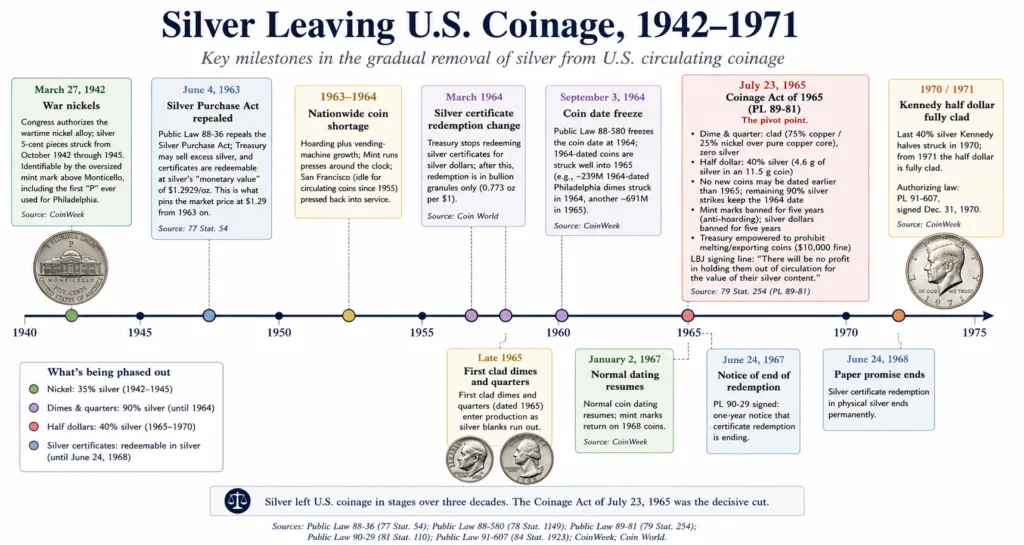
The transition moved fast. Clad dimes and quarters dated 1965 entered production once the silver blanks ran out, and the law forbade dating any of the new coins earlier than 1965. The 40 percent half dollar lasted through 1970; from 1971 on, the Kennedy half went fully clad as well. Silver certificates, the paper dollars that promised redemption in physical silver, got their own sunset: Congress gave holders one year of notice in June 1967, and on June 24, 1968 redemption ended for good. In the final days, people lined up at the assay offices to trade paper for little bags of silver granules, 0.773 ounces per dollar, while they still could.
“There will be no profit in holding them out of circulation”
The emotional center of this story is Johnson’s signing statement. He knew exactly what people were thinking, and he addressed it head on. Would the old silver coins vanish? The answer, he said, was “very definitely” no. Then came the prediction:
“If anybody has any idea of hoarding our silver coins, let me say this. Treasury has a lot of silver on hand, and it can be, and it will be used to keep the price of silver in line with its value in our present silver coin. There will be no profit in holding them out of circulation for the value of their silver content.”
The full transcript is worth reading at the American Presidency Project, because with sixty years of hindsight it reads like a dare. Economists had a name for what happened next long before 1965: Gresham’s law, the old observation that when two kinds of money share the same face value, the cheaper one circulates and the dearer one disappears into drawers.
That is precisely what the public did. Clad coins spent; silver coins stayed home. Within a few years of the Act, finding a silver quarter in change had gone from routine to remarkable, and once the Treasury stepped back from selling silver at $1.2929 in the late 1960s, the market price broke past the old ceiling and never came back. The roughly 12 billion silver coins Johnson expected to keep circulating for another quarter century had all but vanished from commerce by the end of the decade.
What “no profit” looks like at today’s silver price
Now for the scoreboard. With silver at $62.90 an ounce as of July 6, 2026 (per Kitco’s spot price), here is what the coins Johnson said would never be worth hoarding actually melt for:
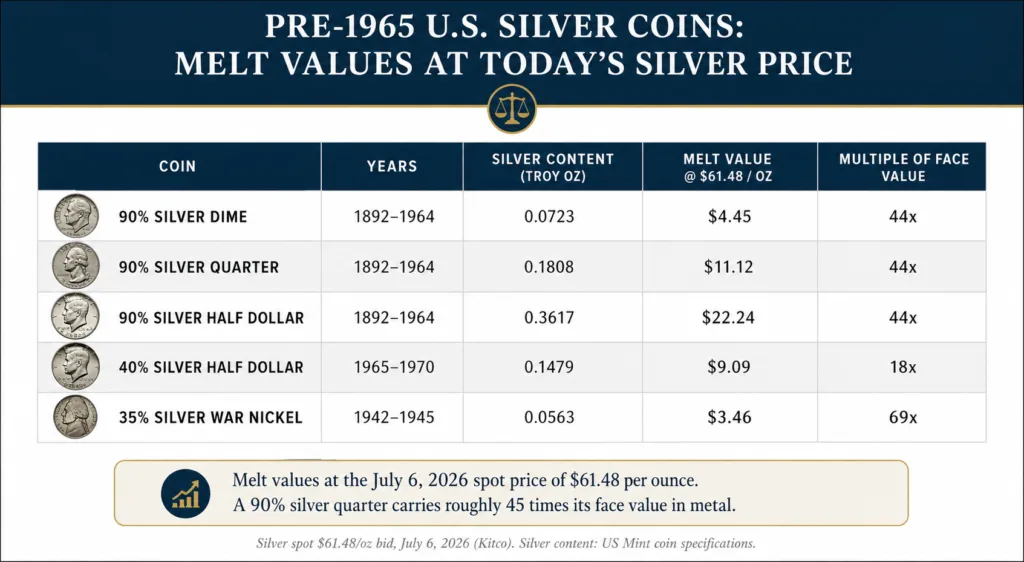
Run the numbers and the pattern is brutal. A 90 percent silver dime holds 0.0723 ounces of silver, worth about $4.55. A quarter holds 0.1808 ounces, about $11.37. A half dollar holds 0.3617 ounces, about $22.75. Even the diluted coins did fine: the 40 percent Kennedy halves of 1965 to 1970 melt for roughly $9.30, and a wartime nickel’s 0.0563 ounces comes to about $3.54, over 70 times its five-cent face. Every $1 of 90 percent face value is roughly $45 of metal.
Anyone who ignored the President in July 1965 and pulled a single roll of quarters aside turned $10 into about $455 of silver, before any collector premium. The mechanics of doing this math for any coin or piece of jewelry are covered in our guide to calculating melt value, and the coins themselves, sold by the bag as junk silver, get a full breakdown in our 90% junk silver buying guide.
To be fair to Johnson, he was not lying so much as betting the stockpile could outlast demand, and the bet failed within three years. The honest lesson is narrower than the goldbug version: nobody in 1965 could promise what silver would cost in 2026. What the government could control was the metal in the coin, and it chose to remove it. Holders of the old coins kept the metal. Holders of the new ones kept the promise.
How to spot pre-1965 silver in the wild
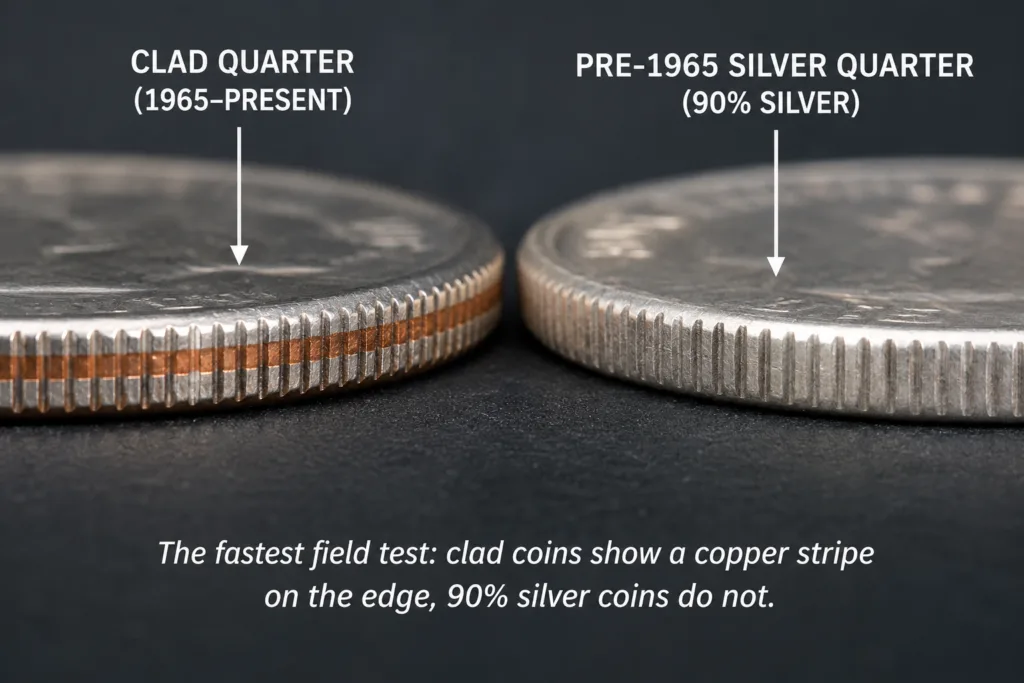
Sixty years of attrition means you will rarely find silver in change, but it still happens, usually when an inherited coin jar gets spent by someone who never looked at the dates. Two checks take about a second each. First, the date: any US dime or quarter from 1964 or earlier is 90 percent silver, and any half dollar from 1964 or earlier is too, with 1965 to 1970 halves at 40 percent. Second, and faster once you have the habit, the edge. A clad coin shows its copper core as a brown stripe running around the rim, like the filling in a sandwich. A silver coin’s edge is solid silver-white, no stripe. You can check a whole stack at once by looking at it from the side.
The reeded edge you are inspecting is itself a relic of hard money, cut into coins centuries ago to stop people shaving precious metal off the rims; we traced that story in why coins have ridges. War nickels take one extra step: from 1942 to 1945 the Mint moved the mint mark above Monticello on the reverse and made it oversized, including the first “P” for Philadelphia ever used on a US coin, per the US Mint’s own history of the nickel. See a big letter floating over the dome, and that nickel is 35 percent silver.
This is why stackers keep coming back to 1965 as the proof of concept. The government did nothing exotic that year. It did something ordinary: when the metal in the money became worth more than the money, it took the metal out and kept the face value. The people holding the old coins were made whole by the silver itself, with no one’s permission required. Six years later the same arithmetic caught up with the dollar’s link to gold, a story we tell in our piece on the Nixon shock of 1971. The 1965 quarter in your pocket spends exactly like the 1964 one. Only one of them is worth $11, and the date on its face tells you which.
