

The short answer first, because it is your money on the counter. The best place to sell gold coins and bars is a dealer who trades bullion all day and prices off the live market. Everyday scrap jewelry usually does best at a specialist gold buyer or a jeweler with a resale business. A pawn shop is the right stop when you need cash today or want a loan instead of a sale. And a refiner pays the highest percentage of anyone, but only if you walk in with thousands of dollars of metal at once.
Four buyers, four answers, one necklace. The offers can sit hundreds of dollars apart on the same item in the same week, and none of the four is necessarily cheating you. Each one runs a different business, does something different with your gold after you leave, and prices your metal around that next move. Once you see the business behind the counter, the offers stop being mysterious and start being predictable.
Why the same chain gets four different offers
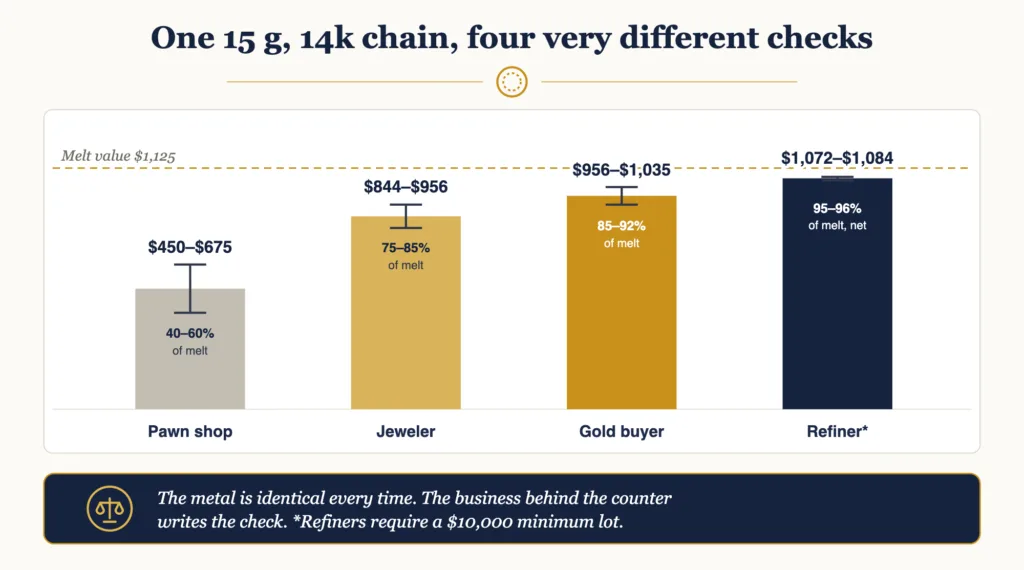
Start with the number every offer orbits: melt value. That is the pure gold in your item multiplied by the current price, and with gold trading near $4,000 an ounce in mid-July 2026, melt values are the highest they have ever been. A 15 gram, 14 karat chain holds about 8.75 grams of fine gold, a hair over a quarter of a troy ounce, which puts its melt value near $1,125. If you have never run that math, our guide to calculating the melt value of gold jewelry walks through it in five minutes, and it is the single most useful thing you can do before selling anything.
Nobody pays full melt, and the gap is not greed. Whoever buys your chain has to test it, hold it, insure it, and eventually convert it back into money through a refiner or a customer. Each step costs something, and each buyer’s costs are different. That is the whole story of where to sell gold: the fewer hands between your item and the refined bar it becomes, and the better the buyer’s own resale channel, the more of that $1,125 lands in your pocket.
Pawn shops are lenders first, gold buyers second
The pawn counter is built around a loan, not a sale. The National Pawnbrokers Association puts the average pawn loan at about $150 and says roughly 85 percent of borrowers come back for their collateral. That is the core business: short money against your item, with your gold sitting in the back room as security. Buying gold outright is the side hustle.
It shows in the offers. A pawnbroker is a generalist who priced a guitar and a power drill before you walked in, and the shop protects itself with conservative assumptions on purity and a wide margin on price. Jewelry trade guides such as Kravit Jewelers’ breakdown of pawn pricing put typical pawn offers around 40 to 60 percent of melt. On our $1,125 chain, that is roughly $450 to $675. AARP’s advice for gold sellers draws the line plainly: if someone offers you 50 cents on the dollar, walk.
None of that makes the pawn shop a villain. It is the only buyer on this list open at 7 pm on a Saturday, the only one that hands you cash in ten minutes, and the only one that will loan against your gold so you can get it back after payday. Speed and optionality are real services. You just should not confuse them with a strong price, because you are paying for them in the spread.
Jewelers pay for the piece, not just the metal
A jeweler looks at your chain differently, because a jeweler has a second way to make money on it: the display case. A piece that can be cleaned, repaired, and resold as jewelry is worth more than its weight, so a jeweler with a healthy estate counter can afford to beat the scrap buyers on the right item. Offers on ordinary pieces tend to land between the pawn counter and the specialists, and on resellable pieces they can go higher than either.
This is where sellers leave the most money on the table, because the exception is bigger than most people think. A signed piece from a major house, a Cartier bracelet, a Tiffany pendant, a clean estate ring with a good stone, can sell for far more than its melt value to the right buyer, because a buyer is paying for the brand, the design, and the provenance, not just the metal. Melting it is legal and quick and destroys the premium forever. The same logic drives the coin world, where a technically honest melt offer on a collectible can be the worst deal in the room. If your item has a brand name, a hallmark, or real age, get an opinion on the piece before anyone quotes you on the metal.
The jeweler’s weakness is the mirror of its strength. Plain scrap, the broken chain, the single earring, the dated class ring, has no display-case future, and many jewelers quote it lazily because it is not the business they want. For that material, the specialists usually win.
Gold buyers and bullion dealers price closest to the market
A dedicated gold buyer or bullion dealer is the only shop on this list whose entire business is the metal itself. Volume is the model: buy all day at a small spread, ship to the refiner in bulk or resell to stackers, repeat. Because the margin per transaction can be thin, the percentage you keep is high. AARP’s reporting found reputable dealers paying up to 98 percent of market value for pure gold coins, with scrap jewelry lower because it still has to survive a refining cycle.
Recognizable bullion is where this channel runs away from the field. An American Eagle or a branded one ounce bar has a live two-way market, so a dealer can quote you tightly off the screen price, often the same day the metal moves. Jewelry involves more judgment, testing, purity discounts, refining logistics, but a busy specialist still tends to land in the 80s and low 90s as a percentage of melt on clean karat scrap. The gap between the screen price and any physical offer is its own subject, and our piece on spot price versus physical price explains why even the best buyer quotes under the number on TV.
Two habits protect you here. Watch the test happen; a serious buyer weighs and tests in front of you and will tell you the purity reading without being asked. And get the offer as a percentage, not just a dollar figure. A shop that answers “92 percent of melt” in plain English is making a claim you can check. A shop that answers “best price in town” is making a claim you cannot. Federal rules already require buyers to be truthful about the measurable facts of your item, its karat and its weight, under the FTC’s jewelry guides. Nothing requires them to volunteer the percentage. That question is your job.
Refiners pay the most and want you the least
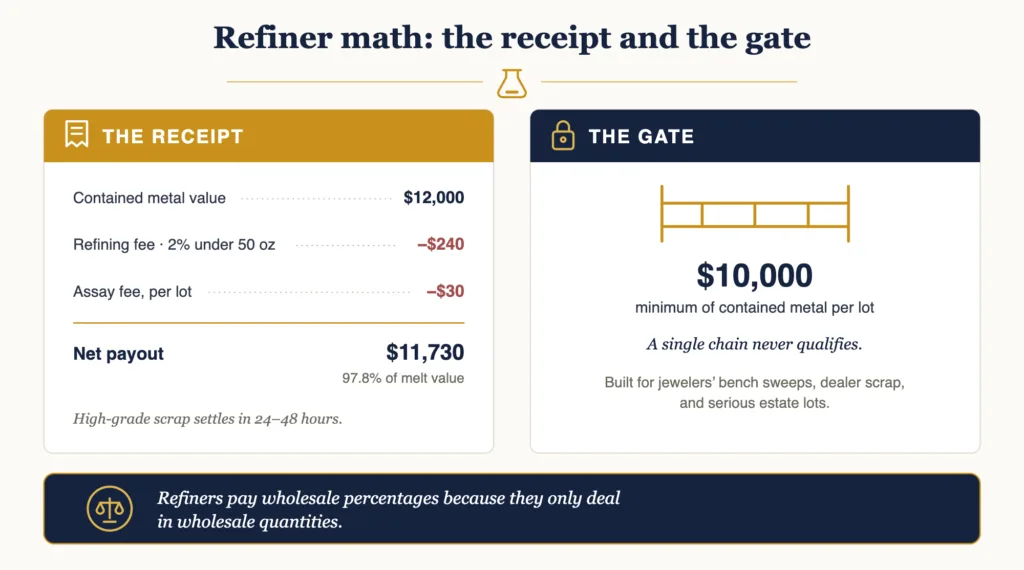
At the top of the chain sits the refiner, the company that actually melts, assays, and repours metal into the bars everyone else trades. Sell here and there are no middlemen left, which is why the percentages look almost unreal next to a pawn ticket. Dillon Gage’s published refining schedule charges 1 percent on karat scrap lots over 50 ounces and 2 percent under it, plus a $30 assay fee per lot, with high-grade scrap settling in 24 to 48 hours. Keep 98 to 99 percent of melt and the $1,125 chain becomes roughly $1,070.
Then comes the gate. The same schedule requires a lot to contain at least $10,000 of pure metal before the refinery will take it. Your single chain never gets in the door. Refiners are wholesale machines built for jewelers’ bench sweeps, dealers’ scrap accumulation, and serious estate lots, and their pricing rewards exactly the volume a household seller does not have. If you inherited a drawer of jewelry, a coin accumulation, and grandpa’s dental gold all at once, a refiner conversation can genuinely make sense. For one necklace, the specialist buyer down the street is effectively your retail window into the refiner’s price, a few points wider, no minimums, cash today.
So where is the best place to sell gold?
Put the four side by side and the pattern is hard to unsee. The pawn shop sells you speed and charges for it. The jeweler pays for beauty when your piece has some. The gold buyer pays for metal and does it tightly because metal is all it does. The refiner pays nearly everything and locks the door behind a minimum. The best place to sell gold is not a name, it is a match between what you are holding and which of those machines wants it most.
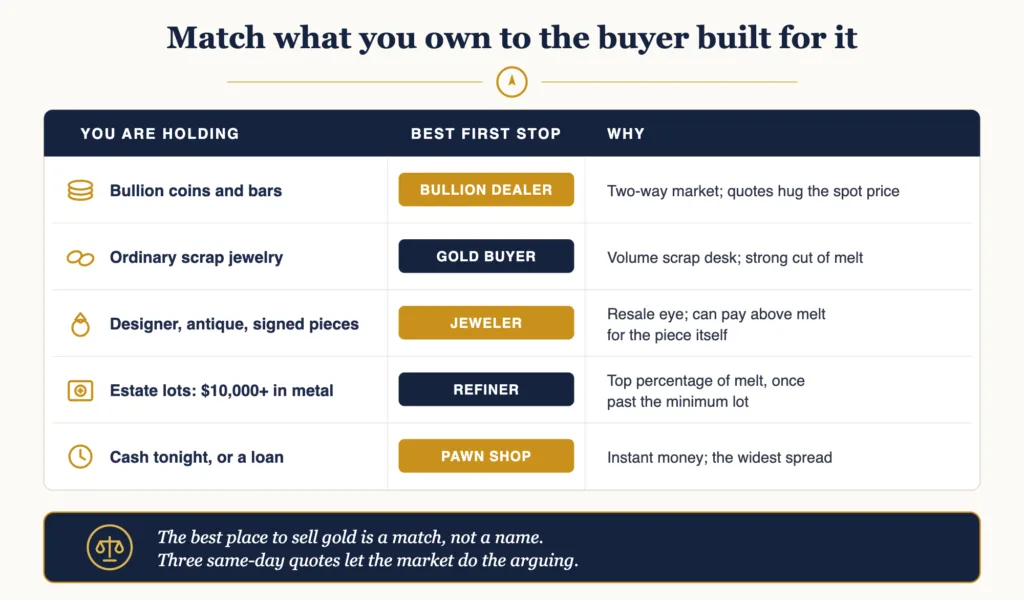
So do the homework in this order. Weigh your items, check the karat marks, and work out melt value at today’s price. Separate anything with a signature, a hallmark, or age, and price the piece before the metal. Then get at least three offers on the same day, AARP’s advice, and ours, because gold moves daily and stale quotes are not comparable. Ask every buyer the same two questions: what percentage of melt is this, and what comes off before I am paid. And once you sell, remember the IRS treats bullion profits under the 28 percent collectibles rate rules, so the record-keeping starts the day the check clears, not next April.
Sell that way and the sign in the window stops mattering. You will know what your gold is worth, which counter wants it, and what a fair cut of the melt looks like before anyone quotes you a dollar. The seller with a number always beats the seller with a hope.
