

I want to start with full transparency. In early discussions about 2025 trade policy, conventional wisdom suggested that tariffs would immediately drive inflation higher, which would automatically benefit gold prices. This made logical sense, if tariffs act as a tax on imports, prices should rise, and gold should appreciate as an inflation hedge. Simple, right?
But logic isn’t data, and assumptions aren’t evidence.
A new study from the Federal Reserve Bank of San Francisco, published November 24, 2025, analyzed tariff changes using 40 years of international data from 16 advanced economies, including the United States, United Kingdom, France, Germany, Japan, and Australia, from the 1980s through 2022. The findings challenged conventional assumptions about tariffs, inflation, and their implications for gold investors.
What the Federal Reserve Data Actually Shows
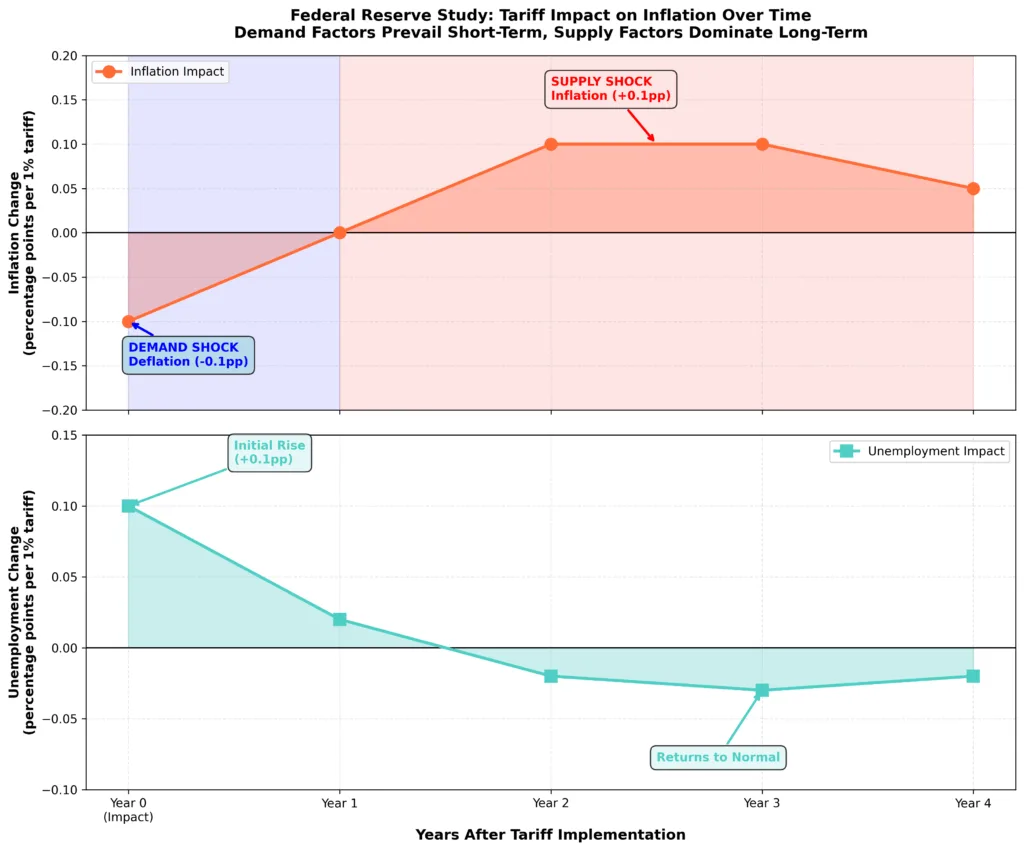
The study found that immediately following tariff increases, inflation initially declines rather than increases. Specifically, a 1 percentage point increase in tariffs historically led to approximately a 0.1 percentage point (10 basis points) decline in inflation in the first year. Unemployment also rose by about 0.1 percentage points during this initial period.
This pattern held across multiple economic eras and countries, suggesting that tariffs behave less like a simple tax on consumers and more like a demand shock, similar to tightening financial conditions. When tariffs increase, consumers and businesses reduce spending, delay investment projects, and reassess risk, which slows price growth rather than accelerating it in the short term.
This directly contradicts the most common talking point: “Tariffs automatically cause inflation across the board.”
The Critical Part Most Investors Miss
The study doesn’t stop at year one. Over time, the effects reverse.
By years two and three, inflation surges back, rising approximately 0.1 percentage points per 1% tariff increase. This delayed inflationary impact peaks around year three and then slowly begins to wane by year four.
The researchers explain: “Demand factors prevail in the short run, but supply factors dominate in the long run.”
Initially, businesses and consumers pull back spending due to uncertainty, which depresses demand and temporarily lowers inflation. But over time, higher input costs from tariffs get passed through supply chains. Equipment investment becomes more expensive, production costs rise, and those costs eventually show up in consumer prices.
Meanwhile, unemployment rises initially but then returns to normal levels or even declines slightly over the same period.
What This Means for Gold Investors
The Federal Reserve research reveals that tariffs create time-varying effects: deflationary in the short run through demand suppression, but inflationary over the medium term as supply-side costs work through the economy.
For gold investors, this timing matters enormously.
Short-Term Considerations: The Demand Shock Phase
During the initial 12-month period following major tariff increases, when deflationary pressures emerge from reduced consumer and business spending, gold faces headwinds from:
- Lower immediate inflation expectations: If headline inflation declines temporarily, some investors may reduce inflation hedge allocations
- Dollar strength from safe-haven flows: Trade policy uncertainty often drives capital toward U.S. dollar assets initially
- Reduced consumer purchasing power: Physical jewelry and retail coin demand may soften as households face economic uncertainty
However, as examined in our analysis of gold as a liquidity crisis indicator, gold’s temporary weakness during economic uncertainty typically precedes sustained appreciation once policy responses begin.
Medium-Term Drivers: The Supply-Side Inflation Surge
The 2-4 year period following tariff implementation, when supply-side inflation dominates, creates ideal conditions for gold appreciation:
- Persistent above-target inflation: Central banks face inflation that proves stickier than their targets, eroding real returns on fixed-income assets
- Policy response dilemmas: The Federal Reserve must choose between fighting inflation (raising rates, harming growth) or supporting growth (keeping rates low, accepting inflation)
- Currency debasement risks: If policymakers prioritize growth over inflation control, monetary expansion supports gold’s role as a store of value
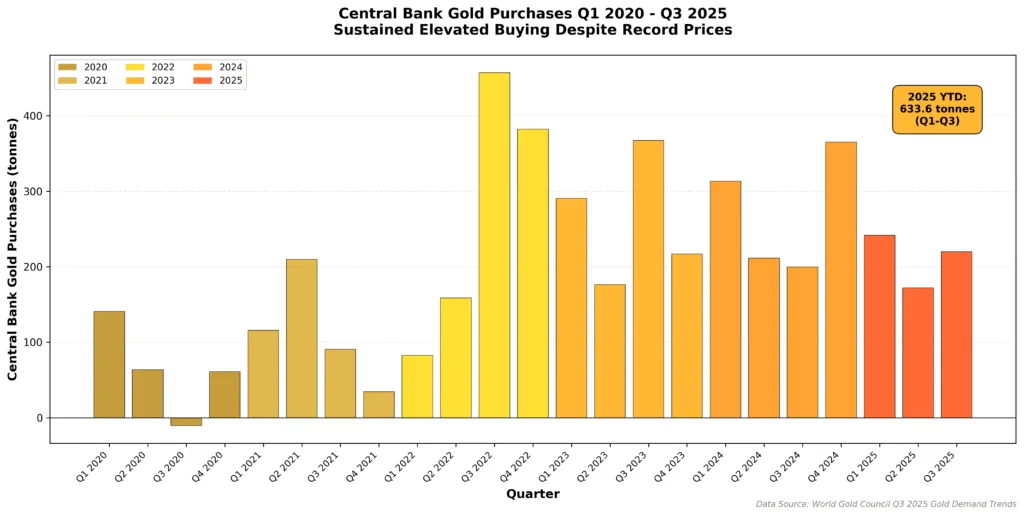
According to World Gold Council Q3 2025 data, gold demand reached a record 1,313 tonnes despite prices trading near all-time highs above $4,000 per ounce. This price-insensitive accumulation, particularly the 634 tonnes purchased by central banks through Q3, demonstrates institutional conviction about gold’s role during complex policy environments.
Why Trade Policy Uncertainty Supports Gold
Beyond the direct inflation effects, tariffs create broader uncertainty that benefits gold’s portfolio role:
Supply Chain Disruption: Companies restructuring global supply chains face increased costs, longer lead times, and operational complexity. This translates to persistent inflation pressures that support gold as an inflation hedge.
Geopolitical Tensions: Tariff policies often trigger retaliation from trading partners, escalating into broader trade disputes. As examined in our analysis of the household debt crisis and gold, geopolitical uncertainty consistently drives safe-haven demand for precious metals.
De-Dollarization Trends: Aggressive use of tariffs can accelerate global efforts to reduce dependence on dollar-based trade. Central banks diversifying reserves away from dollars and toward gold create sustained structural demand regardless of short-term price movements.
Important Caveats: Why This Time Could Be Different
The Federal Reserve researchers emphasize that their estimates should be interpreted with caution. The tariffs enacted in 2025 are unprecedented in magnitude and scope compared to the historical data used in the analysis.
The study notes that effects can vary significantly depending on:
- Permanence perceptions: Whether tariffs are viewed as temporary policy tools or permanent structural changes affects how businesses and consumers respond
- Retaliation patterns: Trading partner responses can amplify or mitigate domestic economic impacts
- Supply chain adaptability: How quickly companies can restructure sourcing and production affects the magnitude and timing of cost passthrough
- Policy uncertainty: Unpredictable future trade policy creates additional risk premiums and hesitation in business investment
As detailed in our examination of Federal Reserve liquidity stress and gold, when policy uncertainty intersects with liquidity constraints in the financial system, gold benefits from multiple reinforcing factors.
Historical Context: Gold During Previous Tariff Episodes
The 1970s Stagflation Precedent
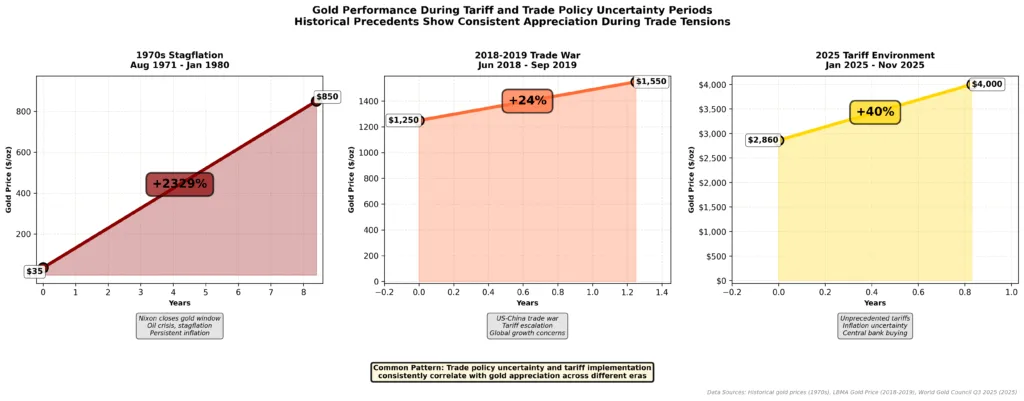
The 1970s featured a toxic combination: trade tensions, persistent inflation, and mounting economic uncertainty. The Nixon administration’s import surcharge in 1971, combined with broader protectionist sentiment, contributed to an environment of economic instability.
Gold, newly freed from the $35 per ounce Bretton Woods peg, surged to over $850 by January 1980, delivering returns exceeding 2,300%. This occurred as policymakers struggled with the same dilemma highlighted in the Federal Reserve study: choosing between fighting inflation and supporting growth.
The 2018-2019 Trade War
More recently, the 2018-2019 U.S.-China trade tensions provided a modern precedent. Gold initially consolidated as markets digested the implications, then rallied from approximately $1,200 per ounce in mid-2018 to over $1,550 by late 2019, representing a gain exceeding 29%.
Critically, gold’s appreciation continued even as the U.S. Dollar Index remained elevated, demonstrating that trade policy uncertainty can support gold regardless of dollar strength.
Portfolio Strategy: Positioning for Complex Outcomes
The Federal Reserve research confirms what sophisticated investors already understood: economic relationships are rarely simple or linear. The tariff-inflation-gold dynamic involves timing, magnitude, and multiple competing forces.
Strategic Allocation Principles
Focus on Medium-Term Drivers: The 2-4 year period when supply-side inflation dominates represents the most favorable environment for gold. Investors with multi-year time horizons should view short-term volatility as opportunity rather than risk.
Physical Ownership Advantages: During periods of trade policy uncertainty and potential financial system stress, physical gold in coins and bars provides ownership without counterparty risk. Physical metal maintains value regardless of institutional solvency or policy outcomes.
Dollar-Cost Averaging: Given the uncertain timing of tariff impacts, systematic accumulation removes the pressure to perfectly time entries while ensuring consistent exposure to structural drivers.
Complement With Silver: Silver provides leverage to gold moves while offering additional industrial demand drivers. Trade policy uncertainty affecting technology and renewable energy supply chains can create particularly strong dynamics for silver.
What Central Banks Know That You Should Too
The sustained central bank accumulation at record price levels reveals critical information. These institutions have access to confidential economic data, operate with multi-decade time horizons, and staff entire departments of monetary economists.
Their aggressive buying at elevated prices signals assessment of long-term currency risk that transcends short-term economic data. As examined in our analysis of Q3 2025 gold demand, this price-insensitive institutional accumulation represents the strongest fundamental driver supporting gold’s structural bull market.
Why This Matters Beyond Headlines
When it comes to investment outcomes, what hurts you isn’t what you don’t know, it’s what you’re certain is true that turns out to be incomplete or wrong.
If the longstanding assumption that “tariffs immediately cause inflation” was incomplete, we must ask: what other economic relationships are accepted as fact simply because they became tradition?
The real skill isn’t repeating what experts say or following conventional wisdom. It’s staying flexible when new evidence challenges old beliefs, and positioning portfolios for complex outcomes rather than simple narratives.
The Bottom Line for Gold Investors
The latest Federal Reserve research reveals that tariffs have complex, time-varying effects: deflationary in the short run through demand suppression, but inflationary over the medium term as supply-side costs work through the economy.
For gold investors, this creates a roadmap:
- Expect volatility in the 12 months following major tariff increases as demand-side effects dominate and economic uncertainty peaks
- Position for sustained appreciation in years 2-4 when supply-side inflation pressures materialize and policy responses favor monetary expansion
- Maintain conviction during temporary weakness, recognizing that gold’s role as a crisis hedge and inflation protection becomes more valuable, not less, during complex policy environments
- Focus on physical ownership to eliminate counterparty risk during periods of trade tensions and potential financial system stress
As examined throughout our analysis of gold’s structural bull market, the fundamental case for precious metals allocation rests on structural factors rather than short-term forecasts: persistent fiscal deficits, monetary system fragility, currency debasement trends, and geopolitical uncertainty.
The Federal Reserve’s tariff research confirms that policy decisions create complex, multi-year economic dynamics. Gold’s role as a portfolio hedge against policy mistakes, inflation surprises, and systemic risks remains as relevant as ever, perhaps more so in an environment where trade policy adds another layer of uncertainty to already challenging economic conditions.
Conclusion: Data Over Narrative
I focus on markets, money, risk, incentives, and outcomes. If the data changes, you have to update, because the price of ignoring reality is always paid in dollars.
The Federal Reserve’s November 2025 research provides crucial data that challenges simple narratives about tariffs and inflation. Neither “tariffs always cause inflation” nor “tariffs don’t cause inflation” tells the complete story. The timing, magnitude, and multiple channels through which tariffs affect the economy matter enormously for investment positioning.
For gold investors navigating 2025’s trade policy environment, understanding these complex dynamics provides strategic advantage. Gold’s role as a hedge against inflation, currency debasement, and policy uncertainty becomes more valuable when the economic relationships are complex and outcomes uncertain.
Whether you’re establishing initial precious metals positions or expanding existing holdings, Bullion Trading LLC offers comprehensive gold and silver solutions backed by market expertise and commitment to investor education. In an environment where tariff policy creates multi-year economic uncertainties, gold ensures your portfolio is positioned for complex outcomes rather than simple narratives.
