
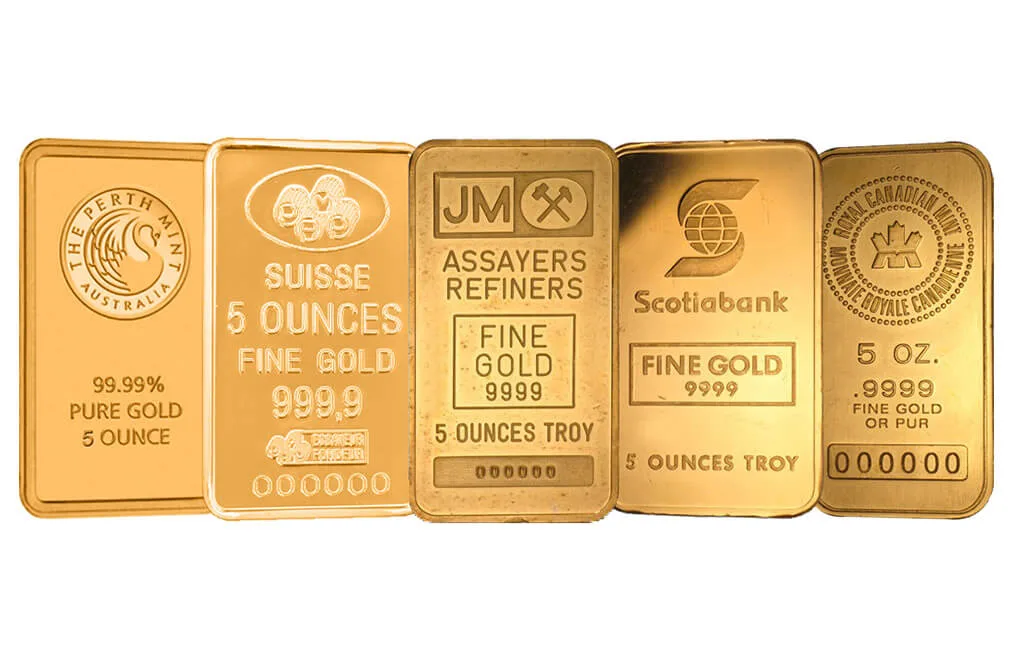
Most gold bars sold to individual buyers in the United States, Canada and Australia are .9999 fine, and that is what buyers and dealers in those markets usually expect. Fineness is written in parts per thousand: .9999 (or 999.9) means 99.99% gold, and .995 means 99.5% gold. (Written as “.9999%” it would mean less than 1% gold.)
Purity and Resale
If you may sell a bar one day, what matters is how easily a dealer can value and resell it. Dealers generally price a bar on its fine gold content, and the offer can also depend on the brand, the condition and how familiar the bar is to their customers.
Are .995 Bars Worth Less?
A .995 bar contains about 0.5% less gold than a .9999 bar of the same weight, and its price should reflect that. No country requires gold bars to be .9999: 995.0 parts per thousand is the minimum fineness for London Good Delivery bars, the roughly 400-ounce bars traded between banks and held by central banks (LBMA). In retail markets where .9999 is the norm, though, a small .995 bar from an unfamiliar maker can take longer to resell, and some dealers offer a little less for it than for a well-known .9999 bar.
What buyers expect varies from market to market. In the wholesale market, and in some Middle Eastern and Asian markets, .995 bars are common and change hands at their gold content. There are a few reasons some bars are made at .995. Some are older bars. Others come from refiners that stop after the Miller (chlorine) process, which brings gold to about 99.5%; reaching 99.99% takes a further electrolytic step, the Wohlwill process, which is slower and ties up more gold in the refinery (Miller process).
When you sell, a bar’s fineness, brand and condition all affect the offer; see what we pay for gold bars today.
When buying, many people in the U.S. choose .9999 bars from well-known refiners because they are the easiest for other buyers and dealers to recognize. Government-minted coins are a different case. The Krugerrand and the American Eagle are 22 karat (.9167 fine), but each 1 oz coin contains a full troy ounce of gold, alloyed with copper (and, in the Eagle, silver) for durability, according to the South African Mint and the U.S. Mint. Dealers recognize these coins at a glance and price them on that ounce of gold, so their lower fineness is not a drawback.
A .995 bar is not a bad purchase if its price reflects its lower gold content and you know how you would sell it. Check the fineness stamped on the bar and on its assay card, and compare prices per ounce of fine gold rather than per bar.