

The precious yellow metal in your wedding ring began its journey billions of years ago, forged in the heart of dying stars and catapulted across the cosmos in spectacular stellar explosions. While most elements lighter than iron are created in the cores of stars, gold requires the extreme conditions found in neutron star collisions , events so violent they literally ripple the fabric of spacetime itself. This extraordinary cosmic origin story doesn’t just make for fascinating science; it fundamentally explains why gold remains one of the rarest and most valuable investment assets on Earth, with prices reaching historic levels of $3,860 per ounce as of October 2025.
The Cosmic Birth of Gold: When Stars Collide
Neutron Star Mergers: The Universal Gold Factory
When humanity detected the collision between two neutron stars in 2017, we confirmed a long-held theory about how elements heavier than iron are forged in the energetic fires of these incredible explosions. These cosmic collisions, known as kilonovas, generate temperatures exceeding 100 billion degrees , conditions extreme enough to force neutrons and protons together, creating gold atoms through a process called rapid neutron capture (r-process).
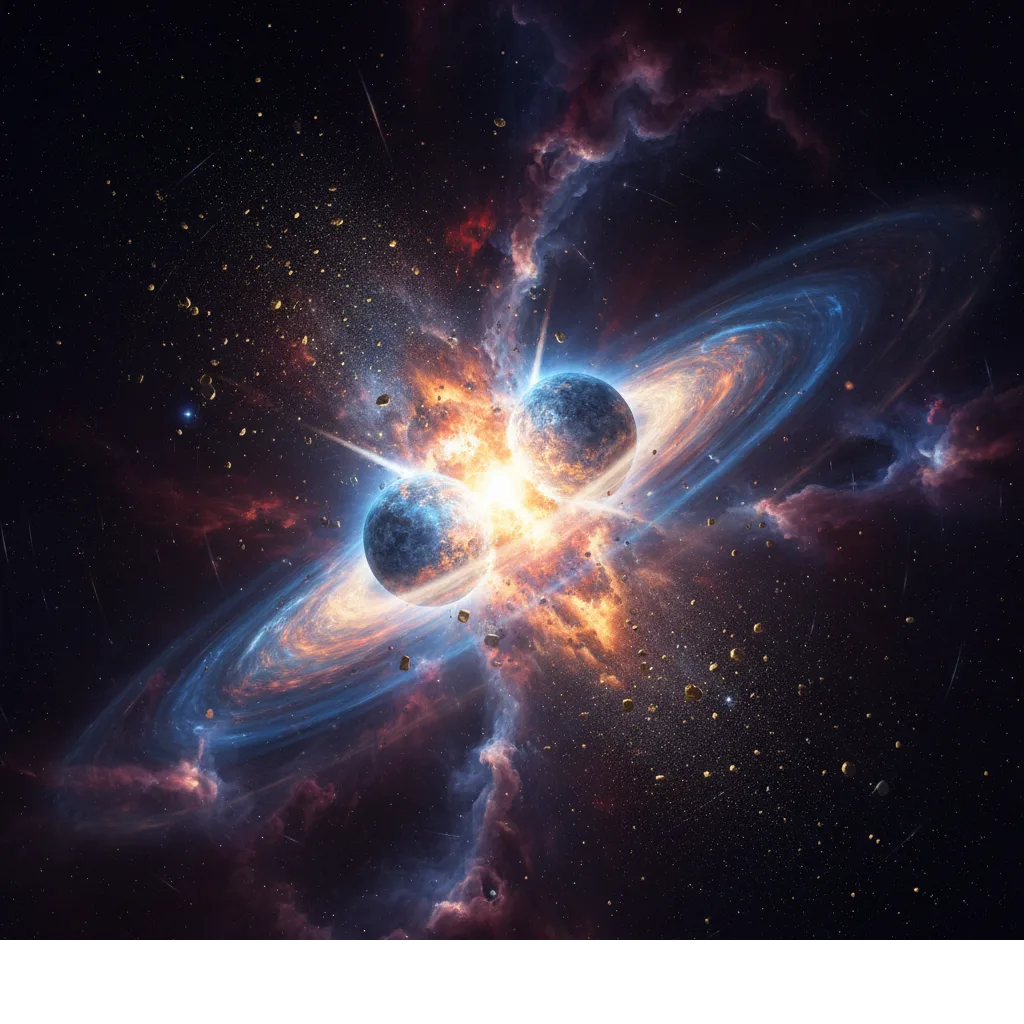
A single neutron star collision can produce enough gold, uranium, and other heavy elements equal in mass to all of Earth’s oceans. These stellar corpses , each containing more mass than our sun compressed into a sphere just 12 miles across , spiral toward each other for millions of years before their cataclysmic merger. The collision ejects massive clouds of newly-formed gold atoms into space at speeds approaching 30% the speed of light.
The Journey to Earth: Billions of Years in the Making
After being created in these collisions and ejected outward, the heavy elements are eventually incorporated into the formation of future stars and planets, meaning all the gold on Earth probably comes from the collision of two distant stars. This cosmic gold dust drifted through space for billions of years, eventually becoming part of the nebula that would birth our solar system 4.6 billion years ago.
During Earth’s violent formation, most of this primordial gold sank toward the planet’s core along with iron and other heavy elements. The gold we mine today arrived later, delivered by asteroids during the Late Heavy Bombardment period approximately 3.9 billion years ago, a cosmic gold rush that seeded our planet’s crust with the precious metal investors covet today.
From Space to Earth’s Crust: The Geological Journey
How Gold Deposits Form on Earth
Once deposited on Earth, gold doesn’t simply sit waiting to be discovered. Geological processes like volcanic activity and tectonic collisions create the conditions necessary for gold deposition, with certain rock formations such as quartz veins and sedimentary rocks often hosting substantial gold deposits.
The formation of mineable gold deposits involves three critical geological processes:
1. Hydrothermal Activity Gold deposits near volcanic regions, particularly around the Pacific Ring of Fire, originate deep within Earth’s mantle, 30 to 50 miles beneath the surface, with magma carrying gold upward. Superheated water dissolves microscopic gold particles from surrounding rocks, concentrating them in veins as the solution cools and pressure decreases.
2. Orogenic Gold Formation Gold formation occurs typically in the late phase of mountain-building events, during changes in far-field stresses, with created and reactivated faults serving as pathways for hydrothermal solutions. These deposits account for approximately 75% of the world’s historical gold production.
3. Placer Deposits Weathering and erosion of primary gold deposits can lead to the formation of placer deposits, where gold, being dense and resistant to chemical weathering, accumulates in stream sediments, beach sands, and glacial deposits. These secondary deposits enabled the famous gold rushes of California and Alaska.
Why Gold’s Cosmic Rarity Drives Investment Value
The Scarcity Equation: Understanding Gold’s Limited Supply
The cosmic origin of gold directly explains its terrestrial scarcity. Recent 2024 research shows that the amounts of gold created in neutron star collisions simply don’t add up to explain all the gold in the universe, suggesting gold may be even rarer than previously thought. This fundamental scarcity underpins gold’s investment thesis.
Central Banks and the Gold Rush 2.0
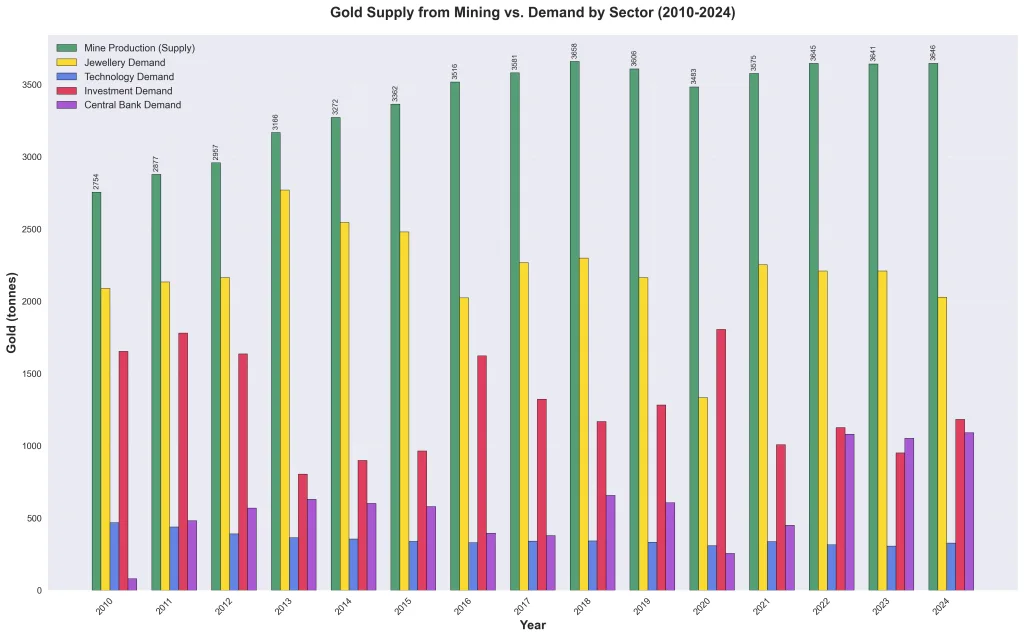
The understanding of gold’s cosmic scarcity has intensified institutional accumulation. Central banks have emerged as dominant gold buyers, with purchases exceeding 800 tonnes year-to-date in 2025, driven by reserve diversification strategies and geopolitical hedging. This institutional demand, combined with gold’s irreplaceable role in technology, from smartphone circuits to satellite components, creates a structural supply-demand imbalance favoring long-term price appreciation.
Investment Implications: From Stellar Origins to Portfolio Strategy
Why Gold’s Formation Story Matters for Investors
Understanding gold’s cosmic origin provides crucial context for investment decisions:
1. Ultimate Supply Constraint Unlike fiat currencies that can be printed at will, gold’s supply is constrained by the frequency of neutron star collisions that occurred billions of years ago. No amount of human intervention can create new gold atoms, we can only redistribute what the universe has already provided.
2. Technology Demand Acceleration Gold’s exceptional conductivity and corrosion resistance make it essential in circuit boards, connectors, and memory chips, with electronics consuming approximately 25% of annual gold demand. As technology advances toward quantum computing and space exploration, gold’s unique atomic properties become increasingly irreplaceable.
3. Price Trajectory Analysis Gold prices are expected to average $3,675/oz by the fourth quarter of 2025 and climb toward $4,000 by mid-2026, with central bank and investor demand remaining strong at around 710 tonnes per quarter. The current gold price as of October 1, 2025, stands at $3,860.17, reflecting growing recognition of gold’s fundamental scarcity.
Portfolio Allocation Strategies for the Cosmic Metal
Given gold’s unique formation story and resulting scarcity, prudent investors should consider:
- Core Holdings: 5-10% portfolio allocation in physical gold for wealth preservation
- Diversification Across Forms: Combine gold bullion bars, coins, and allocated storage
- Dollar-Cost Averaging: Regular accumulation to smooth price volatility
- Long-term Perspective: Hold periods aligned with gold’s millennia-long value retention
The Future of Gold: From Ancient Stars to Modern Portfolios
Technological Catalysts and Market Dynamics
As we advance into 2025 and beyond, several factors will amplify gold’s investment appeal:
Quantum Computing Requirements: Next-generation quantum computers require gold’s unique quantum properties for stable qubit connections, potentially doubling technology sector demand by 2030.
Space Mining Reality Check: While asteroid mining promises vast gold deposits, the technical and economic barriers ensure Earth-based gold remains the only viable source for decades, preserving scarcity dynamics.
Currency Debasement Acceleration: With global debt exceeding $315 trillion and monetary expansion continuing, gold’s role as a hedge against currency devaluation intensifies.
The Investment Horizon: 2025-2030 Outlook
Gold enters the second half of 2025 after an exceptionally strong start to the year, up 26% , shaped by a weaker US dollar, persistent geopolitical risk, robust investor demand and continued central bank purchases. Market analysts project continued appreciation driven by:
- Structural Inflation: Persistent above-target inflation supporting real asset allocation
- Geopolitical Realignment: De-dollarization initiatives increasing sovereign gold accumulation
- Supply Constraints: Declining ore grades and rising extraction costs limiting production growth
Conclusion: Your Connection to the Cosmos
Every ounce of gold represents a tangible connection to the universe’s most violent and spectacular events. Born in the collision of neutron stars, traveled across billions of light-years, and concentrated through geological processes spanning millions of years, gold’s journey to your portfolio is nothing short of miraculous.
This cosmic heritage isn’t just scientific trivia, it’s the fundamental reason gold has preserved wealth for 5,000 years of human civilization and will continue doing so for millennia to come. The same scarcity that made gold precious to ancient pharaohs ensures its value in an age of digital currencies and artificial intelligence.
Whether you’re drawn to gold’s fascinating origin story or its proven investment performance, one fact remains constant: the gold in your portfolio traveled billions of years and survived cosmic catastrophes to reach your hands. In a world of financial uncertainty, there’s profound reassurance in owning an asset forged in the hearts of dying stars , an asset that no government can print, no technology can replicate, and no economic crisis can destroy.
For investors seeking to capitalize on gold’s unique cosmic legacy and terrestrial scarcity, Bullion Trading LLC offers comprehensive solutions tailored to modern portfolio requirements. Our extensive inventory of gold bullion bars, coins, and specialized investment products provides the physical assets necessary to anchor your wealth in the universe’s most enduring store of value.
