

Why can a Morgan Silver Dollar sell for hundreds of dollars when its silver content is only worth around $37? The answer lies in a fascinating transformation that occurs when metal crosses the threshold from mere commodity to cultural artifact. While bullion coins and bars derive their value directly from precious metal content, collectible coins operate in a different realm entirely, one where history, rarity, and human desire create premiums that can reach thousands or even millions of times their melt value.
Understanding the distinction between bullion value and numismatic (collectible) value is crucial for anyone navigating the precious metals market. This article takes you on a journey through the remarkable evolution of coin value, from raw metal extraction to record-breaking auction sales, revealing why certain coins become treasures that transcend their metallic composition.
From Metal to Money: The Birth of a Coin
Every collectible coin begins its journey as raw metal extracted from the earth. Gold, silver, platinum, and palladium are mined, refined to exacting purity standards, and transformed into blanks ready for striking. At this stage, the metal possesses only its intrinsic bullion value, determined solely by weight and purity multiplied by the current spot price.
The minting process adds the first layer of value beyond mere metal. When a blank planchet passes through the mint press, it receives its design, denomination, and legal tender status. For most modern bullion coins like American Gold Eagles, this premium remains modest, often in the range of 3-8% above spot price for gold, though premiums can vary significantly based on mint, product size, demand conditions, and market volatility. However, coins with limited mintage numbers, commemorative designs, or minting errors can plant the seeds of future collectibility. The best gold coins for investment often straddle the line between bullion and numismatic value.
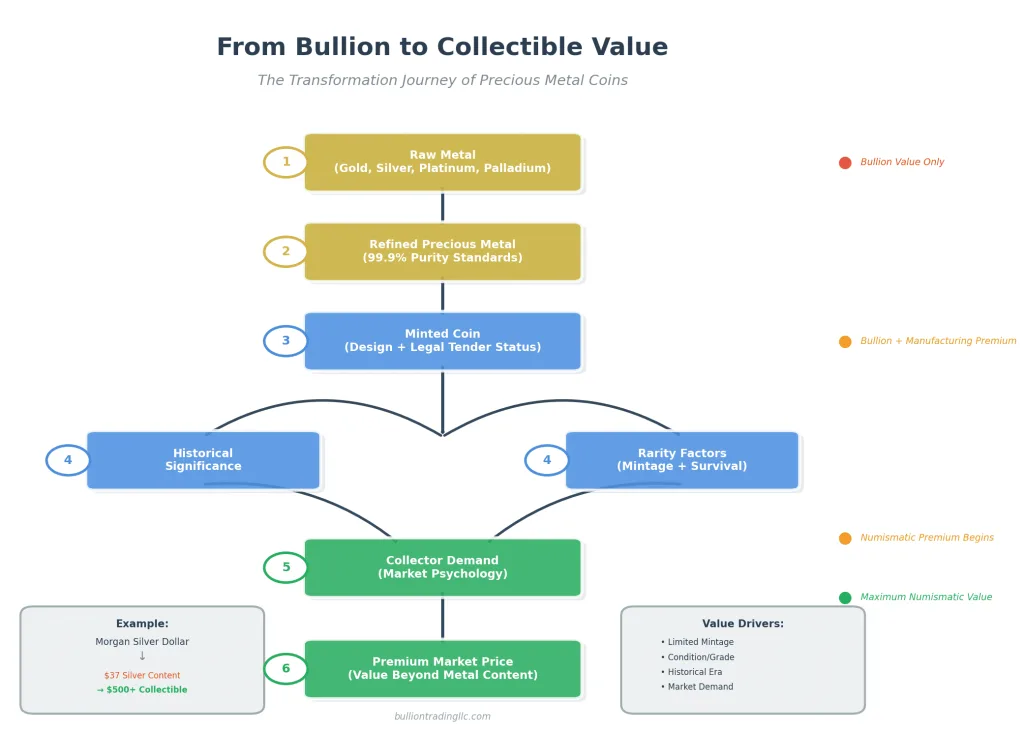
Once minted, coins enter circulation where they accumulate the wear, patina, and history that determine their collectible status, each passing through countless hands and telling stories of its era across decades or even centuries.
How Rarity Transforms Value
Rarity stands as the cornerstone of numismatic value. Like rare art prints commanding premiums over mass-produced posters, coins with limited availability trigger powerful market dynamics that can elevate prices exponentially. Several factors contribute to a coin’s rarity profile:
Limited Original Mintage
Some coins were produced in such small quantities that scarcity was built into their DNA from day one. The 1909-S VDB Lincoln Cent, with its mintage of just 484,000 pieces, represents a stark contrast to the billions of modern pennies produced annually. This inherent scarcity makes it a perennial favorite among collectors, with pristine examples commanding thousands of dollars.
Survival Rate
Time acts as a relentless filter on coin populations. Wars, economic collapses, melting programs, and circulation attrition dramatically reduce surviving specimens. Roman denarii circulated for centuries before disappearing into archaeological sites. Even 20th-century coins face attrition. The Pittman Act of 1918 authorized the melting of hundreds of millions of silver dollars for wartime needs, dramatically reducing the population of Morgan Silver Dollars and other early American silver coinage.
Condition Rarity
While many specimens of a particular coin may exist, finding one in exceptional condition creates secondary scarcity. A 1921 Morgan Dollar in average circulated condition might trade for $30-40, while a pristine MS-67 example can command $5,000 or more, reflecting that coins in superior condition represent a tiny fraction of survivors.
The most extreme rarity occurs when historical events create unique circumstances. The 1933 Saint-Gaudens Double Eagle exemplifies this phenomenon. Though 445,500 were minted, none were officially released to circulation due to President Franklin D. Roosevelt’s gold recall order. Nearly all were melted, making the handful that survived extraordinarily rare. In June 2021, the only legal-to-own specimen sold at Sotheby’s for $18.9 million, representing a premium of approximately 8,100 times its gold content value.
The Role of History & Storytelling
Coins serve as tangible witnesses to human history, connecting us directly to pivotal moments, legendary figures, and vanished civilizations. This historical resonance adds immeasurable value that no amount of metal content can match.
Ancient coins transport collectors to classical civilization. Holding a silver denarius minted during Julius Caesar’s reign creates a connection across 2,000 years. These coins circulated in Roman markets and operated as the currency of the empire. Each represents a frozen moment in ancient commerce, politics, and culture.
More recent coins carry equally compelling narratives. World War II-era coinage reflects wartime sacrifices, with nations replacing traditional metals with steel or zinc to conserve strategic materials. The 1943 steel penny, minted due to wartime copper shortages, serves as a physical artifact of American home front history, though most examples are common and widely available. Commemorative issues celebrate achievements and honor heroes. The 2025 U.S. Marine Corps 250th Anniversary coins create instant collectibles for military numismatists.
Stories embedded in coins extend beyond grand historical narratives to personal connections. Many collectors prize coins connected to their birth year or family heritage. A coin that circulated in a grandparent’s pocket during the Great Depression carries emotional resonance that transforms it from commodity to heirloom.
Condition and Grading: Why a Tiny Scratch Matters
In numismatics, condition is everything. A microscopic scratch, barely visible to the naked eye, can represent the difference between a $500 coin and a $5,000 coin. This extreme sensitivity to preservation quality has given rise to a sophisticated grading industry that has professionalized coin collecting and investment.
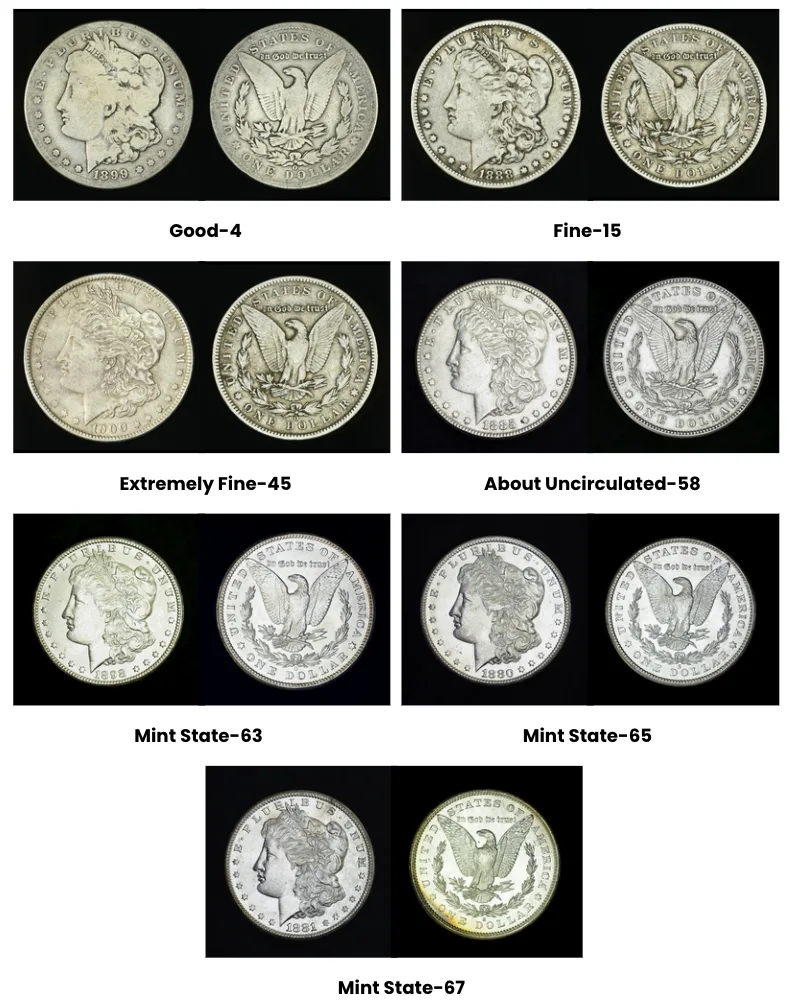
The two dominant grading services, Professional Coin Grading Service (PCGS) and Numismatic Guaranty Corporation (NGC), employ expert graders who examine coins under magnification, assessing every detail of preservation. The numerical grading scale ranges from 1 (barely identifiable) to 70 (perfect mint state), with critical distinctions occurring at the high end of the spectrum.
Consider the remarkable price progression for a classic collectible coin across grade levels:
| Grade | Description | Approximate Value (USD) |
|---|---|---|
| Good-4 (G-4) | Heavily worn; major details visible but flat. | $35 |
| Fine-12 (F-12) | Moderate wear with visible design details. | $85 |
| Extremely Fine-40 (EF-40) | Light wear on highest points, strong definition. | $200 |
| About Uncirculated-58 (AU-58) | Minimal wear; nearly full mint luster. | $400 |
| Mint State-63 (MS-63) | Uncirculated with minor contact marks. | $1,200 |
| Mint State-65 (MS-65) | Choice uncirculated; strong luster, few flaws. | $3,500 |
| Mint State-67 (MS-67) | Superb gem condition; sharp strike, eye appeal. | $12,000 |
This exponential value curve reflects that each grade level represents increasingly rare preservation. Coins naturally deteriorate through handling and circulation. The jump from MS-65 to MS-67 might seem trivial to casual observers, but to experienced numismatists, it represents a quantum leap in eye appeal and preservation quality.
Third-party grading provides crucial benefits for the collectible coin market. Authentication eliminates concerns about counterfeits, a serious problem given sophisticated faking techniques employed by counterfeiters. Sealed, tamper-evident holders (“slabs”) protect coins from environmental damage while allowing viewing. Standardized grading creates liquidity by establishing widely accepted condition standards that facilitate remote transactions, transforming coin collecting into a more professional market that attracts institutional investors.
Collector Demand: The Invisible Force
Unlike precious metal spot prices determined by global commodity markets, numismatic values respond to collector psychology and passion. A coin’s worth isn’t fixed by an objective formula. It rises and falls based on what collectors will pay, driven by shifting trends, generational preferences, and cultural currents.
Popular collecting themes create focal points for demand that dramatically elevate certain series. First issues, the inaugural year of a new design, consistently attract premium interest. The 1916-D Mercury Dime commands prices far exceeding what its rare 264,000 mintage alone would suggest. Error coins represent another passion point. Minting mistakes like doubled dies or off-center strikes create instant rarities. The 2004 Wisconsin State Quarter with extra leaf varieties trades for hundreds despite being modern coins with negligible precious metal content.
Collecting trends evolve across generations. The 50 State Quarters program launched in 1999 introduced millions to coin collecting, revitalizing numismatic interest. When precious metals markets experience volatility, both bullion and numismatic coins see increased attention, though collectibles sometimes move independently of metal prices, responding to collector enthusiasm and record auction publicity.
The rise of online marketplaces like Heritage Auctions has democratized access to collectible coins while intensifying competition for desirable pieces, creating unprecedented price transparency across global markets.
Collectibles vs Bullion for Investors
For investors considering precious metals allocation, understanding the fundamental differences between bullion and numismatic coins is essential for aligning purchases with financial goals and risk tolerance.
Bullion Coins: Straightforward Metal Exposure
Bullion coins offer the most direct path to precious metals ownership. Products like American Gold Eagles, Canadian Maple Leafs, and South African Krugerrands trade at modest premiums above spot price, often in the range of 3-8% for gold and 10-25% for silver, depending on product size, mint, demand conditions, and market volatility. Their value tracks metal prices closely, rising and falling in near-lockstep with London spot quotations. It’s important to note that during periods of market stress or supply constraints, premiums can widen dramatically beyond these typical ranges.
The primary advantages of bullion include:
- Liquidity: Bullion coins enjoy robust markets with ready buyers worldwide
- Transparency: Pricing is straightforward, based on weight, purity, and current spot price
- Low Entry Barriers: Smaller denominations allow gradual accumulation
- Storage Efficiency: Standardized products stack and store easily
Collectible Coins: Rarity-Driven Upside
Numismatic coins operate under different dynamics. Their value derives from a combination of metal content plus rarity premium, with the latter component often dwarfing the former. A pre-1933 $20 gold piece contains nearly one ounce of gold (currently worth approximately $2,600-2,700), yet common-date examples in circulated condition trade for $2,800-3,000, while rare dates in pristine condition can command $50,000 or more.
Collectible coins offer distinct advantages:
- Appreciation Potential: Rare coins can dramatically outperform metal prices
- Multiple Value Drivers: Benefit from both metal appreciation and growing collector demand
- Historical Significance: Own tangible artifacts with cultural and historical importance
- Collecting Enjoyment: Personal satisfaction beyond mere investment returns
However, numismatics carries additional considerations:
- Lower Liquidity: Smaller buyer pool and longer selling timelines
- Expertise Requirements: Successful collecting demands knowledge of grading, authenticity, and market trends
- Transaction Costs: Higher dealer spreads and potential grading/authentication fees
- Market Volatility: Collector demand can shift unpredictably across generations
Sophisticated precious metals investors often maintain diversified holdings spanning both categories. Bullion provides foundational metal exposure and portfolio insurance, while carefully selected numismatics offer asymmetric upside potential. A balanced approach might allocate 70-80% to bullion for metal exposure and liquidity, with 20-30% in quality collectibles chosen for historical significance, condition rarity, or emerging collecting trends.
Morgan Silver Dollar Coin BU - Random Year
This product is currently out of stock and unavailable.
For investors new to numismatics, starting with certified coins (PCGS or NGC) in popular series reduces authentication risks while building knowledge. Classic series like Morgan Silver Dollars, Walking Liberty Half Dollars, and Saint-Gaudens Double Eagles offer excellent entry points, combining precious metal content with collectible premiums and liquid markets.
The Lasting Allure of Collectible Coins
The enduring fascination with collectible coins transcends mere financial considerations. While precious metals serve important portfolio functions as inflation hedges and crisis insurance, numismatic coins offer something more profound: tangible connections to human history, artistry, and cultural evolution.
Every collectible coin tells multiple stories, the historical context of its minting, circumstances of survival, evolution of collector status, and the personal journey of each owner who preserved it.
The precious metals market offers something for every investor profile. Those seeking straightforward metal exposure and maximum liquidity should emphasize bullion products. Collectors and investors willing to develop numismatic expertise and accept lower liquidity can potentially capture substantial premiums through carefully selected rare coins.
At Bullion Trading LLC, we understand that precious metals serve diverse purposes: portfolio insurance, wealth preservation, collecting passion, and investment appreciation. Whether your goals align with cost-effective bullion accumulation or building a significant numismatic collection, we provide the expertise, inventory, and market access to support your precious metals journey.
