
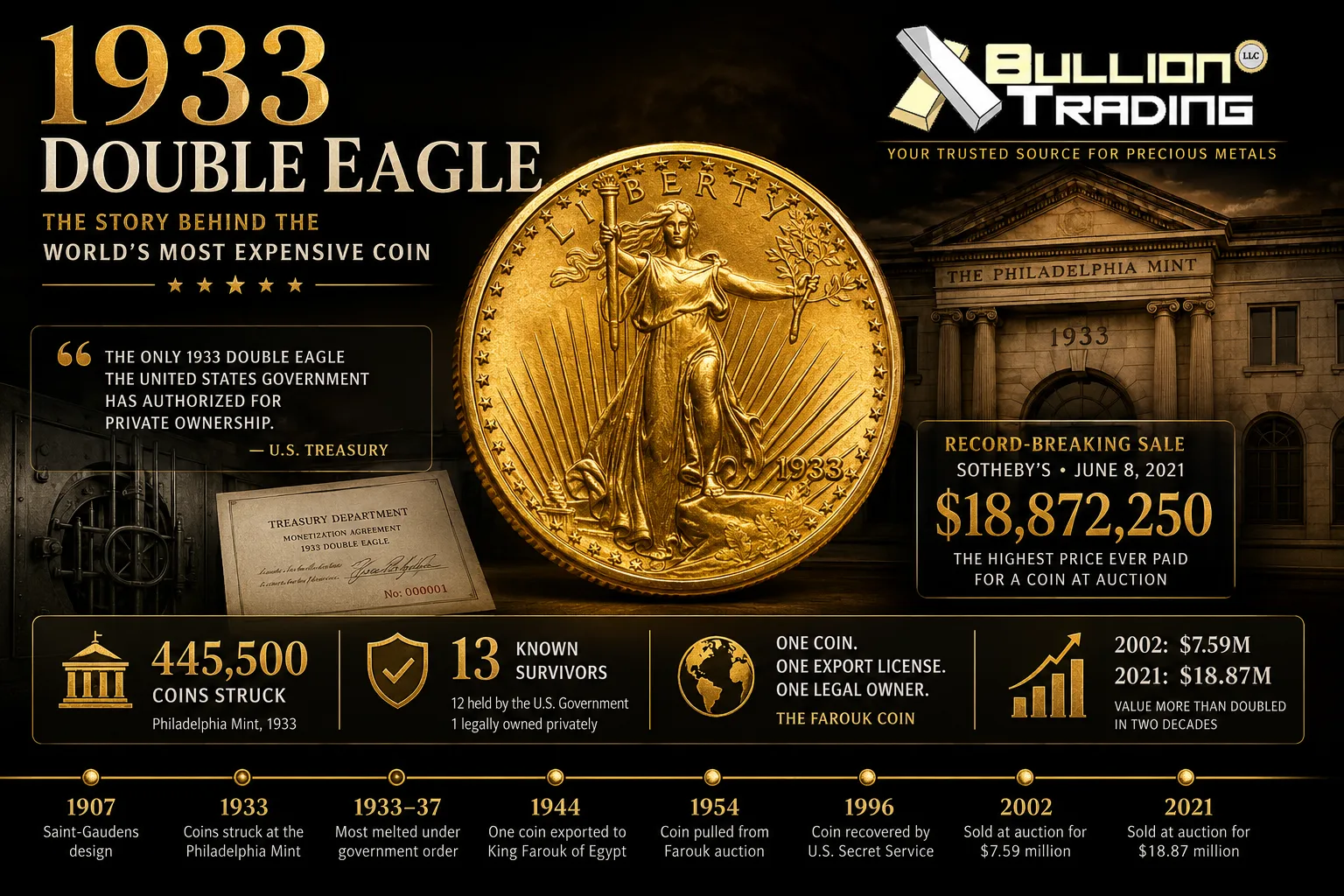

In June 2021, a single twenty dollar gold piece sold at Sotheby’s for $18,872,250. The buyer never showed their face on camera. The coin itself was almost a hundred years old and had been illegal to own for most of that time. That coin is the 1933 Double Eagle, and its journey from the Philadelphia Mint to a private vault is one of the strangest stories in American money.
Most of the coins struck that year were melted before they ever saw circulation. The handful that escaped became evidence in federal investigations, the centerpiece of an Egyptian king’s collection, and finally the headline lots at two record-breaking auctions. To understand why one of those coins is worth nearly nineteen million dollars, you have to start with a sculptor and a president who hated American coinage.
A sculptor, a president, and the rebirth of US gold
Theodore Roosevelt was embarrassed by the state of US coinage in 1904. He wanted something closer to the high relief of ancient Greek tetradrachms, with sculpted figures and a real sense of motion. He recruited Augustus Saint-Gaudens, the most celebrated American sculptor of the era, to redesign the country’s gold pieces. According to the National Park Service at the Saint-Gaudens National Historical Park, the partnership between the two men produced what many numismatists still call the most beautiful coin ever struck in the United States.
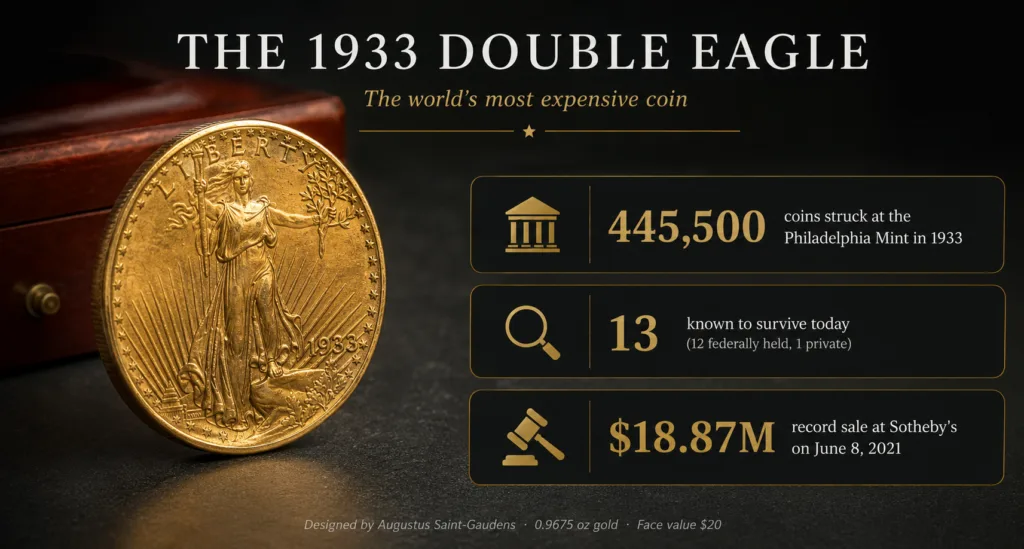
Saint-Gaudens died in August 1907 before the design entered full production. His vision survived him. The obverse showed Liberty striding forward with a torch in one hand and an olive branch in the other, the Capitol dome behind her. The reverse carried a flying eagle with a rising sun. The first issues were struck in ultra high relief, which required multiple blows from a hydraulic press to bring the design up. Those pieces are worth millions on their own. The Mint quickly lowered the relief to make mass production possible, and the regular Saint-Gaudens double eagle ran from 1907 to 1933.
The coin contained 0.9675 troy ounces of pure gold, weighed 33.4 grams, and carried a face value of twenty dollars. Between 1907 and 1932 the Philadelphia, Denver, and San Francisco mints struck more than 70 million of them. The 1933 issue would be different. By the time Philadelphia pressed those last 445,500 coins, the United States was in the depths of the Great Depression, and the country was about to walk away from gold itself.
Roosevelt’s other gold order
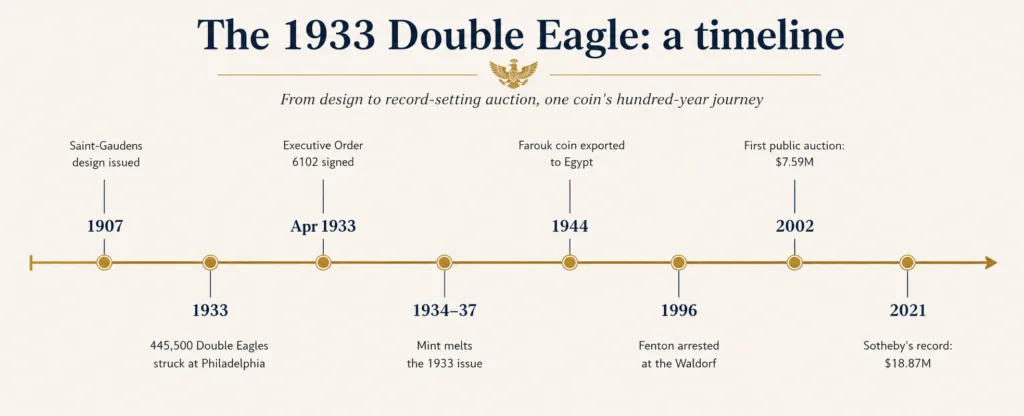
A different Roosevelt signed the order that doomed the 1933 Double Eagle. Franklin Delano Roosevelt took office on March 4, 1933, in the middle of a banking collapse. On April 5 he signed Executive Order 6102, which required American citizens to surrender their gold coins, bullion, and gold certificates to the Federal Reserve. The official rationale was hoarding. The real goal was to inflate the dollar and fight deflation.
The order made private gold ownership above a small allowance a federal crime. Coins of recognized special value to collectors were exempted, a clause that would later matter for the 1933 Double Eagle saga. Roughly a month earlier, on March 6, the Treasury had already ordered banks to suspend gold payments. By the time the new coins came off the presses at Philadelphia, gold was effectively no longer money in everyday commerce.
The 1933 Double Eagles were therefore stamped, counted, weighed, and locked in the Mint’s cashier vault. They were never officially released to the public. Between 1934 and early 1937 the Mint melted them down as part of the Treasury’s broader push to consolidate national gold reserves under the new statutory price of $35 per ounce, up from $20.67. Two coins survived legally, set aside for the Smithsonian’s National Numismatic Collection. Or at least, that was the public version of events.
The Philadelphia hoard that walked out the door
The unofficial version came together slowly. Between 1933 and 1937 an unknown number of 1933 Double Eagles found their way out of the cashier’s cage in Philadelphia. The most likely culprit was George McCann, the Mint cashier in charge of the gold vaults. The probable middleman was Israel Switt, a Philadelphia jeweler with legitimate business at the Mint buying and selling gold scrap. The Secret Service eventually traced nine missing coins to Switt’s network of clients during a 1944 investigation.
That investigation began when the auction house Stack’s announced an upcoming sale of a 1933 Double Eagle. A reporter contacted the Mint for background. The Mint, surprised, contacted the Secret Service. The Treasury took the position that any 1933 Double Eagle in private hands had to have been stolen, because the coins were never officially issued. Agents recovered seven coins from collectors and dealers in 1944 and 1945, plus two more in 1952 and 1955. All of them were melted.
One coin slipped through. In February 1944 the Egyptian legation in Washington applied for an export license to send a 1933 Double Eagle to King Farouk of Egypt, who was building one of the great private coin collections of the era. The Treasury, with mysteriously casual timing, approved the license days before the Secret Service realized the coin had been stolen. By the time the government tried to recall it, the coin was already in Cairo.
King Farouk, the deposed monarch, and a coin that vanished
King Farouk’s reign ended on July 26, 1952, when a military coup forced him into exile in Italy. The new Egyptian government auctioned much of his personal property, including his coin collection, through Sotheby’s in Cairo in 1954. The US government formally asked that the Farouk Double Eagle be withdrawn from the sale and returned. The catalog was edited, the lot was pulled, and the coin disappeared from public view for forty-two years.
Where it went is still a matter of educated guessing. The coin resurfaced in 1996 when British coin dealer Stephen Fenton flew to New York to negotiate a private sale at the Waldorf Astoria. The buyer turned out to be an undercover Secret Service agent. Federal agents arrested Fenton on the spot. He fought back in court for five years, arguing that the coin’s prior export license made it lawfully owned and transferable.
A 2001 settlement produced an unusual compromise. The Treasury agreed to monetize the Farouk coin retroactively by accepting Fenton’s payment of the face value, twenty dollars, which made it the only 1933 Double Eagle a private citizen could legally hold. Fenton and the Treasury split the proceeds of any future auction sale fifty fifty. The coin’s path through bank vaults, royal palaces, and federal evidence lockers reads like a chapter from a broader study of famous precious metals heists, though here the legitimacy was eventually settled by Treasury negotiation rather than by a verdict.
The 2002 auction and the buyer no one knew
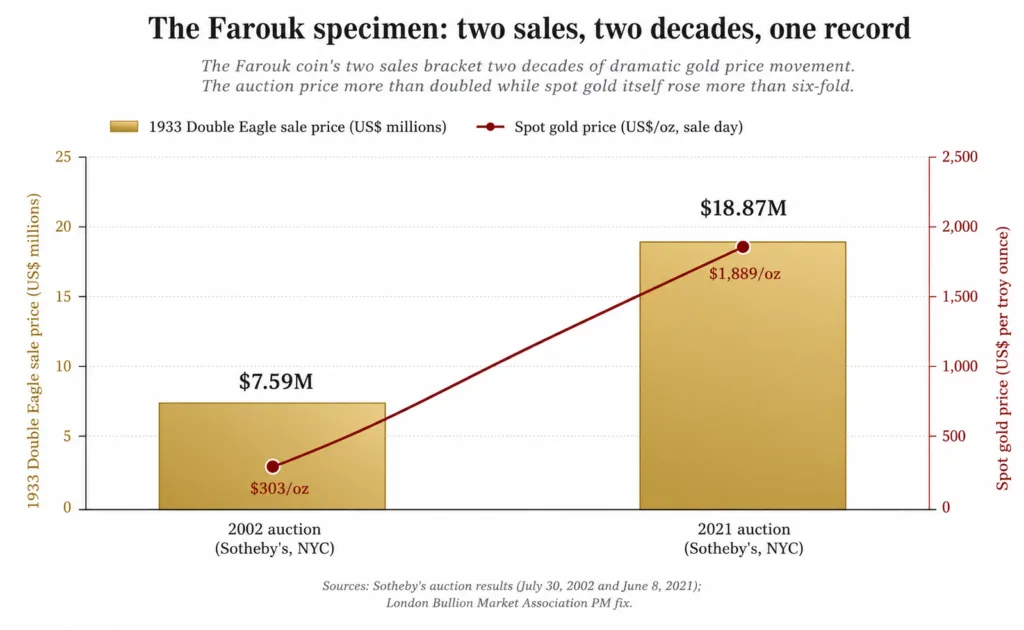
On July 30, 2002, Sotheby’s and Stack’s held a joint auction at the Sotheby’s New York gallery on York Avenue. The lot was a single coin in a clear plastic capsule, displayed alongside the Treasury’s twenty dollar monetization document. The hammer fell at $6.6 million. After the buyer’s premium and the Mint surcharge required by the settlement, the final price was $7,590,020. That figure was the highest price ever paid for a single coin at the time, more than triple the previous record.
The winning bidder stayed anonymous for nearly two decades. In 2021 the buyer revealed himself as Stuart Weitzman, the shoe designer and a longtime collector of philatelic and numismatic rarities. He bought the coin partly as an investment and partly because he liked the story. The cover of his coin’s plastic holder still carries the Treasury legend stating that this is the only 1933 Double Eagle the United States Government has authorized for private ownership. That phrase mattered. It made the coin not just rare but legally unique.
The $18.9 million hammer
Weitzman sold the Farouk coin at Sotheby’s on June 8, 2021, as part of a single-lot sale called Three Treasures. The other items were the British Guiana One Cent Magenta stamp from 1856 and an inverted Jenny stamp block. The Double Eagle sold first. Bidding took less than two minutes to clear the floor. The hammer landed at $16.5 million, and with the buyer’s premium the price came to $18,872,250. The buyer’s identity has not been disclosed.
That figure remains the highest price ever paid for a coin at public auction. The Weitzman coin more than doubled its 2002 price even after adjusting for inflation, which says something about how rare numismatic items behave during periods of monetary uncertainty. Spot gold itself nearly tripled in dollar terms over the same window. Coin collectors watch the spread between melt value and collector value carefully, and few coins illustrate the gap as starkly as this one. The melt value on sale day was roughly $1,800. The rest of the $18.9 million was provenance.
The Langbord ten and the courtroom that closed the case
The Farouk piece is the only 1933 Double Eagle anyone can legally own. There are at least ten others, and the federal government keeps them all. In 2003 Joan Langbord opened a safe deposit box that had belonged to her father, Israel Switt, the same jeweler the Secret Service had investigated sixty years earlier. Inside, she found ten more 1933 Double Eagles. She sent them to the US Mint for authentication. The Mint authenticated them, then refused to give them back, on the ground that they had been stolen from the Philadelphia vault in the 1930s.
The Langbord family sued. The case ran through the federal courts for more than a decade. In 2016 the Third Circuit Court of Appeals ruled en banc in favor of the government, holding that the coins were US property from the moment they left the Mint without authorization. The Supreme Court declined to review the decision in 2017. The ten Langbord coins now sit in the Smithsonian’s National Numismatic Collection in Washington, alongside the two original survivors set aside in the 1930s. Twelve coins held by the government, one held privately. That is the official census, though numismatists quietly debate whether more might still surface from old estates or unopened bank boxes.
Why a single coin still matters
The 1933 Double Eagle works on two levels at once. As a gold coin, it carries less than an ounce of metal, worth a little over two thousand dollars at current spot prices. As a piece of evidence, it captures the precise moment the United States stopped being a gold standard country and began the long experiment with managed paper money that runs through the Bretton Woods agreement and continues today. Saint-Gaudens designed his coin for a republic that priced gold at twenty dollars an ounce. By the time the dies were retired, gold was officially fixed at thirty-five, and ordinary citizens could no longer own it without permission.
The next time a 1933 Double Eagle changes hands in public, if it ever does, the price is unlikely to fall. Coins this scarce do not really unsell. They mostly sit, gathering provenance, until someone is willing to pay for the privilege of saying they own the last of something. That is what makes the price tag less about the gold and more about a small piece of paper bearing a serial number and a sentence saying this coin is the only one of its kind anyone is allowed to keep.
