

Pull a handful of change out of your pocket and look closely at a quarter, right near the date. Somewhere in that small space sits a single letter, easy to miss unless you know to look for it. That letter is a mint mark, and it tells you which branch of the United States Mint actually struck the coin in your hand. Most people spend their whole lives never noticing it. Collectors build entire collections around it. Mint marks are small, quiet, and occasionally the difference between a coin worth twenty-five cents and one worth several thousand dollars.
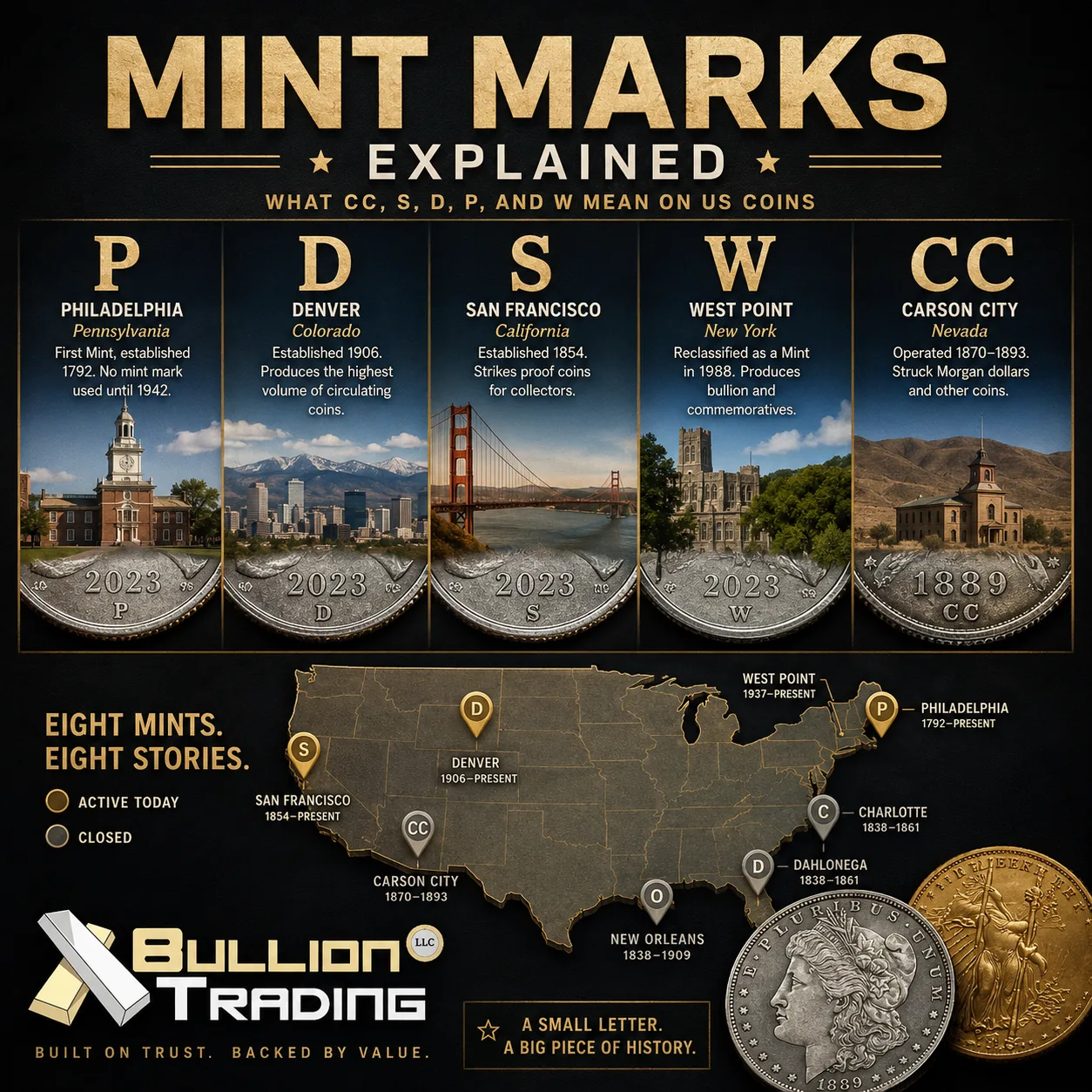
Five letters do most of the work on American coins: P, D, S, W, and the historic CC. Each points to a specific city and a specific chapter of how the country made its money. Once you can read them, an ordinary jar of coins turns into a little map of where American currency comes from.

The little letter and where to find it
A mint mark is just a letter, sometimes two, pressed into the die that strikes a coin. It records the branch of the Mint that produced that piece. The system goes back to the 1830s, when the government opened its first branch facilities and needed a way to tell at a glance which one had turned out a given batch. If a coin came back underweight or off in its metal content, the Mint wanted to know where to look. The mark started as a quality-control tool and only later became a collector’s treasure map.
Finding it takes patience and decent light. On coins struck before 1968, check the reverse, often tucked beneath the eagle, the wreath, or the denomination. After 1968 the Mint moved the mark to the obverse, the front, usually beside the date. On a modern Lincoln cent it sits just below the year. On a Jefferson nickel it hides near the date or the building. The lettering is small on purpose, since it was never really meant for the public. It belongs to the same family of small design details most people never inspect, like the reeded edges on the rim of a coin that were originally added to stop anyone from shaving precious metal off the sides. The U.S. Mint’s own guide to mint marks confirms the four facilities striking coins today and the letters each one uses.
P, D, and S: the everyday workhorses
Philadelphia is the senior mint, running since 1792 as the country’s first. For most of its history its coins carried no letter at all. The reasoning was plain. Philadelphia was the default, so anything without a mark came from there. That changed during World War II. When the Mint pulled nickel out of the five cent coin for the war effort and switched to a silver alloy, it stamped a large P above Monticello so the new composition could be spotted easily. According to PCGS, the 1942-P Jefferson nickel was the first U.S. coin to wear a Philadelphia P. When the wartime alloy ended after 1945, the P disappeared again.
It returned for good decades later. The 1979 Susan B. Anthony dollar carried a P, and in 1980 the letter spread to every Philadelphia denomination but one. The cent was the holdout, and it still is. Pennies from Philadelphia carry no mark to this day, with a single odd exception: the 2017 Lincoln cent wore a P to mark the Mint’s 225th anniversary, the only year it ever did.
Denver is the D, and it is the high-volume engine of American coinage. The Denver Mint began striking coins in 1906, having run as an assay office since the 1860s, and now produces billions of circulating coins a year alongside Philadelphia. There is a catch with the letter D that I will come back to, because it has not always meant Denver.
San Francisco wears the S. It opened in 1854 to handle the gold pouring out of the California fields, and for more than a century it produced ordinary circulating money. Its job has narrowed. Today the San Francisco Mint mostly strikes proof coins, the mirror-finish pieces made for collectors rather than cash registers. If you own a modern proof set, nearly every coin in it carries an S. Knowing the difference between those collector strikes and the bullion or business coins you actually spend is worth your time, and the gap between a proof coin and a bullion coin trips up plenty of first-time buyers.
W: the newcomer from West Point
The W is the youngest letter in the group. It belongs to the West Point Mint in New York, a facility built in 1937 as a silver bullion depository that earned the nickname “the Fort Knox of Silver” and was not officially reclassified as a mint until 1988. For years it quietly struck Lincoln cents with no mark at all, indistinguishable from Philadelphia’s.
Its own letter did not appear until 1984, on a ten dollar gold commemorative honoring the Los Angeles Olympics. That coin holds a second distinction. According to Stack’s Bowers, it was the first legal tender gold coin the United States had produced since 1933. West Point has since become the home of the country’s precious metals coinage. The gold, silver, and platinum American Eagles, the gold Buffaloes, and most modern bullion and commemorative issues all come out of West Point. For almost its entire run, a W coin was something you bought, not something you stumbled on in change. That part of the story has a recent twist, and I will get to it.
CC and the ghosts of mints that closed
This is where it gets interesting. CC stands for Carson City, Nevada, and few mint marks carry more romance. The Carson City Mint opened in 1870 to process the staggering amount of silver coming out of the Comstock Lode, the richest silver strike in American history. Hauling raw ore across the country to Philadelphia made no sense when the metal was coming out of the ground in Nevada, so the government built a mint next to the source.
Carson City struck coins only through 1893, and never in great numbers. Its Morgan silver dollars, made across thirteen dates between 1878 and 1893, rank among the most sought-after coins in the entire American series, with the CC mark sitting on the reverse below the eagle. Because the mintages were small, even common Carson City dates command real premiums, and the key date 1889-CC can run into the tens of thousands of dollars in higher grades, scarce today because so many were melted soon after they were struck. A strange footnote helped their fame along. As CoinWeek recounts, the federal government found nearly 2.9 million uncirculated CC Morgan dollars still sitting in Treasury vaults and sold them to the public in a series of General Services Administration sales between 1972 and 1980, many in the hard plastic holders that collectors now prize on their own. Carson City dollars are a textbook case of why a coin can be worth far more than its metal.
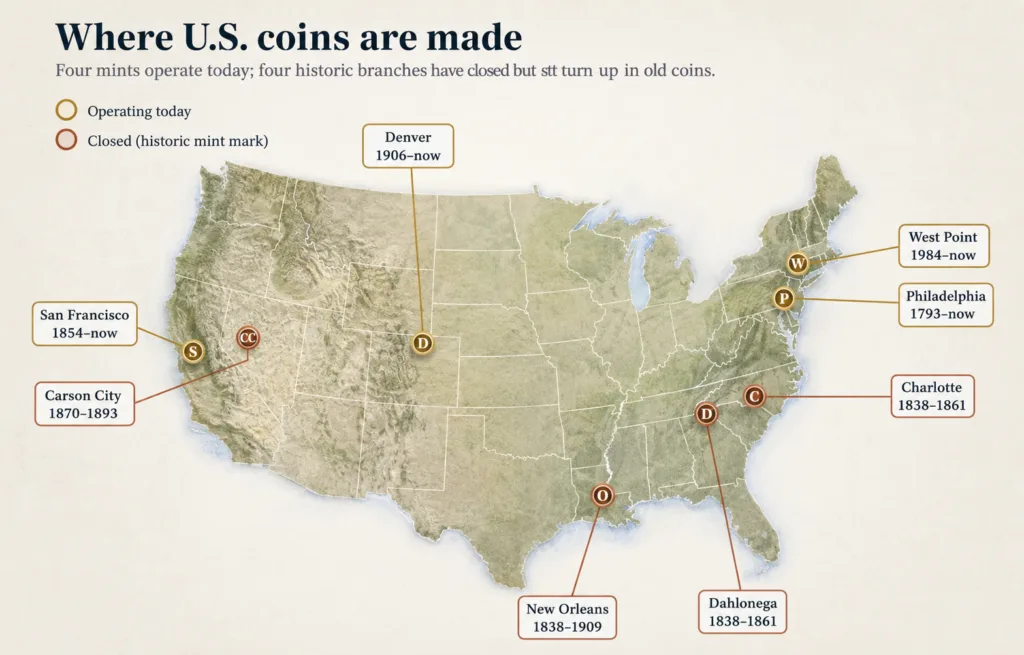
Carson City is not the only retired mark. Before the Civil War the United States ran three Southern branch mints, all opened in 1838. Charlotte, North Carolina used a C and struck gold only, fed by the gold fields of the Carolinas. Dahlonega, Georgia used a D, also gold only, over the same years. New Orleans, the busiest of the three, used an O and produced both gold and silver until 1909, with a long Civil War gap. As PCGS notes in its history of the 1838 branch mints, Confederate forces seized all three in 1861, and Charlotte and Dahlonega never struck another coin.
That Dahlonega D is the catch I mentioned earlier. A D on a gold coin dated before 1861 means Dahlonega, Georgia, not Denver. Denver did not open until 1906, so the same single letter points to two completely different mints depending on the era and the metal. It is the kind of detail that separates a careful buyer from a careless one, and the kind of mistake that costs real money at a coin show.
The blank years: why some coins have no mark at all
If you find an American coin dated 1965, 1966, or 1967 with no mint mark, nothing is wrong with it. The country was in the grip of a coin shortage in the early 1960s. Rising silver prices pushed people to hoard silver coins, and the public’s growing habit of saving pieces by date and mint mark made the squeeze worse. Congress passed the Coinage Act of 1965, which stripped most of the silver out of dimes and quarters, and the Mint removed the mint marks from all circulating coins for three years. The goal was to discourage collectors from yanking coins out of circulation by date and mint while the shortage lasted.
Mint marks came back in 1968, but in a new spot. Instead of returning to the reverse, they moved to the obverse, where they have stayed ever since. So the location of the mark is itself a rough dating clue. A mark on the back points to an older coin. A mark on the front means 1968 or later. It is a small thing, but it is the sort of shortcut that lets an experienced collector sort a pile of coins quickly.
When a single letter changes the price
Here is the practical payoff. The mint mark can be the whole difference between a common coin and a rare one. Two coins can share a date, a design, and a metal, and still be worth wildly different sums because one came from a low-output mint and the other from a busy one.
The most talked-about recent example is the 2019-W quarter. For the first time, the West Point Mint struck quarters meant for circulation and slipped them into the money supply through Federal Reserve banks, two million of each of the five America the Beautiful designs that year. Two million sounds like a lot until you learn that Philadelphia and Denver routinely strike hundreds of millions of each design. As PCGS documented, people tore through their change hunting for the W, and clean examples still trade for well above face value. The Mint ran the same experiment in 2020. The 2020-W nickel was a different animal, though. It never reached circulation at all and came only in collector sets, which makes finding one in pocket change a lost cause.
Scarcity is only half the equation. Condition and authenticity decide the rest, which is why serious buyers lean on independent grading. A rare mint mark is exactly the kind of feature counterfeiters and coin doctors like to add to an otherwise ordinary coin, so professional authentication matters more here than almost anywhere else. Before paying a premium for a CC Morgan dollar or a key-date branch mint gold piece, it is worth confirming the coin has passed through one of the major grading and authentication services like NGC or PCGS. The letter is what makes the coin valuable. The grade is what proves the letter is real.
The story in your spare change
So next time you sort through coins, give the date a second look and check for that little letter beside it. Most of the time it will be a D or a P, struck by the hundreds of millions and worth exactly what it says on the face. Now and then it is a W hiding in a roll of quarters, or an S that wandered out of a proof set and into circulation. And if you ever turn over an old silver dollar and find a CC, you are holding a piece of the Comstock silver boom, made in a desert mint that locked its doors more than a century ago. The mark is tiny. The story behind it rarely is.
