
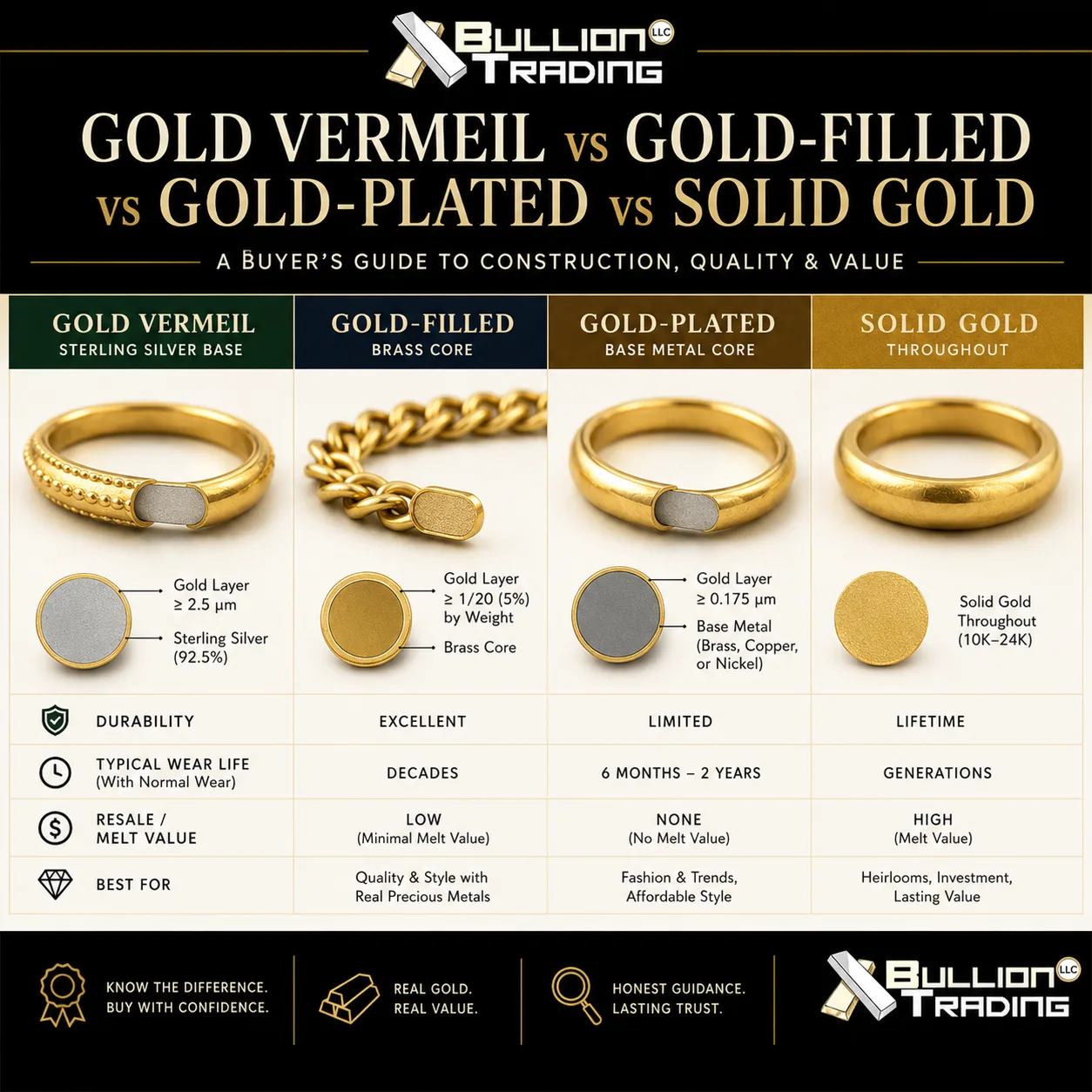

Walk into any jewelry store and the labels start to blur. Gold plated. Gold filled. Gold vermeil. Solid gold. They sit side by side in the display case, sometimes at wildly different prices, and the differences are rarely explained in plain language. The terms are not interchangeable. Each one describes a specific construction with specific federal standards behind it, and the gap between gold-plated and solid gold runs from a few microns of metal that wear off in a year to a piece that holds its weight in metal indefinitely. Knowing which is which protects you from overpaying for the wrong category, and helps you match the right type of gold to the right purpose.
This guide breaks down each of the four main categories the way the U.S. Federal Trade Commission defines them, what to look for on the inside of a clasp or band, and how they behave in daily wear over the years.
Solid gold and the karat scale
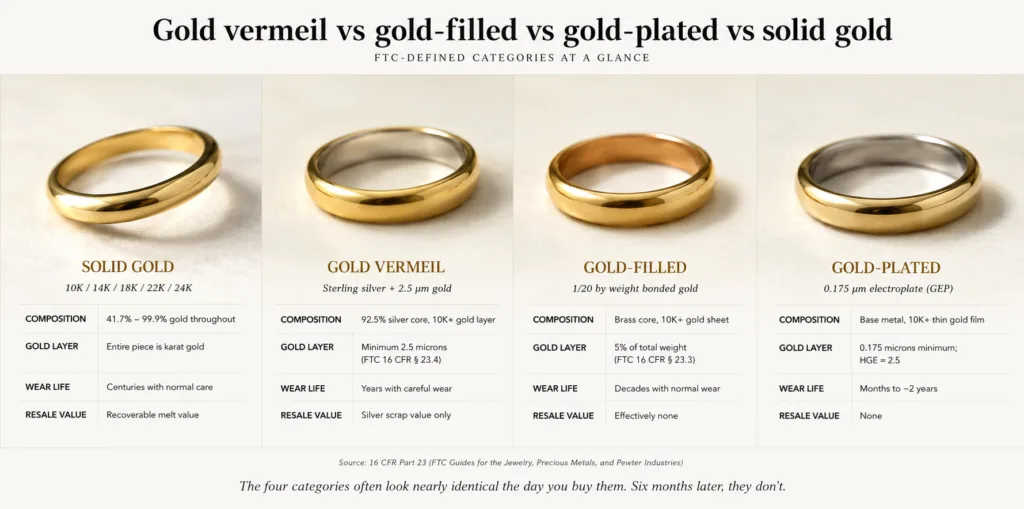
When jewelers say “solid gold”, they mean a piece made entirely from a karat gold alloy throughout, with no base-metal core hiding underneath. The word “solid” can be misleading because it does not mean pure. Pure gold is too soft for almost any practical jewelry, so refiners blend it with copper, silver, palladium, zinc, or nickel to add durability. Karat is the measure of how much pure gold is in that blend, on a 24-part scale. 24K is 99.9% gold. 22K is roughly 91.7%. 18K runs at 75%. 14K is 58.3%. 10K, the legal minimum that can be sold as “gold” jewelry in the United States, is 41.7% pure.
The trade-off is hardness against color and value. Higher karats look richer and yellower, but bend, dent, and scratch more easily. 14K and 18K are the working compromise most American and European jewelers settle on. Engagement rings, watch cases, and pieces meant for daily wear usually land in this range. According to the FTC’s Guides for the Jewelry, Precious Metals, and Pewter Industries codified at 16 CFR Part 23, any product marketed as gold below 10K is misbranded in the U.S. market and the seller is liable for the misrepresentation.
For a closer look at how karat marks, fineness numbers, and country-specific hallmarks decode, the breakdown of karats, purity marks, and hallmarks covers what each stamp inside a ring actually certifies and how to read European, British, and U.S. marks against each other.
Gold vermeil, the sterling-silver standard
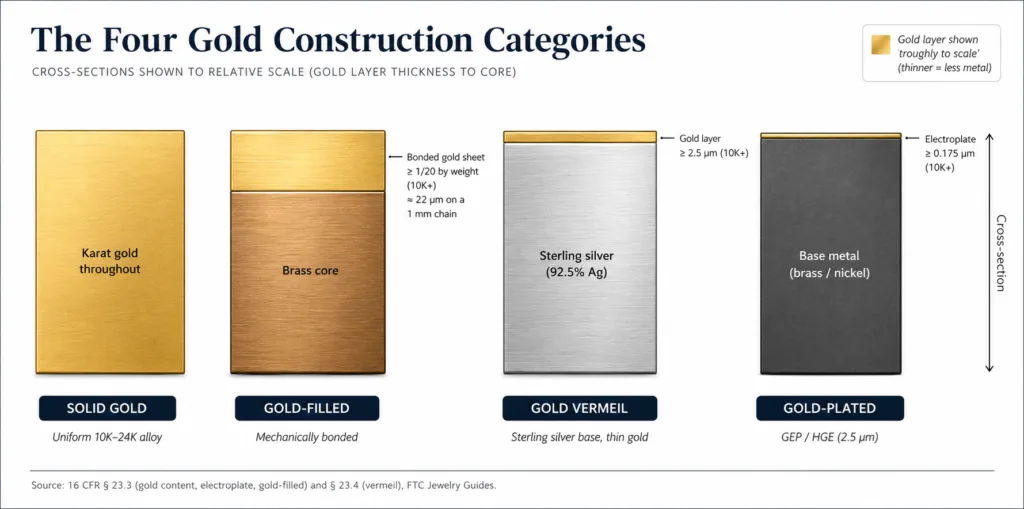
Gold vermeil, pronounced “vur-may”, sits one tier below solid gold and a clear tier above ordinary plated jewelry. The category is regulated, and the rule is strict. To be called vermeil in the United States, a piece must meet three conditions defined in 16 CFR § 23.4. The base metal must be sterling silver, meaning 92.5% pure silver. The gold layer must be at least 2.5 microns thick at its thinnest point. And the gold used for the coating must be at least 10 karat fineness, with most quality producers using 14K, 18K, or 22K.
That combination matters. The sterling silver core gives vermeil real intrinsic value of its own, because silver is itself a precious metal that can be melted and recovered. The 2.5-micron threshold is roughly ten times the thickness of standard gold electroplate. Worn carefully, a vermeil piece can hold its finish for several years before any base showing through becomes noticeable. Worn aggressively on a wrist or chain that rubs constantly against fabric and skin, the finish will eventually wear thin at high-contact spots, and the silver underneath will start to show as a paler, cooler tone.
Vermeil came into mainstream fashion through French royal commissions in the 18th century and has reemerged as the default for designer demi-fine jewelry sold by brands targeting buyers who want the look of gold at a fraction of the solid-gold price. Expect to pay a meaningful premium over standard plating for it, because both the silver base and the heavier gold layer cost more in raw material. A vermeil chain that retails for $180 is doing the same job a solid 14K version would do at $900, and the difference is mostly the volume of metal used.
Gold-filled jewelry and mechanical bonding
Gold-filled is often misunderstood as a synonym for plated, and it is not. The construction is fundamentally different. A gold-filled piece is made by mechanically bonding, usually through heat and pressure, a sheet of karat gold to a base metal core, most often jeweler’s brass. The FTC rule under 16 CFR § 23.3 requires that the gold layer be at least 1/20th (5%) of the total weight of the finished piece, in gold of 10K fineness or higher.
That 5% weight rule produces a layer roughly 50 to 100 times thicker than the gold on standard plated jewelry. The marking inside the clasp or band reflects the construction. A stamp reading “1/20 14K GF” means the piece is 1/20th by weight 14-karat gold filled. “1/10 12K GF” means a heavier 1/10 layer at 12-karat fineness, common in higher-end vintage pieces from American makers in the early twentieth century. If the stamp uses “RGP” for rolled gold plate, the layer is between 1/40 and 1/20 by weight, lighter than gold-filled but heavier than standard plate.
The practical takeaway is longevity. A well-made gold-filled chain, worn daily but treated reasonably, can last decades without exposing the brass beneath. Many of the gold-filled lockets, pocket-watch chains, and eyeglass frames produced in the 1920s through the 1940s still look intact today, which is part of why they remain collectible in antique markets. Gold-filled does not hold value the way solid gold does, since the recoverable gold by weight is modest and the brass core cannot be reused, but for daily wear and skin contact it sits well above plating in both wear life and hypoallergenic behavior.
Gold-plated and the thinnest tier
Gold-plated jewelry is what most people picture when they think of fashion or costume pieces. A base metal, usually brass, copper, or sometimes nickel, is dipped into an electrolytic bath that deposits a thin film of gold across the surface. The FTC requires that any piece sold as “gold electroplate” or “GEP” have a coating of at least 0.175 microns of 10K or finer gold. “Heavy gold electroplate” or “HGE” requires a minimum of 2.5 microns. The FTC’s 2018 revision withdrew prior guidance that anything thinner could be marketed as “gold flashed” or “gold washed”, so those terms now carry no safe harbor. In practice, overseas fashion manufacturers still use them loosely and ignore U.S. labeling requirements entirely.
For comparison, a sheet of standard copy paper is about 100 microns thick. So even the heavier HGE plating is roughly forty times thinner than a piece of paper. Standard fashion plating wears through within months of daily contact, especially on rings and bracelets where the metal rubs against skin, fabric, or other surfaces. Lotions, perfumes, sweat, and chlorinated pool water accelerate the breakdown. Once the plating wears through, the base metal underneath is exposed, which often turns skin green from the copper content and can trigger reactions in people sensitive to nickel.
Plated pieces have a place. They let designers experiment with shapes and finishes that would be too expensive to produce in solid gold, and they make a statement piece affordable enough to discard or replace as trends shift. The mistake buyers make is paying gold-filled or vermeil prices for what is functionally costume jewelry, or assuming a plated wedding band will hold up the way a solid one does. It will not.
How to read the markings inside the piece
Federal labeling rules require that any jewelry sold as gold be marked with the karat or descriptive abbreviation. The mark is usually stamped on the inside of a ring band, the back of a clasp, the underside of an earring post, or the inside of a pendant bail. Reading those stamps is the fastest way to verify what you are actually buying. A bare “14K” or “585” indicates solid 14-karat gold. “18K” or “750” indicates solid 18-karat. The European fineness numbers (585 for 14K, 750 for 18K, 916 for 22K, 999 for 24K) reflect parts per thousand and are the international standard most refiners and assay offices use.
A stamp ending in “GF” means gold-filled, and should always be paired with a karat number and a fraction such as “1/20 14K GF”. A stamp ending in “GE” or “GEP” means gold electroplate. “HGE” means heavy gold electroplate. “GP” or “EP” without further detail almost always means standard plating. Vermeil is sometimes marked simply “925” (the sterling base mark) with separate documentation of the gold layer, since there is no single universally adopted vermeil stamp, and many vermeil pieces are sold with a card or certificate rather than a metal mark.
For a deeper comparison of investment-grade gold against wearable jewelry, the differences laid out in the bullion gold versus jewelry gold breakdown explain why the same metal commands very different prices depending on whether it is sold as a bar, a coin, or a chain.
Value, longevity, and resale
The four categories diverge sharply once you talk about what a piece is worth a year, five years, or twenty years after purchase. Solid gold, even at 10K, retains a recoverable melt value tied directly to the spot price of gold. A solid 14K chain bought for $1,200 has a real metal value at any time that you can calculate from current spot and the chain’s weight in grams. Refineries and pawnshops will pay something close to that scrap value minus a refining margin. The same is not true for the other three.
Vermeil’s recoverable value sits mostly in the sterling silver core, since the gold layer is too thin to refine economically off a single piece. Silver scrap is real money, but at roughly 1/80th the price of gold per ounce, the recovery is modest compared with what you paid. Gold-filled pieces recover almost nothing, because the bonded gold layer cannot easily be separated from the brass core, and most refiners will not accept small lots of mixed gold-filled scrap without a substantial weight minimum. Plated pieces have no recoverable value at all. The base metal is worth pennies.
For a clearer picture of how to calculate the metal value sitting in a piece of jewelry, the step-by-step approach to melt value shows the math that separates marketing claims from real worth, and it works whether you are weighing a chain you inherited or pricing a piece before you buy.
The longevity gap is similarly stark. Solid gold can last centuries with normal care, which is why family heirlooms tend to be solid pieces. Vermeil holds up well for years if you avoid swimming and aggressive cleaning. Gold-filled can match solid gold’s wear life for decades under reasonable treatment. Plated finishes routinely fail inside one to two years of regular wear, and faster than that on rings, since the band rubs against everything you touch.
Conclusion
The four categories solve four different problems. Solid gold is for permanence, investment, and pieces meant to outlast the buyer. Vermeil is the considered middle ground, a real precious-metal piece with a meaningful gold layer for people who want quality without paying solid prices. Gold-filled is the workhorse, especially for chains, eyewear, and everyday pieces that need to take abuse without falling apart. Plated is for fashion, for trying a trend without commitment.
The mistake to avoid is paying for one tier and getting another. Check the stamp, ask the seller the question directly, and treat unclear or missing labels as a red flag. The FTC rules exist because the visible difference between a freshly plated piece and a solid one is almost nothing in a glass display case. The difference six months later, and on the day you try to resell, is everything.
