
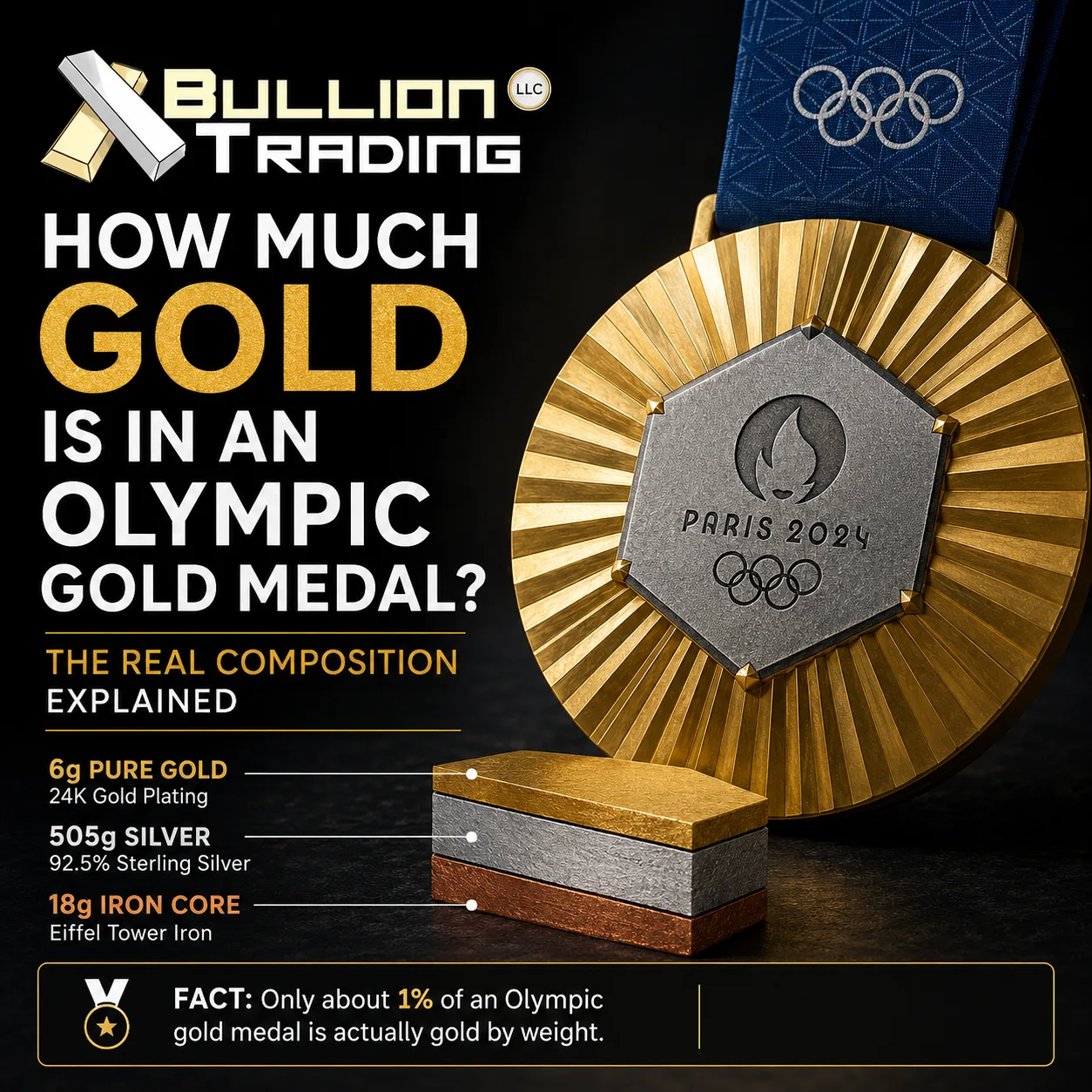

Ask anyone what an Olympic gold medal is made of and most will give a confident, completely wrong answer. They picture a thick disc of pure 24k gold, heavy in the hand, worth a small fortune at any pawn shop on earth. The reality is stranger and a little less romantic. The question of how much gold is in an Olympic gold medal has a precise, slightly disappointing answer: about six grams. That is roughly the weight of a sugar cube, or two paperclips, sitting inside a medal that can weigh more than half a kilogram. The rest is silver and copper, with a thin gold skin on top that has fooled the public for more than a century.
The IOC rule that defines every gold medal
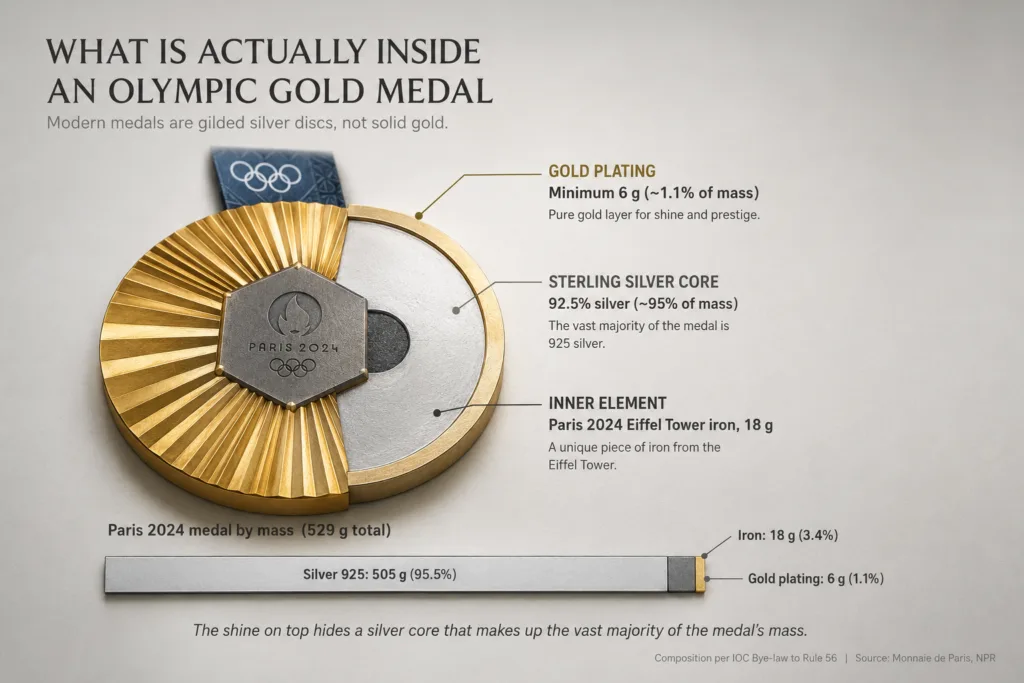
Every Olympic gold medal awarded since 1912 follows the same minimum specification, written into the rules of the International Olympic Committee. The current text sits in the Bye-law to Rule 56 of the Olympic Charter, the section on victory ceremonies and the awarding of medals, and as Britannica summarizes the IOC composition standard, gold medals must be at least 92.5 percent silver and coated with roughly six grams of pure gold. The rule has barely changed in a hundred years. A first place medal must be made of silver with a fineness of at least 925 thousandths, and it must be gilded with at least six grams of pure gold. There is no requirement that the medal be solid gold. There has not been one since the Stockholm Games.
That phrase, “gilded with at least six grams of pure gold,” is the entire reason your favorite swimmer’s neckwear is not worth $40,000 at spot. The gold sits on the outside, applied as plating, and the IOC sets only a minimum. Host cities can add more if they like, but almost none ever do. Six grams is the floor and, for most modern Games, also the ceiling. The host organizing committee designs the medal, picks the artist, sources the metals, and runs the production through a national mint, but the core recipe is fixed.
The 925 silver figure is not arbitrary either. It is the same standard used in fine flatware and jewelry, which is why understanding sterling silver and its 92.5% purity rating tells you almost everything about what a gold medal really is underneath. Strip the surface and you are holding a sterling silver disc. A heavy, expensive one, but sterling all the same.
What’s actually inside: the metals by weight
The Paris 2024 medals are a good place to anchor the numbers because the data is unusually well documented. According to NPR’s reporting on the medals struck by the Paris Mint, each first place medal weighed 529 grams. Of that, six grams was pure gold (24k, applied to the surface), 505 grams was 925 silver, and the central 18 grams was a piece of iron taken from the original Eiffel Tower during one of its periodic restorations. The iron does nothing technically. It is there as a national flex, hammered into a hexagonal panel in the middle. The remainder rounded out the alloy and the ribbon attachment.
London 2012 followed similar math. The Royal Mint, which struck all 4,700 medals on a press it nicknamed Colossus, produced gold medals of 412 grams containing 6 grams of gold, 92.5% silver, and 6.16% copper. The copper makes the alloy harder and gives the silver core some structural rigidity. Without it the medals would dent if dropped. Tokyo 2020 took a different route, sourcing every gram from recycled consumer electronics donated by the Japanese public, but the underlying spec stayed the same: silver core, six grams of gold on top.
So a typical modern Olympic gold medal is roughly 92 to 95% silver by weight, 1 to 1.5% gold, and the balance copper, nickel, or whatever the host mint uses to firm up the alloy. The medal looks like solid gold because the plating is applied uniformly, polished, and laid down thick enough that it does not wear through under normal handling. Athletes can bite them for the photographers without exposing the silver underneath, which is exactly the point.
Why 1912 was the last year of solid gold
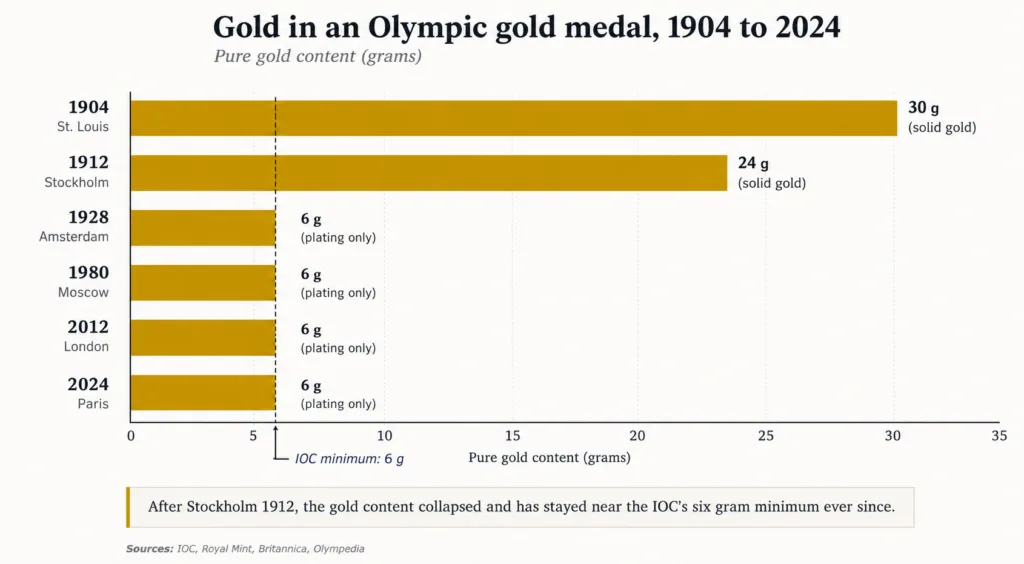
The 1912 Stockholm Games were the last to award genuinely solid gold first place medals, and even then they were small. Each one weighed about 24 grams of gold, smaller than a poker chip. After Stockholm the world went to war, gold prices became volatile, and the IOC quietly switched to gilded silver. The change was practical rather than philosophical. Solid gold medals for hundreds of athletes were expensive in 1912 and would have been ruinous by 1920.
The decision also reflected what gold actually does at that purity. Pure gold is soft. You can scratch 24k with a fingernail in the right conditions. A solid gold medal worn around the neck and handed between thousands of people would deform within a generation. Gilded silver, properly alloyed, keeps its shape for centuries. The Olympic museum in Lausanne still has medals from the 1920s that look nearly identical to the day they were minted.
What the metal in one is actually worth
The melt value is where most people get a small shock. Six grams of gold at a spot price near $2,400 per troy ounce works out to about $463. The silver core, around 500 grams of 925 sterling, at roughly $30 per ounce, brings in roughly $445. Add the copper trace and rounding, and the raw intrinsic value of a Paris 2024 gold medal sits somewhere between $900 and $1,000 at the moment it is awarded. If you want to run the math yourself for any given year, the same approach used in our guide to calculating melt value for silver coins and gold jewelry works just as well for medals: weight times fineness times current spot.
That metal value matters because it sets the floor, not the ceiling. Nobody who has ever won an Olympic gold medal has had it valued for its melt content alone. Auction prices for first place medals routinely clear $50,000 and have, on rare occasions, passed a million dollars. Jesse Owens’s 1936 Berlin gold sold for nearly $1.5 million in 2013. The metal in it was worth less than $800. The premium, in other words, is the story.
This gap between intrinsic value and market value is not unique to Olympic medals. It is the same logic that explains why collectible coins routinely sell for far more than their weight in precious metal. Provenance, condition, and the human story behind an object can multiply its scrap value by a factor of a thousand or more. A gold medal is one of the purest examples of that principle. The atoms inside are commodity. The story attached to them is not.
The purity question and why ‘gold’ is a loose term
Calling these awards “gold medals” is technically correct under Olympic rules and technically misleading if you take the words at face value. The plating itself is genuine 24k gold, around 999 fineness. The medal as a whole, weighted by mass, is closer to 14 thousandths fine. If a jeweler stamped that purity on a piece of jewelry, the legal description would be “gold plated sterling silver,” not gold.
The plating is thicker than ordinary jewelry electroplating because it has to deliver the full six grams across the surface of an 85 millimeter disc, but the surface treatment is more about durability and color uniformity than about reaching some specific purity standard. If you are curious how that fits into the broader picture of how karats and fineness marks work in the jewelry and bullion world, the same fineness system used on hallmarked gold applies to the plating itself, even if no mark is ever struck on the medal.
Recent design quirks worth knowing
The last four Summer Games have each played with the formula in small ways. Rio 2016 leaned hard on sustainability, with 30% of the silver and bronze sourced from recycled materials such as leftover mirrors, X-ray plates, and waste solder, while the gold was extracted under mercury-free, environmentally certified mining practices. PyeongChang 2018 went the other direction and made the medals heavier than usual, hitting 586 grams for the gold. Tokyo 2020 ran the four year “Medal Project,” collecting roughly 80,000 tons of small electronics from across Japan and extracting 32 kilograms of gold, 3,500 kilograms of silver, and 2,200 kilograms of bronze for the medals. Every medal handed out in Tokyo had been a cell phone, laptop, or camera in a previous life.
Paris 2024 was the most theatrical, embedding the Eiffel Tower iron into every medal. The committee called it “a piece of France that every athlete carries home,” and that framing was the point. The iron has no monetary value to speak of, certainly less than a dollar per medal. The symbolism does the heavy lifting. Beijing 2022, the most recent Winter Games, kept things conventional with a five ring concentric design and the standard six grams of plating, sourced from refined Chinese gold reserves.
None of these design choices changed the IOC minimum. They added stories on top of a recipe that has stayed remarkably stable since the era of silent film.
Why the answer surprises people
The reason “six grams” sounds shocking is that gold has cultural weight far beyond its physical weight. We talk about gold medals the way we talk about gold standards, gold records, and golden ages. The word does a lot of work. When the actual object turns out to be 1% gold by mass, the gap between expectation and reality feels almost like a small betrayal.
It is not, though. The medals were never meant to be bullion. They were meant to be durable, beautiful, and recognizable for a hundred years on a shelf. Solid gold would have failed all three tests. A sterling silver disc with a careful gold coating passes every one. The committee that wrote the rule in 1912 understood something the public still occasionally misses: an Olympic gold medal is a symbol that happens to contain some gold, not a piece of gold that happens to be a symbol.
The next time the Games come around and a sprinter bites the medal for the cameras, you can do the math in your head. Roughly 500 grams of sterling silver, six grams of gold, a small story stamped on the back. Worth maybe a thousand dollars at the smelter and somewhere between fifty thousand and a few million at auction, depending on whose neck it hung around. The physical answer is small. Everything else about the object is enormous.
