


The landscape of retirement planning has evolved significantly beyond traditional stocks and bonds. As investors seek portfolio diversification and inflation hedges, precious metals Individual Retirement Accounts (IRAs) have emerged as a compelling option for long-term wealth preservation. According to the Internal Revenue Service, these self-directed accounts allow Americans to hold physical gold, silver, platinum, and palladium within tax-advantaged retirement frameworks.
Understanding precious metals IRA becomes increasingly relevant as gold continues its role as an inflation hedge and central banks worldwide maintain strong precious metals accumulation, with net purchases exceeding 1,000 tonnes annually in recent years according to the World Gold Council.
What Is a Precious Metals IRA?
A precious metals IRA represents a specialized form of self-directed Individual Retirement Account that empowers investors to hold IRS-approved physical precious metals as retirement assets. Unlike conventional IRAs limited to paper investments like stocks, bonds, and mutual funds, these accounts provide direct ownership of tangible bullion products.
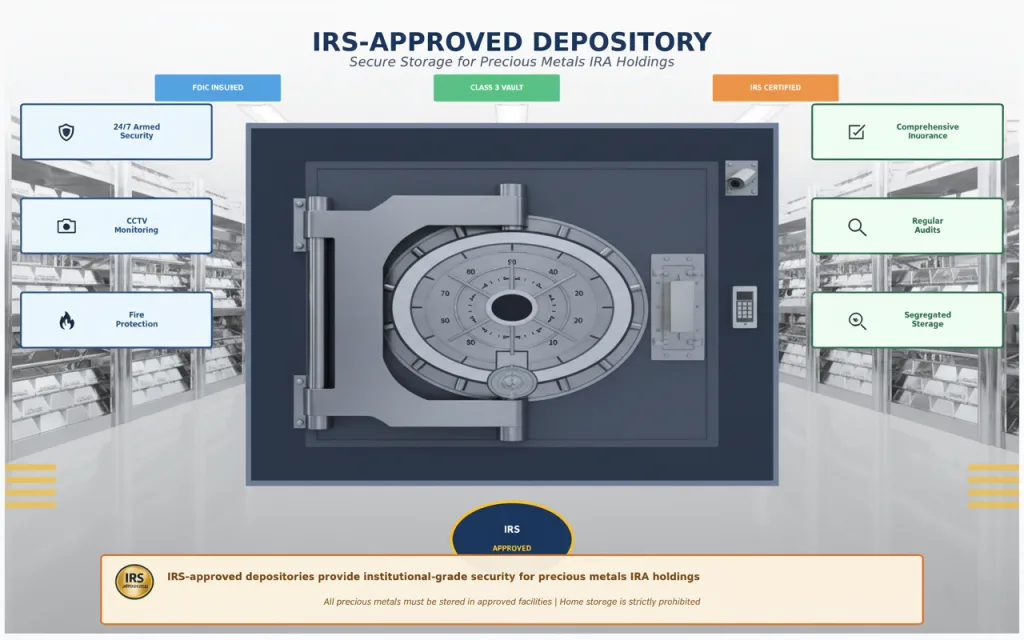
The fundamental structure mirrors traditional retirement accounts, offering identical tax advantages while requiring adherence to specific regulations governing physical asset custody. The IRS mandates that all precious metals held in these accounts must be stored in approved depositories, home storage is strictly prohibited and triggers immediate tax consequences and penalties.
Eligible Precious Metals: IRS Purity Standards
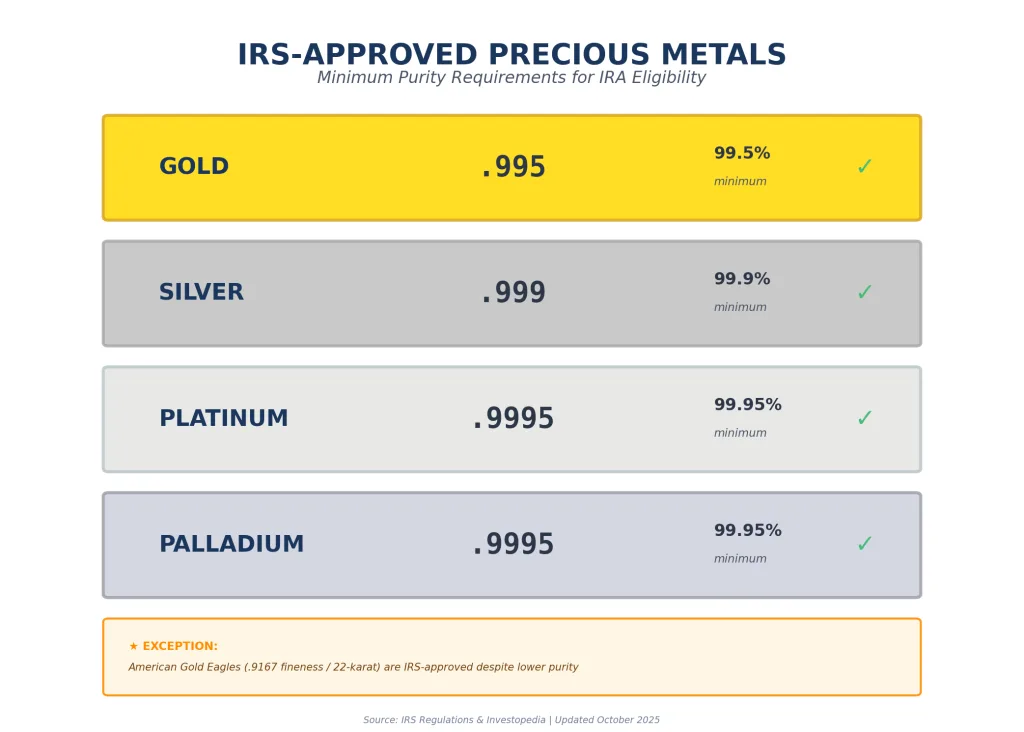
The Internal Revenue Service maintains stringent purity requirements for precious metals IRA eligibility. According to Investopedia, approved metals must meet the following fineness standards:
Gold: Minimum .995 purity (99.5% pure)
Silver: Minimum .999 purity (99.9% pure)
Platinum: Minimum .9995 purity (99.95% pure)
Palladium: Minimum .9995 purity (99.95% pure)
Important Exception: American Gold Eagles are IRS-approved despite being only .9167 fine (22-karat). The IRS explicitly permits these coins as an exception to the standard purity requirements, making them among the most popular IRA-eligible gold products.
Eligible products include government-minted coins such as American Gold Eagles, Canadian Maple Leafs, and Austrian Philharmonics, as well as bullion bars from approved refiners. Collectible coins, numismatic items, and most pre-1933 U.S. gold coins remain ineligible for IRA inclusion.
Types of Precious Metals IRAs
Investors can choose from three primary precious metals IRA structures, each offering distinct tax treatment:
Traditional Precious Metals IRA
Traditional precious metals IRAs accept pre-tax contributions, providing immediate tax deductions in the contribution year. Assets grow tax-deferred until distribution, with withdrawals taxed as ordinary income during retirement. This structure benefits investors expecting lower tax brackets in retirement.
Roth Precious Metals IRA
Roth precious metals IRAs utilize after-tax contributions, eliminating immediate tax benefits but offering qualified tax-free distributions in retirement. This option particularly appeals to younger investors anticipating higher future tax rates or those seeking tax diversification in retirement.
SEP Precious Metals IRA
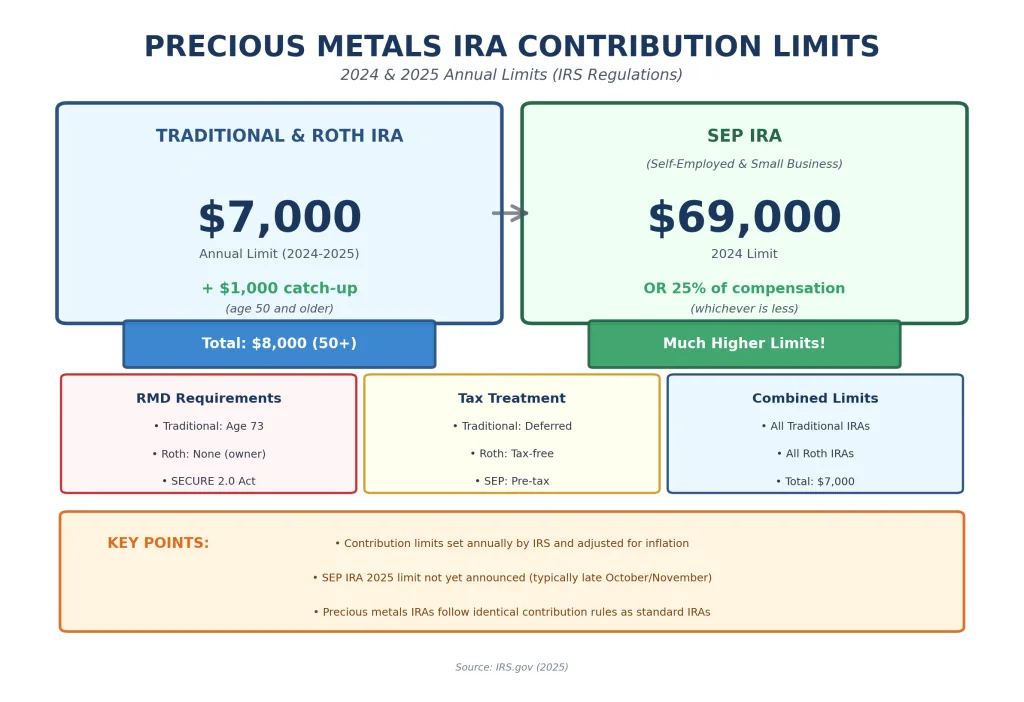
Simplified Employee Pension (SEP) precious metals IRAs serve self-employed individuals and small business owners. The IRS permits contributions up to 25% of compensation or $69,000 for 2024, whichever is less, providing substantially higher contribution limits than traditional IRAs.
Contribution Limits and Distribution Rules
Precious metals IRAs adhere to standard IRA contribution limits established annually by the IRS. For 2024 and 2025, the IRS sets contribution limits at $7,000 annually, with an additional $1,000 catch-up contribution for individuals aged 50 and older, totaling $8,000.
These limits apply collectively across all traditional and Roth IRAs, requiring strategic allocation decisions when maintaining multiple accounts. Unlike 401(k) plans with substantially higher limits, IRA contribution caps necessitate careful long-term planning for significant precious metals accumulation.
Required Minimum Distributions
Traditional precious metals IRAs mandate Required Minimum Distributions (RMDs) beginning at age 73, consistent with standard IRA rules under the SECURE 2.0 Act. The IRS calculates RMDs based on account value and life expectancy, requiring either cash distributions or in-kind precious metals transfers. Roth IRAs escape RMD requirements during the account holder’s lifetime, providing greater flexibility for estate planning.
Setting Up a Precious Metals IRA: The Process
Establishing a precious metals IRA requires coordination among three essential parties: a specialized custodian, a precious metals dealer, and an IRS-approved depository. While most major brokerage firms don’t offer full self-directed physical bullion custody services, specialized custodians with expertise in alternative asset custody are typically required for comprehensive precious metals IRA management.
Step 1: Select a Qualified Custodian
IRS regulations mandate that a qualified trustee or custodian maintain precious metals IRA accounts. These entities, typically banks, trust companies, or specialized firms, handle IRS reporting, manage account paperwork, and coordinate with depositories. When evaluating custodians, consider annual fees, transaction costs, and customer service quality.
Step 2: Fund Your Account
Investors can fund precious metals IRAs through several methods:
- New Contributions: Direct contributions subject to annual limits
- Transfers: Direct movement from one IRA custodian to another, avoiding taxable events
- Rollovers: Movement from employer-sponsored plans like 401(k)s, subject to 60-day completion requirements
Direct transfers and rollovers from existing retirement accounts represent the most common funding method, allowing substantial precious metals accumulation without triggering immediate tax consequences. Similar to strategies used in selecting the best types of gold and silver for investments, careful planning ensures optimal allocation.
Step 3: Purchase Approved Metals
After funding, work with your custodian to purchase IRS-approved precious metals from reputable dealers. The custodian facilitates transactions, ensuring compliance with purity standards and proper documentation. Investors should research current gold premiums to understand total costs beyond spot prices.
Step 4: Secure Depository Storage
All precious metals must be stored in IRS-approved depositories featuring comprehensive insurance, robust security systems, and regular audits. Depositories offer two storage options:
Segregated Storage: Your metals are stored separately and identified specifically as your property, typically commanding higher fees but ensuring precise asset tracking.
Commingled Storage: Your metals are stored with other investors’ holdings of the same type and purity, offering lower costs while maintaining individual ownership records.
Costs and Fees: Understanding the Investment
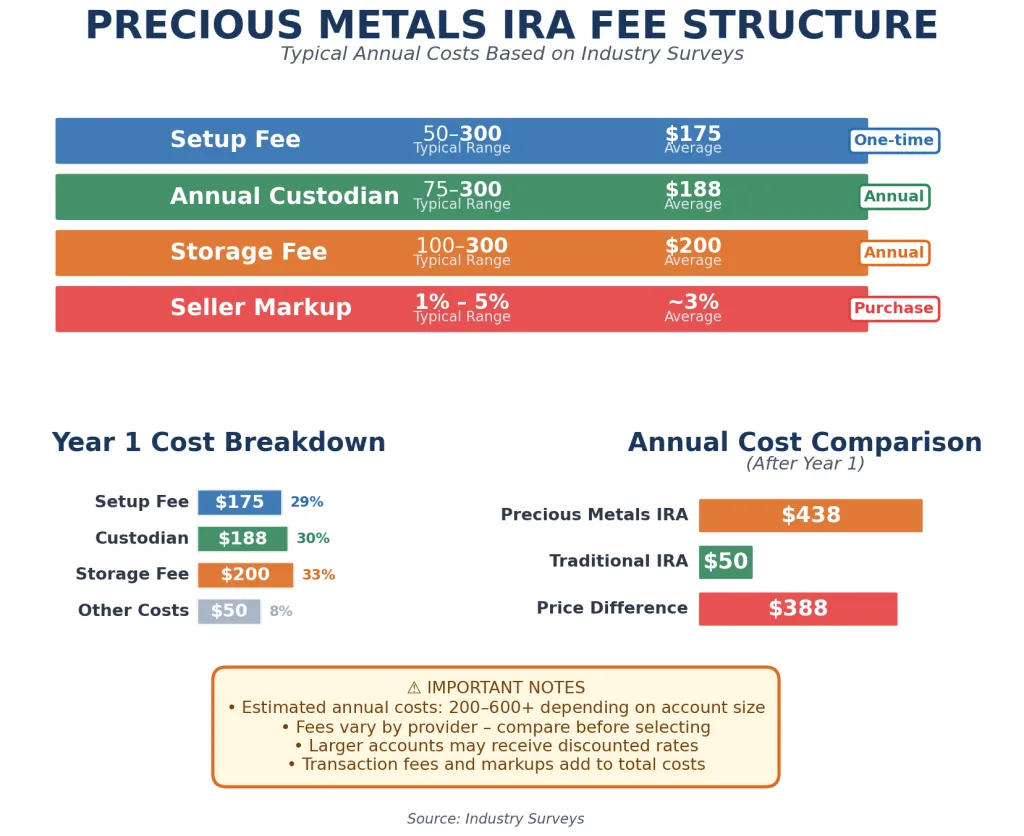
Precious metals IRAs typically incur higher fees than traditional IRAs due to physical asset handling requirements. According to industry surveys, investors should budget for these estimated costs:
- Setup Fees: One-time charges ranging from $50 to $300 for account establishment
- Annual Custodian Fees: Ongoing administrative charges between $75 and $300 annually
- Storage Fees: Depository charges based on value or flat rates, typically $100 to $300 annually
- Transaction Fees: Costs for purchasing and selling metals, varying by dealer and product
- Seller Markup: Premiums above spot price when purchasing metals, typically 1% to 5% depending on product and quantity
Note: Total all-in annual costs typically range from $200 to $600 or more, depending on account size and custodian. These are estimated ranges based on industry data; actual fees vary significantly by provider.
Understanding these costs proves essential for accurate return calculations. While gold investment profits have been substantial over the years, fees can significantly impact net returns, particularly for smaller accounts.
Tax Advantages and Implications
The primary appeal of precious metals IRAs lies in their tax-advantaged status. Traditional IRAs offer tax-deferred growth, meaning contributions may reduce current taxable income while allowing assets to appreciate without annual tax obligations on gains. This tax structure can substantially enhance long-term returns compared to taxable brokerage accounts.
Roth precious metals IRAs sacrifice immediate tax benefits for tax-free qualified distributions, potentially yielding superior after-tax returns for investors in rising tax environments. This consideration becomes particularly relevant given current fiscal policy debates and potential future tax rate increases.
Prohibited Transactions and Penalties
IRS regulations strictly prohibit certain activities within precious metals IRAs. Prohibited transactions include:
- Personal possession of IRA-held metals
- Using metals as collateral for loans
- Selling metals to or buying from disqualified persons
- Receiving personal benefit from IRA assets before distribution
Violations trigger immediate account disqualification, resulting in full taxation of account value plus potential 10% early withdrawal penalties for account holders under age 59½. The stringent rules underscore the importance of working with experienced custodians.
Strategic Considerations: Balancing Portfolio Allocation
Financial advisors typically recommend limiting precious metals IRA allocation to 5% to 10% of total retirement portfolios. While gold and silver offer portfolio diversification and inflation protection, they generate no income through dividends or interest, potentially underperforming income-generating assets over extended periods.
The gold-silver ratio provides valuable insights for determining optimal allocation between these metals. Historical analysis suggests diversification across multiple precious metals reduces volatility while maintaining portfolio protection characteristics.
Precious Metals IRAs vs. Other Gold Investment Options
Investors seeking precious metals exposure can choose from several alternatives beyond IRAs:
Physical Gold Ownership: Direct purchase provides immediate access and eliminates custodian fees but sacrifices tax advantages and requires personal storage arrangements.
Gold ETFs: Exchange-traded funds offer liquid, cost-effective exposure without storage concerns but lack the tax benefits and physical ownership characteristics of IRAs.
Mining Stocks: Equity investments in gold mining companies provide leveraged exposure to metal prices but introduce operational risks and lack direct price correlation.
Each option presents distinct advantages, with precious metals IRAs offering unique combinations of tax benefits, physical ownership, and retirement account structure.
Common Mistakes to Avoid
Successful precious metals IRA management requires avoiding several common pitfalls:
Inadequate Research: Selecting custodians and dealers without thorough due diligence can result in excessive fees or service quality issues. Verify credentials, read customer reviews, and compare fee structures before committing.
Improper Rollover Execution: Indirect rollovers require 60-day completion to avoid taxation and penalties. Direct transfers eliminate this risk and represent the preferred funding method.
Overpaying for Metals: Understanding how to spot authentic precious metals and fair pricing prevents costly mistakes. Compare dealer premiums and consider bulk purchases for better pricing.
Neglecting Diversification: Concentrating exclusively in precious metals IRAs creates unbalanced portfolios vulnerable to metal price volatility. Maintain diversified retirement holdings across multiple asset classes.
Conclusion: Is a Precious Metals IRA Right for You?
Precious metals IRAs offer compelling benefits for investors seeking portfolio diversification, inflation protection, and tangible asset ownership within tax-advantaged retirement structures. The accounts provide legitimate hedges against currency devaluation, fiscal instability, and economic uncertainty while maintaining retirement account tax benefits.
However, higher costs, custodial complexity, and lack of income generation require careful consideration. These accounts best serve investors who:
- Possess existing diversified retirement portfolios
- Seek strategic precious metals allocation (5% to 10% of total retirement assets)
- Understand and accept higher fee structures
- Maintain long-term investment horizons exceeding 10 years
- Value portfolio diversification beyond traditional paper assets
As gold continues competing with traditional assets like real estate, precious metals IRAs provide unique exposure mechanisms suited to retirement investment timeframes.
For investors ready to explore precious metals IRAs, Bullion Trading LLC offers comprehensive expertise in physical precious metals suitable for IRA accounts, including gold bars, silver coins, and platinum products.
