


For most of the last century, a central bank that wanted safety bought US Treasuries and called it a day. That instinct is breaking. Central banks buying gold have pushed official-sector demand to levels the market has not seen since the age of fixed exchange rates, and the latest reading from the World Gold Council suggests this is no longer a quiet experiment run by a handful of nervous reserve managers. It is hardening into the consensus view. The people who manage the world’s money are telling pollsters, in record numbers, that they expect to hold more gold and less of the dollar a few years from now.
What the 2026 survey actually found
Every year the World Gold Council, working with YouGov, asks the people who actually run national reserves how they think about gold. This year’s Central Bank Gold Reserves Survey drew 76 responses between 5 February and 19 May 2026, the largest turnout in the survey’s history and a step up from the 73 institutions that replied in 2025. A bigger sample matters here, because it means the answers are getting harder to wave away as a fringe opinion.
The headline numbers are striking. A record 45 percent of reserve managers said they expect their own institution to add gold over the next twelve months, and a remarkable 89 percent think global central bank gold holdings will keep climbing. Look out five years and the conviction gets stronger: 84 percent believe gold will make up a larger slice of total reserves by then, up from 76 percent the year before. Even the simple fact of ownership has shifted, with 93 percent of respondents now holding gold compared with 81 percent not long ago. Shaokai Fan, the Council’s global head of central banks, put it plainly when the results landed, saying central bank demand for gold “remains on an upward trajectory.”
What stands out is not any single figure but the direction of every figure at once. When managers were asked why they hold the metal, 90 percent pointed to how gold behaves in a crisis, 84 percent to its record as a long-term store of value, and 82 percent to plain diversification. Among emerging-market institutions, 85 percent named hedging geopolitical risk as a reason to own it. These are not the answers of people chasing a hot trade. They read like the answers of people quietly rewriting the rules of what a safe reserve looks like.
Why the dollar is slowly losing its grip
The flip side of buying gold is selling, or at least no longer accumulating, the dollar. In the same survey, 74 percent of respondents said they expect the US dollar’s share of global reserves to be moderately or significantly lower in five years. They do not expect the euro or the renminbi to fill the gap in any meaningful way. The currency they expect to gain ground is gold.
That lines up with what the hard data already shows. According to the IMF’s COFER reserve figures, the dollar accounted for 56.77 percent of allocated foreign exchange reserves at the end of 2025, down from a peak of roughly 71 percent around the turn of the millennium. That is a slow bleed rather than a collapse, and it is worth being honest about why. The IMF has repeatedly pointed out, including in an October 2025 analysis, that a good chunk of the dollar’s shrinking share comes from exchange-rate math rather than managers actively dumping greenbacks. When other currencies appreciate, the dollar’s slice of the pie looks smaller even if nobody sold a thing.
Still, the intent behind the gold buying is hard to misread, and it has a clear catalyst. After 2022, when hundreds of billions of dollars in Russian central bank assets were frozen following the invasion of Ukraine, every reserve manager on earth had to confront an uncomfortable thought. Dollar reserves held in the Western banking system can be switched off. Gold sitting in your own vault cannot. That single realization did more to revive the case for bullion than any price forecast. This is the same dynamic analysts flagged years ago when they argued that gold benefits as central banks de-dollarize, except now the trickle has turned into something closer to a policy.
None of this means the dollar is finished, and anyone selling that story is overstating the case. The greenback still dominates trade invoicing, debt issuance, and daily settlement by a wide margin. The reserve shift is a rebalancing at the edges, not a coronation of a new king. If you want the sober version of why a weaker dollar does not equal a dead one, it is worth separating the dollar collapse predictions from the reality before drawing conclusions.
There is also a structural tailwind that gets less attention than geopolitics. Under the Basel III banking rules, allocated physical gold is now treated as a zero-risk, high-quality liquid asset, which puts it on a similar regulatory footing to cash and government bonds. That reclassification quietly raised gold’s status inside the financial plumbing, and it helps explain why institutions feel comfortable holding more of it. Readers who want the mechanics can dig into what Basel III and gold as HQLA actually changed.
The pace of buying, and the caveat nobody mentions
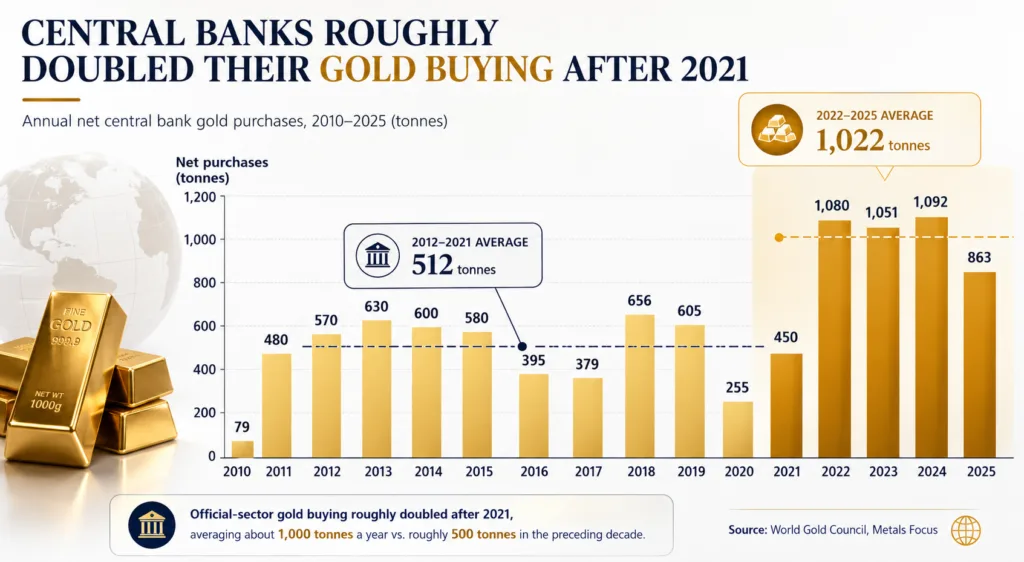
The scale of the shift is easier to grasp in tonnes than in percentages. Over the past four years, central banks have soaked up an average of roughly 1,000 tonnes of gold annually. Across the preceding decade the figure was closer to 500 tonnes. They have, in other words, doubled their appetite. The last time the official sector bought gold at anything like this rate, the world was still emerging from the wreckage of the Second World War, which is exactly why some analysts describe this as central banks buying the most gold since the end of World War II.
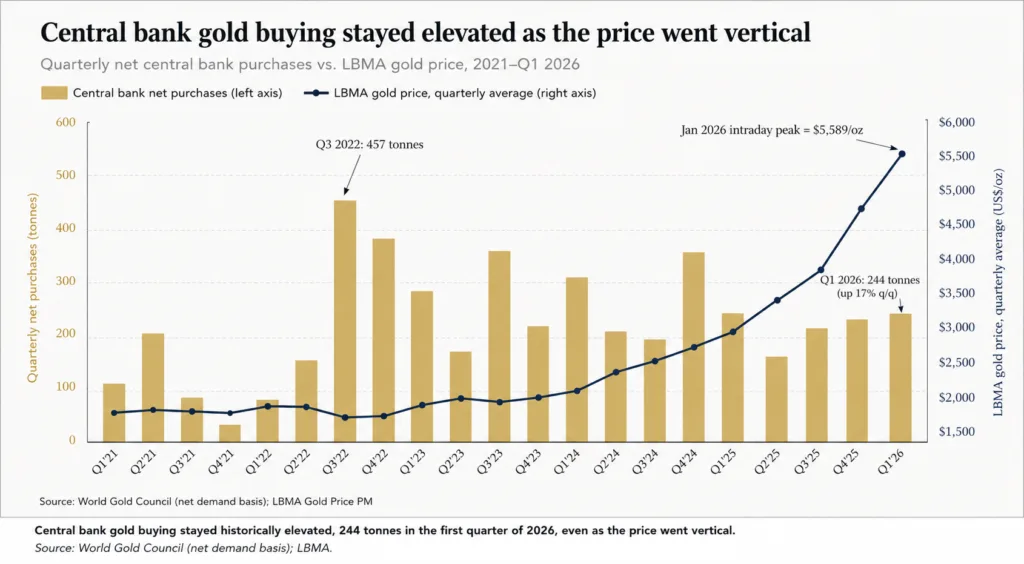
Here is the part the bullish headlines tend to skip, and it cuts in a direction most people do not expect. The pace did ease last year. Full-year buying came to 863 tonnes in 2025, down from roughly 1,090 tonnes in 2024, as record prices made reserve managers more selective about when to step in. But the bigger story in early 2026 is a reporting gap, not a buyers’ strike. The figure central banks formally report to the IMF showed a thin 16 tonnes of net buying in the first quarter, with Türkiye alone selling around 70 tonnes. Taken at face value, that looks like the buying nearly stopped. It did not. The World Gold Council, which also counts the purchases that never make it into the official monthly tallies, put actual net central bank demand for the same quarter at 244 tonnes, up 17 percent on the prior quarter, with Poland and Uzbekistan leading the buying. The gap between 16 and 244 is the number worth sitting with.
Most of that gap comes down to who reports, and when. China is the obvious example. The People’s Bank of China discloses its additions in modest dribbles, around eight tonnes in April, while Chinese net gold imports ran to 317 tonnes in the first quarter alone. Very little of that shows up promptly on the official balance sheet, if it appears there at all. So the tallies that feed the nervous headlines lag well behind what is actually being bought. Price explains the rest. Gold hit an all-time high of 5,589 dollars an ounce on 28 January 2026 before pulling back to around 4,300 dollars by mid-June. When the metal triples in a couple of years, even a committed buyer picks its moments, which is why the tonnage eased in 2025 while the conviction behind it did not.
It also helps to know how this gold actually gets onto the books, because the method tells you how committed these buyers are. According to the Council’s 2026 findings, half of the institutions that add gold do it through a domestic purchase programme, buying it at home and paying in their own local currency. Another 38 percent fund their buying by selling other reserve assets, which in practice often means trading dollars for bullion. The first route never touches foreign exchange markets at all, so it builds a national stockpile without spending hard currency. That is a deliberate, structural way of accumulating gold, not an opportunistic punt, and it is most visible across emerging markets in Asia, the Middle East, and Central Europe where reserve diversification has become explicit policy.
What the reserve shift means for everyone else
You are not a sovereign reserve manager, so why should any of this land on your radar? Because the official sector is the largest and least price-sensitive buyer in the gold market, and its behavior sets the floor everyone else stands on. When a national bank buys bullion, it generally is not trading it back out next quarter. That metal leaves the float and tends to stay gone, which tightens supply in a way that ordinary investment demand rarely matches. A persistent, price-insensitive bid is the kind of thing that turns a cyclical rally into something more durable.
It also tells you something about how serious institutions define safety in 2026. They are not abandoning bonds or cash. They are adding a layer that carries no counterparty, cannot be frozen by a foreign government, and has held purchasing power across every monetary regime in recorded history. That logic does not stop being true at the retail level. The reasons a reserve manager in Warsaw or Mumbai wants gold in the vault are the same reasons an individual might want a few ounces outside the banking system. The motivations scale down cleanly.
The forecasters have noticed. J.P. Morgan’s commodities research team expects gold to average close to 6,000 dollars an ounce by the final quarter of 2026, and central bank demand sits near the top of their list of drivers. Forecasts are not guarantees, and gold can stay volatile and frustrating in the short run, as this year’s pullback from the January peak already proved. But the structural story underneath the price noise is the part worth holding onto. When the institutions that print the world’s currencies decide they would rather own gold than more of each other’s paper, that is a signal, not a footnote.
So the question for an ordinary investor is no longer whether the smart money is moving into gold. The 2026 survey settles that. The question is whether you want to be positioned alongside that move or watch it from the sidelines. Owning physical metal will not make you a central bank, but it does let you borrow their reasoning. If the people closest to the world’s monetary risks are quietly building a private reserve they can hold in their own hands, it is at least worth asking what they understand that the rest of the market is still catching up to.
