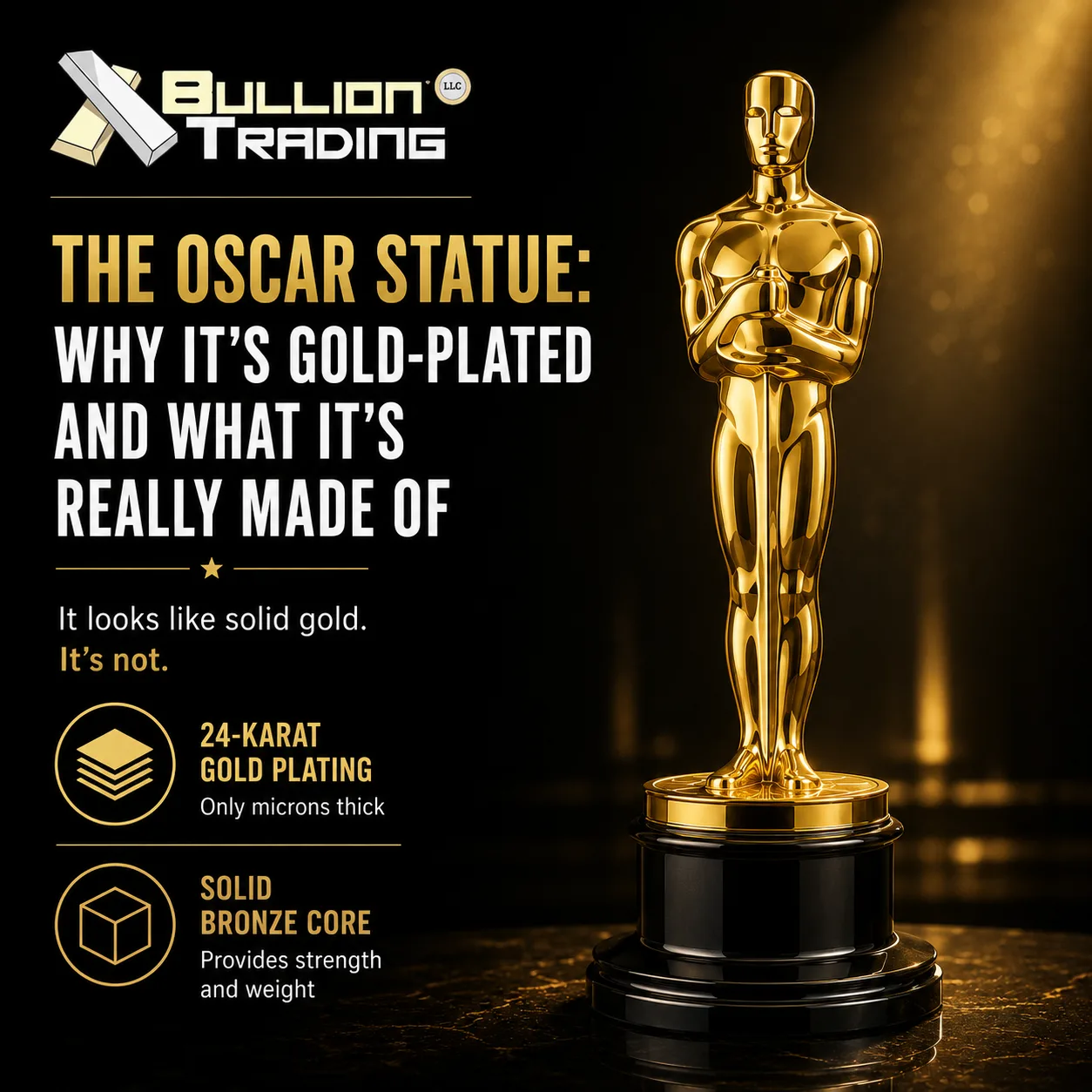

Every year a few dozen people walk off a stage in Los Angeles holding a heavy gold figure, and almost none of them know what they are actually carrying. The Oscar statue looks like a bar of poured gold that someone shaped into a man. It is not. Strip away the shine and you find bronze, a metal worth far more for its weight on a foundry scale than for anything a jeweler would pay you. The gold is real, but it is a skin, not a body. Working out what the Oscar statue is made of turns into a small lesson in why gold plating exists at all, and why nearly every famous “gold” object you can name is built the exact same way.
What’s under the gold
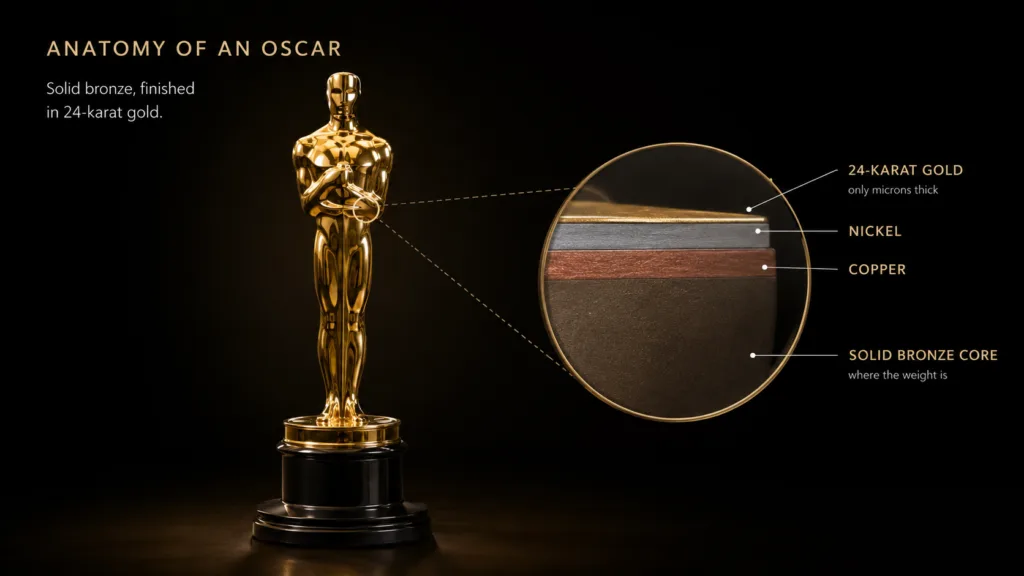
Officially the trophy is the Academy Award of Merit. The figure is a knight gripping a crusader’s sword, standing on a reel of film whose five spokes stand for the five original branches of the Academy: actors, directors, producers, technicians and writers. It rises 13.5 inches and weighs 8.5 pounds, which catches most winners off guard the moment they reach for it. As NBC Los Angeles has laid out in detail, the body is solid bronze finished in 24-karat gold.
Bronze is the part nobody photographs. It is a copper alloy, dense and cheap next to gold, and it gives the Oscar both its surprising heft and its toughness. The gold you see sits on top of that bronze as an electroplated layer measured in millionths of an inch. So when someone asks what the Oscar is made of, the honest answer is bronze first, gold second, and only a whisper of the second. The trophy belongs to the same family as costume jewelry and dressed-up watch cases, a world away from a solid bar. If you have ever tried to sort out how a thin gold coating differs from solid gold or gold-filled pieces, the Oscar is about the cleanest example you could ask for, and our breakdown of gold vermeil, gold-filled, gold-plated and solid gold shows exactly where it falls on that scale.
A recipe that kept changing
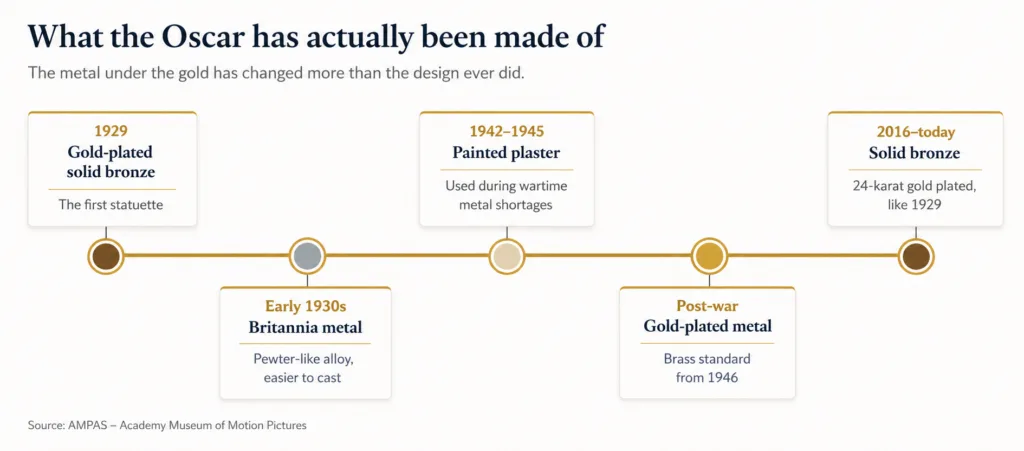
The Oscar has not always been built this way. The very first statuettes, handed out at the inaugural banquet on May 16, 1929, when Emil Jannings took best actor, were gold-plated solid bronze. Within a few years the Academy dropped the bronze in favor of britannia metal, a pewter-like tin alloy that took a smoother polish before plating and made the figures easier to finish. For decades that softer alloy, dressed in gold, was the standard Oscar that winners carried home.
Then the war arrived. Metal was rationed, and for three years during World War II winners received Oscars cast in painted plaster instead. The Academy made good on it afterward, inviting recipients to trade the plaster figures back for proper gold-plated metal once supplies returned. The design itself never budged through any of this. Cedric Gibbons, the MGM art director, drew the knight, and Los Angeles sculptor George Stanley turned the drawing into a three-dimensional model, and that silhouette has outlasted every change of metal since 1929. Only the base drifted around in size until the current standard was fixed around 1945.
In 2016 the Academy circled back to the beginning. It returned the statuette to solid bronze, the original 1929 material, working from a digital scan of an early Oscar to recover the slightly softer features that decades of remolding had quietly worn away. The Oscar handed out today is, in a real sense, closer to the first one ever made than to most of the trophies that came in between.
Why not just make it solid gold
Here is the question almost everyone lands on eventually. If it is the most coveted trophy on earth, why is it gold on the outside and base metal underneath? The answer is partly money and partly physics, and the two reinforce each other.
The case for plating makes itself the moment you picture the alternative. Gold is heavy and soft. A solid gold figure of the same size would weigh well over twice what the bronze does, and the Academy casts about fifty of them every year, so the raw metal bill alone would run into the millions each awards season. Worse, pure gold dents and scratches with handling. A solid gold Oscar would slowly deform every time it changed hands, and nobody wants to hoist a trophy that bends in their grip.
The gold actually on the statue is almost comically cheap by comparison. The plating is only about 0.38 microns thick, roughly two hundred times thinner than a human hair, so melting every trace of gold off a single Oscar would fetch around $57, as E! News and other outlets have reported. Even with gold trading at several times the price used in that estimate, the coating holds only a few hundred dollars of metal at the very most, and the whole statuette, bronze and all, scraps out for not much more. The Oscar’s worth was never in its bullion, which is exactly why a champion’s prize so rarely tracks its scrap value. You see the same gap with sporting medals, and the math behind how much gold is really in an Olympic gold medal runs along the same lines. If you genuinely wanted to know what a piece of gold is worth by weight, you would calculate its melt value, and the Oscar would come up close to empty.
How the gold actually gets on
Making a modern Oscar has more in common with casting museum sculpture than with stamping out trophy-shop hardware. The work happens at Polich Tallix, a fine art foundry in New York’s Hudson Valley, the kind of shop that pours bronze for serious sculptors. Each statuette begins as a wax copy pulled from a mold. That wax form gets coated in a ceramic shell and fired at around 1,600 degrees Fahrenheit, which melts the wax out and leaves a hollow, Oscar-shaped cavity. Molten bronze, poured at more than 1,800 degrees, fills the shell. The cast figure is then cooled, broken free of the ceramic, and sanded down to a mirror polish. The Copper Development Association has documented this lost-wax process step by step, and turning out roughly fifty statuettes this way takes about three months.
The gold goes on last, and not in the Hudson Valley but down in Brooklyn. A company called Epner Technology handles the plating with a proprietary process it markets as Laser Gold. This is the part I find genuinely odd in the best way. Epner first developed Laser Gold for Xerox and later for NASA, which prizes gold for the way it reflects heat and light on spacecraft. By Epner’s own account, each Oscar is racked, electro-cleaned, copper plated, then bright-nickel plated, and finally lowered into the Laser Gold tank, a cycle that runs more than six hours per statue. Those copper and nickel underlayers are not filler. They give the gold a smooth, even foundation to bond to, which is why the finished surface reads like poured metal instead of spray paint.
The gold Epner lays down is real 24-karat, and the company says its version runs about three times harder than ordinary pure gold, backed by a guarantee that covers not the lifetime of the owner but the lifetime of the Oscar itself. That hardness is the whole trick. Pure gold is famously soft, so a normal 24-karat skin would scratch and rub thin under years of handling and display. A 24-karat finish that actually resists wear is a quiet feat of chemistry, and it is the reason these statuettes still glint decades after the speeches.
What 24-karat really means here
It is worth slowing down on that “24-karat” label, because it does a lot of work and hides a lot of nuance. Twenty-four karat means pure gold, the very top of the karat scale, with nothing else alloyed in. On a ring or a coin, that figure tells you how much of the whole object is gold. On the Oscar it tells you only how pure the coating is, not how much gold is present. You can have a 24-karat surface wrapped around a body that contains no precious metal at all, and that is precisely what the Oscar is.
That distinction trips up plenty of buyers in the real market, not just trivia fans. A “gold” item can be solid, filled, vermeil or merely plated, and the karat number alone will not tell you which. It is the same reason hallmark stamps and fineness marks exist on jewelry, and reading how karats, purity marks and hallmarks actually work is the difference between paying for gold and paying for the look of it. The Oscar is the look of it, executed about as well as anyone can manage.
The name, and the strange rule about owning one
The trophy was not always called Oscar, and nobody is entirely certain who first did. The story the Academy itself repeats is that its librarian, Margaret Herrick, glanced at the statuette and said it reminded her of her Uncle Oscar. The columnist Sidney Skolsky was using the name in print by 1934, the Academy adopted it officially in 1939, and the origin has stayed pleasantly fuzzy ever since, as History has documented. A pewter-and-gold knight standing on a film reel does not obviously resemble anyone’s uncle, which is part of why the story has lasted.
The stranger fact is that you cannot really own an Oscar the way you own other prizes. Since 1951 the Academy has required winners, and their heirs after them, to offer the statuette back to the Academy for a single dollar before selling it to anyone else. Refuse, and the Academy is within its rights to keep it. The rule converts a few hundred dollars of plated bronze into an object that legally cannot be cashed in, which is a peculiar and oddly perfect status for a thing whose entire value lives in what it stands for rather than what it is made of. Statuettes that predate the rule do occasionally surface at auction and fetch enormous sums, and the price has nothing to do with the metal.
So what is it, really
An Oscar is a bronze sculpture wearing a six-hour coat of space-grade gold. It was designed in 1929, spent a stretch of the war years cast in painted plaster, and on any given day holds a few hundred dollars in raw materials at most. That gap between what it costs to make and what it means to win is the entire point of the object. The next time you watch someone lift one over their head, you will know the heavy part is bronze, the bright part is barely there, and the value, all of it, lives in the name.
