


You packed a few gold coins and a couple of silver bars, zipped them into your carry-on, and then the doubt hit you somewhere around the security line. Can you actually fly with gold and silver, or are you about to spend the next hour explaining yourself to a screener who has never seen a one-ounce Eagle before? The short answer is yes, and it is far more routine than most travelers assume. The longer answer, the one that keeps your metal in your bag and out of a government locker, depends on whether you are flying across the state or across a border, and on one specific dollar figure that almost everyone remembers wrong.
The short answer for domestic flights
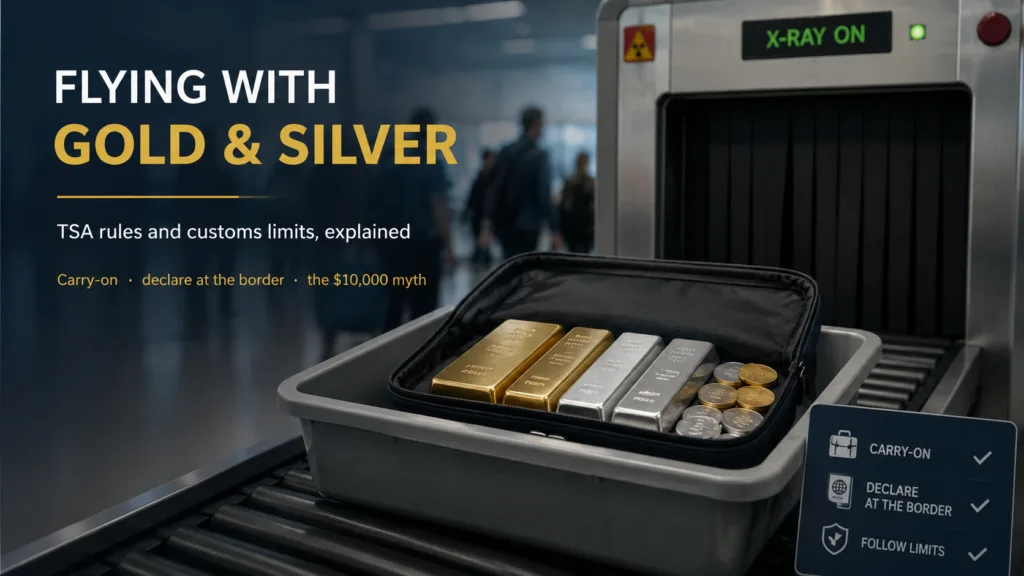
If you are flying inside the United States, there is no federal rule that stops you from carrying gold or silver, and there is no cap on how much you can bring. The Transportation Security Administration is a security agency, not a tax collector. Its job is to keep weapons and explosives off the plane, not to police the value of what you own. Coins, bars, rounds, and jewelry all clear screening without any special category. TSA’s guidance on jewelry and valuables says to keep valuable items with you rather than in checked bags, and bullion gets the same personal-property treatment: pack it, send it through the X-ray, and collect it on the other side.
The wrinkle is physical, not legal. Gold and silver are dense, and dense objects show up as solid dark shapes on an X-ray scanner. A stack of coins or a kilo bar can look unusual enough to earn you a secondary inspection, where an officer opens the bag and takes a closer look. That is not a problem. It is a thirty-second conversation if you handle it calmly and have nothing to hide. Domestic flights involve no customs at all, so once you clear the checkpoint you are done.
What screening actually looks like
Keep your metal in your carry-on. This is the single most useful habit for anyone moving bullion by air. Checked luggage disappears, gets rerouted to the wrong city, and occasionally gets opened by people who are not supposed to open it. A bag of gold coins that vanishes somewhere over Denver is a loss you will struggle to recover, because airline liability for checked baggage is capped well below what your metal is worth. Carry-on keeps the bullion in your sight and under your control the entire trip, which is the same logic you would apply to a secure storage setup at home: the fewer hands that touch it, the better.
If you would rather not have your holdings spread across a screening tray in front of a line of strangers, you can ask the officer for private screening. It is your right, and agents handle these requests routinely. Bring documentation too. A receipt or an invoice that shows you bought the coins, along with the original packaging or assay card, does two things at once. It reassures the screener that the metal is yours, and it gives you a clean paper trail if questions come up later. None of this is mandatory for a domestic hop, but it turns a potentially awkward moment into a non-event.
The $10,000 number everyone gets wrong
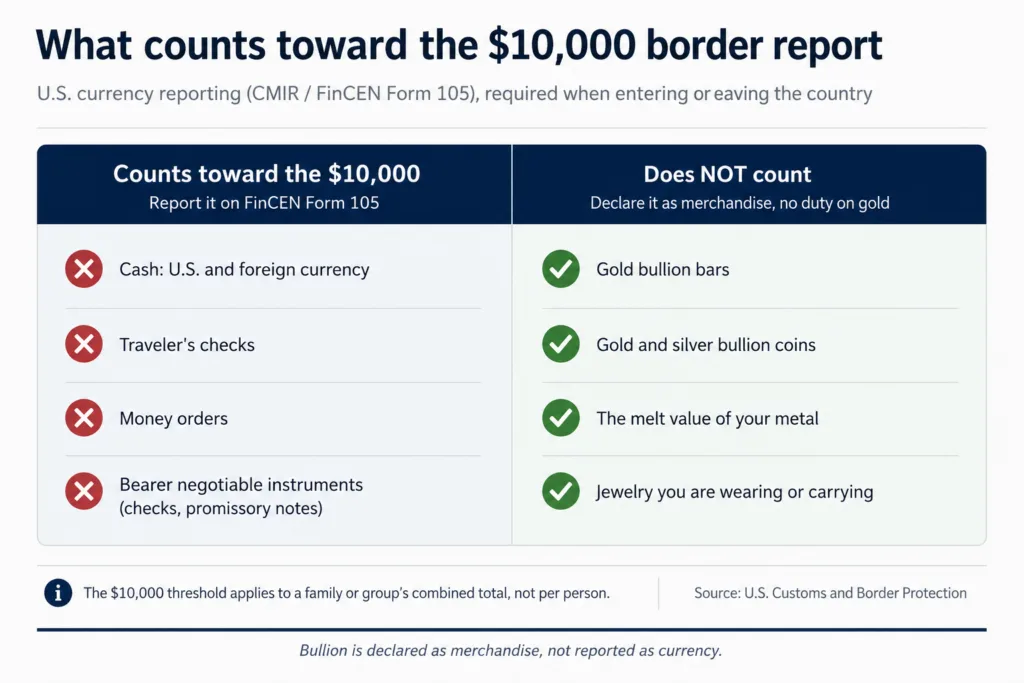
Here is the figure that causes more confusion than any other in this conversation. Somewhere along the way, people picked up the idea that you cannot leave or enter the country with more than $10,000 in gold. That is not what the rule says. The $10,000 threshold is a reporting requirement for currency and monetary instruments crossing the border, and it has nothing to do with a limit on how much metal you can own or carry.
When you physically move more than $10,000 into or out of the United States, you have to report it to U.S. Customs and Border Protection on a Report of International Transportation of Currency or Monetary Instruments, the CMIR, better known as FinCEN Form 105. As CBP explains the mandate, it covers currency and negotiable instruments such as traveler’s checks and money orders, and it applies to a family or group’s combined total, not per person. The twist that catches people off guard is how the government classifies bullion. Gold bars and bullion are not treated as monetary instruments for this filing, so the melt value of your metal does not count toward the threshold, even though it obviously has worth. Coins muddy this a little. A gold coin is also legal tender with a face value, and customs has not always treated high-value coins the same as plain bars, so with coins the safe move is to report anything over $10,000 rather than lean on the bullion exemption.
So a traveler carrying $40,000 worth of gold bars does not trigger Form 105 based on the metal’s melt value, while a traveler with $10,001 in actual banknotes does. It feels backwards, but that is the line the regulations draw. The catch is that the metal still has to be declared as merchandise, which is a separate obligation I will get to in a moment. And if you happen to also be carrying a fat envelope of cash alongside your coins, that cash counts toward the threshold on its own.
Do not be tempted to play games with the number. Breaking an amount into smaller pieces, or coordinating with a travel companion to keep each person under the limit, is a federal offense called structuring, and it is prosecuted on its own merits. Skipping the form when you should have filed it is worse. The penalties run to civil and criminal liability, fines, and prison time, and the cash or instruments can be seized and forfeited outright. Officers are authorized to take the entire amount, not just the slice above $10,000. You can read the obligation and the warnings directly on the official FinCEN Form 105 itself.
Declaring gold and silver at the U.S. border
Crossing back into the country with metal is where the actual rules live. Gold coins, medals, and bullion were once barred from private import, but today they may be brought into the United States freely, and there is no duty on them. The catch is that you still have to declare them. You do that on the standard customs declaration form every returning traveler fills out, and verbally if an officer asks.
A few things will get your metal stopped at the door regardless of how you declare it. That same CBP guidance bars gold originating in or brought from Cuba, Iran, Burma (Myanmar), or most of Sudan, under sanctions enforced by the Office of Foreign Assets Control. Counterfeit coins are illegal to import, full stop, and copies of gold coins are blocked unless they are properly marked by the issuing country. None of this is exotic. It just means you should know where your metal came from and that it is the genuine article, which is a good idea long before you ever board a plane.
When you are unsure whether something counts as a coin, a collectible, or a monetary instrument, declare it anyway. A declaration that turns out to be unnecessary costs you nothing. A false or missing declaration is the thing that turns a normal arrival into a seizure and a very bad afternoon. Officers have wide latitude, and the traveler who volunteers information almost always fares better than the one who waits to be asked.
Other countries, other rules
The United States is relatively relaxed about bullion compared with much of the world, so do not assume your home country’s logic travels with you. The European Union, for one, draws the line in a completely different place. Under the cash control rules in force since June 2021, the EU folded gold into its definition of cash. A traveler entering or leaving the bloc has to declare holdings worth €10,000 or more, and the European Commission’s guidance on EU cash controls spells out that the figure now captures gold coins with a gold content of at least 90 percent and gold bars, nuggets, or clumps that are at least 99.5 percent pure. So the same kilo bar that flies under the radar of the U.S. currency form has to be declared the moment it crosses into Europe at value.
India goes further still, and it rewrote the fine print again for 2026. Its duty-free allowance covers gold jewelry only, and only for Indian nationals who have lived abroad continuously for at least a year, capped at 20 grams for a man and 40 grams for a woman. Stay away for six months to a year and there is no duty-free room at all, though you can still bring in up to a kilogram of gold at a concessional duty of 6 percent under the customs notification in force for 2026, against roughly 36 percent for everyone else. Bars and coins never qualify for the free allowance. They are dutiable from the first gram and have to be declared through the red channel on arrival, with seizure and penalties waiting for anyone who walks the green channel with undeclared metal. The lesson generalizes well beyond these two examples. Check the destination’s rules, not just the departure airport’s, because the country you are flying into usually has the stricter opinion.
A practical playbook for moving metal by air
Most of the smart moves here are small. Keep the bullion in your carry-on, and if you are carrying a real quantity, split it so a single misplaced bag does not wipe you out. Travel with the original packaging, assay cards, and a receipt, and photograph everything before you leave home. Recognizable, sealed products from known mints clear inspection faster than loose, unmarked metal, because an officer can identify them at a glance. Build a position around verifiable coins and bars and the airport becomes a much shorter conversation, part of why thoughtful stackers build a private reserve the way they do.
Be honest about silver, too. Silver is heavy and bulky relative to its value, so even a modest dollar amount turns into a brick that dominates the X-ray and your shoulder. A few thousand dollars of 90 percent junk silver coins weighs a surprising amount, and that bag will get a second look every time. If your reason for flying with metal is simply to relocate it, ask whether you need to move the physical bars at all. Professional allocated vault storage lets you hold metal in another jurisdiction without ever wheeling it through a terminal, and it sidesteps both the screening hassle and the loss risk in one move.
Arrive early enough that a secondary inspection does not cost you the flight, request private screening if you want it, and keep your holdings to yourself in the gate area. There is no upside to announcing that the bag at your feet is full of gold. Insure the metal if your policy allows it, and treat the trip with the same seriousness you would give any high-value cargo.
The bottom line before you book
Flying with gold and silver is legal, common, and mostly a matter of paperwork and packing rather than permission. The friction comes from confusion, not prohibition. Burn one fact into memory and you will avoid the trap that snares most travelers: the $10,000 figure is a cash reporting threshold, not a ceiling on how much metal you can carry, and U.S. bullion does not even count toward it. Declare what you should, keep your documentation in order, and check the rules of every country on your itinerary. The safest stack to travel with is one built from recognizable, verifiable products that any officer can identify on sight, which matters the next time you add to your holdings.
