


Once you hold enough metal that losing it would actually hurt, the question stops being “what do I buy” and becomes “where does it live.” Offshore gold storage is how serious stackers answer that, by putting meaningful holdings in a jurisdiction with strong property rights, a professional vault, and a tax regime that does not punish them for owning bullion. The three options most people weigh are Singapore, Switzerland, and the safe in their own house. They are not interchangeable. One is modern and cheap, one is old-money expensive, and one is convenient right up until something goes wrong.
This is a comparison for people who already own real metal and are deciding where to put the bulk of it. There is no single right answer, because it depends on how much you hold, how fast you might need it, and which country’s tax authority has your name. What I can do is lay out what each option costs, how each is taxed, who guards the metal, and where the real risks sit.
What you are really choosing when you store offshore
Two decisions get tangled together here. The first is jurisdiction: whose courts, customs rules, and political stability stand between you and your metal. The second is the legal form of the holding, which is where allocated and unallocated storage part ways. With allocated storage you own specific, serial-numbered bars or a defined parcel that is yours in law, segregated from the operator’s balance sheet, so if the operator fails your metal is not part of the bankruptcy. Unallocated storage makes you a creditor with a claim on a pool of metal, which is cheaper and more liquid but carries counterparty risk. The difference is not academic, and it is worth understanding the distinction between allocated and unallocated gold before you wire money anywhere.
Why send metal abroad at all? Mostly to escape single-point-of-failure risk at home. American stackers remember Executive Order 6102, the 1933 order that required citizens to hand in most of their gold to the Federal Reserve. That history is why jurisdiction diversification appeals to people who think in decades. Metal held under a different flag, governed by different courts, is metal no single government decision can reach all at once.
Singapore: modern vaults, no GST, strong property rights
Singapore is the newcomer that rewrote the rulebook. In 2012 it removed the goods and services tax on investment-grade bullion, and that one move turned the city-state into a serious bullion hub almost overnight. Today Singapore’s GST sits at 9 percent after the increase that took effect on 1 January 2024, but qualifying investment precious metals are fully exempt. According to the Inland Revenue Authority of Singapore, the exemption covers gold of at least 99.5 percent purity, silver of at least 99.9 percent, and platinum of at least 99 percent, whether in bars on the LBMA Good Delivery list or in specified bullion coins.
The detail that catches people out is which coins qualify. The rule turns on purity, so 22-karat coins fall outside it. A Canadian Gold Maple Leaf and an American Gold Buffalo qualify, but a Gold American Eagle and a Gold Krugerrand do not, because at roughly 91.67 percent fine they sit below the 99.5 percent gold threshold. The silver Eagle and silver Maple, being fine silver, are on the prescribed list. The point is that “investment grade” has a precise legal meaning here, and it pays to check your specific product against the IRAS list rather than assume.
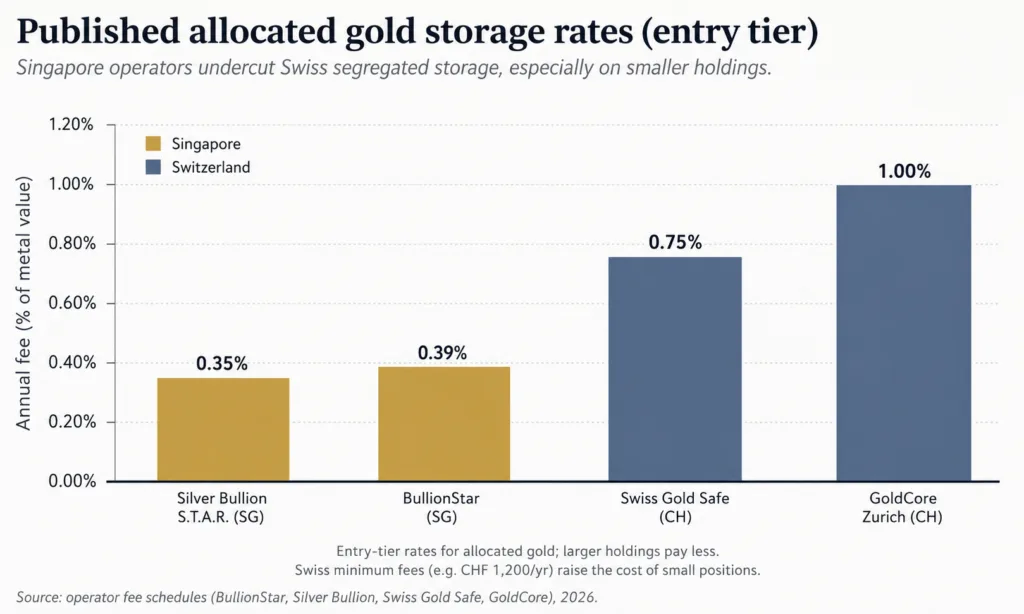
On security, the marquee facility is Le Freeport Singapore, a roughly 30,000 square metre high-security complex next to Changi Airport that opened in 2010, with Brink’s, Loomis, and Malca-Amit all operating vaults inside it. Private investors usually reach that infrastructure through dealers such as BullionStar or Silver Bullion’s The Safe House, both of which offer genuinely allocated, segregated storage with the investor as legal owner. Cost is where Singapore really competes. BullionStar’s published schedule charges 0.39 percent a year for allocated gold, and Silver Bullion’s S.T.A.R. storage runs from 0.35 percent down to 0.25 percent for larger parcels, per their published rates.
Then there is rule of law, which is the quiet reason institutions trust Singapore. It ranked 16th of 143 jurisdictions in the World Justice Project’s 2025 Rule of Law Index, the highest in its region. For a place to park metal you may not touch for years, predictable courts and clean enforcement matter more than marketing.
Switzerland: legacy security and neutrality, at a price
Switzerland is the name everyone reaches for first, and not without reason. The country refines a huge share of the world’s gold, its political neutrality is centuries deep, and its property protections are about as strong as they come. The Heritage Foundation’s 2025 Index of Economic Freedom ranked Switzerland second in the world with a property rights score of 94.5, and the World Bank’s governance data puts its rule-of-law standing among the highest measured. If your reason for going offshore is institutional permanence, this is the benchmark.
The tax treatment is good for gold and only gold. Under Article 44 of the Swiss VAT Ordinance, investment gold is exempt from value-added tax: bars of at least 995 fineness from a recognized assayer, and bullion coins minted after 1800 that are at least 900 fine, were legal tender, and sell for no more than 80 percent above their gold content. The catch is that silver and platinum get no such break. They carry the standard Swiss VAT, which rose to 8.1 percent on 1 January 2024, unless you keep them inside a bonded warehouse where duty and tax stay suspended. You can confirm the current rates with the Swiss Federal Tax Administration. For a white-metal stacker, that single difference can make Singapore the cheaper home.
The bonded route runs through Switzerland’s freeports, the most famous being the Geneva Freeport, where high-value goods sit in customs limbo and import duty and VAT are suspended until the metal leaves for the domestic market. These are not lawless vaults, though. After a 2009 reform of the customs rules, warehouse keepers must maintain an electronic inventory of stored sensitive goods, including their value and who controls them, as the Institute of Art and Law describes.
What you pay for all this legacy is, predictably, more. Segregated Swiss storage tends to run higher than Singapore’s, and it bites hardest on smaller holdings. GoldCore’s Zurich storage, vaulted with Loomis, is tiered from 1.0 percent a year below 100,000 dollars down to 0.49 percent above 750,000, per its storage page. Swiss Gold Safe AG quotes allocated storage from 0.75 percent down to 0.50 percent with a minimum of 1,200 Swiss francs a year, which tells you the model is built for size. None of this is a knock on Switzerland. You are buying the most established safe-haven jurisdiction on earth, and the recent surge in Swiss gold exports shows how central the country still is to the physical market.
Storing at home: control you can hold, insurance you mostly cannot
Home storage is the only option where you can open a door at 2 a.m. and put your hands on the metal. No counterparty, no annual fee, no custodian who can freeze an account, and no third party with a record of what you hold. For a portion of a stack, that immediacy and privacy is genuinely valuable, and there is a sensible case for keeping some metal stored safely at home as ready access. The trouble starts when home storage becomes the whole plan for a meaningful holding.
Two facts puncture the convenience. The first is that most home safes are far weaker than buyers assume. A safe carrying the common Residential Security Container rating is certified, under the revised UL standard, to resist only about a five-minute attack by one person with basic hand tools. Real burglary protection means a UL 687 rating such as TL-15 or TL-30, where the number is net working time against tools, and those safes cost thousands and weigh a great deal. The UL standards are public if you want to read what the labels actually promise, via UL Solutions. A “fireproof” sticker, worth noting, says nothing about burglary resistance.
The second fact is the one that should stop you cold. A standard homeowners policy barely insures bullion at all. The widely used ISO Homeowners 3 special form caps coverage at just 200 dollars for “money, bank notes, bullion, gold other than goldware, silver other than silverware, platinum other than platinumware, coins,” and the like, as the sample form published by the Insurance Information Institute spells out. By contrast the same policy allows 1,500 dollars for jewelry theft. Bullion is singled out for the harshest limit in the book. You can sometimes schedule valuables on a separate floater, but for raw bullion that coverage is often expensive or hard to find, so most home-stored metal is effectively uninsured against theft.
And theft is not rare. FBI data recorded hundreds of thousands of residential burglaries in 2024, and you can pull the current figures from the FBI Crime Data Explorer. None of this makes home storage wrong. It makes it a place for a slice you can afford to lose, not the foundation of a serious position.
Offshore gold storage compared: cost, tax, security, and risk
Lined up against each other, the three sort cleanly. Singapore wins on cost and tax breadth, exempting investment gold, silver, and platinum alike. Switzerland wins on the depth of its safe-haven reputation, at a price premium and with VAT still on white metals. Home storage wins on access and privacy and loses badly on insurance and physical security. The figure below scores each across the five dimensions a buyer actually weighs.
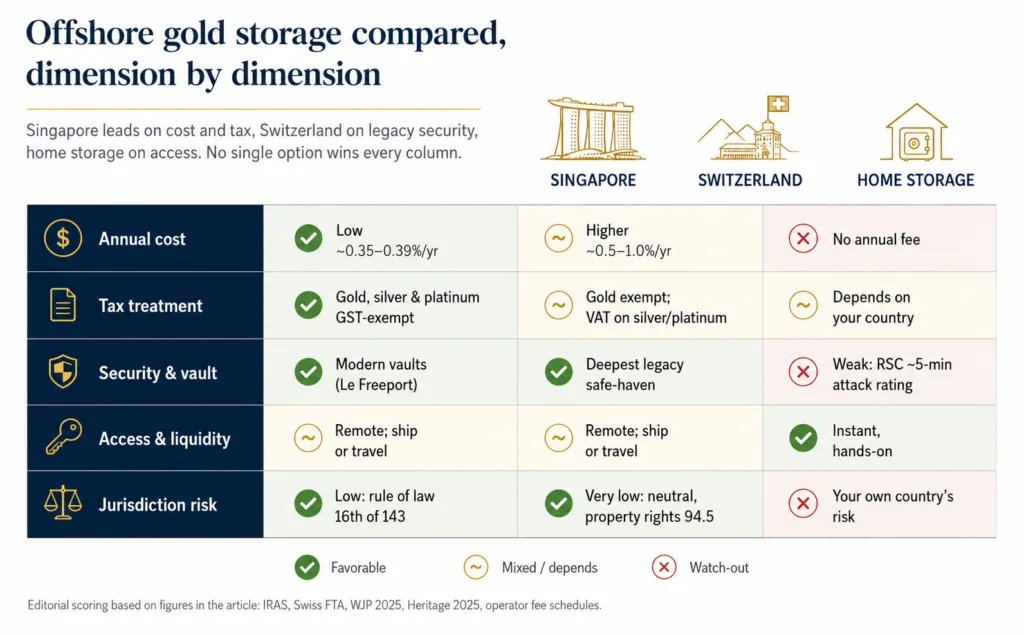
On the running cost that compounds year after year, the gap is real. Allocated gold storage in Singapore lands well under half a percent a year, while segregated Swiss storage often starts near one percent for smaller holdings before scale brings it down, and carries minimum annual fees that penalize small positions. Home storage has no annual fee, but a serious safe plus whatever specialty insurance you can secure is not free either, and the protection you get is thinner than the price suggests.
Tax and reporting depend on where you live
Everything above describes the rules in the storage jurisdiction. Your own country’s rules sit on top, and they are the ones that can surprise you. The GST exemption in Singapore or the VAT exemption in Switzerland governs buying and holding there; it says nothing about what you owe when you sell, or what you must report at home. Most developed countries tax capital gains on bullion and require residents to report certain foreign holdings, and the specifics vary by country and change over time. If the metal is earmarked for a US retirement account the rules are stricter still, since a precious metals IRA must use an IRS-approved depository rather than your own safe. This is not the place for blanket tax advice, and you should not treat it as such.
One point worth flagging is reporting. Singapore and Switzerland both participate in the Common Reporting Standard, the system through which tax authorities automatically swap financial-account information. Physical allocated metal held in your own name as a bailment is generally not a reportable financial account, but the moment it sits inside a custodial account, a pooled structure, or is paired with cash at a financial institution, reporting can attach. The honest answer is that this turns on the exact structure and on your country of residence, so confirm it with a cross-border tax professional rather than relying on a forum post or, frankly, an article like this one.
Matching the vault to the holding
The choice gets easier once you stop looking for a winner and start matching each option to a job. If you want the lowest running cost, the broadest tax exemption across gold, silver, and platinum, and a modern facility with strong property rights, Singapore is hard to beat, and it suits a growing stack where fees compound. If your priority is the deepest, most time-tested safe-haven jurisdiction and you are storing enough that a higher fee and a minimum charge do not sting, Switzerland earns its premium. And home storage belongs in the mix for the slice you want within arm’s reach, sized to what you can genuinely afford to lose given how little a standard policy will pay.
Most serious stackers I have seen do not pick one. They keep a working amount at home, then split the meaningful holdings across at least one offshore jurisdiction, allocated and segregated, so no single court, customs rule, or burglar can reach all of it. The metal is the easy part. Deciding where it sleeps, and under whose laws, is the decision that actually protects it.
