
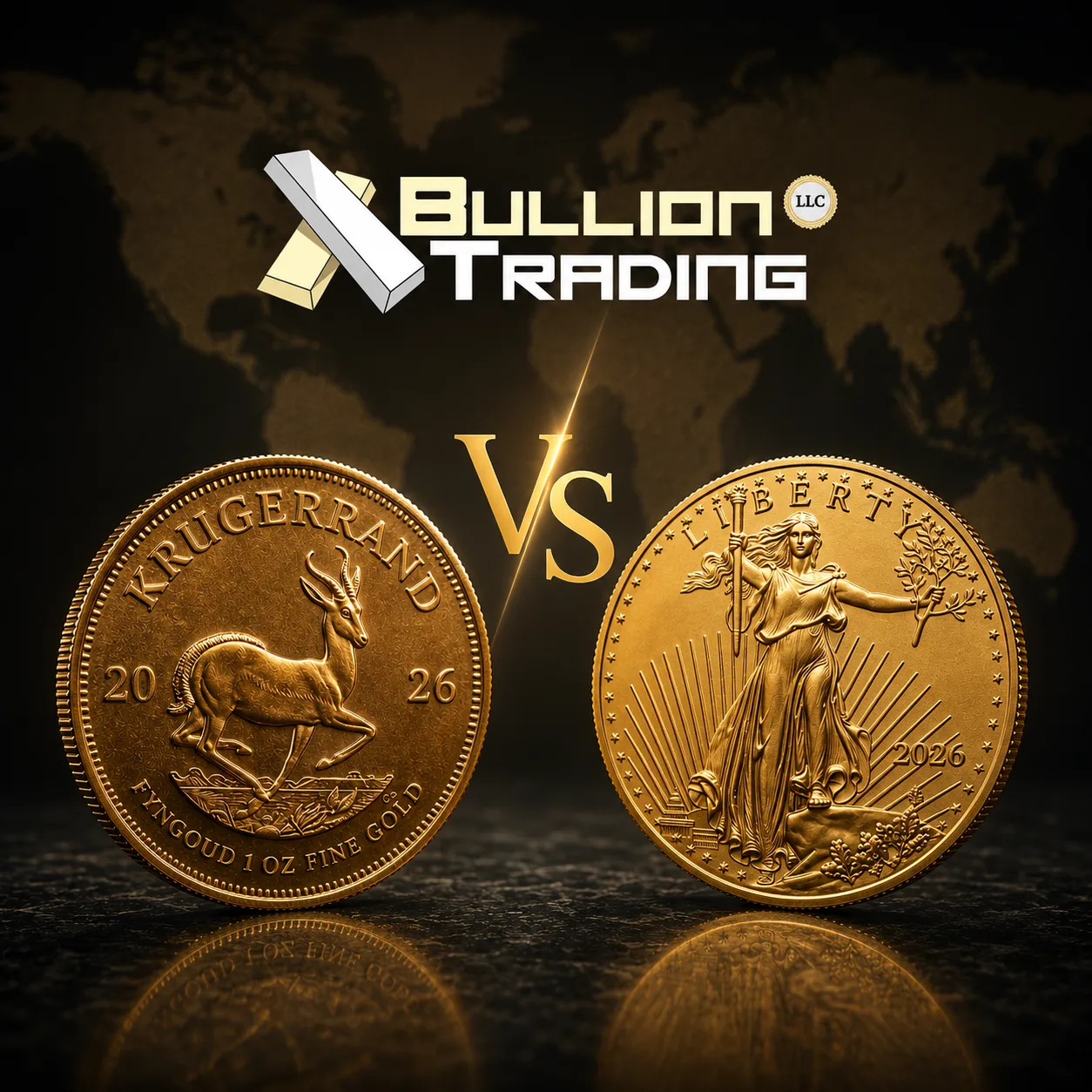

Here is the part that surprises most first-time buyers: in the krugerrand vs gold eagle decision, the gold itself is a tie. Both coins hold exactly one troy ounce of pure gold. Both are struck in 22-karat alloy at .9167 fineness, and both end up weighing about 1.0909 troy ounces once you count the metals mixed in for hardness. Melt them down and you get the same ounce of gold. So the choice was never really about the gold. It is about everything wrapped around it: what you pay over spot, whether the coin can go in a retirement account, who will buy it back, and which mint’s promise you trust.
I want to be useful here rather than diplomatic, so this is framed as a decision with a real answer at the end, not a “they’re both great, follow your heart” cop-out. Let’s get the specs exactly right first, because a comparison that fudges the numbers is worse than no comparison at all.
South African Gold Krugerrand vs American Gold Eagle
The specs, straight from the mints
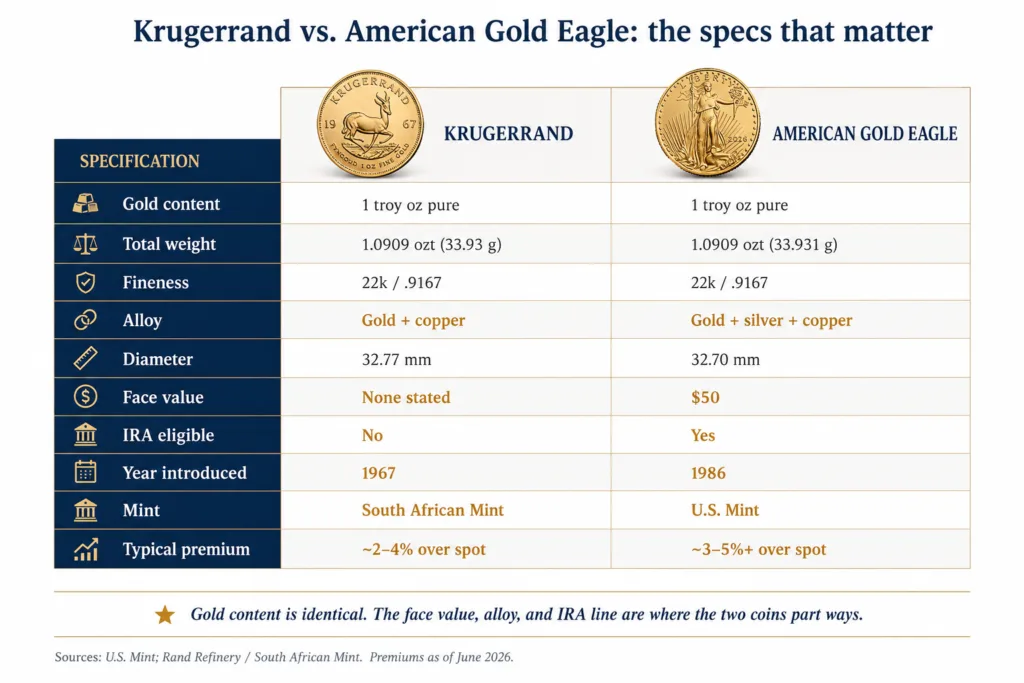
Start with the American Gold Eagle. The U.S. Mint, which has produced it since 1986 under the Gold Bullion Coin Act of 1985, lists the one-ounce coin at 32.70 mm across, 2.87 mm thick, with a total weight of 1.0909 troy ounces (33.931 grams). Its composition is 91.67% gold, 3% silver, and 5.33% copper, and it carries a $50 face value stamped right on it. That face value is symbolic, since the coin’s gold is worth roughly eighty times that today, but it matters legally: the Eagle is United States legal tender, and its weight, content, and purity are guaranteed by the U.S. government.
The Krugerrand is the same ounce of gold in a slightly different package. Produced by the South African Mint and refined by Rand Refinery, it has been struck since 1967. The one-ounce coin measures 32.77 mm wide and 2.84 mm thick, and weighs about 33.93 grams total. Its alloy is the older recipe: 91.67% gold and 8.33% copper, with no silver. That copper is why the Krugerrand has a faintly warmer, more orange tone than the Eagle’s slightly paler hue. The big difference on paper is what the coin does not say. The Krugerrand carries no stated face value at all. It is legal tender in South Africa by proclamation, but no number is printed on it, because it was designed from the start to be valued purely by its gold content.
So both coins give you one ounce of gold, both are 22-karat, both weigh about 1.0909 troy ounces. The Eagle adds silver to its copper and states a $50 denomination; the Krugerrand uses copper alone and states nothing. Those are small physical differences. The differences that move money are everything that follows.
Why the Krugerrand usually costs less per ounce
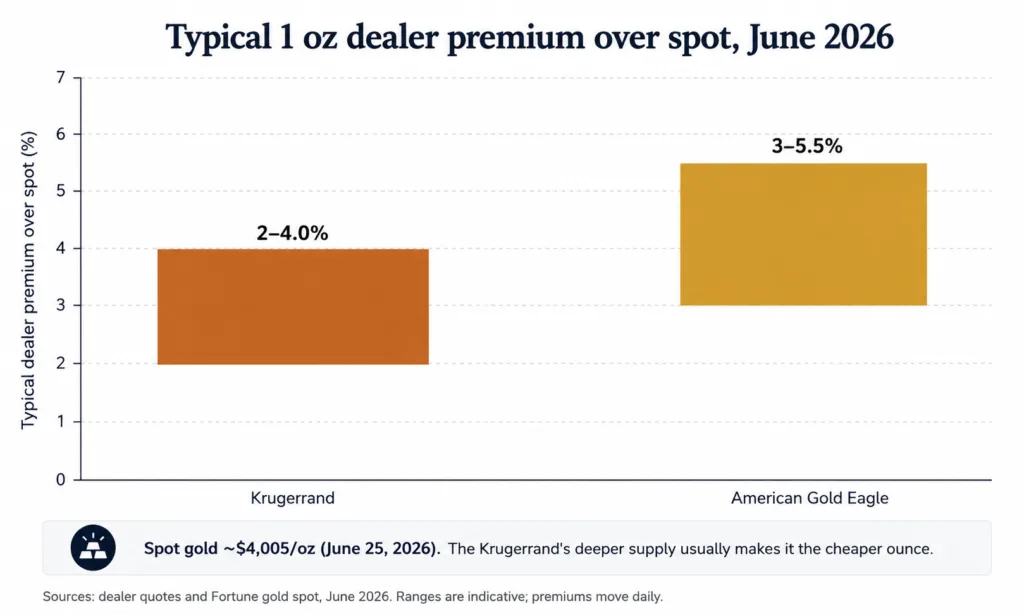
You never pay just the spot price for a physical coin. You pay spot plus a premium that covers minting, distribution, the dealer’s margin, and plain old supply and demand for that specific product. With gold trading around $4,005 an ounce on 25 June 2026, that premium is the main lever you control, and it is where these two coins genuinely diverge.
As of late June 2026, dealers are typically quoting the Krugerrand at roughly 2% to 4% over spot, while the American Gold Eagle tends to run about 3% to 5% or more. In dollar terms that gap usually lands somewhere around $30 to $70 an ounce in the Krugerrand’s favor, though it widens and narrows with the market. The reason is not quality. It is volume and geography. The Krugerrand has been mass-produced since 1967 and at one point made up about 90% of the world’s gold coin market, so the supply is deep and the maker’s margin is thin. The Eagle, by contrast, is the default coin for American buyers, and that home-field demand lets it command a premium that the rest of the world’s bullion does not. Patriotism, familiarity, and IRA demand all get baked into the sticker.
If you are buying ounces to hold for a decade, that premium gap compounds. Buy ten ounces and a $50 difference per coin is $500 you either kept or handed over at the counter. It is worth understanding why dealers quote what they quote, because the cheapest headline price is not always the best deal once you factor in the spread you will face when you sell.
The retirement account dealbreaker
This is the cleanest, most decisive difference between the two coins, and it trips people up constantly. The American Gold Eagle is eligible for a precious metals IRA. The Krugerrand is not. And here is the genuinely odd part: they have the exact same purity.
The rule lives in the tax code at IRC Section 408(m). For bullion, it sets the bar at the minimum fineness a commodity exchange requires for futures delivery, which for gold works out to .995, or 99.5% pure. Both of these coins are .9167, so on a straight purity test, neither should qualify. The Eagle gets in anyway because Congress wrote it a specific exemption: section 408(m)(3)(A) carves out the U.S. gold coins minted under federal law, the Eagle among them, so its 22-karat alloy is waved through despite missing the .995 bar. The Krugerrand has no such carve-out. It fails the fineness test and isn’t named in the statute, so it stays out.
Same ounce of gold, same 91.67% purity, opposite answer, entirely because of how the law is written. If a gold IRA is part of your plan, this single line settles the debate, and it is worth reading up on which metals actually qualify for a retirement account before you buy a coin you cannot use.
US resale recognition versus global liquidity
Both coins are easy to sell. The question is where, and to whom. Inside the United States, the Gold Eagle is the coin every dealer, pawn shop, and counter knows on sight. It is the most traded gold bullion coin in the country, and an American buyer or seller almost never has to explain what it is. That recognition is worth something real when you are the one trying to liquidate quickly and you want a fair, fast bid without a lecture.
The Krugerrand plays a different game. It was the original export-driven bullion coin, built specifically to put South African gold into hands all over the world, and decades of that effort gave it the broadest global footprint of any gold coin. Dealers from London to Dubai to Hong Kong recognize it instantly. So the honest framing is this: the Eagle gives you the smoothest resale at home, and the Krugerrand gives you the widest acceptance abroad. If you expect to sell in the U.S., that tilts to the Eagle. If you value a coin that travels, or you simply like not being tied to a single country’s market, the Krugerrand has the edge.
History and the trust you are buying
Part of what you pay for in any sovereign coin is the issuer’s credibility, and these two come at it from opposite directions. The Krugerrand is the one that started it all. When it launched in 1967, it was the first modern bullion coin designed for ordinary investors to own gold by the ounce, and its success is the reason the Maple Leaf, the Eagle, the Britannia, and the Panda all exist. Its obverse carries Paul Kruger, the 19th-century president of the South African Republic, and its reverse a pronking springbok, the national animal. There is a weight of history in holding the coin that created the category.
The Eagle’s pitch is institutional rather than historical. Since 1986 it has carried an explicit U.S. government guarantee of its weight, content, and purity, which is a specific legal promise standing behind every coin. For a lot of American buyers that backing is the whole point. You are not just trusting a refinery’s assay; you are trusting the United States Mint to stand behind the number stamped on the coin. Neither form of trust is better in the abstract. One is “I own the coin that proved this could work,” the other is “my own government guarantees what’s in my hand.”
Durability: where 22-karat quietly wins
Here is one thing both coins get right, and it is easy to overlook if you have been told that higher purity is always better. Pure 24-karat gold is soft. It scratches, dents, and picks up fingerprints if you so much as look at it wrong, which is why pristine condition matters so much for resale on .9999 coins. The Krugerrand and the Eagle both dodge that problem by alloying their gold with copper, which makes them noticeably harder and more forgiving to handle than a pure coin.
The copper does not dilute the gold you own, since both coins still contain a full ounce of it. The alloy just rides on top as extra weight and extra toughness. For a coin you might actually pick up, store at home, or pass around, that 22-karat hardness is a practical advantage, and it is one of the few categories where these two coins are simply on the same team.
The US tax fine print most buyers miss
Two tax points are worth knowing before you buy, and both are specific to U.S. taxpayers, so treat this as orientation rather than advice for your situation. None of it is a substitute for talking to your own tax professional.
First, the capital gains treatment. The IRS taxes physical gold as a collectible, which means long-term gains on either coin can be taxed at a rate of up to 28%, higher than the long-term rate on stocks. That applies equally to the Krugerrand and the Eagle, so it is not a differentiator. It is just a reality of owning physical metal that a lot of new buyers do not see coming.
Second, and this one does differ between the coins, is dealer reporting. When you sell certain bullion items back to a dealer, the dealer has to file a Form 1099-B with the IRS. Under the industry guidelines dealers follow, the Krugerrand is on the reportable list once you sell 25 ounces or more in a single transaction. The American Gold Eagle is specifically exempt from that 1099-B reporting, no matter how many you sell. To be clear, this is about the dealer’s paperwork, not about whether you owe tax. You owe tax on a real gain either way. But if the reporting itself matters to you, the Eagle is the quieter coin at the point of sale. The threshold and the rules here move, so confirm the current treatment with the dealer and a tax advisor before you act on it.
Krugerrand vs gold eagle: so which should you buy?
Strip away the romance and it comes down to what you are optimizing for. The gold is identical, so let the wrapper decide.
Choose the American Gold Eagle if you want it in a retirement account, since it is IRA-eligible and the Krugerrand flatly is not. Choose it if you will most likely sell inside the United States and want the fastest, most frictionless bid. Choose it if the explicit U.S. government guarantee is the kind of backing that lets you sleep at night, or if the quieter 1099-B treatment on a sale appeals to you. You will pay a bit more per ounce for those things, and for many American buyers that is a fair trade.
Choose the Krugerrand if your goal is the most gold for the fewest dollars, since it usually runs about $30 to $70 an ounce cheaper and that gap compounds across a stack. Choose it if you value the deepest global liquidity and like a coin that is recognized and traded on every continent. Choose it if you are buying in a taxable account anyway, where IRA eligibility is irrelevant, and you would rather put the premium savings into more ounces. For a buyer who just wants efficient, portable, no-frills gold, it is hard to beat the coin that invented the whole idea.
If you are still torn, notice which of those two paragraphs you nodded along to. That is your answer. And if you are new to all of this, it is worth walking through a first-time buyer’s checklist before you place an order, and reading up on how the Eagle stacks up against the Canadian Maple Leaf if you want to see how a higher-purity rival changes the math. The gold is the easy part. The right coin is the one whose wrapper fits the job you are hiring it to do.
