


When purchasing gold, whether for investment, jewelry, or collection, understanding fineness standards becomes essential for making informed decisions. The precious metals market employs multiple measurement systems to communicate gold purity, from karats to decimal fineness, each serving distinct purposes across global markets. This comprehensive guide demystifies gold fineness standards, enabling investors and collectors to confidently navigate precious metals purchases.
What Is Gold Fineness? The Foundation of Precious Metals Standards
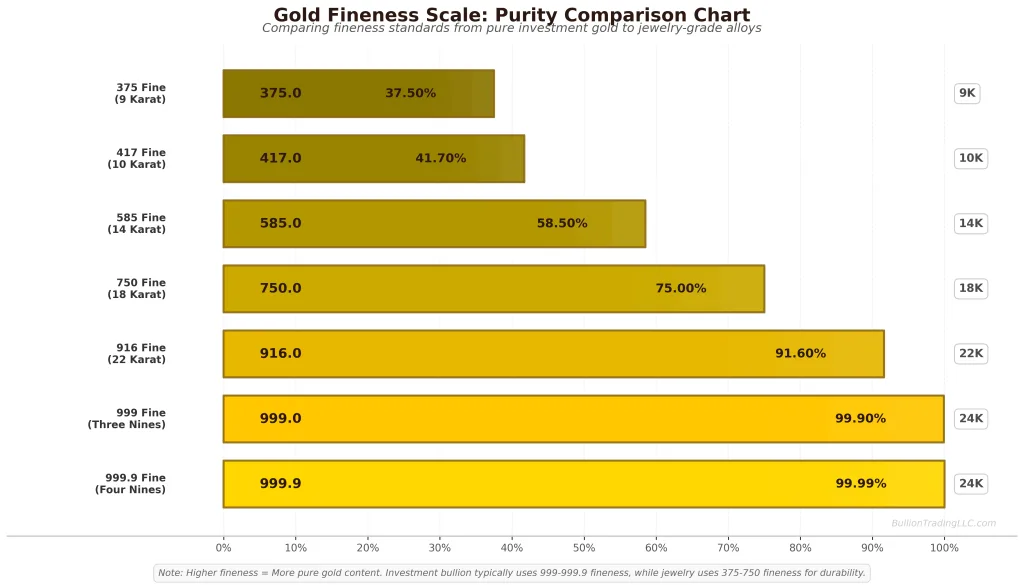
Gold fineness represents the proportion of pure gold content within an item, expressed as parts per thousand. A gold bar marked “999” contains 999 parts pure gold per 1,000 parts total material, or 99.9% purity. This measurement system provides precise communication of gold content across international markets, ensuring transparency in bullion trading.
The chemical properties of gold make it uniquely suited for purity measurement. As element 79 on the periodic table, gold (Au) is naturally soft and malleable when pure, requiring alloying with other metals for most practical applications. Understanding fineness standards allows buyers to distinguish between investment-grade bullion and jewelry-grade alloys.
The Karat System: Traditional Gold Purity Measurement
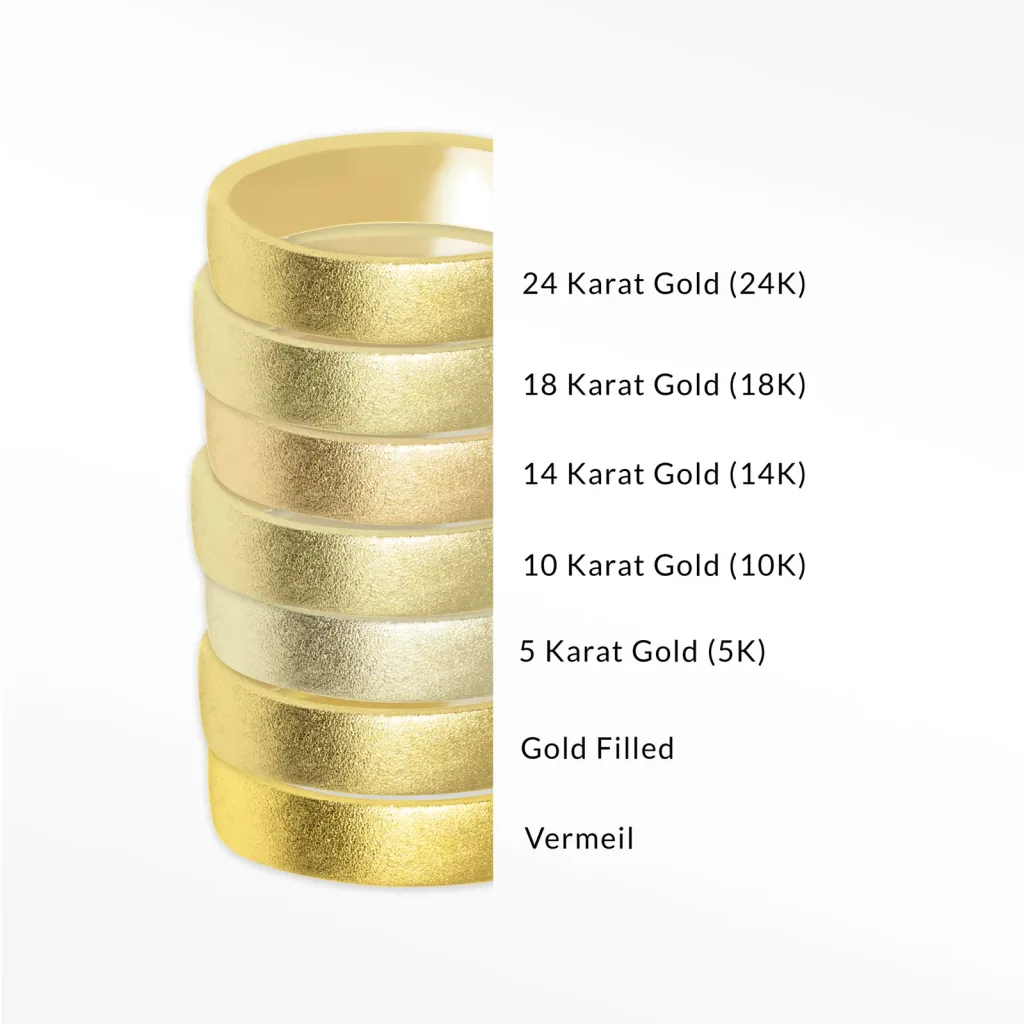
The karat system, predominant in jewelry markets, divides gold purity into 24 parts. Pure gold equals 24 karats (24K), making each karat equivalent to approximately 4.167% gold content. This ancient measurement system originated from the carob seed (carat), historically used as a standard weight in gem trading.
Common Karat Designations and Their Meanings
24 Karat Gold (24K)
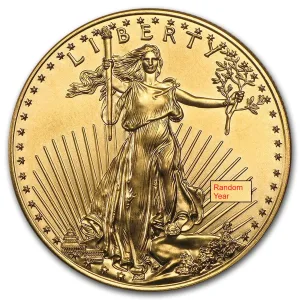
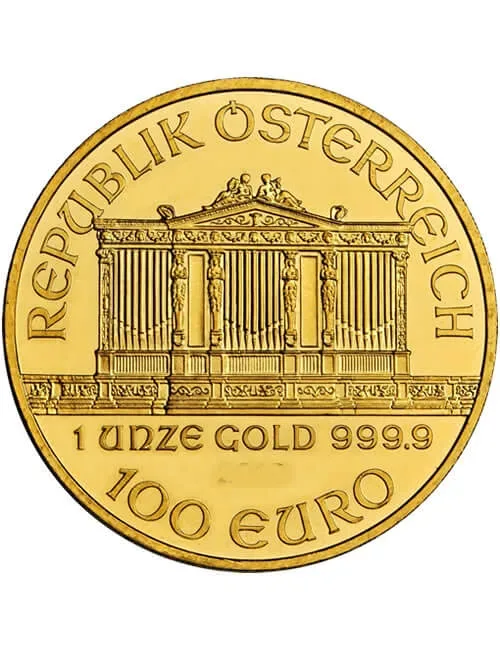
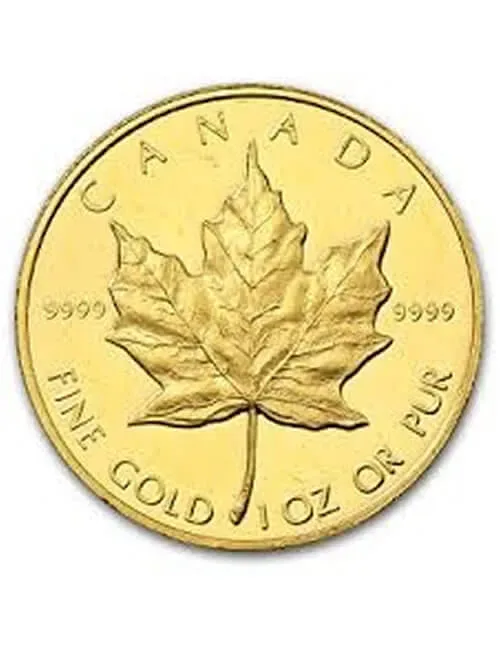
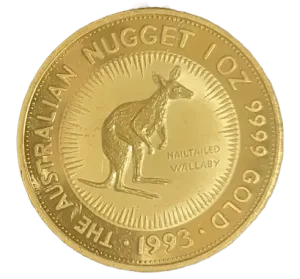
Twenty-four karat gold represents maximum purity achievable in commercial products, 99.9% to 99.99% pure gold. Major world gold bullion mints produce 24K products including American Gold Eagles, Canadian Gold Maple Leafs, and Austrian Philharmonics. Due to pure gold’s softness (2.5 on Mohs hardness scale), 24K gold rarely appears in jewelry, instead dominating investment bullion markets.
22 Karat Gold (22K)
At 91.67% purity (916.7 fineness), 22K gold balances high gold content with enhanced durability through strategic alloying. The American Gold Eagle, the most popular gold coin for investment in the United States, contains 22K gold alloyed with silver and copper for scratch resistance. Indian jewelry traditions favor 22K gold for its rich color while maintaining sufficient hardness for ornate designs.
1 oz Gold Coin Values
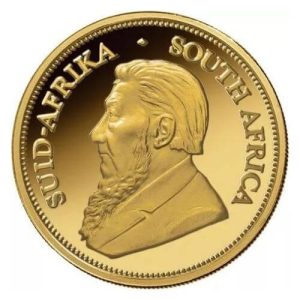


Australian Lunar Series III 2025 Year of the Snake 1oz Gold Bullion Coin
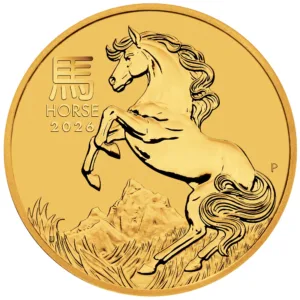
Australian Lunar Series III 2026 Year of the Horse 1oz Gold Bullion Coin
18 Karat Gold (18K)
Containing 75% pure gold (750 fineness), 18K represents the premium standard for fine jewelry worldwide. European luxury brands predominantly use 18K gold, as it provides excellent durability, takes high polish, and allows for various color variations through different alloying metals. The 25% alloy component typically consists of copper, silver, nickel, zinc, or palladium, depending on desired color (yellow, white, or rose gold).
14 Karat Gold (14K)
At 58.33% purity (585 fineness), 14K gold dominates the American jewelry market. The higher proportion of alloy metals (41.67%) creates exceptional durability for everyday wear rings, bracelets, and chains. While noticeably lighter in color than higher karat golds, 14K offers superior tarnish resistance and maintains value while accommodating active lifestyles.
10 Karat Gold (10K)
The minimum standard legally marketable as “gold” in the United States, 10K contains 41.67% pure gold (417 fineness). Though substantially alloyed, 10K jewelry provides extreme durability at accessible price points. The high base metal content makes 10K pieces more susceptible to tarnishing and less valuable for precious metals investment purposes.
The Fineness System: Decimal Precision for Global Markets
Professional bullion markets employ the fineness system, expressing purity as parts per thousand, for its precision and international standardization. This system, also called millesimal fineness, facilitates accurate assaying and transparent pricing across global precious metals exchanges.
Standard Fineness Levels in Bullion Markets
999.9 Fine Gold (Four Nines)
Representing 99.99% purity, four nines gold constitutes the highest standard widely available in commercial bullion products. The Royal Canadian Mint pioneered this ultra-pure standard with the Gold Maple Leaf coin in 1979, setting new benchmarks for investment-grade gold products. Achieving four nines fineness typically requires sophisticated multi-stage refining processes, often involving the Miller chlorination method followed by Wohlwill electrolytic refining. While even higher purities (99.999% or “five nines”) exist for specialized industrial applications, 999.9 represents the practical maximum for investment bullion.
999 Fine Gold (Three Nines)
At 99.9% purity, three nines gold represents a widely-used standard for investment bullion worldwide. Major refineries including PAMP Suisse, Valcambi, and Credit Suisse produce both 999 and 999.9 fine gold bars depending on product specifications. This purity level balances maximum gold content with practical manufacturing considerations, making it the international benchmark for bullion trading.
995 Fine Gold
Some specialized gold products, particularly historic bullion items, maintain 99.5% fineness. While slightly less pure than modern standards, 995 fine gold remains acceptable for institutional markets meeting LBMA Good Delivery requirements.
916 Fine Gold (22K)
More precisely 916.7 fineness (91.67% purity), this standard appears primarily on certain bullion coins like the American Gold Eagle, where the alloy addition (copper and silver) enhances durability for handling and potential circulation. Note that 916 fineness is less common than 999 or 999.9 in large institutional bullion bars, appearing mainly in government-minted coins and traditional jewelry. Historic gold coins like British Sovereigns also used 22K gold, though these occupy a unique position between bullion and numismatic collectibles.
Converting Between Karats and Fineness
Understanding conversion between measurement systems empowers informed purchasing decisions. The formula for converting karats to fineness:
Fineness = (Karats ÷ 24) × 1000
Example: 18K gold = (18 ÷ 24) × 1000 = 750 fineness (75.0% pure gold)
Conversely, converting fineness to karats:
Karats = (Fineness ÷ 1000) × 24
Example: 916 fineness = (916 ÷ 1000) × 24 = 22K gold
Hallmarks and Assay Marks: Verifying Gold Authenticity
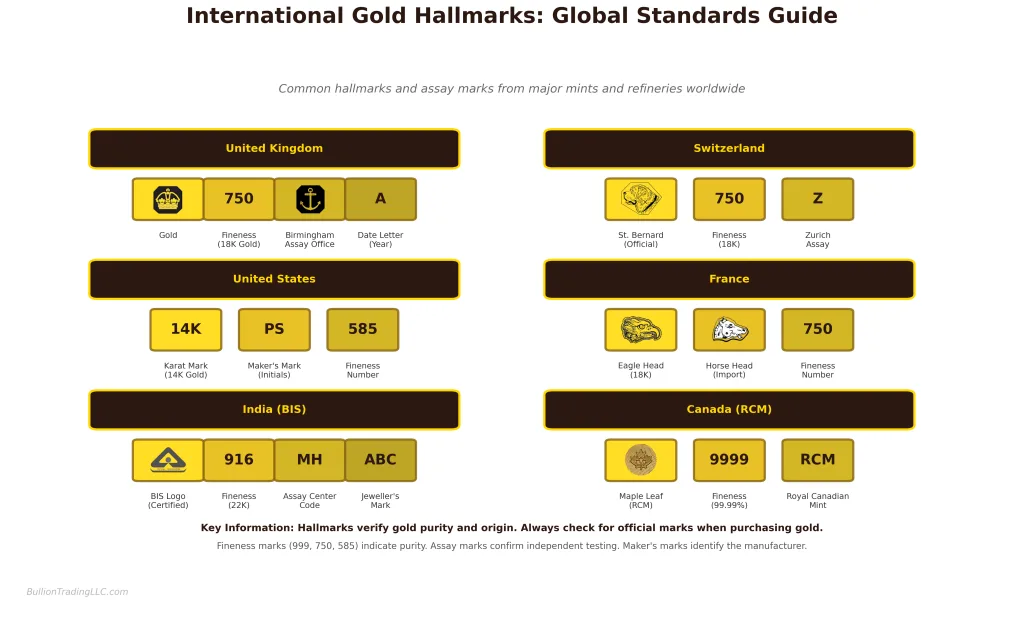
Hallmarks, official marks stamped on precious metals, serve as quality guarantees from recognized assay offices or manufacturers. Understanding hallmark systems protects buyers from counterfeit products and confirms stated purity levels.
Components of Complete Hallmarking
Fineness or Karat Mark
The primary indicator displays purity level, either as karat notation (18K, 14K) or fineness numbers (750, 585, 999). In the United States, karat marks often appear with “K” or “KT” designation, while European and Asian markets predominantly use fineness numbers.
Maker’s Mark
Manufacturers stamp unique identifying symbols or initials indicating the producer. Major bullion refineries including PAMP Suisse, Perth Mint, and Royal Canadian Mint maintain registered trademarks globally recognized for quality assurance. When authenticating gold products, verifying maker’s marks against official registries helps identify counterfeits.
Assay Office Mark
Independent assay offices, government-authorized laboratories that test and certify precious metals, apply distinct hallmarks confirming their verification. The United Kingdom operates the world’s oldest hallmarking system, with assay offices in London, Birmingham, Sheffield, and Edinburgh each maintaining unique symbols dating back centuries. United States gold products typically carry manufacturer certifications rather than independent assay office marks.
Date Letter or Year Mark
Some hallmarking systems include date codes indicating the year of manufacture or assay. British hallmarks feature alphabetic date letters that cycle through 25-year periods, enabling precise dating of antique gold items, valuable information for collectible and numismatic pieces.
International Hallmarking Variations
European Convention on Control Marks
The Vienna Convention established the Common Control Mark (CCM), scales symbol in an octagonal shield, recognized across member nations. Gold bearing this mark has undergone independent testing confirming stated fineness, facilitating international trade without redundant testing.
Asian Hallmarking Systems
India’s Bureau of Indian Standards (BIS) requires hallmarking on all gold jewelry, stamping a distinctive logo alongside fineness markings (916, 750, 585). Chinese gold products display manufacturer chops (stamps) alongside fineness markings, with the Chinese character for gold (金) often accompanying numerical purity indicators.
United States Practice
American gold products typically display karat marks and manufacturer trademarks without mandatory independent assay office verification for most jewelry and smaller items. The Federal Trade Commission regulates marking accuracy, imposing strict penalties for misrepresentation. Quality manufacturers exceed minimum standards, voluntarily submitting products for third-party certification. Government-minted bullion coins like American Gold Eagles carry U.S. Mint guarantees of weight and purity, while major private refiners often provide assay certificates with their products.
Practical Applications: Choosing Gold Fineness for Your Needs
Different gold fineness levels serve distinct purposes across investment, jewelry, and collecting categories.
For Investment and Wealth Preservation
Serious precious metals investors prioritize maximum purity, 999 or 999.9 fineness, to optimize gold content per dollar invested. Investment-grade bullion products minimize premiums over spot price, with purity representing a key factor in resale liquidity. When building a bullion position, consistent fineness standards (all 999 or all 999.9) simplify portfolio management and facilitate eventual liquidation.
For Jewelry and Wearable Items
Jewelry applications require balancing gold content against durability. For pieces subject to daily wear, engagement rings, wedding bands, bracelets, 14K or 18K gold provides optimal durability while maintaining precious metals value. Heirloom pieces or special occasion jewelry may justify 22K gold, combining impressive gold content with sufficient strength for delicate designs.
For Numismatic and Collectible Coins
Collectible gold coins span various fineness levels depending on era and origin. Pre-1933 U.S. gold coins typically contain 90% gold (900 fineness), reflecting the standard for circulating coinage of that era. Modern U.S. commemorative gold coins generally feature 999 or 999.9 fineness, prioritizing pure gold content over alloy durability. When comparing investment options, numismatic premiums based on rarity, historical significance, and condition typically exceed differences in gold content, making fineness a secondary consideration for serious collectors.
Common Misconceptions About Gold Fineness
Myth: 24K Gold Is “100% Pure”
Even four nines gold (99.99%) contains trace impurities. Achieving absolute 100% purity remains impossible with current refining technology, residual elements persist at parts-per-billion levels. For commercial purposes, 999.9 fine gold represents the practical maximum, with the slight impurity having negligible impact on value or properties.
Myth: Higher Karat Always Means Better Value
While higher purity contains more gold, it doesn’t automatically translate to superior value. A well-crafted 18K jewelry piece from a prestigious maker may command higher prices than a crude 24K item due to craftsmanship, design, and brand premium. In bullion investing, 22K American Gold Eagles often trade at similar premiums to 999.9 fine Gold Maple Leafs despite lower purity, thanks to liquidity and recognition factors.
Myth: Gold Fineness Affects Price Per Ounce
Bullion pricing primarily reflects actual gold content, a 22K coin weighing one troy ounce contains the same pure gold value as approximately 0.917 troy ounces of 24K gold. Markets generally adjust pricing based on fine gold content. However, identical fine gold content doesn’t guarantee identical prices: premiums vary based on product recognition, brand reputation, liquidity, manufacturing quality, and market demand. For example, government-minted coins often command higher premiums than generic bars despite identical gold content, while established refineries like PAMP Suisse typically achieve better pricing than lesser-known producers. Fineness becomes one factor among many affecting final purchase price.
Testing and Verification: Confirming Gold Fineness
Multiple testing methods verify stated gold fineness, protecting buyers from counterfeits or misrepresented products.
Non-Destructive Testing Methods
X-Ray Fluorescence (XRF) Analysis
XRF spectrometers provide rapid, non-destructive fineness testing by analyzing elemental composition through X-ray excitation. Professional dealers and refineries employ XRF devices costing $15,000-$40,000, delivering results within seconds with accuracy to ±0.1% fineness. This technology has revolutionized gold authentication, allowing verification without damaging items.
Electronic Gold Testers
Portable electronic testers measure electrical properties (primarily conductivity, though some measure resistivity or related characteristics), comparing readings against known fineness standards. While less precise than XRF, quality electronic testers ($300-$1,500) can distinguish between major karat levels and identify obvious counterfeits when used on clean, uncoated surfaces. These devices work best on flat, exposed metal and may struggle with plated items, surface contamination, or jewelry with complex geometries.
Traditional Destructive Testing
Acid Testing
The ancient touchstone method uses nitric acid solutions of varying strengths to verify gold fineness. Jewelers apply acid to inconspicuous areas, observing dissolution rates to estimate karat levels. While reliable for quick field testing, acid tests consume microscopic amounts of gold and lack the precision of modern analytical methods.
Fire Assay
Fire assay, melting gold samples with lead in a cupellation furnace, remains the definitive standard for fineness verification, accurate to ±0.01%. Refineries conducting fire assays provide official certificates accepted globally for bullion trading. However, this destructive process requires sample removal, making it suitable only for bar verification or jewelry meltdowns.
The Future of Gold Fineness Standards
As precious metals markets evolve, fineness standards continue adapting to technological capabilities and market demands. The London Bullion Market Association (LBMA) maintains Good Delivery standards requiring minimum 995 fineness for gold bars, with most modern refineries producing 999.9 fine products exceeding these requirements.
Emerging technologies like blockchain-based tracking systems show promise for creating permanent digital provenance records accompanying physical gold products, from refinery to final buyer. While several initiatives exist and major refiners are exploring these technologies, universal adoption remains in development stages. These innovations aim to enhance authentication confidence and combat counterfeiting, complementing rather than replacing traditional fineness standards and hallmarking systems that have governed gold commerce for centuries.
Conclusion: Mastering Gold Fineness for Informed Decisions
Understanding gold fineness, whether expressed in karats, decimal fineness, or through hallmarking systems, empowers confident precious metals purchases. Investment-grade bullion demands maximum purity (999-999.9 fineness), while jewelry applications balance gold content against practical durability considerations (14K-22K). Verifying fineness through hallmark examination, manufacturer reputation, and when necessary, professional testing protects against counterfeit products while ensuring stated purity standards.
Whether you’re acquiring 999.9 fine gold bars for maximum investment efficiency or selecting 18K jewelry pieces for personal enjoyment, Bullion Trading LLC offers comprehensive precious metals solutions backed by reputable dealers who guarantee fineness standards. Our extensive understanding of fineness systems ensures your gold purchases align with intended purposes and deliver expected value through enhanced peace of mind and liquidity advantages.
