
Thirteen small coins, passed hand to hand at the altar, carry one of the oldest promises in the Hispanic Catholic wedding: I will provide, and I will share everything I have with you. They are called las arras matrimoniales — the marital pledge — and behind that keepsake sits a much larger Mexican love affair with gold.
This is a plain-English guide to what the thirteen coins mean, who gives them, and what they are actually made of — and to the real, enduring gold that Mexican families have gifted for generations: the Centenario and its smaller siblings, the Hidalgo pesos.
What las arras matrimoniales are
Las arras — from the Spanish for “earnest money” or “pledge” — are thirteen coins exchanged during a Catholic wedding Mass. Traditionally the groom pours them into the bride’s cupped hands as a spoken promise that he will provide for her and their future family; her acceptance signals trust in that promise. Many couples today exchange the coins back and forth, expressing a shared, equal partnership.
In the order of the ceremony, las arras usually follow the exchange of rings and precede the finalizing of the vows. The priest blesses the coins before they change hands, and they are presented in an ornate box or chest called a cofre. The custom is old — commonly traced to the Roman arrha (earnest money that sealed a betrothal) and to the marriage rites of Visigothic Spain — and Spain carried it across the Atlantic to Mexico and Latin America, and to the Philippines.
Las arras — thirteen coins, blessed and passed hand to hand, presented in the cofre. In the mass-market set they are gold-tone keepsakes; some families use real gold instead.
The number thirteen is the heart of the symbol, and three readings are all in circulation:
| Reading | Meaning |
|---|---|
| Jesus + the 12 apostles | The most common Catholic interpretation |
| 12 months + 1 for the poor | An older folk reading — the thirteenth coin is a call to charity |
| 13 shared values | A modern reading — the values the couple pledges to share |
Why the set contains exactly thirteen coins.
Who gives the arras — the padrinos
In Mexican and Mexican-American weddings, sponsors called padrinos and madrinas underwrite meaningful parts of the celebration. The padrino and madrina de arras are the sponsors responsible for the coins: they buy the set, often choose it together, and present it at the altar. It is precisely this sponsor role — someone looking for a meaningful, lasting gift — where the choice of what the coins are made of becomes an interesting one.
The padrinos present the coins
The padrino and madrina de arras choose and buy the set, and carry the cofre to the altar; a young coin bearer — the arras equivalent of a ring bearer — sometimes brings it up the aisle.
The priest blesses the thirteen
Before the coins change hands, the priest blesses them — the moment that sets the arras apart from an ordinary gift.
The coins pass, hand to hand
The groom, or both partners, let the thirteen coins fall from one set of cupped hands into the other — a promise meant to be seen and heard by everyone present.
What the coins are made of — an honest look
Here is the plain truth many wedding sites gloss over: the standard, widely-sold thirteen-coin arras set is a keepsake, not bullion. The coins are typically gold-tone, gold- or silver-plated base metal, and the cofre is a plated or resin box, often set with rhinestones. Popular sets — many bearing the image of the Virgen de Guadalupe — sell for roughly $20 to $80. Their value is entirely symbolic, and that is exactly as intended: the ritual carries the meaning.
Some families instead choose real silver or gold coins, or heirloom coins handed down through the family. That is a matter of taste and means, not liturgical requirement. When a family wants the arras to be genuinely precious — or wants a separate, enduring gift to mark the wedding — they step out of the decorative-keepsake market and into real bullion. In Mexican culture, that path leads almost inevitably to one coin.
| Aspect | Traditional 13-coin arras set | Real Mexican gold coin |
|---|---|---|
| What it is | Keepsake for the ceremony | Bullion / heritage gift |
| Metal | Gold-tone, gold- or silver-plated base metal | Solid .900 fine gold |
| Typical cost | ~$20–$80 for the set + cofre | Priced to live gold content |
| Value over time | Sentimental only | Holds intrinsic gold value |
| Best for | The wedding ritual itself | A lasting gift — a family patrimonio |
Two different objects for two different jobs — the ceremony, and the lasting gift.
The Centenario — Mexico’s iconic gold coin
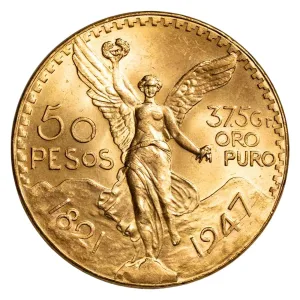
The 50 Peso gold coin, universally called the Centenario, was first struck in 1921 to mark the centenario — the 100th anniversary — of Mexico’s independence, dated from the 1810 uprising led by Miguel Hidalgo. It is one of the most substantial gold coins ever produced for circulation and investment: a gross weight of 41.6666 grams, of which 37.5 grams is pure gold — an actual gold weight of 1.2057 troy ounces at .900 fineness, about 37 mm across. That is more gold than a one-ounce Gold Eagle or Krugerrand, part of its appeal as a statement gift.
The Centenario’s obverse shows the Ángel de la Independencia — Mexico City’s Winged Victory — framed by laurel, with the coat of arms on the reverse.
The obverse shows the Ángel de la Independencia — the Winged Victory known as “El Ángel” that crowns the monument on Mexico City’s Paseo de la Reforma — holding a laurel wreath and broken chains, standing before the volcanoes Popocatépetl and Iztaccíhuatl. The reverse bears Mexico’s coat of arms: the golden eagle on a nopal cactus, devouring a serpent.
One quirk every buyer should know: most Centenarios you will meet are dated 1947. That is a “frozen” restrike date. The original 1921 issue was only about 180,000 coins; from the late 1940s onward the Mexican Mint kept striking coins bearing the 1947 date to satisfy demand, producing millions more over the decades. So a “1947” Centenario may have been minted long after 1947 — which is why the coin is plentiful, liquid, and priced closely to its gold content.
The Hidalgo series — smaller gold pesos
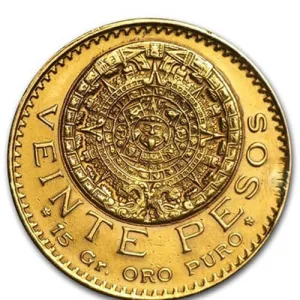
The Centenario has a family of smaller siblings, most bearing the portrait of independence hero Miguel Hidalgo, all struck in the same .900 fine gold. They let a family give real Mexican gold at a range of price points — the 50 / 20 / 10 / 5 / 2.5 peso ladder that has long made gold pesos a patrimonio: a store of value you can start small, add to, and pass on.
| Denomination | Gross weight | Pure gold (g) | Pure gold (oz) | Diameter | Main design |
|---|---|---|---|---|---|
| 50 Pesos (Centenario) | 41.6666 g | 37.5 g | 1.2057 oz | ~37 mm | Ángel de la Independencia + volcanoes |
| 20 Pesos | 16.6666 g | 15.0 g | 0.4823 oz | ~27 mm | Aztec Sun Stone (reverse) |
| 10 Pesos | 8.3333 g | 7.5 g | 0.2411 oz | ~22.5 mm | Miguel Hidalgo |
| 5 Pesos | 4.1666 g | 3.75 g | 0.1206 oz | 19 mm | Miguel Hidalgo |
| 2.5 Pesos | 2.0833 g | 1.875 g | 0.0603 oz | 15.5 mm | Miguel Hidalgo |
Mexican gold pesos, exact specifications — all .900 fine (90% gold), struck by La Casa de Moneda de México. Weights shown are actual gold content (AGW).
How the gift scales by coin
Approximate pure-gold metal value at a sample spot near $4,050/oz, before dealer premium. Check live prices — gold moves daily.
Track the live gold price
Mexican 50 Peso Gold Coin was last recorded at $5,035.75 on November 3, 2026. Between November 4, 2025 and November 3, 2026, it is down 3.8% and has ranged between $4,973.28 and $7,114.30.
The wider culture — gold for life’s milestones
Gifting gold at sacramental milestones runs deep in Mexican Catholic life. At a quinceañera — a girl’s 15th birthday and passage into young womanhood — godparents traditionally present blessed gifts: a rosary, a medal, or a gold necklace with a pendant of the Virgen de Guadalupe, often meant as an heirloom. At a baptism and first communion, the padrinos again give a religious medal or a small piece of gold.
And on December 12, the Día de la Virgen de Guadalupe — the feast of Mexico’s patron saint, a national holiday since 1859 — gold Guadalupe medals and coins are among the season’s most cherished gifts. Across all of these — wedding, quinceañera, baptism, Guadalupe — the through-line is the same: gold as a way to make a blessing tangible, and to hand faith and security from one generation to the next.
Give real Mexican gold
We don’t sell the ceremonial plated arras set — that belongs to the bridal shop, and it’s perfect for the ritual. But if you’re a padrino, a parent, or a couple who wants to mark the occasion with something real and lasting, the Centenario and the Hidalgo pesos are exactly what we carry, and we ship nationwide.
Real Mexican gold — the Centenario & friends
View current prices and availability. Add available items to your cart, or open a product for details. Ask us to help match a coin to the occasion.

The ceremonial 13-coin arras set is a symbolic keepsake sold by bridal and Catholic-goods shops; the coins above are real .900–.9999 fine gold, priced to their live metal content. For the wedding ritual itself, buy the pretty set — the meaning is in the moment.
Common Questions
Questions families ask us
What are las arras matrimoniales?
They are thirteen wedding coins exchanged during a Mexican or Hispanic Catholic wedding Mass. The groom traditionally gives them to the bride as a promise to provide for and share everything with their household; many modern couples exchange them mutually as a sign of equal partnership. A priest usually blesses the coins first.
Why are there exactly 13 coins?
The most common Catholic reading is that they represent Jesus and the twelve apostles. An older folk interpretation sees the twelve months of the year plus a thirteenth coin set aside for the poor, a reminder of charity. Many couples today treat them as thirteen values they promise to share.
Who buys and gives the arras?
Traditionally the padrinos de arras — the wedding sponsors, a godfather (padrino) and godmother (madrina) — purchase the coin set and present it at the altar. A young coin bearer, like a ring bearer, sometimes carries the cofre (box) up the aisle.
Are the arras coins real gold?
Usually not. The standard, mass-market thirteen-coin arras set is a symbolic keepsake made of gold-tone, gold-plated, or silver-plated base metal, sold for roughly $20–$80 with a decorative box. That is by design — the meaning is in the ritual. Some families instead choose real silver or gold coins, or heirloom coins, if they want the arras to be genuinely precious.
What is the Centenario, and how much gold is in it?
The Centenario is Mexico’s iconic 50 Peso gold coin, first struck in 1921 for the 100th anniversary of independence. It contains 37.5 grams of pure gold — 1.2057 troy ounces — in a 41.6666-gram coin of .900 fine gold, about 37 mm across. That is more gold than a one-ounce Gold Eagle or Krugerrand.
Why are so many Centenarios dated 1947?
1947 is a “frozen” restrike date. The original 1921 mintage was only about 180,000 coins, but from the late 1940s onward the Mexican Mint kept producing coins bearing the 1947 date to meet investor demand — millions of them over the following decades. So a “1947” Centenario may actually have been minted long after 1947. This is why the coin is common, liquid, and priced close to its gold content.
What smaller Mexican gold coins are available as gifts?
The Hidalgo series offers real gold at lower price points, all at .900 fineness: the 20 Pesos (0.4823 oz), 10 Pesos (0.2411 oz), 5 Pesos (0.1206 oz), and 2.5 Pesos (0.0603 oz). The smaller pieces make giftable, genuine-gold keepsakes for a baptism or quinceañera.
When do Mexican families traditionally gift gold?
At weddings and quinceañeras (a girl’s 15th birthday), at baptisms and first communions, and around December 12, the Día de la Virgen de Guadalupe, Mexico’s patron saint. Gold Guadalupe medals, jewelry, and coins are given as blessed, heirloom gifts meant to pass faith and security to the next generation.
This guide is prepared by the Bullion Trading LLC editorial team. Customs and observance vary by family, community and location. Confirm religious requirements and timing with a trusted authority in your own tradition. Metal prices and examples are educational, not a purchase quote. About our editorial team