
By Isaac Kahan, written with Samir I.
On November 14, 2026, The New York Times reported on a 67-year-old New Yorker who was told online that buying gold would protect his money, and who handed $9 million in gold bars to a stranger on the Upper West Side. I spoke with the reporter for that story. Against gold investment scams like this one, the FBI’s rule is the one to remember: the US government and legitimate businesses will never ask you to buy gold. If anyone does, it is a scam. I have been in the precious-metals business for decades. Here is what I’ve seen of how scammers pick their targets and the signs that show up when a victim tries to buy gold, with the official advice on what families can do.
What happened in the $9 million gold bar theft
The victim was told his money was in danger. In March 2025, according to police accounts reported by PIX11, he got a security alert on his computer from someone claiming to work for a security company, who said his financial assets had been compromised. He was convinced to buy $9 million worth of gold bars to secure his assets. In April 2025, near West 81st Street and Broadway, he handed the bars to a man who fled on foot. In November 2026, more than a year and a half later, the NYPD released images of the suspect and asked the public for help finding him.
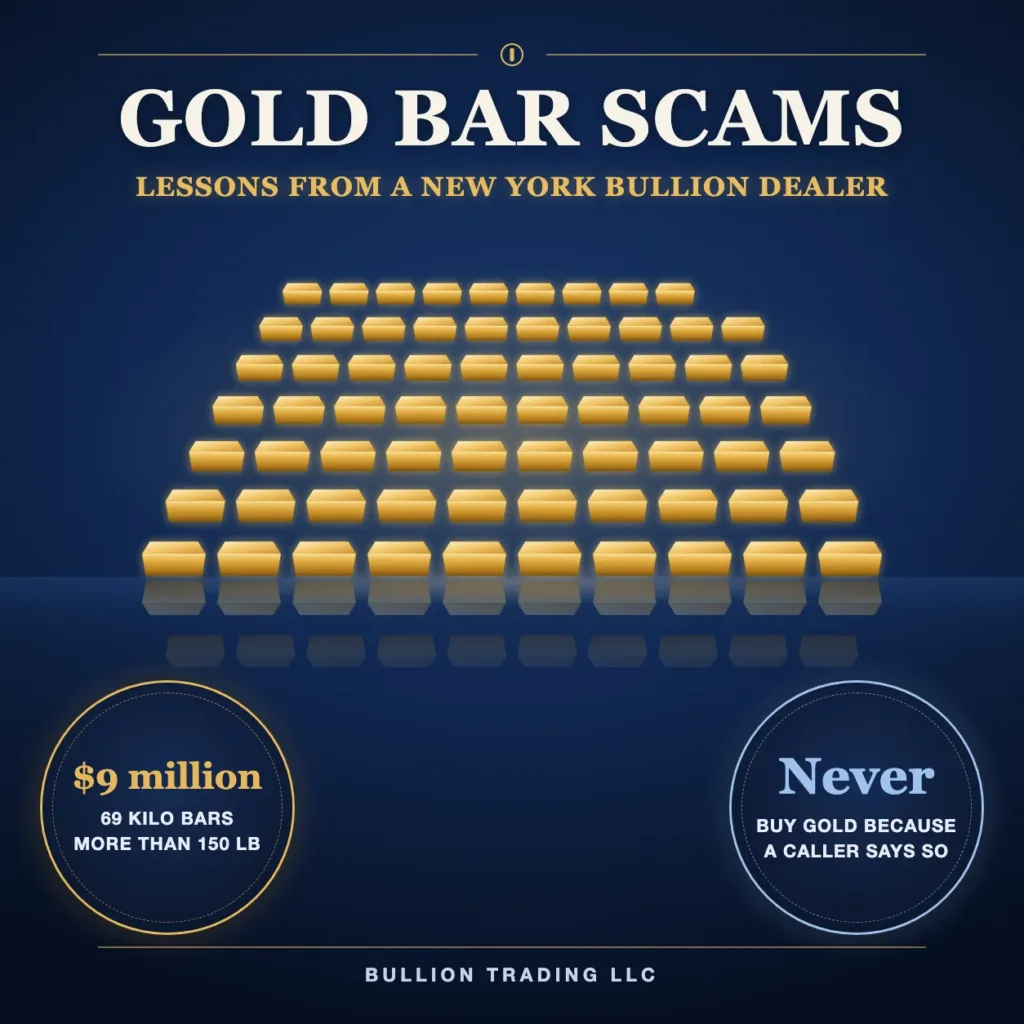
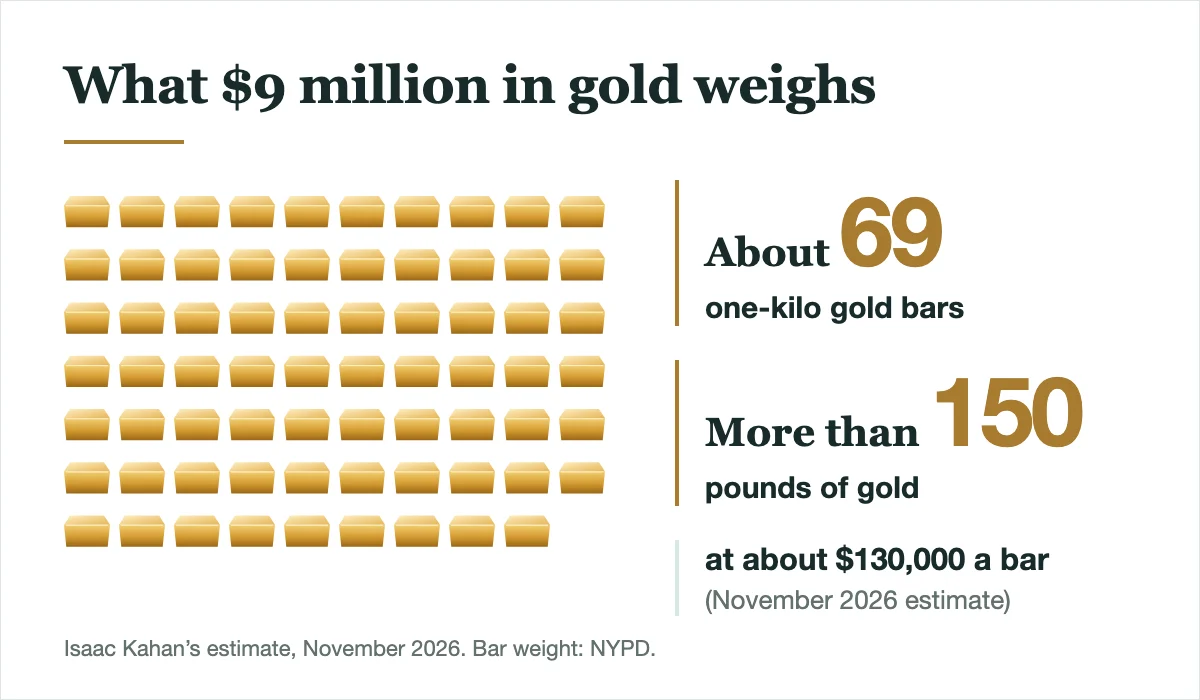
The first thing I thought about was the weight. Police said each bar weighed one kilogram. Gold’s price has moved since 2025, but at about $130,000 for a kilo bar in November 2026, $9 million buys about 69 bars, more than 150 pounds of gold. I don’t even know how he would be able to carry that. You can’t even lift that.
Who gold bar scammers target, and why gold
In my experience these schemes typically target people in their 70s and 80s and push them to liquidate their assets to buy gold. The FBI’s January 2024 warning describes the same thing: scammers instruct victims, “many of whom are senior citizens,” to turn their assets into cash or precious metals, then send couriers to collect them.
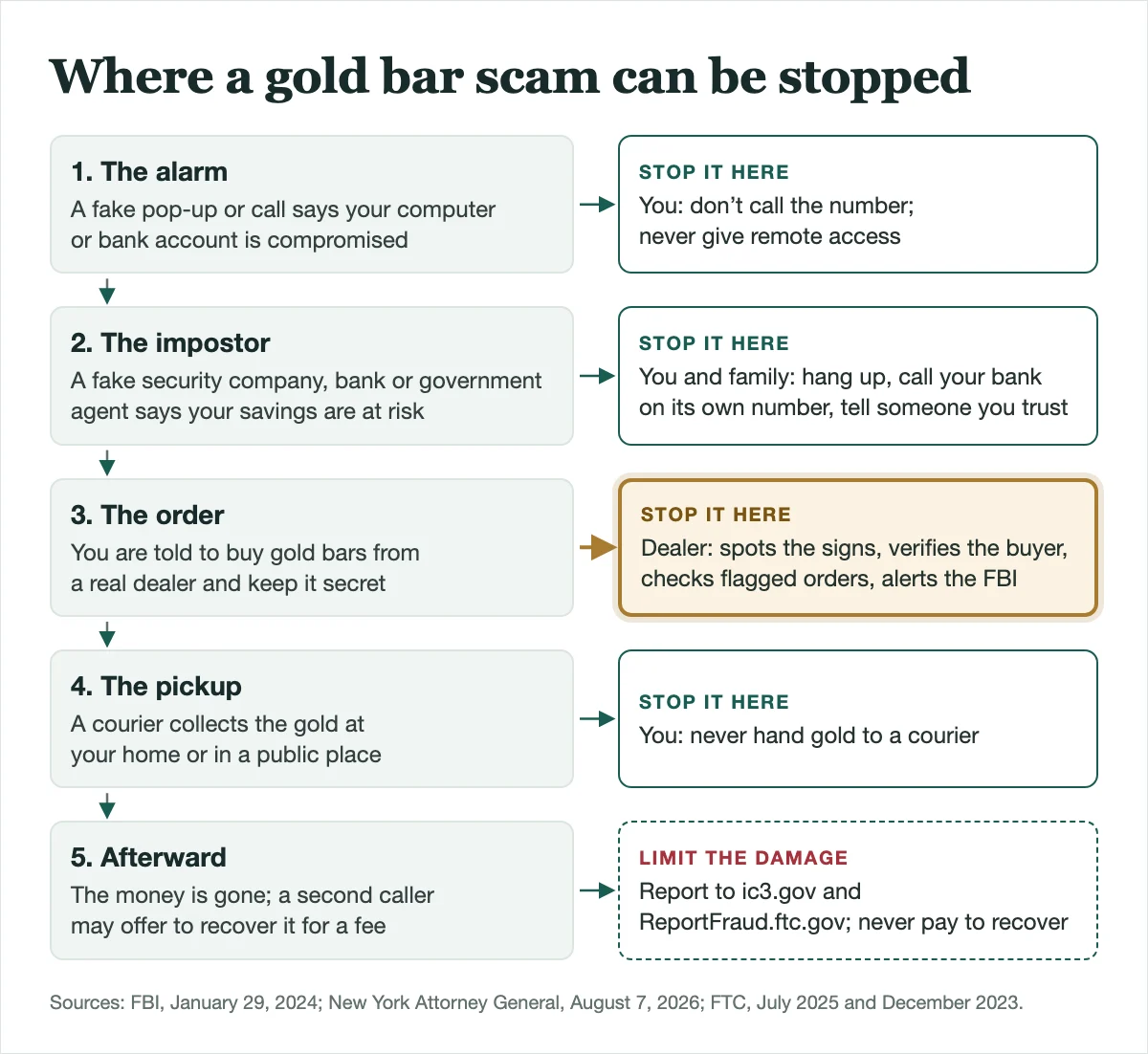
New York Attorney General Letitia James describes the usual script. A fake pop-up says a computer or bank account has been compromised, the caller gets remote access, and a supposed investigator says the savings must be turned into gold to stay safe. According to her office’s August 7, 2026 alert, victims are told to buy the bars “from legitimate dealers” and to keep the matter from bank employees and family. The same alert says the NYPD has investigated more than 100 gold bar scam cases over the past two years, with losses above $100 million.
Gold is also essentially impossible to trace. And because victims are told to buy from legitimate dealers, the purchase itself can look ordinary. Our guide to gold bullion scams walks through each step of the courier scheme and the FBI’s loss figures, along with other gold scams such as counterfeit bars and below-melt “bargains.”
The warning signs a gold dealer sees
When a person starts throwing the dollar amount first to me, that’s a telltale sign right away. An investor asks which bar, what weight, what purity. Someone following a scammer’s script has been told to convert a sum of money, so the gold itself hardly matters to them.
These requests still reach us. About once every two weeks our business gets a somewhat cryptic request to buy gold bars; it used to happen every day. A few years ago, while we were closed for Rosh Hashana and Yom Kippur, several online orders came in from people who turned out to be targets of these schemes, and we were able to cancel some of them. One victim’s daughter contacted me after she noticed a suspicious wire transfer of $150,000. It was heartbreaking.
| What the dealer sees | Why it can point to a scam |
|---|---|
| The buyer leads with a dollar amount, not a product | Scammers tell victims to convert a sum of money; investors start with the bar or coin |
| No questions about weight or purity | The metal is going to a courier, so its details don’t matter to the buyer |
| A large order, sometimes paid by wire | Victims are told to withdraw their savings and buy metal; scammers sometimes have them wire funds to a dealer |
| The buyer is secretive about why they are buying | Victims are told to keep the purchase secret, even from their bank and family |
| Pressure to buy right away | Scammers create a false sense of urgency and press victims into decisions on the spot |
How we slow the process down
We do try to slow the process down. When a purchase looks suspicious, I flag it to the FBI and arrange for agents to speak with the person I’m worried about. Large or unusual first orders get extra checks: we verify the buyer’s identity, ask the buyer to confirm in writing that no third party is directing the purchase, and show a scam warning that includes the FBI’s announcement. Orders of $1,000 or more that we flag for potential fraud go to the nearest FedEx location for pickup in person, and smaller flagged orders may be held until they are verified.
If anyone tells you to buy gold from a particular dealer to keep your money safe, including from us, it is a scam. Hang up, and call someone you trust before you buy or send anything.
What families can do to stop a gold bar scam
Family and friends can break the secrecy these scams depend on. In one of the cases I described, it was a victim’s daughter who spotted the wire.
Watch for a parent who suddenly wants to buy gold, moves large sums by wire, lets a stranger control the computer, or won’t say who they have been talking to. Scammers tell victims to keep quiet, so the New York Attorney General’s advice is to “hang up and contact someone you trust.” The FTC is just as direct: “Don’t give bars to a courier, and don’t deliver them,” it says in its gold bar scam alert. Friends and relatives can also call the Justice Department’s National Elder Fraud Hotline, 833-FRAUD-11 (833-372-8311), which takes reports of fraud against anyone age 60 or older, Monday to Friday, 10 a.m. to 6 p.m. Eastern time. The hotline itself warns that scammers have posed as its staff to ask for personal information or money.
If you think a gold bar scam has already happened
Act fast. Stop talking to the caller, call your bank on the number printed on your card or statement, and report it to the FBI at ic3.gov and to the FTC at ReportFraud.ftc.gov. In New York City, the Attorney General encourages victims to contact their local NYPD precinct. Victims and their families can also contact the Attorney General’s office online or at 1-800-771-7755. The FBI asks victims to include the name and location of the metal dealer and the account the money was wired to. Be wary of anyone who offers to recover the money for a fee: the FTC warns that recovery scams target people who have already lost money.
The one rule that stops gold bar scams
Gold bar scams depend on making you believe that buying gold will protect your money. The FBI puts it plainly: “The US Government and legitimate businesses will never request you purchase gold or other precious metals.” If anyone tells you to buy gold to protect your money, or to hand it to someone else, hang up and call someone you trust.
Frequently asked questions
Will a bank or the government ever tell me to buy gold?
No. The FBI says the US government and legitimate businesses will never ask you to buy gold or other precious metals, and the FTC says no one from the government will ever tell you to buy and deliver gold bars.
How much does $9 million in gold weigh?
More than 150 pounds. At about $130,000 for a one-kilogram bar in November 2026, $9 million buys about 69 bars, roughly 69 kilograms, or 152 pounds, of gold.
Can a gold dealer stop a gold bar scam?
Sometimes. A dealer can notice the warning signs, verify the buyer, hold a suspicious order and alert the FBI, and in some cases cancel the order. Family members can notice the signs too: one victim’s daughter contacted me after spotting a suspicious $150,000 wire.
Isaac Kahan, Bullion Trading LLC